A universal life cost of insurance increase is a change in the current monthly charge an insurer deducts for the death benefit, and it is allowed only within the guaranteed maximum rates printed in the contract and the state's rules on non-guaranteed elements. Most states learn of it, and tell owners, through the annual report: the NAIC's illustrations model requires the report to carry a prominent notice when an adverse change has been made since the last one. New York goes further. Its Regulation 210 requires a disclosure to owners at least 60 days before an adverse change, a filing with the Department of Financial Services 120 days before, and bars insurers from using a change to recoup past losses or raise profit margins above those projected at issue. For the service desk, the call that follows ("why did my charges go up, and can they do that?") is answered from two places: the contract's table of maximum rates and the current charges. Botminds' In-Force Policy Servicing reads both, cites the page, and runs the company's projection so the representative can say what the change does to how long the policy lasts. This guide covers the rules, the notice and the call.
Regulatory text is quoted from New York's regulation, the DFS release and the NAIC models. The policies and people in the examples are fictional sample data in the solution.
New York tells owners before the change; the NAIC model tells them after
- Filed with DFS with an actuarial memorandum · ≥ 120 days before120 → 60 d
- Disclosure to owners · ≥ 60 days before60 → 0 d
- Change takes effect; notice in the next annual report, up to a year laterup to 12 months
Why did my universal life cost of insurance increase?
For one of two reasons, and the annual report usually shows which. Either the insured is a year older and the same rate scale charges more at the new age, or the insurer has changed the scale itself, raising current rates for a class of policies toward the guaranteed maximums.
The first is built into universal life. The monthly deduction pays for the death benefit at the insured's current age, so the charge rises with age even when nothing about the scale changes, and it rises faster when the account value falls and more of the death benefit has to be bought each month. The second is a decision: the insurer revises a non-guaranteed element of the policy.
What are non-guaranteed elements in a universal life policy?
Non-guaranteed elements are the parts of a policy the insurer may change after issue. The NAIC illustrations model defines them as "the premiums, benefits, values, credits or charges under a policy of life insurance that are not guaranteed or not determined at issue", against guaranteed elements, which are "guaranteed and determined at issue" (NAIC Model #582, §4F). Current cost of insurance rates below the guaranteed maximums are the clearest example; credited interest above the guaranteed minimum and dividends on participating policies are the others an owner meets most.
New York requires the current scale of those elements to be shown to the owner "no later than the date of issue", in a way "that will allow an easy comparison to the corresponding guarantees" (11 NYCRR §48.3(a)). An owner who still has that disclosure, or the original illustration, can see how far today's rates have moved from where they started.
Owners can tell the two apart from the annual report. For universal life, it must show "the total amounts which have been credited or debited to the policy value during the current report period, identifying each by type (e.g., interest, mortality, expense and riders)" (NAIC Model #585, §9B(3)). A mortality line that jumps between two reports while the insured is only a year older points to a scale change.
Can an insurer raise the cost of insurance? Up to the guaranteed maximum, and no further
Yes, within limits written into the contract. The NAIC's Universal Life model requires the policy to "provide guarantees of minimum interest credits and maximum mortality and expense charges", and to describe "the guaranteed maximum mortality charges" in its account of how cash surrender values are calculated (NAIC Model #585, §7C–D). The current rate can move; the guaranteed maximum cannot.
What the contract fixes, and what the insurer may change
Guaranteed in the contract: A table of maximum monthly rates by age, never exceeded.
Current, and non-guaranteed: The rates actually charged, at or below the table, which may rise or fall.
Guaranteed in the contract: A minimum credited rate.
Current, and non-guaranteed: The rate currently credited above the minimum.
Guaranteed in the contract: Maximum expense charges and loads.
Current, and non-guaranteed: The charges currently deducted.
Guaranteed in the contract: The contract pages, in its table of guaranteed rates.
Current, and non-guaranteed: The annual report and any change notice.
Whether a particular increase is lawful turns on both columns. A current rate above the contract's table is outside what the contract allows. A current rate below the table can still be challenged if the change did not follow the contract's own terms for redetermining rates or the state's rules for doing so, which is where New York's regulation is the most detailed.
How much notice for a cost of insurance increase? New York's 60 and 120 days
In New York, at least 60 days to owners and 120 days to the regulator. The Department of Financial Services summarised the rule when it adopted it: "Starting March 19, 2018, Life Insurers Must Now Notify Consumers at Least 60 days Prior to an Adverse Change in Non-Guaranteed Elements of an In-Force Life Insurance or Annuity Policy", and insurers must "Notify DFS at Least 120 Days Before an Adverse Change" (DFS press release, 19 September 2017).
The regulation's text adds the content of the filing. An insurer "shall file any adverse change in the current scale of non-guaranteed elements applicable to existing life insurance policies … with the superintendent at least 120 days prior to implementation", with an actuarial memorandum, a tabulation of the changes by pricing cell, and a narrative of the experience behind them (11 NYCRR §48.4(d)). Each year, by 1 May, the insurer must also list every adverse change made in the prior year, with an actuary's statement that each complied.
Outside New York the common rule is after the fact. Under the NAIC illustrations model, where an adverse change "that could affect the policy has been made by the insurer since the last annual report, the annual report shall contain a notice of that fact and the nature of the change prominently displayed" (Model #582, §10D). States that adopted the model may have added advance notice of their own; the policy's state decides.
What a New York cost of insurance notice must say, item by item
A New York disclosure must let the owner compare old, new and guaranteed charges side by side, in the policy's own terms. Regulation 210 requires it "at least 60 days prior to any adverse change in the current scale of non-guaranteed elements" and lists the contents (11 NYCRR §48.3(b)).
Five things a New York adverse-change disclosure must contain
- "the non-guaranteed elements that have changed"
Named in the same terminology the policy uses, so the owner can find them in the contract.
- "the new current scale of non-guaranteed elements"
The rates that will apply.
- "the prior current scale of non-guaranteed elements since the last disclosure"
The rates being replaced.
- "the guaranteed scale"
The contract’s maximums, so the owner sees the room left.
- "a prominent description of any adverse change … identifying the nature of the change and that the change is adverse"
Or the conditions under which it would be adverse.
The list is also a good script for any representative in any state. An owner who hears which charge changed, the old and new rates, and the guaranteed maximum in the contract has the facts to decide what to do; one who hears "rates are subject to change" has a reason to complain.
What can justify a cost of insurance increase, and what cannot?
In New York, changes in expected future experience can justify it; past losses and higher profit cannot. DFS put the rule in one line: "Only certain enumerated factors, which do not include profit, can be considered when seeking to change non-guaranteed elements."
“A readjustment to non-guaranteed elements on existing policies shall be based on expectations as to future experience and shall not recoup past losses.”
11 NYCRR §48.2(b)(6), New York Regulation 210
The regulation spells the factors out by product. For one class of policies, those subject to Insurance Law §4232(b), the revised scale must be "reasonably based on the difference … of the anticipated experience factors underlying the two scales with respect to expenses, mortality, investment income and persistency" (§48.2(b)(2)). An insurer "shall not increase the profit margins at any policy duration above the profit margin projected at that duration at the date of issue of the policy", unless the superintendent finds the increase necessary to the insurer's financial condition (§48.2(b)(5)).
Three further limits matter for blocks that change hands or are reinsured. Reinsurance costs may not drive an adverse change unless the insurer would have made it anyway (§48.2(d)). An acquiring insurer's procedures may not be "less favorable to policy owners than the procedures used by the original insurer" (§48.2(e)). And the board-approved criteria must state "the maximum period, not to exceed five years, between reviews of anticipated experience factors and non-guaranteed elements for reasonableness" (§48.2(f)(3)). Records of how each change was determined must be kept "for six years after the termination of the last policy subject to the board-approved criteria" (§48.4(g)).
What a representative can explain from the contract, and when to route the call
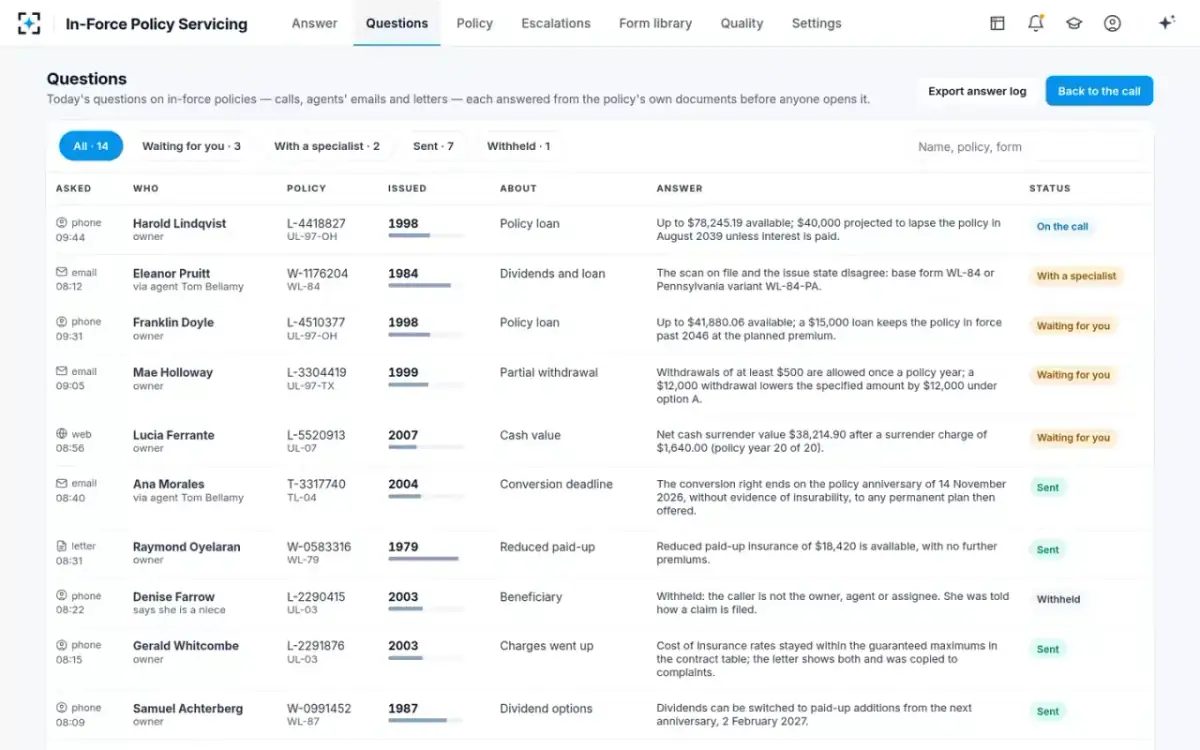
A representative can explain three things from the contract and the report: which charge rose, that the new rate is within the guaranteed table, and what the change does to how long the policy lasts. What the representative should not do is defend the reasons for the change; that belongs to the insurer's actuarial and compliance functions, and an owner disputing it has made a complaint.
A charge question answered from the contract's guaranteed table
When the charge goes up: who needs what
Today
Sees a higher monthly deduction on the annual report and calls to ask why, and whether it is allowed.
With agents
Hears which charges rose, that they stay within the contract’s guaranteed maximums, and what the change does to how long the policy lasts.
Still theirs: The choice: pay more, change the policy, or let it run.
Today
Can see this month’s deduction but not the contract’s table of maximum rates, so the honest answer is a callback.
With agents
Answers from the contract’s guaranteed table beside the current charges, with the page cited, and a projection of the new lapse year.
Still theirs: What to say, and when the question is really a complaint.
Today
Gets every charge question, most of them answerable from the contract.
With agents
Gets the ones that need judgement: a charge that appears to exceed the table, or an owner disputing the basis of the change.
Still theirs: Every reading of an unclear clause.
Today
Learns about charge disputes from the complaint register, months later.
With agents
Has each charge answer copied to complaints, with the page and the figures it rested on.
Still theirs: Whether the answer was right, and the register.
The same week's quality sample includes one such answer: a charge question on a 2003 universal life policy, answered "Cost of insurance within the guaranteed table", with five of five sentences cited. That is the kind of answer a complaints lead wants to read before it goes, not after the complaint arrives.
What can I do when my universal life premiums go up?
Four choices, each with a trade-off, and the right one depends on how long the policy needs to last. An owner should see a projection on the new charges before choosing, which is what an in force illustration is for; the in force illustration guide explains how to ask for one and what it must show.
Pay more: higher premiums keep the policy funded, but on a policy inside a seven-year testing window a large payment can make it a modified endowment contract; the 7 pay test, worked through shows the limit. Reduce the face amount: lower charges, but a reduction in the first seven contract years re-runs that test, and a second-to-die policy is retested on any cut below its lowest death benefit in those years. Let it run: the annual report must warn when, on guaranteed assumptions, the policy will not last to the next report, so the warning is the signal to act. Use a loan to pay premiums: possible on many policies, but loan interest compounds and can bring the lapse forward, as how loan interest works until a lapse shows. To see a charge answer and its projection in the solution, start from In-Force Policy Servicing.
Questions people ask
Is a cost of insurance increase legal?
It can be. The current rate may rise up to the guaranteed maximum in the contract, if the insurer follows the contract's terms and the state's rules. In New York, the change must rest on expected future experience, may not recoup past losses or lift profit margins above those projected at issue, and needs 60 days' notice to owners.
How do I check my cost of insurance charges?
Compare the mortality charges on two annual reports, which must list amounts debited by type, with the table of guaranteed maximum rates in your contract. If the rate charged at your age is above the table, ask the insurer in writing; if it is below but rose sharply, ask whether the scale changed and why.
What is the guaranteed maximum cost of insurance?
It is the highest rate the contract allows the insurer to charge for the death benefit at each age, printed in the policy. The NAIC Universal Life model requires policies to state guaranteed maximum mortality charges alongside minimum interest and maximum expense charges.
What are non-guaranteed elements?
The premiums, benefits, values, credits or charges that are "not guaranteed or not determined at issue", in the NAIC model's words: current interest above the minimum, current cost of insurance below the maximum, dividends. They can change; the guaranteed elements cannot.
Does the cost of insurance go up every year?
The dollar charge usually does, because the rate rises with the insured's age and is applied to the amount of death benefit the account value does not cover. That is different from a scale change, which raises the rates themselves; only a scale change is an "adverse change" that triggers New York's 60-day notice.
Where can I complain about a cost of insurance increase?
To the insurer first, in writing, and then to the insurance department of the state where you live or where the policy was delivered. In New York, the Department of Financial Services receives each adverse change filing in advance, with the actuarial memorandum behind it.