An in force illustration of a life insurance policy is a projection of the policy's future benefits and values, furnished after it has been in force for a year or more and based on the insurer's current illustrated scale. Under the NAIC's Life Insurance Illustrations Model Regulation, which states adopt in their own form, the insurer must furnish one when the owner asks, and the annual report tells owners to contact their state insurance department if it has not arrived within 30 days. A servicing projection is the faster tool a representative runs on a call to show what a loan or a stopped premium would do. The two are easy to confuse, and the difference matters to model risk, actuarial and complaints teams, because the regulation defines an illustration by what a document shows, not by what it is called. Botminds' In-Force Policy Servicing labels its projections "not an illustration" and lets the representative order a formal one from the answer; this guide explains why the label alone is not the control.
Quotations are from the NAIC model texts and state law, linked where they appear. The sample policy, a 1998 universal life policy owned by Harold Lindqvist at a fictional carrier, is invented.
An in force illustration and a servicing projection are built for different jobs
In force illustration: Showing the owner how the policy may perform, on request or with the annual report.
Servicing projection on the call: Helping a representative answer one what-if question while the caller waits.
In force illustration: The insurer’s illustrated scale: never more favourable than the disciplined current scale or the currently payable scale.
Servicing projection on the call: The company’s in-force projection engine on current assumptions, as configured.
In force illustration: Shown, labelled, and before the non-guaranteed ones.
Servicing projection on the call: Not required; often omitted to answer the question.
In force illustration: An illustration actuary, appointed by the board, certifies it each year.
Servicing projection on the call: Whoever owns the engine and its assumptions.
In force illustration: Dated, paged “page 4 of 7”, labelled, with the required statements.
Servicing projection on the call: Whatever the screen shows.
In force illustration: On the owner’s request; the annual report points to a 30-day expectation.
Servicing projection on the call: Never owed; a convenience.
What is an in force illustration of a life insurance policy?
An in force illustration is one of three kinds of illustration the NAIC model defines, the one given after the policy has run for a year. The model defines an illustration as "a presentation or depiction that includes non-guaranteed elements of a policy of life insurance over a period of years", and an in force illustration as "an illustration furnished at any time after the policy that it depicts has been in force for one year or more" (NAIC Model #582, §4H). The other two are the basic illustration used at sale and the supplemental illustration that may accompany it.
The non-guaranteed elements are what make it an illustration. The model defines them as the premiums, benefits, values, credits or charges not guaranteed or fixed at issue (the definition, and what changing one triggers): dividends, credited interest above the guaranteed rate, current cost of insurance charges below the guaranteed maximums. A table of guaranteed values alone is not an illustration; a table that shows current crediting or charges carried forward is.
The model's scope is broad but not total. It applies to group and individual life policies and certificates except variable life insurance, annuities, credit life, and policies "with no illustrated death benefits on any individual exceeding $10,000". Universal life and participating whole life policies sit squarely inside it.
How do I request an in force illustration, and how long does it take?
An owner requests an in force illustration by calling the insurer, writing to it or asking the agent, and the model expects it within 30 days. Where the annual report does not already include one, the model requires a prominent notice telling the owner how to ask and what to do if it does not come.
“You may annually request, without charge, such an illustration … If you do not receive a current illustration of your policy within 30 days from your request, you should contact your state insurance department.”
NAIC Life Insurance Illustrations Model Regulation, §10B, the notice an annual report without an in force illustration must display
The obligation behind the notice is plain: "Upon the request of the policy owner, the insurer shall furnish an in force illustration of current and future benefits and values based on the insurer's present illustrated scale" (§10C). No signature is required on receipt. State law can add its own prompt; New York requires an annual notice on cash-value policies that includes "a statement that the insured has the right to request an updated policy illustration" (N.Y. Ins. Law §3211(g)).
Examiners test it too. The life and annuity policyholder service standards in the NAIC handbook include that the insurer sends every owner an annual report of policy values and, on request, an in force illustration or policy summary (NAIC Market Regulation Handbook, 2024 summary). For a service desk, that makes the request itself a tracked item: when it came in, when it went out, on which scale.
What an in force illustration must show: guarantees first, then the illustrated scale
An in force illustration must meet the model's general rules and its format and tabular-detail standards; §10C names them as Sections 6A, 6B, 7A and 7E. In practice that means a labelled, dated, paged document that shows guaranteed values beside non-guaranteed ones and says plainly which is which.
The format rules an in force illustration inherits from the model
| Rule | What the model says | What it stops |
|---|---|---|
| Label and identity (§6A) | Clearly labelled “life insurance illustration”, with the insurer, the insured’s name, age and sex, the underwriting class, the generic name, product name and form number, and the initial death benefit. | An unlabelled table passed off as a statement of values. |
| Date and pages (§7A(1)–(2)) | Labelled with the date it was prepared; each page numbered “page 4 of 7 pages”. | Pages lifted out of context, or an old projection reused. |
| Guarantees first (§7A(6)–(8)) | Guaranteed death benefits and surrender values shown and clearly labelled; guaranteed elements shown before the non-guaranteed ones. | Current values read as promises. |
| Value on surrender (§7A(10)) | The amount available in a lump sum “after deduction of surrender charges, policy loans and policy loan interest”. | An account value quoted as if it were cash. |
| The three statements (§7A(12)) | That benefits and values are not guaranteed, that the assumptions are subject to change by the insurer, and that actual results may be more or less favourable. | Silence about how a projection can be wrong. |
| Prohibitions (§6B) | No stating or implying that non-guaranteed elements are guaranteed; no “vanish” or “vanishing premium”; nothing more favourable than the illustrated scale. | The sales-era practices the model was written against. |
Is an in force illustration guaranteed? What the illustrated scale is, and is not
No. The guaranteed columns are guaranteed; everything else is an illustration of the insurer's current scale carried forward, which the model requires it to say. The scale is constrained so the illustration cannot be more optimistic than the insurer's own experience supports.
The constraint has three parts. The "currently payable scale" is the scale in effect for the policy form now, or declared to take effect within 95 days. The "disciplined current scale" is a limit "reasonably based on actual recent historical experience, as certified annually by an illustration actuary". The illustrated scale may be no more favourable than the lesser of the two (§4C, D and G). The insurer's board must appoint the illustration actuary, who certifies each year that the scale complies (§11).
One certification duty matters most to an in-force block. The actuary must disclose if non-guaranteed elements "illustrated for both new and in force policies are not consistent with the nonguaranteed elements actually being paid, charged or credited to the same or similar forms" (§11C(5)). An owner holding a 1998 policy is entitled to an illustration that reflects what that form is actually being credited and charged, not the scale of a product sold today.
Illustration vs projection: why the label does not decide
The difference between an illustration and a projection is not a matter of vocabulary. Under the model, any "presentation or depiction" that includes non-guaranteed elements "over a period of years" is an illustration, and one furnished after the first policy year is an in force illustration. A projection that shows a policyowner twenty years of current-assumption values meets those words, whatever its heading says.
That is why a servicing projection needs a deliberate policy. Two uses are low-risk: the representative reads the projection to answer a what-if question on the call, and the answer the owner hears is a date and a direction ("with interest added, the policy is projected to lapse in August 2039"). The risky use is a document: a table of future values on current assumptions, sent to the owner, without guaranteed columns, dated pages or the required statements.
In-Force Policy Servicing draws part of the line itself. Every projection comes from the carrier's own in-force projection engine, never from the agents, and is labelled "servicing projection · current assumptions · not an illustration". A formal in-force illustration can be ordered from the same answer. But the solution's sample reply letter to Harold includes a 20-year table, footnoted to the projection run, and it goes to an in-force specialist before it is sent because the projected lapse falls within 15 years. Whether such a table may go to an owner as it is, must be reformatted as an in force illustration, or should be replaced by one is a decision for the carrier's compliance team and illustration actuary under its states' versions of the rule. The settings let them make it once and apply it to every reply.
A servicing projection on the call: what if he pays the interest each March?
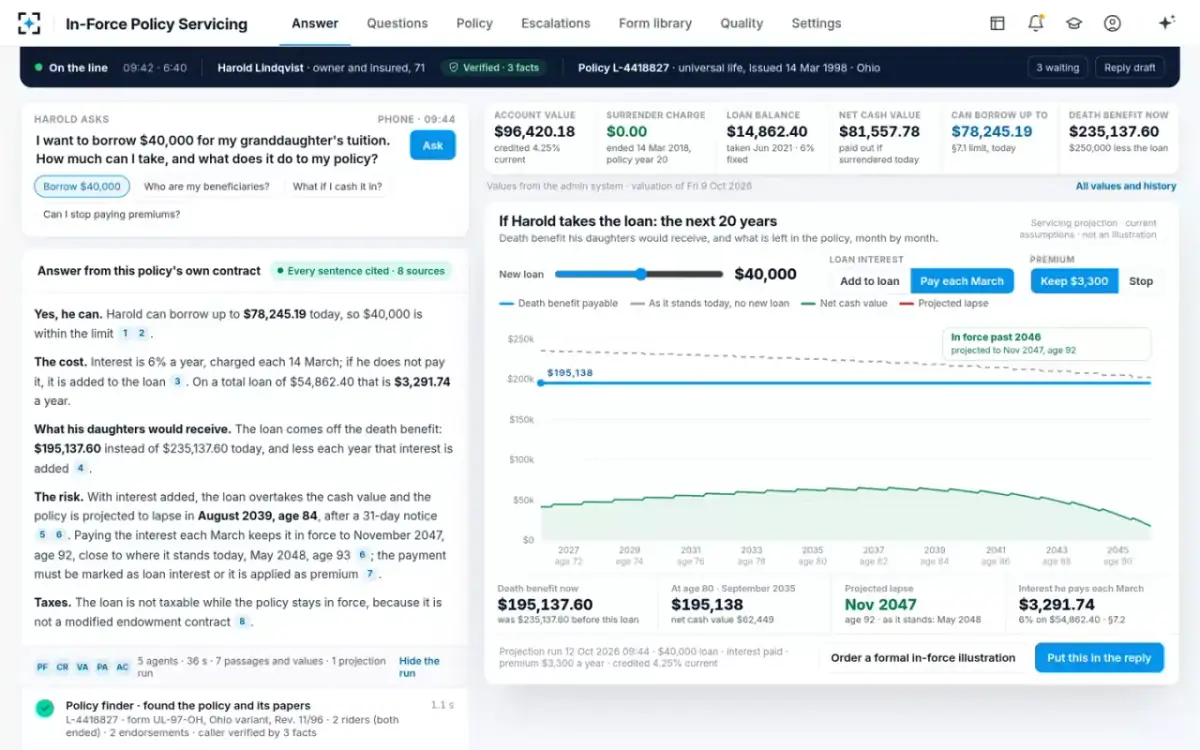
What the second line asks before a projection reaches a policyowner
Model risk, actuarial and complaints teams ask the same questions of any projection a carrier shows its customers. The checklist below is the version for in-force servicing; most items can be answered once, as settings, rather than on every reply.
Before a servicing projection reaches a policyowner
- Which engine and which assumptions produced it?
The company’s own in-force engine, a named version and a named assumption set, recorded with each run.
- Is the basis consistent with the illustrated scale?
A projection more favourable than the illustrated scale invites the comparison the model forbids for illustrations.
- Does it go beyond the call?
Spoken on the call, it is an answer. Sent as a table of future values, it may be an in force illustration in law.
- If it is sent, does it carry guarantees and the required statements?
Guaranteed columns first, the date, page numbering and the three statements, or a formal illustration instead.
- Who reviews it before it goes?
A threshold, such as a projected lapse within 15 years or a large loan, that sends it to a specialist.
- Does it match the annual report?
The starting values must be the same valuation the owner’s statement shows, or the owner sees two truths.
- Is every run kept?
The inputs, the outputs and the reply, so a complaint years later can be answered with what the owner was shown.
- Is a formal illustration one click away?
The owner’s right to one on request does not depend on what the representative already showed.
What does an annual policy report show? The in-force document every owner already gets
For policies designated for illustrations, the annual report is the in-force document every owner receives without asking, and it is where a lapse should first be seen. For universal life, the illustrations model and the NAIC's Universal Life Insurance Model Regulation list the same contents.
What a universal life annual report must show, by the NAIC models
1year
at most between reports: “at least annually”, without charge
3months
the most the report period may end before the report is mailed
6
values and amounts required: policy value, credits and debits, death benefit, net cash value, loans, report dates
1warning
if, on guaranteed assumptions, the policy will not stay in force to the next report
The report must also say when something adverse has happened. Model #582 §10D requires that if the insurer has made an adverse change to non-guaranteed elements since the last annual report, the report must say so, and what changed, prominently. That is the cost-of-insurance increase most universal life owners first learn about; what a cost of insurance increase notice must say covers the stricter New York version.
How often should I review my universal life policy?
At least once a year, when the annual report arrives, and before any change. The model's own notice gives the reason: "You should not consider replacement of your policy or make changes in your coverage without requesting a current illustration." For a universal life policy the changes that most often go wrong are a new loan, a stopped or reduced premium, a partial withdrawal and a reduction in the face amount.
Each of those changes the curve the annual report describes, and only a projection shows how. A loan with unpaid interest is the clearest case: how loan interest works until a lapse follows one through. A face reduction or a large premium can also change the policy's tax status, which the modified endowment contract 7 pay test works through.
How the projection answers on the call and hands off to the formal illustration
The service design that keeps both documents honest is a division of labour. The servicing projection answers the question on the call in seconds, from the company's engine, with the lapse year and the comparison the caller needs. The formal in force illustration, on the illustrated scale and in the regulated format, follows when the owner will rely on future values in writing.
The reply letter: plain words, a table, footnotes and a review before it goes
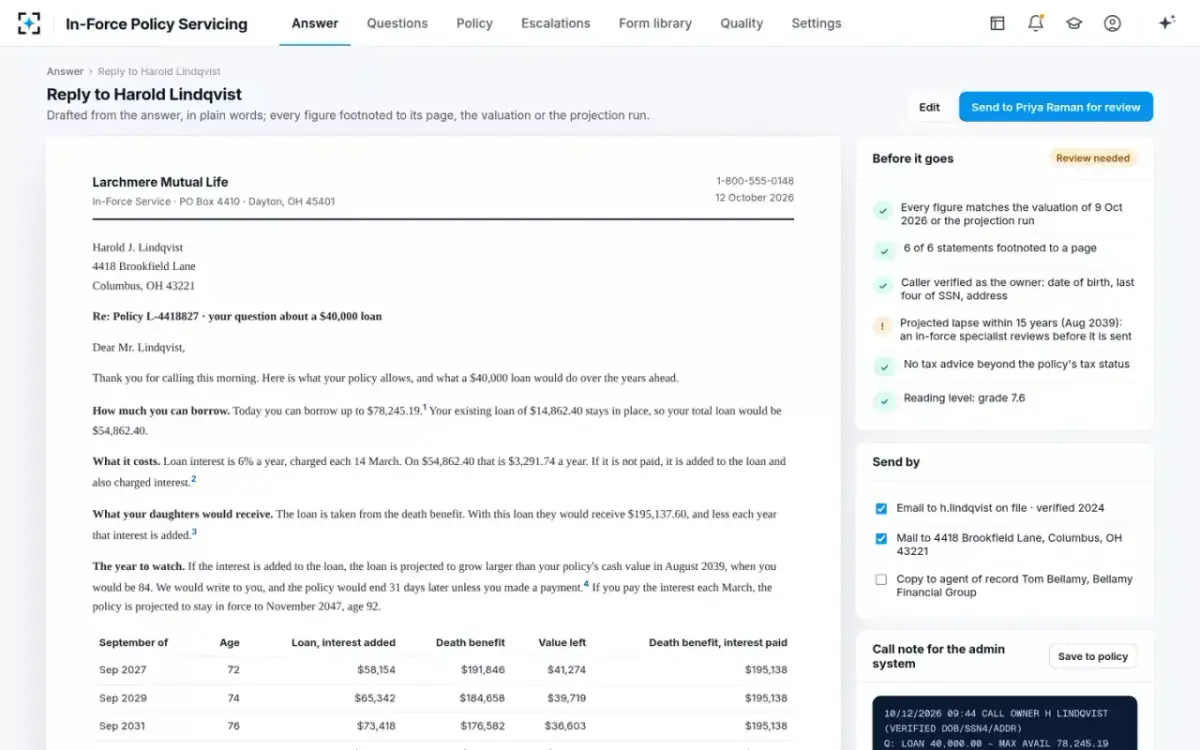
Three settings in the solution carry the policy. The review threshold (projected lapse within 10, 15 or 20 years, or a loan above a set amount) decides which replies a specialist reads. The projection horizon (240 or 360 months) decides how far a what-if runs. And every run is kept with its inputs, so the quality team can sample what owners were shown. To see a projection, the order button and the review together, start from In-Force Policy Servicing; the full loan call is traced in the policy servicing co-pilot guide.
Questions people ask
What is the difference between an illustration and a projection?
In everyday speech, little: both show how a policy might perform. In regulation, an illustration is any depiction of non-guaranteed elements over a period of years and carries format, basis and disclosure rules. A projection used internally to answer a question is outside those rules only so long as it stays an internal tool; sent to an owner, it may be an illustration in law.
Why should I get an in force illustration?
Because it shows whether the policy, on the insurer's current scale, will last as long as you need it, and what changes would do. The NAIC model's notice says owners should not replace a policy "or make changes in your coverage without requesting a current illustration". Universal life owners with loans or reduced premiums have the most to learn from one.
Is an in force illustration free?
Under the NAIC model, yes, once a year: the annual-report notice says the owner "may annually request, without charge, such an illustration". States that adopted the model may vary the wording, so the policy's own annual report is the place to check.
What is an illustration actuary?
An actuary the insurer's board appoints to certify each year that the disciplined current scale used in illustrations complies with the actuarial standard of practice and the regulation. The actuary must be a member in good standing of the American Academy of Actuaries and must disclose inconsistencies between illustrated and actual non-guaranteed elements.
Does a variable universal life policy get an in force illustration under these rules?
Not under NAIC Model #582, which excludes variable life insurance from its scope along with annuities and credit life. For an in-force variable policy, ask the insurer which projection document it provides and on what basis.
How long must an insurer keep illustrations?
For the sale, the model requires the signed basic illustration and any revised one to be kept "until three (3) years after the policy is no longer in force". It sets no separate retention period for in force illustrations, so carriers apply their states' general records rules, which for policy records can run years beyond the policy's end.