The life insurance grace period in California is at least 60 days from the premium due date, and the policy stays in force during it. A lapse for nonpayment is not effective unless the insurer has mailed notice at least 30 days before termination to the policy owner, to any designee the owner named to receive lapse notices, and to any known assignee (Cal. Ins. Code §§10113.71 and 10113.72). In 2021 the California Supreme Court held that both sections apply to every policy in force when they took effect on 1 January 2013, regardless of when it was issued, so a 1990s policy that says "31 days" is read with 60. For a service desk, that means the grace period a representative quotes depends on the state as well as the contract. Botminds' In-Force Policy Servicing reads both: the policy's own grace and lapse clauses, and the issue and residence facts that decide which state's rule overrides them. This guide sets out California's rule, the McHugh case, how it compares with New York and Florida, and what a service desk must know about each California policy.
The statutes, the court opinion and the Department of Insurance bulletin are quoted from their official publications. The policy and screens shown are fictional sample data in the solution.
The same missed premium, as a 31-day contract reads it and as California law reads it
- Grace period in the contract · 31 days31 d
- Grace · notice must be mailed within 30 days of the due date30 d
- Grace continues · at least 30 days’ notice runs30 d
What is the grace period for life insurance in California?
Sixty days at least. "Each life insurance policy issued or delivered in this state shall contain a provision for a grace period of not less than 60 days from the premium due date. The 60-day grace period shall not run concurrently with the period of paid coverage. The provision shall provide that the policy shall remain in force during the grace period" (Cal. Ins. Code §10113.71(a)).
Three phrases in that subsection do the work. "Not less than 60 days" sets a floor, so a contract can give more. "Shall not run concurrently with the period of paid coverage" stops an insurer counting days the owner has already paid for as grace, which matters for monthly-deduction policies. And "shall remain in force" means a death during the grace period is a covered death, paid on the same clocks as any other death claim (the death claim clocks under the NAIC model and state law). The section reaches group as well as individual policies (how an employer's group policy runs its grace period is covered in group life insurance grace period): "a life insurance policy includes, but is not limited to, an individual life insurance policy and a group life insurance policy, except where otherwise provided" (§10113.71(c)).
Does California require a lapse notice, and who must receive it?
Yes. A notice of pending lapse "shall not be effective unless mailed by the insurer to the named policy owner, a designee named pursuant to Section 10113.72 for an individual life insurance policy, and a known assignee or other person having an interest in the individual life insurance policy, at least 30 days prior to the effective date of termination if termination is for nonpayment of premium" (§10113.71(b)(1)).
The timing has two edges. The notice to the owner and designee must go "by first-class United States mail within 30 days after a premium is due and unpaid" (§10113.71(b)(3)), and it must reach the post at least 30 days before termination. Notices to assignees may be electronic with the assignee's consent. The subdivision "shall not apply to nonrenewal", so a term policy reaching the end of its term is a different event. Section 10113.72(c) repeats the rule from the designee's side: no individual policy "shall lapse or be terminated for nonpayment of premium unless the insurer, at least 30 days prior to the effective date of the lapse or termination, gives notice to the policy owner and to the person or persons designated".
What is a lapse notice designee?
A lapse notice designee is a person, other than the owner, whom the owner names to receive notice before the policy lapses for nonpayment: a grown child, a trusted friend, an adviser. California makes the offer mandatory: an individual policy "shall not be issued or delivered in this state until the applicant has been given the right to designate at least one person, in addition to the applicant, to receive notice of lapse or termination of a policy for nonpayment of premium", on a form with "the name, address, and telephone number" of each designee (Cal. Ins. Code §10113.72(a)).
The right does not end at issue. "The insurer shall notify the policy owner annually of the right to change the written designation or designate one or more persons", and the owner may change it more often (§10113.72(b)). For a service desk, that makes the designee a field to read on every California lapse question and every change-of-address call, and a source of complaints when the designee on file is out of date.
Does the 60-day grace period apply to old policies? What the McHugh case decided
Yes. In McHugh v. Protective Life Insurance Company, decided on 30 August 2021, the California Supreme Court held: "We conclude that sections 10113.71 and 10113.72 apply to all life insurance policies in force when these two sections went into effect, regardless of when the policies were originally issued" (S259215). The court said this reading "protects policy owners — including elderly, hospitalized, or incapacitated ones who may be particularly vulnerable to missing a premium payment — from losing coverage".
McHugh: a 2005 term policy, a 31-day grace clause and a death four months after lapse
$1M
term policy issued in March 2005, with a 60-year term
$310
annual premium for the first ten years
31days
grace period in the contract; the 9 January 2013 premium went unpaid
June2013
the insured died, after the insurer had treated the policy as terminated
The facts show why the rule matters to service. McHugh had paid every premium through January 2012. The insurer reminded him of the 9 January 2013 due date in December, warned him in a second letter that the policy would lapse by 9 February, and after the grace period offered reinstatement if paid by 12 March. Around then he suffered a serious fall, and he died in June 2013. The case turned on whether the 2013 statutes reached a 2005 policy at all, and the court held that they did.
The Department of Insurance told insurers what followed. Its Bulletin 2021-8 says policies "must contain a grace period of not less than 60 days, by endorsement if necessary", and that insurers must give owners of individual policies the designee right. It also notes that "The court was not asked to decide what remedies are available to policyholders or beneficiaries in the event an insurer has not complied with these code sections." For a carrier, the practical consequence is that every California policy in force on 1 January 2013, whatever its printed clause, should be serviced on the 60-day and designee rules.
What happens if the insured dies during the grace period?
The policy pays, because it remains in force during the grace period. California's statute says so in terms. What it does not spell out is whether the unpaid premium is deducted from the proceeds; that is in the policy's own grace clause and, in other states, in statute.
New York and Florida both write the deduction into law. New York lets the insurer "deduct from the policy proceeds the portion of any unpaid premium applicable to the period ending with the last day of the policy month in which such death occurred" (N.Y. Ins. Law §3203(a)(2)). Florida lets the overdue premium "with interest not in excess of 8 percent per year thereon" be "deducted in any settlement under the policy" (Fla. Stat. §627.453). A beneficiary asking why a claim paid slightly less than the face amount is usually looking at that deduction; the death claim itself is handled by claims, not the service desk.
Life insurance grace periods by state: California, New York and Florida compared
Grace periods and lapse notices differ by state in length, in when the clock starts for flexible-premium policies, and in who besides the owner must be told. Three large states show the range.
Three states, three lapse rules: grace, notice and the third person
| California | New York | Florida | |
|---|---|---|---|
| Grace period | Not less than 60 days from the premium due date, not concurrent with paid coverage | 31 days or one month for scheduled premiums; 61 days for flexible premiums, from the day the net cash value cannot cover a month’s charges | Not less than 30 days |
| Notice before lapse | Mailed within 30 days after the premium is due and at least 30 days before termination | For scheduled premiums, mailed 15 to 45 days before the due date, or no lapse within a year of default; for flexible premiums, within 30 days after the insurer finds the value insufficient | For insureds 64 or older, mailed at least 21 days before the lapse takes effect, on policies issued from 1 October 1997 and in force a year |
| The third person | A designee the applicant must be offered at application, and annually; plus known assignees | Notice goes to “such other person” if one is designated in writing; assignees may ask for notice | A secondary addressee the applicant must be offered; the agent of record is also notified |
| Old policies | All policies in force on 1 January 2013 (McHugh, 2021) | As the statutes apply to the policy | Policies issued on or after 1 October 1997 for the secondary notice |
Two details trip up multi-state service desks. New York's notice goes to the designee "if any other person shall have been designated in writing to receive such notice, then to such other person" (§3211(b)(1)), while California's goes to the owner and the designee. And Florida ties its senior notice to grace: where a policy gives more than 51 days of grace, the notice must go out "at least 21 days before the expiration of the grace period provided in the policy" (§627.4555(1)). A desk that answers every state with one script will be wrong somewhere every day.
Universal life in California: when do the 60 days start?
For a fixed-premium policy the start is easy: the premium due date. For universal life, where premiums are flexible, the policy defines when a premium becomes due, usually the point at which the value left will not cover the next monthly deduction. The NAIC's Universal Life model sets the general pattern: unless the policy says otherwise, it lapses on the day the net cash surrender value reaches zero, after at least 30 days' written notice (NAIC Model #585, §7F; a loan's part in reaching that day is traced in how life insurance loan interest works).
California's non-concurrence rule is what a representative must apply on top. The 60 days cannot overlap coverage the owner has already paid for, so the count starts when paid coverage ends, not when a projection first shows a shortfall. How each form defines that moment is in the contract or its California endorsement, which is why the solution reads the policy's own grace clause and does not assume one.
The contract page behind a lapse answer, on a sample Ohio policy
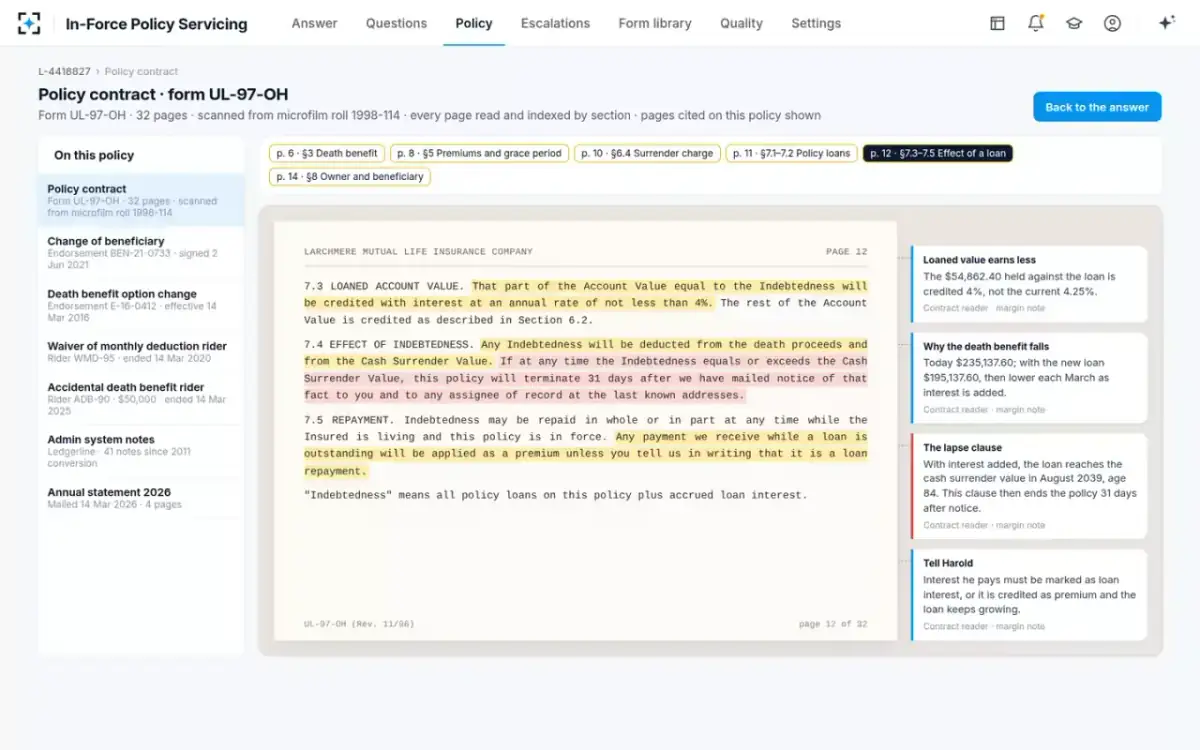
What a service desk must know about each California policy
Answering a California lapse question correctly takes six details, most of them outside the admin system's billing screen. In-Force Policy Servicing's policy finder works them out before an answer is drafted, and the representative sees which one is missing.
Six details behind a correct California lapse answer
- Was the policy issued or delivered in California, or in force there on 1 January 2013?
McHugh applies the statutes to every policy in force when they took effect, whatever the issue date.
- Is there a designee on file, and when was the annual right-to-change notice last sent?
The lapse notice is not effective unless the designee was mailed it too.
- Is there a known assignee or other person with an interest?
A collateral assignment to a lender puts the lender on the notice list.
- When did paid coverage end?
The 60 days run from there, not from the first shortfall in a projection.
- When was the notice mailed, by what class of mail, to which addresses?
Within 30 days after the premium was due, first-class, and at least 30 days before termination.
- What does the contract or its California endorsement say?
A longer grace in the contract governs; a shorter one is read up to 60 days.
The same details decide what happens after the grace period: whether the owner can still choose a nonforfeiture option, covered in which nonforfeiture option applies when premiums stop, and how a policy loan's interest can bring the lapse on in the first place, worked in how life insurance loan interest works. To see a lapse answer drafted from the contract on a sample policy, start from In-Force Policy Servicing.
Questions people ask
Can a California life insurance policy lapse without notice?
Not effectively, for nonpayment of premium. The notice of pending lapse is not effective unless it is mailed to the owner, any designee and any known assignee at least 30 days before termination, and an individual policy may not lapse unless that notice was given. Nonrenewal at the end of a term is outside the rule.
Does California's 60-day grace period apply to group life insurance?
Yes. Section 10113.71 defines a life insurance policy to include "a group life insurance policy, except where otherwise provided". The designee rights in section 10113.72 are written for individual policies.
What was the McHugh case?
McHugh v. Protective Life Insurance Company (California Supreme Court, 2021) concerned a $1 million term policy issued in 2005 with a 31-day grace period, which the insurer treated as terminated in 2013 before the insured died. The court held that California's 60-day grace and designee-notice statutes apply to all policies in force on 1 January 2013, regardless of issue date, and sent the case back without deciding the remedy.
What happens if my insurer did not send the 30-day notice?
The statute says a notice not mailed as required is not effective, so the lapse it announced is in question. The Department of Insurance's 2021 bulletin notes the court was not asked to decide remedies and that the Department will enforce the sections "in accordance with existing law". A beneficiary in that position should contact the insurer and, if needed, the Department.
Is the life insurance grace period the same in every state?
No. California requires at least 60 days, Florida at least 30, and New York 31 days or one month for scheduled premiums and 61 days for flexible-premium policies. Notice rules and third-party designee rights differ even more, so the policy's issue state and the owner's state both matter.
What does "shall not run concurrently with the period of paid coverage" mean?
That the 60 days start only when the coverage the owner has paid for runs out. An insurer cannot count a month already covered by a premium or a monthly deduction as part of the grace period, so the owner always gets the full 60 days of unpaid grace.