The group life insurance grace period is the time after a premium falls due during which the employer can still pay and the coverage stays in force. In the states whose standard provisions are quoted here it is 31 days, for every premium except the first, and the death benefit continues throughout it: a death on day 20 of the grace period is covered even if the premium has not yet arrived. The policy may make the employer liable for a pro rata premium for the days the coverage ran. If the grace period ends with the premium still unpaid, the policy can end, and the questions move to who was told, when, and what rights each employee then has. Group Premium Reconciliation, Botminds' solution for group billing teams, tracks each employer's due date and grace end beside the reconciliation of its payment, so the billing desk sees an unpaid bill in time to act.
The examples use fictional sample data from the solution: a book of 26 employer groups whose premiums are due on the 1st, with a 31-day grace period. For October 2026 coverage, grace ends on Saturday 31 October.
An October group life premium, three ways the month can end
- Due 1 Oct, grace runs20 days
- Paid; coverage continuesIn force
- Grace: death benefit in force31 days
- Conversion window, where it applies31 days
- Grace31 days
- Carrier still accepting claimsuntil notice
- Notice delivered, then three workdays5 days
How long is the grace period for group life insurance?
Thirty-one days in the states quoted here, for every premium after the first. South Carolina requires every group life policy delivered in the state to contain "A provision that the policyholder is entitled to a grace period of thirty-one days for the payment of any premium due except the first". Florida's statute uses the same words with the numeral: "a grace period of 31 days for the payment of any premium due except the first".
Two details in that wording matter on a billing desk. The grace period belongs to the policyholder, the employer, not to each employee; it is about the group premium, not an individual's payroll deduction. And it does not apply to the first premium, so a new group that never pays its first bill was never in force on the grace period's terms. Both statutes also let the policyholder cut the grace period short by giving the insurer written notice of discontinuance in advance, in accordance with the policy.
Is a death during the grace period covered?
Yes. The statutes say the grace period is one "during which grace period the death benefit coverage continues in force", unless the employer gave advance written notice of discontinuance. A claim for an employee who dies on 20 October, under an October premium that was due on 1 October and has not been paid, is payable.
The premium for those days is not forgiven. Both statutes allow the policy to provide that the policyholder "is liable to the insurer for the payment of a pro rata premium for the time the policy was in force during such grace period." A billing team that lets a lapsed group's grace-period premium go uncollected is giving away coverage it was obliged to provide.
"The policy may provide that the policyholder is liable to the insurer for the payment of a pro rata premium for the time the policy was in force during the grace period."
S.C. Code § 38-65-210(1), the first standard provision of a group life policy
How long is the grace period in group life insurance policies in South Carolina and other states?
South Carolina's is 31 days, and so is Florida's. Other states set their own standard provisions, each in its own insurance code, which is why the question is asked state by state. Read the state statute for the state where the policy was delivered; the group policy itself must contain the provision "in substance" or something more favourable to the insured.
The group life dates in the statutes quoted here
| Rule | What it says | Where |
|---|---|---|
| Grace period | 31 days for any premium except the first; death benefit continues; pro rata premium may be charged | S.C. § 38-65-210(1); Fla. Stat. § 627.559 |
| Conversion on leaving the group | Apply and pay the first premium within 31 days after termination; no evidence of insurability; not term insurance | S.C. § 38-65-210(8) |
| Conversion when the whole policy ends | Only for people insured at least five years; amount may be capped at the lesser of the lost cover and $10,000 | S.C. § 38-65-210(9) |
| Death in the conversion period | The amount that could have been converted is payable as a claim under the group policy | S.C. § 38-65-210(10) |
| Notice of the conversion right | Within 15 days of the event; late notice extends the right 45 days; no notice within 90 days ends it at day 90 | N.Y. Ins. Law § 3220(a)(8) |
| Discontinuance for non-payment | Carrier liable for claims incurred before the grace period ends; if it keeps the policy going, no end before the third scheduled workday after notice | NAIC model #110, section 4 |
What happens after the grace period ends?
If the premium is still unpaid, the policy can end for non-payment, and the carrier is liable for claims incurred before the grace period ended. The NAIC's model regulation on group coverage discontinuance puts it this way: where a policy provides for automatic discontinuance after a premium remains unpaid through the grace period, "the carrier shall be liable for valid claims for covered losses incurred prior to the end of the grace period."
The trap is the carrier's own behaviour. If it acts after the grace period as though the policy continues, for instance by continuing to recognise claims, the model makes it liable for losses until its written notice of discontinuance takes effect, and that date "shall not be prior to midnight at the end of the third scheduled workday after the date upon which the notice is delivered." A billing desk that lets an unpaid group drift for weeks while claims are still being accepted has extended the coverage, whatever the policy says.
Does the insurer have to notify the employer before cancelling?
Under the NAIC model, the notice of discontinuance goes to the employer and asks it to tell employees the date coverage ends, and the carrier supplies notice forms for them. The notice must also warn the employer that if it keeps collecting contributions after that date it may be held solely liable for the benefits they were for. The state's enacted version decides the details, and the policy's own terms add to them.
For the billing desk, the practical rule is to send the notice as soon as the decision is made, not at the next month-end, because the end of coverage cannot come before the notice takes effect if the carrier has kept the policy going. The broader duties of an employer that does not pay, including withheld premium, are set out in what happens when an employer did not pay the premium.
What is the conversion period after group life ends?
Usually 31 days from the end of coverage. South Carolina's provisions let an employee whose group life ends on leaving employment or the eligible class buy an individual policy "without evidence of insurability", as long as the application is made and the first premium paid "within thirty-one days after the termination". If the employee dies within that period before the individual policy takes effect, the amount they could have converted is payable as a claim under the group policy.
When the whole group policy ends, for non-payment among other reasons, South Carolina's right is narrower: it applies to people insured for at least five years, and the policy may cap the converted amount at the smaller of the coverage lost and "ten thousand dollars". An employee with $150,000 of group life in a lapsed group may be able to convert only a fraction of it.
The window starts at the termination, not when anyone hears of it, which makes late reporting dangerous. New York requires the employee to be told of the right within 15 days either side of the termination (N.Y. Ins. Law § 3220; quoted in retro termination insurance); a late notice extends the right for 45 days after it is given, but if no notice is given within 90 days the right ends at day 90. In the sample case, a termination on 30 June was reported to the carrier on 2 October, 94 days later, and the conversion and portability letter went out that day. Under a rule like New York's, that letter arrives after the window has closed. How the billing desk handles such late terminations is set out in retro termination insurance credits.
What is the difference between portability and conversion in group life?
Conversion turns group coverage into an individual permanent policy, at the insurer's individual rates for the employee's age, without evidence of insurability; it is a standard provision the statutes require. Portability is a feature some group policies add, letting a departing employee keep term coverage by paying the premium directly, on terms the policy sets. It is not among the standard provisions quoted on this page, so whether it exists, and on what terms, is in the policy and certificate.
The two often appear in the same letter, as they do in the sample case, and they share a weakness: both have deadlines that run from the end of coverage. A billing team that learns of a termination late should assume both deadlines are already running.
Is a short payment an unpaid premium?
Not until it has been reconciled. Most group premium that arrives "short" is not unpaid at all: it is a self-bill employer's own calculation, taking off terminations the bill still showed and adding hires it did not. Treating the shortfall as non-payment, and starting the lapse process on it, would end coverage over a difference the employer may be right about.
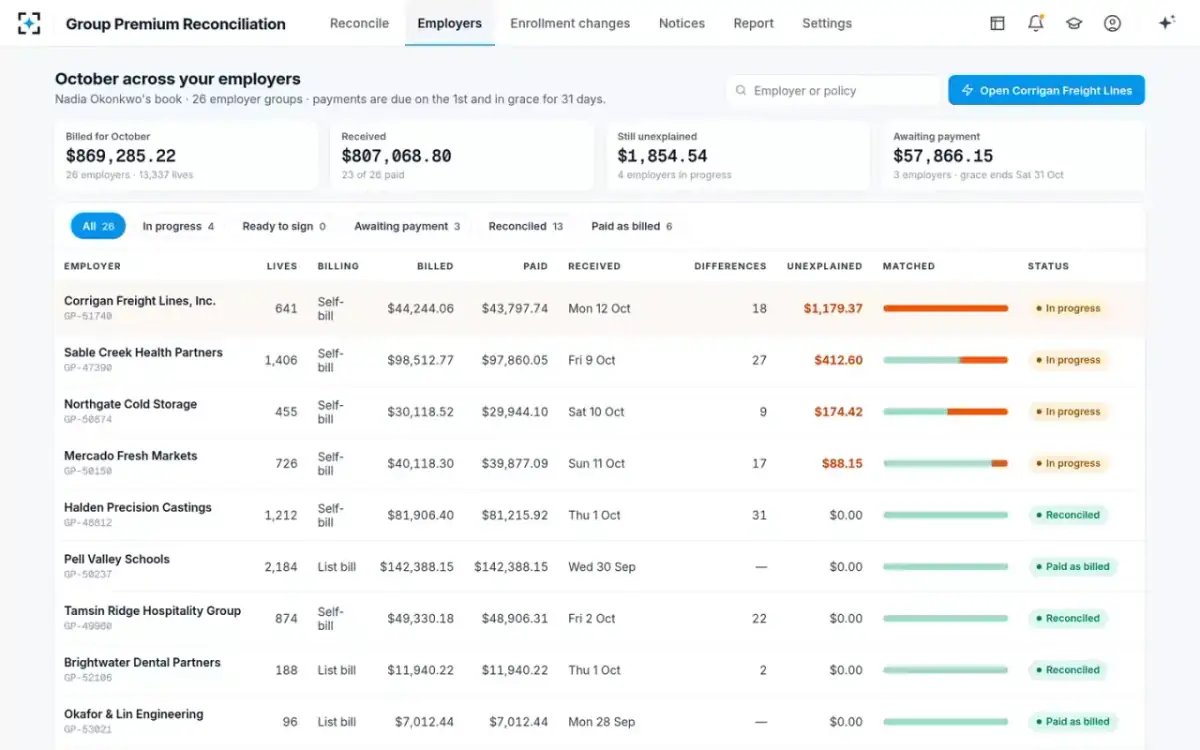
The sample case shows the scale. Corrigan Freight Lines paid $43,797.74 on 12 October against an October bill of $44,244.06, $446.32 short and well inside its grace period. Reconciled employee by employee, the bill itself was wrong by more than that: the corrected October bill came to $43,889.11. Of the remaining $91.37, July's $140.00 was due under the retro clause, $40.00 was refunded for age bands payroll had moved early, $13.00 was held for two evidence-of-insurability decisions and $4.37 of rounding was written off. The employer ended the month owing $100.00, carried to the November bill. None of it was a reason to send a notice of discontinuance.
The order of work matters for the grace period. A reconciliation finished in days leaves the rest of the 31 days for the account manager to settle what is genuinely owed; a reconciliation that takes weeks by hand can run past day 31 with the carrier still unsure whether the employer has paid.
Grace periods in the billing system
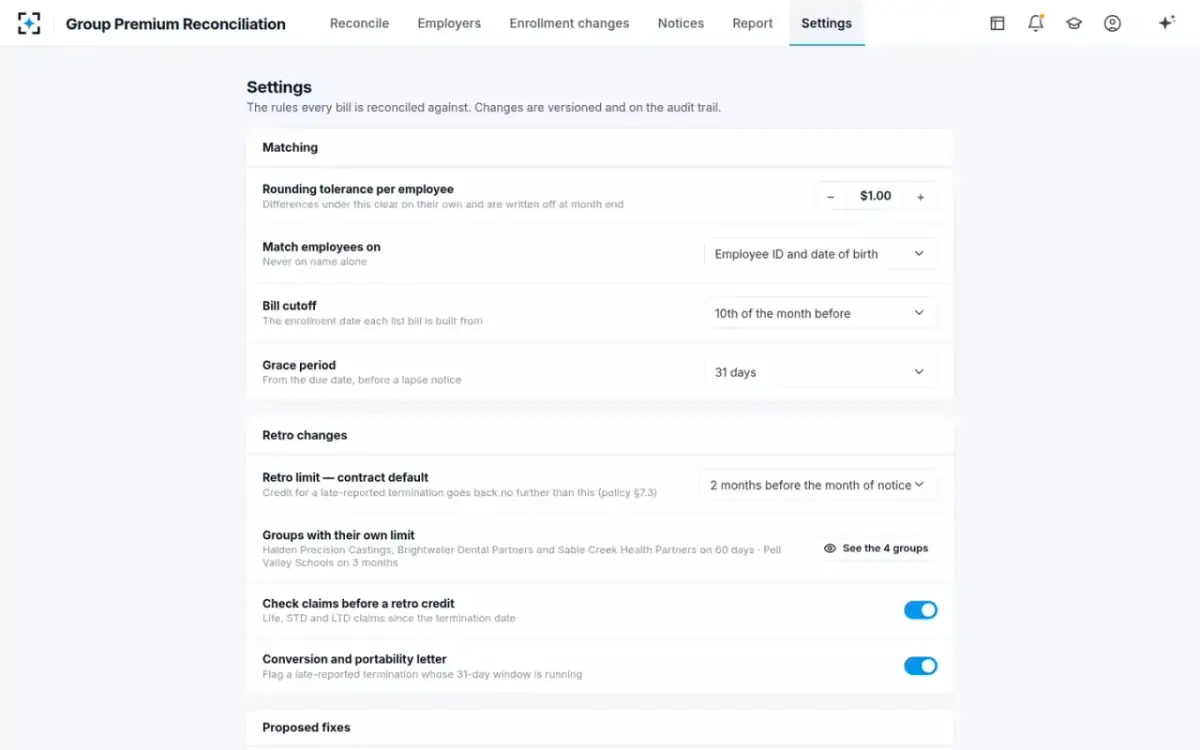
The grace period is a setting, and it should be visible beside every unpaid bill. In the sample book the setting is 31 days from the due date before a lapse notice, with 45 and 60 days available for groups whose contracts allow more. On the employers screen, three groups had not paid their October premiums on 12 October, $57,866.15 between them, each marked with the grace end date.
October premiums awaiting payment, with the grace end date, in Group Premium Reconciliation
The grace period and the conversion check as settings in Group Premium Reconciliation
What to check on a group life bill in its grace period
Seven checks for an unpaid group life bill, before day 31
- Confirm the due date and the grace end from the policy
Thirty-one days in the statutes quoted here; the policy may give more.
- Check whether the employer gave written notice of discontinuance
If it did, in advance and under the policy's terms, the grace period may not apply.
- Look for claims incurred since the due date
A death in the grace period is covered whether or not the premium arrives.
- Work out the pro rata premium for the grace days
If the policy provides for it, the employer owes it even if the group lapses.
- Decide, and send any notice of discontinuance promptly
If the carrier keeps treating the policy as in force, coverage runs until the notice takes effect.
- Supply the employer with notices for employees
They point employees to their certificates and any right to convert or continue.
- Ask whether payroll is still deducting
Employee contributions withheld for a lapsed policy are plan assets the employer must account for.
Questions people ask
Is the group life grace period 30 or 31 days?
In the South Carolina and Florida statutes it is 31 days, matching the 31-day conversion window. A policy may be more generous, but not less, because the statute requires the provision or one more favourable to the insured.
Does the grace period apply to the first premium?
No. The standard provision covers "any premium due except the first". A group that never pays its first premium does not get the statutory grace period on it.
Can an employer reinstate group life after it lapses?
Only on the insurer's terms. None of the standard provisions quoted here requires reinstatement of a lapsed group policy, so it depends on the policy and the carrier; employees' individual conversion rights run on their own deadlines meanwhile.
Does the grace period cover employee-paid supplemental life?
The grace period is the policyholder's, so it covers the group premium, including the part employees pay through payroll. What employees paid is a plan asset the employer must pass on; if the employer withheld it and the policy lapsed anyway, the contributions are still owed to the plan.
Who owes the premium for the grace period if the group lapses?
The employer, if the policy says so: both statutes let the policy make the policyholder liable for a pro rata premium for the days the policy was in force during the grace period. In the sample book, three employers were inside their grace period on 12 October, with $57,866.15 outstanding between them.