An employee benefits reconciliation template is a spreadsheet that lines up, for each employee and each coverage, what was billed, what enrollment says the employee has and what was paid or deducted from pay, so that every difference can be found, given a cause and fixed. Most templates fail in the same place: they compare totals, or they match on names, and so they find that a bill is wrong without finding which line is wrong or why. The template below works line by line, for a carrier reconciling an employer's payment or for an employer's benefits team reconciling a carrier's invoice against payroll. It is also the method Group Premium Reconciliation, Botminds' solution for group premium billing teams, runs with agents, which is why the page ends with an honest comparison of the two.
The worked figures use fictional sample data from the solution: Corrigan Freight Lines, an employer with 645 employees and four coverages each (basic life and AD&D, short-term disability, long-term disability and voluntary life), paying its October 2026 premium with its own spreadsheet. That is about 2,500 premium lines for one employer in one month.
Sixteen columns for an employee benefits reconciliation template, one row per employee per coverage
| Column | What goes in it | Why it matters |
|---|---|---|
| Employee ID | The employer's ID, stored as text | The primary match key; leading zeros lost to number formatting break it |
| Date of birth | From enrollment, not payroll | The second key, and the input to every age band |
| Name | For people to read | Never used to match |
| Coverage | Basic life, STD, LTD, voluntary life, each on its own row | Errors are per coverage; a total per employee hides them |
| Class | The plan class the employee is in | Rates and benefit formulas differ by class |
| Volume | Coverage amount, or covered salary for salary-based benefits | Most life and disability premium is volume times rate |
| Rate basis | Per $1,000 or per $100 of salary, and the age band if any | Shows which rule produced the rate |
| Coverage month | The month being paid for | A June termination paid for in October is a different month |
| Billed | From the list bill | The carrier's view at the cutoff |
| Expected from enrollment | Volume times rate, as of the coverage month | What should have been billed, given every change since the cutoff |
| Paid or deducted | From the remittance or payroll | The employer's view |
| Difference | Paid minus expected | Signed, never absolute |
| Cause | One of a fixed list of causes | Free text cannot be counted or audited |
| Evidence | File, line and clause that support the cause | Without it the cause is a guess |
| Proposed fix | Bill, credit, refund, hold or refer | One action per line |
| Decided by | Name and date | Who accepted the fix, for the audit and the next person |
What columns should a benefits reconciliation template have?
It should have at least the sixteen above: two keys, the coverage and the month, the volume and rate that produce premium, the three views of the same line (billed, expected from enrollment, paid), and four columns that turn a difference into a decision (cause, evidence, fix and who decided). The last four are the ones most templates leave out, and they are the ones that make the next month faster, because a difference with a cause and evidence does not have to be investigated twice.
Three design choices matter more than any column. Keep one row per employee per coverage, not one per employee, so a $64.00 voluntary life error is not netted against a $33.78 disability error. Compute "expected from enrollment" from enrollment for the coverage month, not at the bill cutoff, because the cutoff is the reason the bill is wrong. And keep the cause list closed, so that at month end the template can say how many differences of each kind there were.
How do you reconcile employee benefits, step by step?
Reconcile employee benefits monthly, line by line: tie the payment to the cash, load the bill, rebuild enrollment for the coverage month from every enrollment file since the cutoff, compute expected premium, match on ID and date of birth, give every difference above a small tolerance a cause and evidence, apply the contract's rules, and only then accept fixes and write the corrected bill. An employer's benefits team reconciling a carrier invoice runs the same steps with payroll deductions in place of the remittance.
The order matters. Rebuilding enrollment before matching is what finds the employees who were added, ended or changed after the bill was cut; on Corrigan's October bill there were 14 such changes across six enrollment files, none of them on the bill. Tying to cash first stops a remittance that does not match the money from being reconciled at all. And applying the contract last stops a self-bill employer's own deductions from being accepted because they look reasonable.
Monthly is the minimum, for a reason beyond tidiness. Premium an employer withholds from pay is a plan asset under the Department of Labor's rule, and for welfare plans it must reach the plan "in no event" later than 90 days after it is withheld. A reconciliation that runs quarterly finds a deduction with no coverage behind it after that clock has run.
The match key: employee ID and date of birth, never name
Match on employee ID and date of birth, and leave any line that fails both for a person. A VLOOKUP on name returns the first match it finds, so two employees with the same name collapse into one and the second is silently left unmatched; payroll and enrollment also spell names differently, and a married name changes in one system before the other. A VLOOKUP on employee ID alone fails differently: IDs stored as numbers lose leading zeros, and an ID reused for a rehire matches the wrong history.
The fix in a spreadsheet is a concatenated key, ID and date of birth as text, with an exact-match lookup and a count of matches beside it, so a key that matches twice is caught. Group Premium Reconciliation's default setting is the same pair, with "employee ID and last four of SSN" and "employee ID only" as alternatives a carrier can choose; it never matches on name alone.
How to reconcile benefits billing in Excel without breaking the contract
The arithmetic of expected premium is simple: volume divided by the rate unit, times the rate. The errors come from the inputs to it, and three of them need a formula of their own.
The age band date. Age-banded rates move on a date the contract names. If the contract moves bands at the policy anniversary, the age that sets the rate is the age at the last anniversary, not today's age; a template that computes age from today's date moves the band on the birthday and overstates premium until the anniversary. That is what Corrigan's payroll did for two employees, overpaying $40.00 on voluntary life whose bands move on 1 January. The IRS uses yet another date for imputed income on group-term life above $50,000, the employee's age on the last day of the tax year (26 CFR 1.79-3), so keep that calculation out of the billing template and in a separate imputed income calculation.
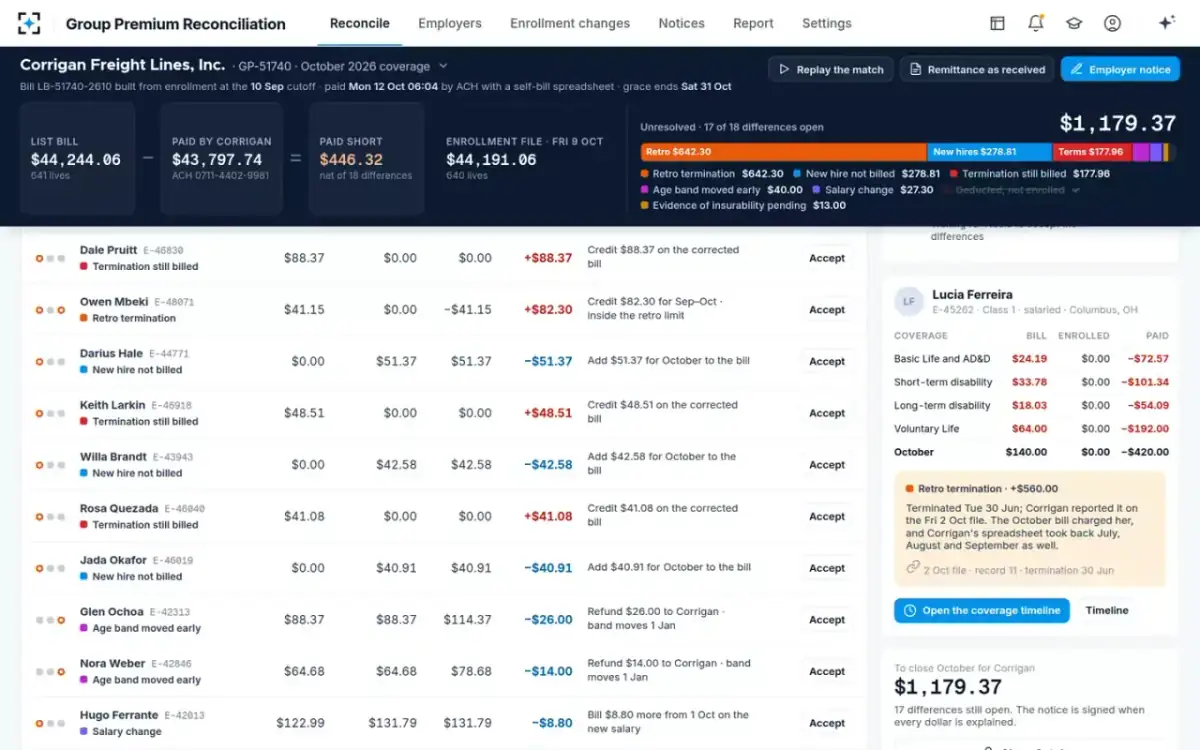
The retro months. For a termination reported late, the template needs the month of notice and the contract's limit to work out the first creditable month. Under a clause that credits back at most two months before the first day of the notice month, like the one retro termination insurance quotes, a termination reported on 2 October is credited from 1 August. In Excel that is the first day of the notice month moved back two months (EDATE on the first of the month), compared with each coverage month. Corrigan's Lucia Ferreira, terminated on 30 June and reported on 2 October, was taken back for July to October at $140.00 a month; the formula credits $420.00 and leaves July's $140.00 due.
The tolerance. Apply a rounding tolerance per employee, not to the total: under $1.00 per employee in the sample settings. On Corrigan's bill, 11 employees fell inside it for −$4.37 in all. A $5.00 tolerance on the bill total would pass any set of line errors that nets to under $5.00, however large each line is.
Cause codes: the eight reasons a line differs
A closed list of causes is what turns a reconciliation into management information. Group Premium Reconciliation uses eight, counting rounding. Counted across the fictional sample book in October, the expensive causes are not the frequent ones.
One month's differences by cause: the frequent causes are the cheap ones
Terminations still billed and new hires not billed are frequent and mechanical: the enrollment file says what happened. Retro terminations, evidence-pending amounts and deductions with no enrollment are rarer, and each is a decision about a person's coverage. A deduction with no enrollment behind it means an employee is paying for life insurance that does not exist; in the sample, payroll had deducted $19.20 a month for $30,000 of voluntary life whose election was rejected for a missing date of birth.
What does benefits reconciliation cost per month?
It costs the analyst's hours, which are easy to see, and the errors the method misses, which are not. No regulator or public body publishes reconciliation hours or error rates for group billing, so the honest answer is a model built from a team's own numbers. The four terms below are the ones worth pricing.
The monthly cost of reconciling one self-bill employer by template, in four terms
Analyst time
hours a month × loaded hourly cost
Estimated at 16 hours for a 600-life self-bill employer by hand in the persona time study behind the solution.
Billing manager
Write-offs
unexplained differences written off at quarter end
Small amounts left in suspense because no one found the cause.
Controller
Credits past the limit
months credited beyond the contract's retro limit
Given because the clause was not found or the date of notice was not kept.
Billing manager
Premium never billed
new hires and salary increases missed × months until found
Corrigan's four unbilled new hires were $278.81 for one month.
Billing manager
Priced with public figures, the first term is smaller than most teams assume. BLS puts the mean annual wage of billing and posting clerks, its nearest occupation, at $51,070 in May 2025 (BLS OEWS), about $24.55 an hour over 2,080 hours before benefits and overhead. Sixteen hours a month is then about $393 of wages for one self-bill employer (our arithmetic). The other three terms are where the money is. Corrigan's four new hires, if missed, were $278.81 a month of premium for coverage already in force; missed for a year, $3,345.72. And the sample book's October report shows $1,262.40 of premium kept in one month only because retro limits were applied.
The fourth term also carries a risk the formula cannot price. A deduction with no enrollment behind it, found at claim time, is a death claim the carrier must decide on coverage it never issued. The cost of that is not a premium amount.
When does a reconciliation spreadsheet stop working?
A spreadsheet stops working when the hours go into finding differences rather than deciding them. In the time study behind the solution, half of a by-hand reconciliation is matching employee by employee and chasing enrollment files for each mismatch; the decisions, retro credits and the notice, take the rest.
Where 16 hours of by-hand reconciliation go, from the Group Premium Reconciliation time study
By hand, 16 hours
- Pulling files together · 12.5%
- Matching · 25%
- Chasing enrollment · 25%
- Retro credits · 18.75%
- Bill and notice · 18.75%
Four signs say the template has reached its limit: more than a handful of self-bill employers on one analyst; enrollment arriving in several files a month per employer; contracts with different retro limits, so the formula needs a lookup per group; and a template that only one person can run. In the sample book three groups credit late terminations for 60 days and one for three months, against a default of two months before the month of notice. A template can hold that table. It cannot stop a colleague using the default.
Template, outsourced service or agents: what to look for
Whatever does the matching, judge it by whether each line that differs ends with a cause, its evidence and a named person's decision. A template can do that if someone builds and maintains it; an outsourced premium accounting service can do it if the contract asks for it; agents can do it if they are built to propose and not to post. The comparison below sets a well-built template beside Group Premium Reconciliation.
A well-built template and Group Premium Reconciliation, on one employer's month
Template, by hand: Paste the employer's spreadsheet in; re-map columns when the layout changes.
Group Premium Reconciliation: Reads 820s, spreadsheets and PDFs as received, and ties them to the ACH trace.
Template, by hand: Apply each file since the cutoff by hand, in date order.
Group Premium Reconciliation: Rebuilds each employee's coverage month by month from every file, with rejected entries flagged.
Template, by hand: Lookups on a concatenated key; duplicates found if someone counts them.
Group Premium Reconciliation: Employee ID and date of birth for every employee and coverage; a failed match stays open for a person.
Template, by hand: Typed into two columns, when there is time.
Group Premium Reconciliation: Each difference labelled with its cause and the file, line and clause behind it.
Template, by hand: A lookup table of retro limits, kept current by hand.
Group Premium Reconciliation: Each group's limit as a versioned setting; overrides need the controller and a reason.
Template, by hand: The analyst accepts, writes the corrected bill and the letter.
Group Premium Reconciliation: The analyst accepts each fix and signs a notice already drafted, quoting the clause.
Where the solution fits is specific. It is built for carriers and administrators reconciling employer premium payments for group life, disability and supplemental coverage. An employer's own benefits team reconciling a carrier's invoice against payroll can use the template above; the solution's agents read from the carrier's side. A carrier choosing between a pilot of software and improving its template should test either on closed bills where the answers are known, as set out in testing benefits reconciliation software on last quarter's bills.
The template's last four columns, filled in: cause, evidence, fix and decision
Questions people ask
How often should benefits be reconciled?
Every month, against every bill. Monthly is what the billing cycle and the cutoff produce, and it keeps employee contributions inside the Department of Labor's outer limit of 90 days for welfare plans. A quarterly reconciliation finds a deduction with no coverage behind it after that window.
Is there a free employee benefits reconciliation template?
The sixteen columns on this page are free to copy into any spreadsheet. What no template supplies is the contract table behind it: each group's retro limit, age-band date and tolerance, which must come from the group policies themselves.
Should a reconciliation include terminated employees?
Yes, for every month they were billed or paid for. A termination still billed and a retro termination taken back are two of the most common differences, and a termination also starts the employee's right to convert group life, which South Carolina's standard provisions give 31 days to exercise. Leaving terminated employees out hides both.
What tolerance should a benefits reconciliation use?
A small one per employee, set as a policy, not a habit. The sample settings in Group Premium Reconciliation clear differences under $1.00 per employee and allow $0.00 to $5.00. Never apply a tolerance to the bill total.
Who should approve the adjustments a reconciliation finds?
The billing analyst for routine fixes, and someone with financial authority above set limits. In the sample settings, write-offs above $25, credits above $2,500 per employer a month and any credit past a retro limit need the finance controller's co-signature.
Can a spreadsheet handle conversion notices for late terminations?
It can flag them, if it keeps the termination date and the date the carrier was told. Rules differ by state: New York requires notice of the conversion right within 15 days of the event, and ends the right at 90 days if no notice is given. A template that keeps only the coverage month cannot see either date.