A group insurance billing analyst is the person at a group life and disability carrier who takes each employer's monthly premium payment and makes it agree with two other things: the list bill the carrier sent and the enrollment the carrier holds. Where the three disagree, the analyst finds out why, employee by employee and coverage by coverage, applies the contract's rules to the difference, and writes the corrected bill and the letter to the employer. The work is hard because the three sources disagree by design: the bill is built from enrollment as of a cutoff date, the employer pays from its own payroll, and enrollment keeps changing until the money arrives. Group Premium Reconciliation is Botminds' solution for that month: agents match every employee across bill, enrollment and payment and propose a cause and a fix for each difference, and the analyst decides and signs.
Most carriers do not advertise this job, and the people who hold it rarely write about it. It is a seat built on memory: which employer pays from a spreadsheet, which contract credits a late termination for 60 days and which for two months, which payroll moves a rate on the birthday. This guide follows one such seat through a month, using a fictional sample book in the solution: 26 employer groups with 13,337 covered employees, worked by a senior group billing analyst called Nadia Okonkwo. The people, employers and carrier are invented; the rules quoted are real.
One group billing seat, and the three people it leans on
Today
Opens each remittance, ties it out in a spreadsheet, chases enrollment for every mismatch and writes the employer notice herself.
With agents
Starts from the lines that differ, each with its cause and a proposed fix, and signs a notice that is already drafted.
Still theirs: Every accepted fix and every signature on a corrected bill.
Today
Works rejected enrollment entries and evidence-of-insurability decisions without knowing which ones payroll is already deducting for.
With agents
Sees every change since the cutoff in one list, with the rejected entry flagged and the deduction behind it.
Still theirs: Any change to enrollment.
Today
Defends a charge the employer did not expect with a personal reading of the contract.
With agents
Sends a letter that quotes the clause for every amount the employer did not expect.
Still theirs: The conversation with the employer and the broker.
Today
Signs quarter-end write-offs for suspense and unapplied cash that no one can explain.
With agents
Sees suspense and money owed by employer, and co-signs only what is above the limits.
Still theirs: Write-offs above $25, credits above $2,500 per employer a month, and any retro override.
What does a group insurance billing analyst do?
A group insurance billing analyst reconciles each employer's premium payment to the bill and to enrollment, explains every difference, applies the contract to it, and issues a corrected bill and a notice. In a month that means five jobs for every employer that does not pay exactly what it was billed: pull the bill and the employer's payment detail together, match them employee by employee, chase the enrollment changes behind each mismatch, work out credits for late-reported terminations under the contract's limit, and write the corrected bill and the letter.
The Bureau of Labor Statistics does not count a "billing analyst" occupation. The nearest it counts is billing and posting clerks, of whom there were 404,060 in May 2025, with a median wage of $48,500 and a mean of $51,070; insurance carriers employed 5,640 of them, at a mean of $53,140 (BLS OEWS, May 2025). The occupation's task list on O*NET reads like half of this seat: "Verify accuracy of billing data and revise any errors", "Resolve discrepancies in accounting records" and "Consult sources, such as rate books, manuals, or insurance company representatives, to determine specific charges". The other half, reading a group policy's retro clause and an enrollment file, is not in any federal job description. That is one reason the seat is hard to back-fill.
What is premium billing in group insurance?
Premium billing in group insurance is the carrier billing the employer, as policyholder, each month for every covered employee's coverage, and the employer paying one amount for all of them. Two arrangements dominate. Under a list bill, the carrier lists every employee and coverage from the enrollment it holds and sends the total. Under a self bill, the employer works out what it owes from its own payroll and sends the money with its own calculation. The difference between them decides where the analyst's errors come from, and is set out in list bill vs self bill.
Either way, part of the money is not the employer's. Premium withheld from an employee's pay for a contributory plan becomes a plan asset under the Department of Labor's rule "as of the earliest date on which such contributions" can reasonably be segregated from the employer's general assets, and for welfare plans no later than 90 days after it is withheld. A billing analyst who sees an employer deducting for coverage that is not on the bill is looking at more than a billing error.
What is a billing cutoff date, and why does it create next month's work?
A billing cutoff date is the enrollment date the list bill is built from. In the sample book it is the 10th of the month before coverage, so the October bill reflects enrollment as of 10 September. Anything the employer reports after that, an addition, a termination or a salary change, is not on the bill, but the employer's payroll already reflects it when it pays.
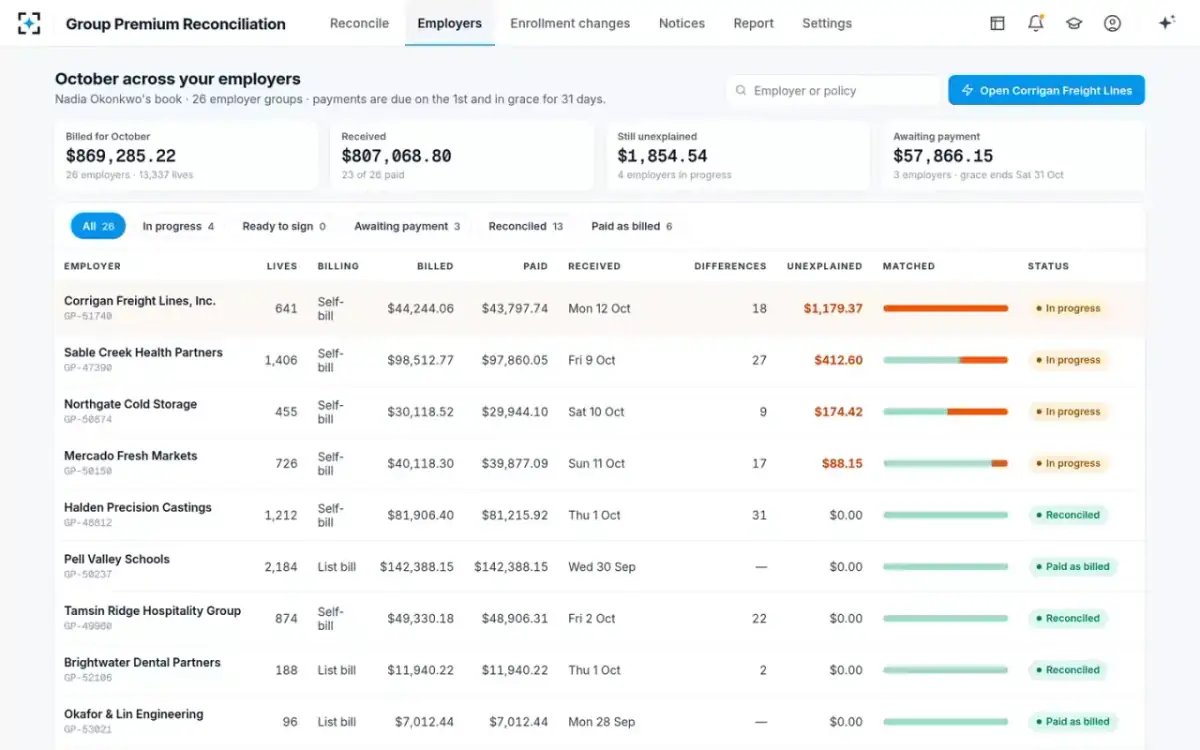
That gap is the analyst's inventory. For one sample employer, Corrigan Freight Lines, six enrollment files arrived between the 10 September cutoff and the October payment, carrying 14 changes, none of them on the October bill. Corrigan paid $43,797.74 against a bill of $44,244.06. Each of those 14 changes is a line the analyst must find, explain and either bill, credit or leave alone, and the same will happen next month.
A month in the seat, from the cutoff to the signed notice
The month has a shape. The cutoff fixes the bill around the 10th; the bills go out; payments and remittance spreadsheets arrive around the first of the coverage month; the grace period runs; and the corrected bills and notices go out before the next cutoff. In between, each self-bill employer is a small project.
One 600-life self-bill employer, by hand and in Group Premium Reconciliation: where the hours go
- Pulling the bill and spreadsheet together2 h
- Matching employee by employee4 h
- Chasing enrollment for each mismatch4 h
- Retro credits against the contract3 h
- Corrected bill and notice3 h
- Total1 h
The largest blocks by hand are not the hard ones. Matching 645 employees across four coverages, about 2,500 premium lines, is a lookup; chasing enrollment for each mismatch is a search through files. The judgement sits in the smaller blocks: whether a late termination is credited, whether an amount is held or refunded, what the letter says. That is the split the solution is built around.
How many employer groups does a billing analyst handle?
No published survey from a regulator or public body counts employer groups per billing analyst, so any number quoted for the industry is a guess. What decides a workable book is not the count of employers but the count of lines that will differ: covered employees, times coverages, times the share of employers who self-bill, times how much their enrollment moves after the cutoff.
The sample book shows why the count of employers misleads. Nadia's 26 groups range from 96 to 2,184 covered employees and carry 13,337 in all. A 2,184-life school district that pays as billed costs her minutes; a 641-life freight carrier that self-bills cost an estimated day and a half to two days by hand. In August, before the agents, the team logged an estimated 38 hours to reconciliation across the book. A carrier sizing its own seats can count, for each employer, the premium lines and the differences per month over the last quarter of closed bills, and staff to the differences.
October across 26 employers: lives, billing method, differences and what is still unexplained
Who handles premium discrepancies?
The billing analyst owns every premium discrepancy, but each kind is settled by a different person and a different piece of evidence. A termination still billed is the analyst's to credit; a rejected enrollment behind a payroll deduction is the enrollment specialist's to fix; a charge the employer disputes is the account manager's to explain; a credit past the contract's limit is the controller's to approve or refuse. A seat that tries to settle all of them alone ends up writing the hard ones off.
Eight causes of a premium difference, and who settles each
| Cause | What the analyst sees | Evidence that settles it | Who decides |
|---|---|---|---|
| Termination still billed | Billed, not in enrollment, not paid | The termination on an enrollment file after the cutoff | Analyst credits it |
| New hire not billed | Paid and enrolled, not on the bill | The addition and its effective date | Analyst adds it |
| Salary change | Paid a different amount for life or disability | The new salary and the date it takes effect | Analyst |
| Age band moved early | Paid more than billed | The contract's rule for when a band changes | Analyst refunds or bills |
| Retro termination | Employer took back several months | The termination date, the date of notice and the retro clause | Analyst inside the limit; controller beyond it |
| Evidence of insurability pending | Paid for an amount not yet approved | The pending decision | Held in suspense until it is made |
| Deducted, not enrolled | Paid for coverage that does not exist | The rejected or missing election | Enrollment specialist, with the employer |
| Rounding | Cents per employee | The tolerance in the carrier's settings | Cleared under the tolerance |
Two of the eight are not billing questions at all. Premium paid for supplemental life above the guaranteed amount while evidence of insurability is pending is money for coverage that may never exist, which is why it is held rather than kept. A deduction with no enrollment behind it is coverage an employee believes they have, and a claim is where it would otherwise be found. In the sample, Grace Holloway's payroll had deducted $19.20 a month for $30,000 of voluntary life whose election had been rejected for a missing date of birth.
What skills does a group billing analyst need?
A group billing analyst needs to read a group policy's billing clauses, an enrollment file and a payroll spreadsheet, and to know the handful of federal and state rules that sit under the arithmetic. None of it is advanced mathematics; all of it is precise. The rules below are the ones that change an amount on a bill.
Age. Three different dates can move an age-banded rate. The contract usually names one, often the policy anniversary. The IRS values group-term life above $50,000 by the employee's age on the last day of the tax year (26 CFR 1.79-3; see the imputed income calculator). And the EEOC allows cost comparisons for age-based reductions in age brackets of up to five years (29 CFR 1625.10). When payroll moves a rate on the birthday and the contract moves it at the anniversary, the employer overpays until the anniversary; in the sample, two employees' voluntary life was moved early and $40.00 was refunded.
Retro terminations. The contract sets how far back a late-reported termination is credited. Federal rules set what a retroactive end of coverage can mean for the person: for disability coverage, a retroactive cancellation is a "rescission" and an adverse benefit determination unless it is for failure to pay premiums. The full mechanics are in retro termination insurance credits.
Conversion notices. A termination reported late means the employee's notice of the right to convert group life goes out late, and state law decides what that does. New York requires notice within 15 days either side of the termination, extends the window when notice is late, and ends it at 90 days if no notice is given (N.Y. Ins. Law § 3220; retro termination insurance works the dates). South Carolina's standard provisions give thirty-one days to apply after termination. The analyst is often the first person to see the late date.
Files. Enrollment arrives in the X12 834 format or the employer's own layout, payment detail in an X12 820 or a spreadsheet. Knowing what those files can and cannot say is set out in 834 file format for group life and disability.
What is lost when the analyst is away
What is lost is the part of the job that is not written anywhere a colleague can find it. The bill and the payment are in systems. The reasons are in one person's head: which four employers have their own retro limit, which payroll provider moves rates on birthdays, which employer always pays the new hires a month early. In the sample book, three groups credit late terminations for 60 days and one for three months, against a contract default of two months before the month of notice. A cover analyst working from the default credits the wrong months.
The cost shows up at quarter end. Small differences no one can explain sit in suspense and are written off; credits past a contract's limit are given because no one could find the clause; a deduction with no enrollment behind it is found when a claim is filed. None of these is a large number on one bill. Across a book they are the difference between premium that can be defended and premium that is guessed. The mechanics of suspense itself are covered in what premium suspense is and who works it.
"I don't need help with the 627 lines that match. I need the 18 that don't, with the reason."
Nadia Okonkwo, senior group billing analyst in the fictional sample book
Where Group Premium Reconciliation changes the billing analyst's month
Group Premium Reconciliation takes the matching and the search off the seat and leaves the decisions on it. Six agents read the employer's payment and spreadsheet, rebuild each employee's coverage from the enrollment files, set bill, enrollment and payment side by side for every employee and coverage, label each difference with its cause and evidence, apply the contract's retro limit, and draft the corrected bill and the letter. None of them posts cash, edits enrollment or sends anything to an employer.
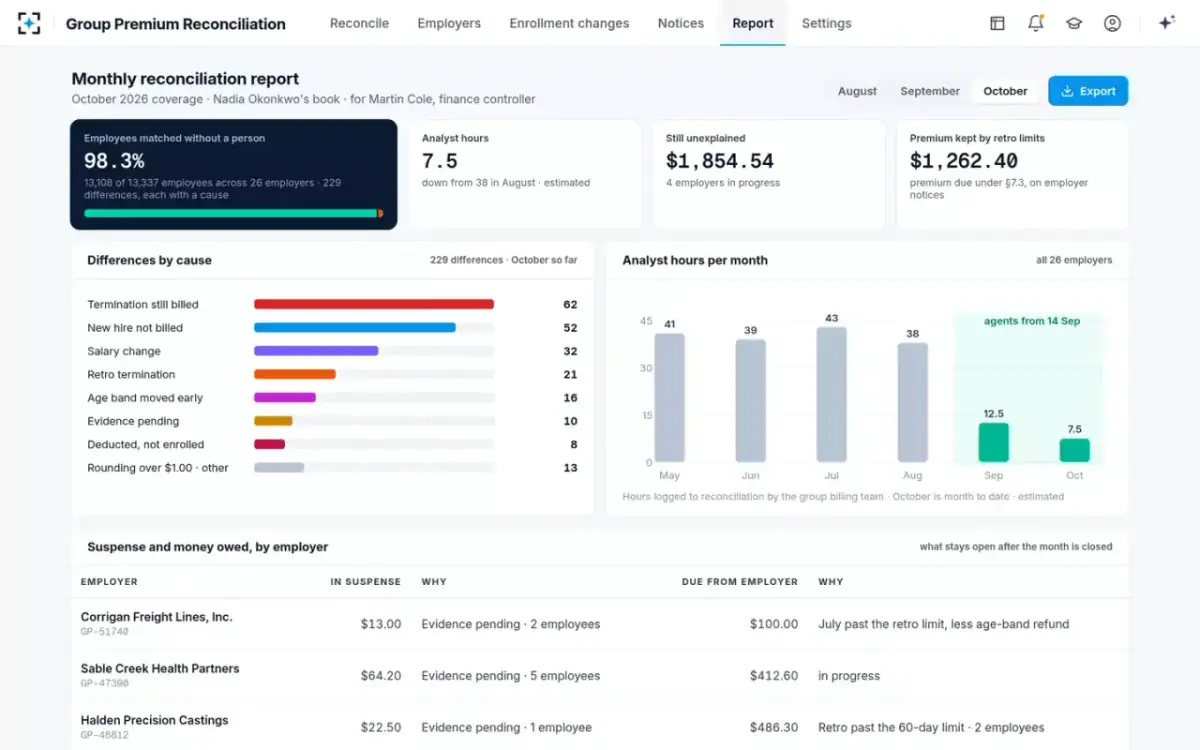
On Corrigan's October bill, 616 of 645 employees matched to the cent and 11 within the $1.00 tolerance; 18 differed by $1,198.57 gross. Nadia accepted 16 routine fixes together, worked the one retro termination left, and signed a corrected bill of $43,889.11 with $100.00 carried to November. Across the book, the October report shows 13,108 of 13,337 employees matched without a person, and estimated analyst hours falling from 38 in August to 7.5 in October to date. These are results on fictional sample data; the design target for matching without a person is 97% of employees.
The monthly reconciliation report the controller reads
What the seat keeps is the work that needed a person all along: deciding whether a late termination is credited, explaining a July charge to an employer, refusing an override. The tools a carrier already runs for billing do not do this part, which is the subject of premium billing systems and where they stop.
Questions people ask
Is a group billing analyst the same as a premium accountant?
They overlap but are not the same seat. The billing analyst works employer by employer and employee by employee, deciding what each employer owes; premium accounting books the cash, the receivable and the write-offs that result. A receivable that stays unpaid has its own statutory treatment, covered in the 90-day non-admitted rule.
What is the salary of an insurance billing analyst?
BLS publishes no figure for billing analysts as such. For billing and posting clerks, its nearest occupation, the May 2025 median was $48,500 a year across all industries, and the mean at insurance carriers was $53,140. Analyst titles with contract and enrollment work often sit above clerk grades; check local postings.
Why do employers pay a different amount from the list bill?
Because the bill is built from enrollment as of a cutoff, and the employer pays from a payroll that already reflects changes made after it. Terminations, new hires, salary changes and payroll's own rate rules all move the payment. On Corrigan's October bill those changes netted to $446.32 short, out of $1,198.57 of gross differences.
Does a billing analyst post cash or change enrollment?
Usually neither: cash application and enrollment are separate controls in most carriers, and the analyst proposes adjustments to both. In Group Premium Reconciliation no agent posts cash or edits enrollment either; the analyst accepts each fix and the enrollment specialist makes any enrollment change.
How long does it take to reconcile one self-bill employer by hand?
For a 600-life self-bill employer with four coverages, the persona time study behind the solution estimates 1.5 to 2 days by hand, about 16 hours. The same estimate puts it at about an hour with the agents, most of it the analyst's review and signature.
What happens to differences nobody can explain?
They sit in suspense and, at many carriers, are written off at quarter end. In the solution an unexplained difference stays labelled "unexplained" rather than being given a guessed cause, and a write-off above $25 needs the finance controller's co-signature in the sample settings.