List bill vs self bill is a question of who builds the monthly premium invoice for an employer's group coverage. Under a list bill, the carrier lists every covered employee and coverage from the enrollment it holds, prices each line and sends the total; the employer pays it. Under a self bill, also called self-administered billing, the employer works out what it owes from its own payroll and sends the money with its own calculation; the carrier checks it. The two arrangements put errors in different places: a list bill is wrong when the carrier's enrollment is out of date, and a self bill is wrong when the employer's payroll or its reading of the contract is. Group Premium Reconciliation, Botminds' solution for group billing teams, reconciles both kinds, employee by employee, and the sample employer on this page shows why both still need it.
The sample is fictional data from the solution: a book of 26 employer groups at a carrier called Thornbury Life & Benefits, some on list bill and some on self bill, and one self-bill employer, Corrigan Freight Lines, whose October 2026 payment is followed below.
List bill vs self bill, row by row
List bill: The carrier, from its enrollment as of the bill cutoff.
Self bill: The employer, from payroll, usually in its own spreadsheet.
List bill: The carrier's enrollment, as reported by the employer.
Self bill: The employer's payroll deductions and its reading of the rates.
List bill: On a later bill, as adjustments, once reported.
Self bill: In the current payment, as differences from the carrier's figure.
List bill: A termination still billed; a new hire not billed yet.
Self bill: A rate moved on the wrong date; a deduction with no enrollment behind it.
List bill: Often the employer, when it checks the bill against payroll.
Self bill: The carrier, when it checks the payment against its bill and enrollment.
List bill: Mostly at the next cutoff, applying reported changes.
Self bill: Every month, reconciling each line of the employer's calculation.
What is the difference between list bill and self bill?
The difference is whose numbers the payment starts from. A list-bill employer receives the carrier's figure and either pays it or adjusts it; a self-bill employer sends its own figure and the carrier adjusts that. Everything else follows: who does the arithmetic, when changes in enrollment show up, and who is likely to notice an error first.
It is not a difference in who owes the premium. Under both, the employer is the policyholder and owes the carrier for coverage in force, and under both, the employees' share withheld from pay is a plan asset under the Department of Labor's rule, owed to the plan as soon as it can reasonably be separated from the employer's own money (29 CFR 2510.3-102). Nor is it a difference in the grace period: group life policies give the policyholder 31 days to pay where state standard provisions require it, as South Carolina's and Florida's do, and the death benefit stays in force while those days run (S.C. standard provisions; see the group life grace period).
What is a list bill?
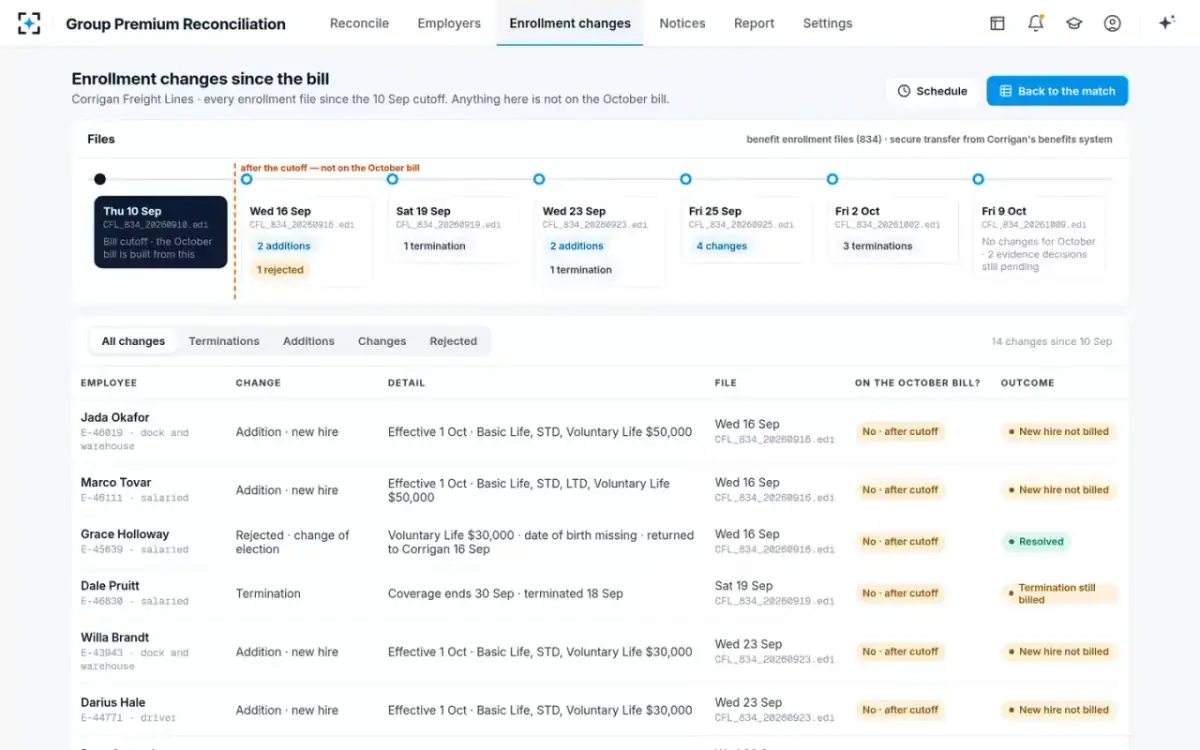
A list bill is a premium invoice that lists each covered employee, each coverage and each premium, built by the carrier from its enrollment as of a cutoff date. In the sample book the cutoff is the 10th of the month before coverage, so the October bill shows enrollment as it stood on 10 September. The employer's job is to pay it, and to report changes so that next month's bill is right.
The list bill's weakness is time. Anything the employer reports after the cutoff, or forgets to report, is wrong on the bill until a later one catches up. An employer with low turnover and stable salaries barely notices: in the sample book Pell Valley Schools, with 2,184 employees on list bill, paid its October bill of $142,388.15 exactly as billed. An employer with weekly hires and terminations sees the bill drift every month, and the temptation is to pay what payroll says instead.
What is self billing in insurance?
Self billing in insurance is an arrangement in which the employer, not the carrier, calculates each month's group premium, usually from its payroll deductions, and remits it with a statement of how it got there. The carrier keeps the right to check the calculation against its own bill and enrollment. Its appeal for an employer is that it pays for the employees it actually has this month.
Its weakness is that the employer is doing the carrier's arithmetic with the carrier's rules, which it may not know. Age-banded rates move on the date the contract names; evidence of insurability decides whether an elected amount above the guaranteed issue limit is in force; a retro clause limits how far back a late termination is credited. Payroll knows none of these unless someone tells it. And the employer's eligibility rules still apply: New York's standard provisions require that "all new employees of the employer" in an eligible class "must be added", which a self-bill spreadsheet can omit as easily as a list bill can.
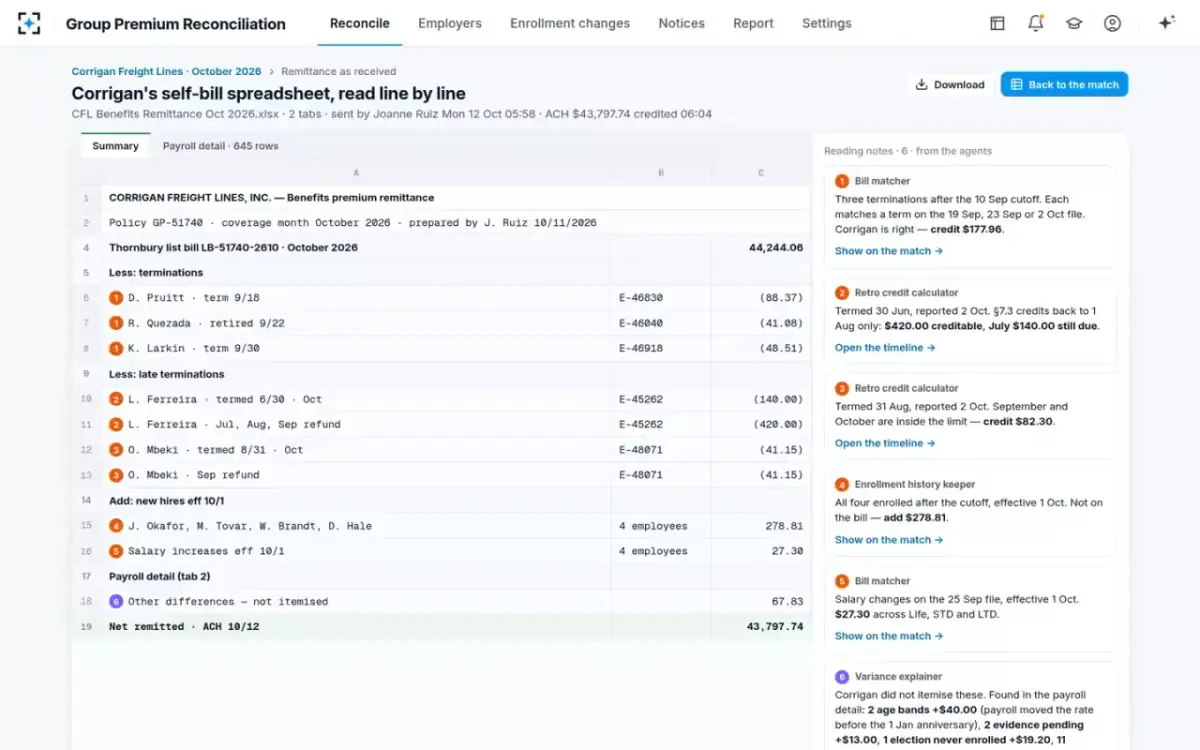
A self-bill remittance as received: the employer's arithmetic, line by line
What is a direct bill, and how is list bill vs direct bill different?
A direct bill goes to the insured person, not to the employer. Coverage an employee keeps after leaving, such as an individual policy taken under a group life conversion right, is billed to that person directly; so are some voluntary products an employer makes available but does not collect through payroll. List bill and self bill are both employer billing; direct bill takes the employer out of the premium flow.
The distinction matters to reconciliation because it moves the employee off the employer's bill. A conversion policy, which South Carolina's provisions describe as "an individual policy of life insurance" issued without evidence of insurability, is a new contract with its own premium. A termination still on the employer's bill after the employee has converted is double counting, and a self-bill employer that keeps deducting after the termination is holding money that belongs to no coverage.
One employer's month, both ways
The most useful way to see the difference is to split one employer's errors by where they came from. Corrigan's October payment, against a list bill of $44,244.06, carried 18 differences above the tolerance, $1,198.57 gross. Most of them were reporting timing, enrollment changes the list bill did not yet show; a smaller part was payroll applying rules the contract does not.
Where Corrigan's $1,198.57 of October differences came from, in Group Premium Reconciliation
By origin
- Enrollment changes after the cutoff · 94%
- Payroll applying the wrong rule · 6%
Read the split both ways. Had Corrigan been on a pure list bill and paid as billed, the 94% would not have disappeared; it would have arrived as adjustments on November's and December's bills, after the money had changed hands, and the terminations still billed would have been paid for. On self bill, the 94% arrived in October's payment, where it could be checked. The 6% is the price of self billing: errors that exist only because the employer did the arithmetic. Small in dollars, they include the line that matters most, a $19.20 deduction for $30,000 of voluntary life whose election had been rejected.
Fourteen enrollment changes after the cutoff, none of them on the October bill
Which is better, list bill or self bill?
Neither is better in general; each suits a different employer. List bill suits employers with stable enrollment, few salary-based coverages and little appetite for doing premium arithmetic. Self bill suits large employers with frequent changes and a payroll team that can be told the carrier's rules, and it suits the carrier only if it reconciles each self-bill payment line by line rather than accepting the net.
Four questions usually decide it. How many enrollment changes does the employer make a month? A self bill keeps the payment current. Does its payroll know the contract's rules for age bands, evidence of insurability and retro terminations? If not, a self bill will carry small, steady errors. Will the carrier check every line of each payment? If not, the self bill is trusted rather than reconciled. And who will notice a deduction with no coverage behind it before a claim does? Under either arrangement the honest answer is: only a line-by-line reconciliation.
Who reconciles a self bill?
The carrier's billing analyst reconciles a self bill, with three other people supplying the answers: the enrollment specialist for rejected or late enrollment, the employer account manager for anything the employer disputes, and the employer's own benefits administrator, who built the spreadsheet. In the sample case the remittance came from Corrigan's benefits administrator, Joanne Ruiz, and the corrected bill and letter went back to her, copied to the account manager and the broker of record.
Four people around one self-bill employer's month
Today
Builds the remittance from payroll, itemises the changes she knows about and nets the rest into one line.
With agents
Receives a letter that names each difference by employee ID and initials and quotes the clause behind it.
Still theirs: Payroll deductions and the employer's own reporting.
Today
Pastes the spreadsheet beside the bill, runs a lookup on employee ID and works every mismatch by hand.
With agents
Starts from the lines that differ, each with a cause, evidence and a proposed fix.
Still theirs: Every accepted fix and the signature on the corrected bill.
Today
Works rejected enrollment without knowing which ones payroll is already deducting for.
With agents
Sees the rejected election with the deduction behind it, and confirms it with the employer.
Still theirs: Any change to enrollment.
Today
Explains a charge the employer did not expect from a personal reading of the contract.
With agents
Sends a letter that quotes the clause for every unexpected amount.
Still theirs: The relationship with the employer and the broker.
How to make a self bill smaller each month
A self bill's payroll errors shrink when the carrier hands the employer its rules and returns every difference with the clause attached. All of the 6% on Corrigan's payment came from three rules payroll did not have: when an age band moves, what an elected amount above the guaranteed issue limit costs while evidence is pending, and that a rejected election means no coverage to deduct for. None of them is secret; they are in the group policy, which payroll has rarely read.
Four habits help. Give the employer's benefits administrator a one-page rule sheet with each coverage's rate basis, the age-band date and the guaranteed issue amounts (in the sample, voluntary life is guaranteed to $150,000, and two employees paying on amounts above it were held in suspense for $13.00). Ask for every adjustment to be itemised by employee, so there is no "other differences" line; Corrigan's unitemised $67.83 hid four different causes. Send back the rejected enrollment with the deduction it affects, the same day. And make the corrected bill name each difference by employee ID and initials, with the clause, so the next spreadsheet starts from the right rule. The aim is not to move the employer to list bill; it is to make the self bill's arithmetic the carrier's.
How Group Premium Reconciliation handles both arrangements
For a self-bill employer, the solution reads the remittance as received, spreadsheet, PDF or X12 820, extracts every employee line and every adjustment the employer wrote, ties it to the cash, and checks each line against the bill and enrollment rebuilt for the coverage month. For a list-bill employer that pays as billed, there is little to reconcile in the payment, but the same enrollment rebuild finds what the next bill must correct. On Corrigan's October bill, 616 of 645 employees matched to the cent and 11 within the $1.00 tolerance; the 18 that differed each got a cause and a proposed fix, and the corrected bill came to $43,889.11.
Whichever arrangement an employer uses, the carrier's position is stronger when the letter quotes the contract. Corrigan's notice explained a $140.00 July charge under the retro clause and a $40.00 refund under the age-band clause, and carried $100.00 to November. The rules behind those amounts are set out in retro termination insurance credits and why a balanced 820 can still be wrong. When the employer simply stops paying, a different set of rules applies, covered in what happens when an employer did not pay the premium.
Questions people ask
Is self billing the same as self-administered billing?
Yes, in group insurance the terms are used for the same arrangement: the employer administers the premium calculation. Some carriers use "self-administered" for the plan as a whole, including enrollment, and "self bill" for the invoice; check the group policy's billing provision for which the employer has agreed to.
Can an employer switch from list bill to self bill?
With the carrier's agreement: the billing arrangement is part of the group's administration terms, so renewal is the natural point to change it. A switch is worth a parallel month: run the self bill beside the list bill and reconcile both before the list bill stops.
Who is responsible if a self-bill employer underpays?
The employer, as policyholder, owes the premium for coverage in force, whatever its spreadsheet says. If a shortfall is not settled, the policy's grace period and the state's rules on non-payment apply; the NAIC's model regulation makes a carrier liable for valid claims "incurred prior to the end of the grace period" when a policy lapses for non-payment.
Does a list-bill employer have to pay exactly what is billed?
It is expected to, and to report changes for the next bill. A list-bill employer that deducts known terminations has turned the payment into a partial self bill; the carrier then has to reconcile it line by line like any other.
Which arrangement produces more billing errors?
No public body publishes error rates for either, so the answer has to come from a carrier's own bills. In the sample case, 94% of one self-bill employer's October differences by value came from enrollment timing that a list bill would also have had, and 6% from payroll rules that only a self bill produces.