When an employer leaves group insurance premiums unpaid, three sets of rules decide what happens. The group policy's grace period keeps coverage in force for a time after the due date, and the insurer must pay valid claims incurred during it. After that, the policy can end for non-payment, and under federal health rules an end dated back to the unpaid period is not a forbidden "rescission". Separately, any premium the employer took from employees' pay is not the employer's money: it is a plan asset that must be paid over promptly, and keeping it can be a federal crime. This guide sets out who must do what, for group health, life and disability coverage, from the employer's side and the carrier's. It is written for the employer account managers and billing teams at carriers and for employers' benefits staff; it is not legal advice.
Botminds' Group Premium Reconciliation is software for a carrier's group billing team: agents match each employer's payment to the bill and to enrollment, employee by employee. It matters here because a carrier's reconciliation is often where a missing payment, or a deduction with no coverage behind it, is first seen. The examples use the solution's fictional sample book of 26 employer groups.
From a payroll deduction to a lapse: who must act at each step
A person decides
Employer, as plan sponsorWithholds employees' share of the premium from pay. From the earliest date it can be separated from the employer's own money, it is a plan asset, and for a welfare plan it must reach the plan no later than 90 days after it is withheld.
Never: treats the withheld premium as its own cash
Agent
Carrier: Remittance readerSees that no payment arrived by the due date, or that the payment does not tie to the bill. The employer goes on the list awaiting payment, with the grace period's end date.
Never: posts cash or changes the amount received
A person decides
Carrier: billing analystContacts the employer through the account manager during the grace period. Valid claims incurred before the grace period ends are the carrier's to pay.
A person decides
Carrier: notice of discontinuanceIf the premium is still unpaid, sends the policyholder written notice, asking it to tell employees the date coverage ends and warning that if it keeps collecting contributions it may be solely liable for those benefits.
A person decides
EmployeesShould be told the date and to check their certificates for any right to continue or convert coverage. An employer that keeps deducting after that date may be solely liable for those benefits.
What happens when an employer did not pay health insurance premiums?
Coverage usually stays in force through the policy's grace period, and then ends for non-payment unless the premium is paid. Under the NAIC's model regulation on group coverage discontinuance, when a policy ends automatically for unpaid premium, the carrier stays liable for valid claims for losses incurred before the grace period ended (NAIC Model #110; the group life grace period quotes the section). If the carrier acts as though the policy is still in force after the grace period, for example by continuing to accept claims, it stays liable until written notice of discontinuance takes effect, no earlier than midnight at the end of the third scheduled workday after the notice is delivered (NAIC Model #110).
For group health coverage, the federal rule on rescissions does not stand in the way of ending coverage back to the unpaid period. A retroactive cancellation is not a rescission when it is "attributable to a failure to timely pay required premiums or contributions (including COBRA premiums) towards the cost of coverage". In plain words: ending coverage for unpaid premium does not need the 30 days' advance notice a rescission would, but where a state follows the NAIC model, claims incurred before the grace period ended remain payable. What an employee then owes for claims in that period, and what the employer owes the employee, depends on the policy, state law and the circumstances.
Are employee premium deductions plan assets?
Yes. The Department of Labor's rule says the assets of a plan include "amounts that a participant has withheld from his wages by an employer, for contribution" to the plan, from the earliest date they can reasonably be segregated from the employer's general assets. Group health, life and disability plans are welfare plans, and the rule applies to all of them.
That makes a withheld premium different from an ordinary unpaid bill. An employer that is late paying its own share of premium owes the insurer a debt. An employer that keeps its employees' share is holding plan assets, and the rule itself notes that it does not bar criminal prosecution under 18 U.S.C. 664.
How long does an employer have to remit premiums?
As soon as the money can reasonably be separated from the employer's own, and for a welfare plan never later than 90 days after it was withheld. For plans with fewer than 100 participants there is a safe harbor: an amount deposited with the plan by the 7th business day after it was withheld is treated as on time. The 90 days is an outer limit, not a payment term.
Who must do what when a group premium goes unpaid
| Party | Duty | Where the rule comes from |
|---|---|---|
| Employer, withheld share | Pay it to the plan as soon as it can be segregated; never more than 90 days after withholding (welfare plans) | DOL plan-asset rule, 29 CFR 2510.3-102 |
| Employer, small plans | Deposit within 7 business days to be within the safe harbor (fewer than 100 participants) | 29 CFR 2510.3-102(a)(2) |
| Employer, as policyholder | Pay the premium within the policy's grace period; tell employees if coverage will end | The group policy; NAIC model #110 section 5 |
| Carrier | Pay valid claims incurred before the grace period ends | NAIC model #110 section 4A, as each state enacted it |
| Carrier | Give written notice of discontinuance, with a request that employees be told and a supply of notice forms | NAIC model #110 section 5 |
| Carrier, health coverage | May end coverage back to the unpaid period without it counting as a rescission | 29 CFR 2590.715-2712(a)(2)(ii) |
Can coverage be cancelled if the employer did not pay?
Yes, once the grace period has run without payment, for health, life and disability coverage alike. The policy's grace period sets the time; for group life, state standard provisions set it at 31 days in states such as South Carolina, with the death benefit in force throughout (S.C. standard provisions). For disability coverage, the federal claims rule excludes non-payment from what counts as a rescission: a retroactive cancellation is a rescission "except to the extent it is attributable to a failure to timely pay required premiums or contributions". The grace period for group life is the subject of its own guide.
What a carrier cannot do is behave as if the policy continues and then deny claims as if it had ended. That is the point of the NAIC model's third-workday rule: once the carrier keeps treating the policy as in force, coverage runs until its written notice takes effect.
Does the insurer have to notify employees?
Under the NAIC model, the insurer notifies the employer and asks the employer to notify employees, and gives the employer notice forms to hand out. State versions differ, so check the rules of the state where the policy was issued. The model's notice also carries a warning aimed at the employer that keeps taking deductions after coverage has ended.
"if the policyholder or other entity continues to collect contributions for the coverage beyond the date of discontinuance, the policyholder or other entity may be held solely liable for the benefits with respect to which the contributions have been collected."
NAIC Group Coverage Discontinuance and Replacement Model Regulation (#110), section 5A
The same section asks the carrier to provide, with the notice, a supply of forms for employees "urging the employees or members to refer to their certificates or contracts in order to determine what rights, if any, are available to them upon the discontinuance." For group life, those rights usually include converting to an individual policy within a fixed window after coverage ends.
Is it illegal for an employer to deduct premiums and not pay them?
It can be. Federal law makes it a crime for any person who "embezzles, steals, or unlawfully and willfully abstracts or converts to his own use or to the use of another, any of the moneys, funds, securities, premiums, credits, property, or other assets of any employee welfare benefit plan", punishable by a fine or up to five years in prison. Whether a particular failure to pay is criminal, a breach of fiduciary duty or a dispute about a bill depends on the circumstances and is for the Department of Labor, prosecutors and courts.
The Department of Labor's Employee Benefits Security Administration enforces these rules across all plan types. Its FY 2025 results give the scale of that work, not of unpaid premiums in particular.
EBSA's enforcement work in FY 2025, across all employee benefit plans
$1.4B
recovered for plans, participants and beneficiaries
222,246
inquiries closed by EBSA Benefits Advisors
$469M
recovered ($468.7 million) through informal resolution of individual complaints
45
convictions from criminal investigations
Where are unpaid premiums reported?
For an employer-sponsored plan in the private sector, EBSA is the federal agency employees are pointed to. It says workers with a problem with an employee benefit plan can contact an EBSA Benefits Advisor; many inquiries "arrive through EBSA's toll-free number, 1-866-444-EBSA (3272)", or online at askebsa.dol.gov. Repeated complaints or significant violations can lead to an investigation. Questions about how an insurer handled a lapse, such as its notices, go to the state insurance department where the policy was issued.
The documents that settle an employee's question about a lapse
- Pay stubs showing the deductions
Each deduction, its amount and the coverage it is labelled as.
- The certificate of insurance
It names the insurer, the policy number and any right to continue or convert coverage.
- Written confirmation of coverage from the insurer
Whether coverage is in force and to what date, from the insurer directly; the employer's word is not the insurer's.
- Any notice of discontinuance
From the employer or the insurer, with the date it was received.
- Claims and bills since the last paid date
Including any claim denied as "no coverage".
- Dates of any continuation or conversion deadline
They can run from the date coverage ended, not the date the employee was told.
What a carrier's billing team sees first, and how Group Premium Reconciliation shows it
A carrier sees an unpaid premium as a payment that did not arrive, or arrived short, and the date its grace period ends. In the sample book in Group Premium Reconciliation, payments are due on the 1st and in grace for 31 days; on 12 October three employers had not paid, $57,866.15 between them, with grace ending on Saturday 31 October. That list is where the account manager's calls start, long before any notice of discontinuance.
Three employers awaiting payment in Group Premium Reconciliation, and when grace ends
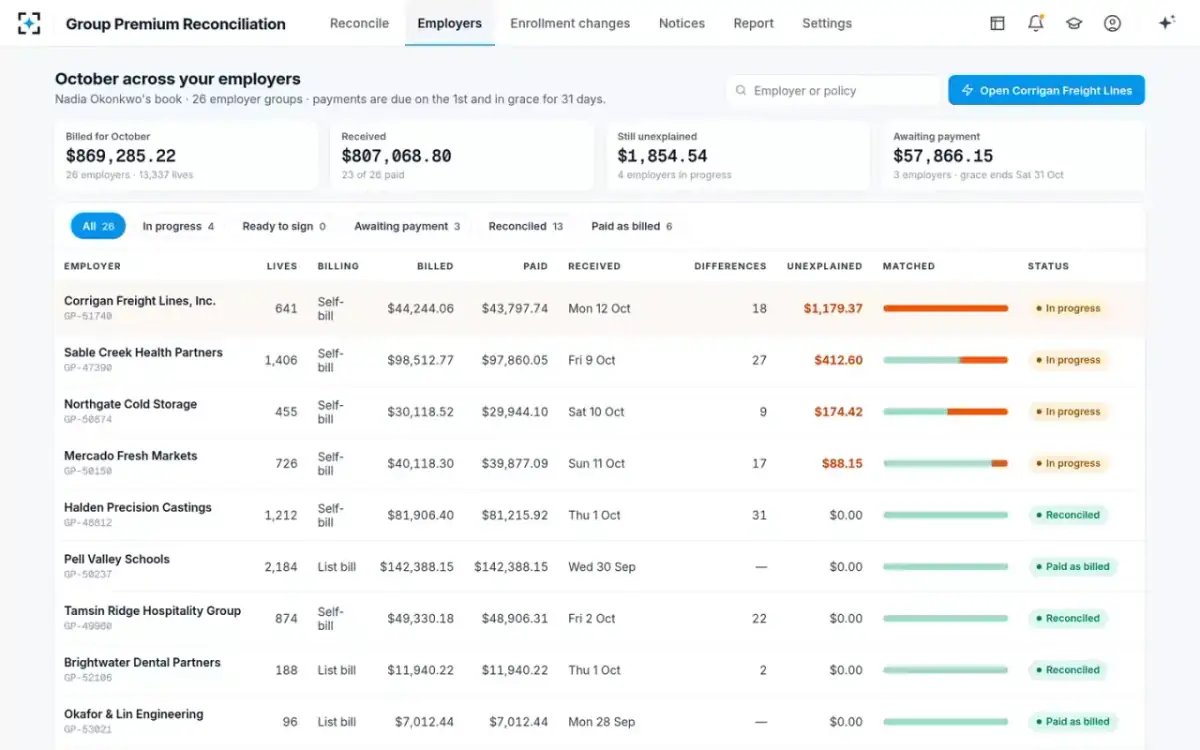
The reconciliation also catches the reverse case, which the employer's own books may not show: payroll deducting for coverage that does not exist. In the sample, Corrigan Freight Lines' payroll deducted $19.20 a month for an employee's $30,000 of voluntary life whose election had been rejected for a missing date of birth, so she was never enrolled. Had she died, the claim would have been denied. Group Premium Reconciliation labels such a line "deducted, not enrolled" and sends it to a person, one at a time, never in a batch; in the sample book's October there were eight. How each kind of difference is worked is set out in list bill vs self bill.
Life and disability coverage: the same money, different consequences
The plan-asset rule does not distinguish between health, life and disability: employee contributions to any of them are plan assets once withheld. What differs is what a lapse costs the employee. A lapse of group life ends a death benefit and starts the clock on the right to convert, usually measured from the date coverage ended, not the date the employee learned of it. A lapse of disability coverage can leave an employee who becomes disabled during the gap with no claim at all.
That is why a carrier's billing team should treat a short or missing payment from an employer with contributory coverage as more than a collections item. The steps it takes in the grace period, a call, a written notice to the employer and the notice forms for employees, are the ones that decide whether employees hear about the lapse in time to act. A carrier that also refunds premium after a cancellation runs into state refund deadlines, covered for property and casualty lines in how long an insurer has to refund premiums.
Questions people ask
Who pays claims during the grace period?
The insurer. Under the NAIC model regulation, when a policy ends automatically for unpaid premium the carrier is liable for valid claims for losses incurred before the end of the grace period. Group life policies may make the employer liable for a pro rata premium for the grace period.
Can the insurer cancel coverage back to the last paid date?
Federal health rules allow a retroactive end for unpaid premium without treating it as a rescission. State law still protects the grace period: under the NAIC model, claims incurred before it ends remain payable, and if the insurer kept treating the policy as in force, coverage cannot end before the third scheduled workday after its written notice is delivered.
What if premiums were deducted for coverage that never existed?
The deductions are still plan assets the employer must account for, and the employee has paid for nothing. The insurer should confirm in writing whether the employee is covered. A carrier that reconciles each employee's payment against enrollment can find the gap; in the sample case it was one employee at $19.20 a month.
Does the employer have to tell employees the policy is ending?
The NAIC model asks the carrier to request it, and supplies notice forms for the purpose. It also warns that an employer that keeps collecting contributions after the end date may be held solely liable for the benefits those contributions were for.
Can employees get deducted premiums back?
If the employer kept money withheld for coverage that was not provided, EBSA can help: in FY 2025 its Benefits Advisors recovered $468.7 million through informal resolution of individual complaints across all plan types. Contact it at 1-866-444-3272 or askebsa.dol.gov.