A premium billing system is the software an insurer uses to bill premiums: for group benefits, it prices each employer's coverage from enrollment and rate tables as of a cutoff date, produces the list bill, tracks what is owed and applies the cash when it arrives. It answers the question "what should this employer pay?" It usually does not answer the next one: why the employer paid a different amount, which employees and coverages account for the difference, and what the contract says should happen to each. That second job is reconciliation, and on a book with self-bill employers it is where most of the billing team's hours go. Group Premium Reconciliation, Botminds' solution for group billing teams, does that second job beside the billing system: it reads the list bill the billing system produced, the employer's payment and every enrollment file, and leaves only the real differences for a person.
The examples use fictional sample data from the solution: a carrier's book of 26 employer groups, and one self-bill employer, Corrigan Freight Lines, billed $44,244.06 for October 2026 coverage, which paid $43,797.74.
Corrigan's $1,198.57 of October differences, by what it takes to settle them
By what settles it
- Contract retro clause · 53.6%
- Enrollment after the cutoff · 40.4%
- Age-band rule or a coverage decision · 6%
What is a premium billing system?
A premium billing system turns policies, enrollment and rates into invoices and a receivable. In group life and disability that means, for each employer and month: the covered employees and coverages as of the cutoff, the volume and rate for each (a salary multiple, an elected amount, an age band), the total, the due date and the grace period, and then the payment, the balance and any lapse notice. Premium billing in group insurance is billing the employer as policyholder, not each employee; the employees' share is collected by the employer through payroll.
Two rules every group billing system has to hold are set outside it. The grace period is in the state's standard provisions; South Carolina's, for example, give the policyholder 31 days to pay every premium after the first (S.C. standard provisions; the group life grace period quotes them). And what happens when a group lapses unpaid, including that the carrier stays liable until its notice takes effect if it keeps the policy going, is in each state's version of the NAIC's model regulation. A billing system that cannot hold a grace period per group, and the date notice was delivered, cannot run a lapse correctly.
What is the difference between billing and reconciliation?
Billing works out what should be paid; reconciliation explains what was paid. A billing system computes the expected premium from enrollment as of a cutoff, sends it and waits. Reconciliation starts when the money arrives: it compares the payment with the bill and with enrollment as of the coverage month, employee by employee and coverage by coverage, gives each difference a cause, applies the contract to it, and decides what to bill, credit, refund or hold.
The cutoff is where the two diverge. The October bill is built from enrollment on 10 September; the employer pays from October's payroll. In between, on Corrigan's account, six enrollment files carried 14 changes. The billing system will apply them to November's bill. The reconciliation has to deal with them now, because they are inside October's payment.
Does a billing system reconcile payments?
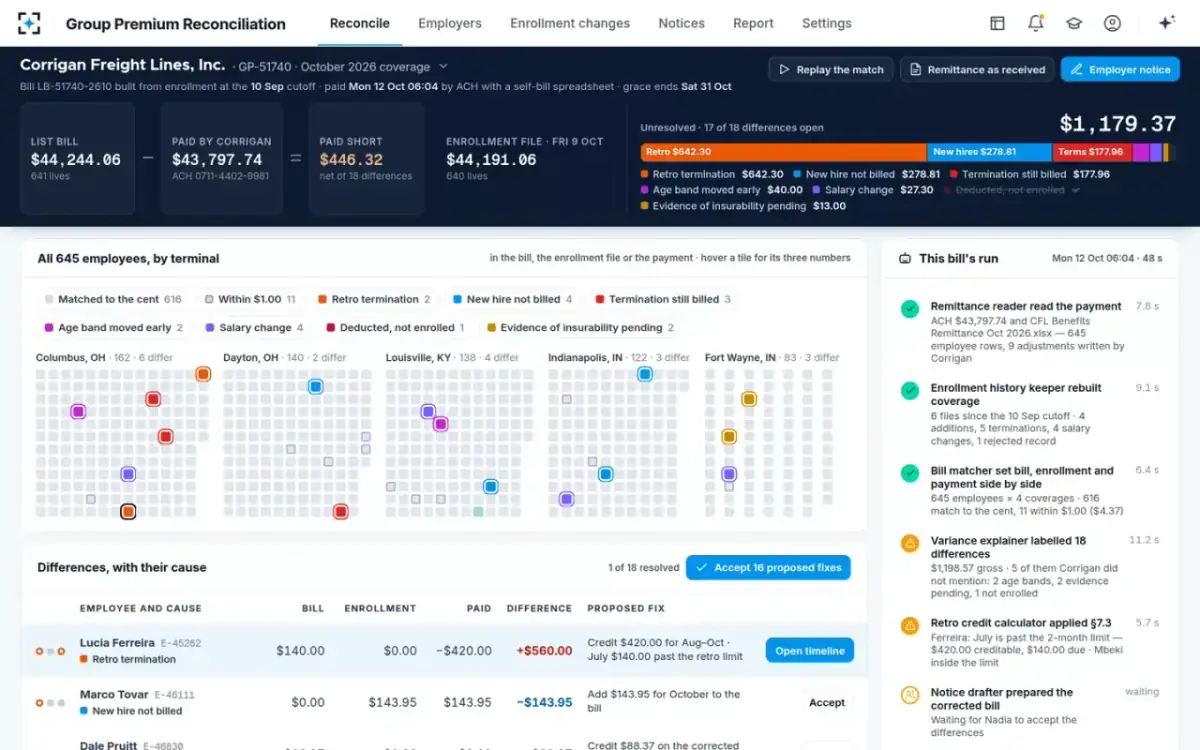
It applies them, which is not the same. A billing system matches a payment to an invoice, usually by amount and account, and carries the balance: $446.32 short on Corrigan's October bill. Some systems let an analyst key in adjustments against the invoice. What a billing system does not usually hold is the employer's own line-by-line calculation, the enrollment history as of each coverage month, the contract clause for a late termination and the reason for each line.
That gap is how a billing team ends up keeping a spreadsheet beside the billing system. The analyst exports the bill, pastes in the employer's self-bill spreadsheet, runs a lookup on employee ID and works every mismatch by hand, then keys the outcome back into the billing system as adjustments. The billing system ends up with the right balance and none of the reasons, which is what an auditor, an employer disputing a charge or the next analyst needs. The template for that spreadsheet, and when it stops working, is in the employee benefits reconciliation template.
Can a billing system handle self-bill employers?
It can accept a self-bill employer's payment and post it; checking it is a different job. A self-bill employer sends its own figure, built from payroll with its own reading of the rates. Checking it means reading the employer's spreadsheet in whatever layout it uses, matching every employee line, and testing each adjustment against the contract. On Corrigan's payment that meant finding that a line headed "Other differences, not itemised", $67.83, was two age bands payroll had moved early, two amounts for coverage awaiting evidence of insurability, one deduction for an election never enrolled and 11 roundings.
None of those is a billing-system concept. An age band moved on the birthday when the contract moves it at the anniversary is a contract question; the IRS's own rule for imputed income uses yet another date, the employee's age on the last day of the tax year (26 CFR 1.79-3; see the imputed income calculator). A deduction for coverage that does not exist is an enrollment question about a person. The difference between self bill and list bill, and why each produces its own errors, is set out in list bill vs self bill.
One employer's bill as the reconciliation sees it, beside the billing system's total
What features should a group premium billing system have?
A group premium billing system should price every coverage the way the contracts do, keep every rule as a dated setting per group, and hand line-level detail to whatever reconciles the payment. The list below is what to look for when choosing or reviewing one; the last three items are the ones that decide how much reconciliation work it leaves.
Ten things to look for in a group premium billing system
- Rates by class, volume and age band
Salary multiples, elected amounts and age-banded rates, with the contract's date for moving a band.
- A list bill by employee and coverage
Not only a total per employer. Reconciliation starts from the line detail.
- Per-group cutoff, due date and grace period
Groups differ; the grace period must be visible beside every unpaid bill.
- Per-group retro rules
How far back a late termination or addition is credited, as a setting, not a habit.
- Enrollment history by effective date
Coverage as of each month, not just the current state, so a late change can be priced correctly.
- Intake for 834 files and carrier layouts
Including rejected entries, kept and reported rather than dropped.
- Receivable, cash application and lapse notices
With the date any notice of discontinuance was delivered.
- Line-level export for reconciliation
The bill, employee by employee and coverage by coverage, to whatever explains the payment.
- Adjustments with a reason and evidence
Each credit or charge tied to an employee, a cause and a clause.
- An audit trail of rule changes
Who changed a rate, a limit or a grace period, when, and which bills it touched.
What does premium billing software cost?
No public body publishes prices for premium billing software, and vendors price it in different ways, so a list price says little. The useful comparison is total cost: what the system costs to license and configure, and what work it still leaves for people. The last row of the table is the one most often left out.
The cost of a premium billing system, line by line
| Cost line | What drives it | How to estimate it |
|---|---|---|
| Licence or subscription | Premium volume, lives or seats | The vendor's quote for your book |
| Configuration of rates and contracts | Number of groups, classes, age bands and custom rules | Groups with non-default rules × hours to set and test each |
| Onboarding each employer's files | Number of distinct 834 and payment layouts | Employers × hours per layout, per year of turnover |
| Running the bill each month | Exceptions at the cutoff | Hours per cycle from your own logs |
| Reconciliation left over | Self-bill employers and enrollment change after the cutoff | Hours per self-bill employer per month × loaded hourly cost |
The last row can be larger than the system. The persona time study behind Group Premium Reconciliation estimates a 600-life self-bill employer at about 16 hours a month by hand, and the sample team logged an estimated 38 hours to reconciliation across its 26 employers in August. A billing system that leaves that work untouched has moved it, not removed it.
How reconciliation makes next month's bill better
A reconciliation that only closes this month's balance wastes most of what it learns. Each difference with a cause is also a fault report on the billing inputs: a new hire not billed is an enrollment file that arrived after the cutoff; an age band moved early is a payroll rule that disagrees with the contract; a deduction with no enrollment is a rejected entry no one told payroll about. Fed back, those causes make the next bill closer to the next payment.
Counted across a book, they also show which fix is worth making. In the fictional sample book's October report, terminations still billed (62) and new hires not billed (52) were the largest causes, both of them timing between the employers' enrollment files and the bill cutoff; salary changes (32) came next. A carrier seeing that pattern has three levers outside any software: move the cutoff closer to the due date, ask the largest self-bill employers for files on a fixed day before it, and send rejected entries back the day they fail. The rarer causes, retro terminations (21), evidence-pending amounts (10) and deductions with no enrollment (8), need per-group contract settings and a person's decision, which is where billing configuration and reconciliation have to agree.
The money follows the same split. The same report shows $1,262.40 of premium kept in one month because retro limits were applied rather than every late termination being credited in full, and estimated analyst hours falling from 38 in August to 7.5 in October to date. Those are results on fictional sample data, not a customer's measured outcome; a pilot on your own closed bills gives your equivalents.
Where Group Premium Reconciliation sits beside the billing system
Group Premium Reconciliation sits after the billing system and before the next bill. It reads the list bill the billing system produced, by employee and coverage; it does not produce bills, post cash or change enrollment. Six agents read the employer's payment and spreadsheet, rebuild every employee's coverage from the enrollment files, set bill, enrollment and payment side by side, label each difference with its cause and evidence, apply the contract's retro limit, and draft the corrected bill and the employer notice. The billing analyst accepts each fix and signs.
A premium billing system and Group Premium Reconciliation, on the same employer's month
Premium billing system: Enrollment and rates as of the cutoff.
Group Premium Reconciliation: The list bill, the employer's payment as received and every enrollment file since.
Premium billing system: The list bill, the receivable and the cash application.
Group Premium Reconciliation: Each difference with its cause, evidence and proposed fix; a corrected bill and a notice.
Premium billing system: Posted against the invoice; the balance carried.
Group Premium Reconciliation: Read line by line; each adjustment tested against enrollment and the contract.
Premium billing system: Credited as keyed in.
Group Premium Reconciliation: Credited only inside the contract's limit; an override needs the controller and a reason.
Premium billing system: Not visible.
Group Premium Reconciliation: Evidence-pending amounts held in suspense; deductions with no enrollment sent to a person.
Premium billing system: The analyst, outside the system.
Group Premium Reconciliation: The analyst, inside it, with the evidence attached and the decision on the audit trail.
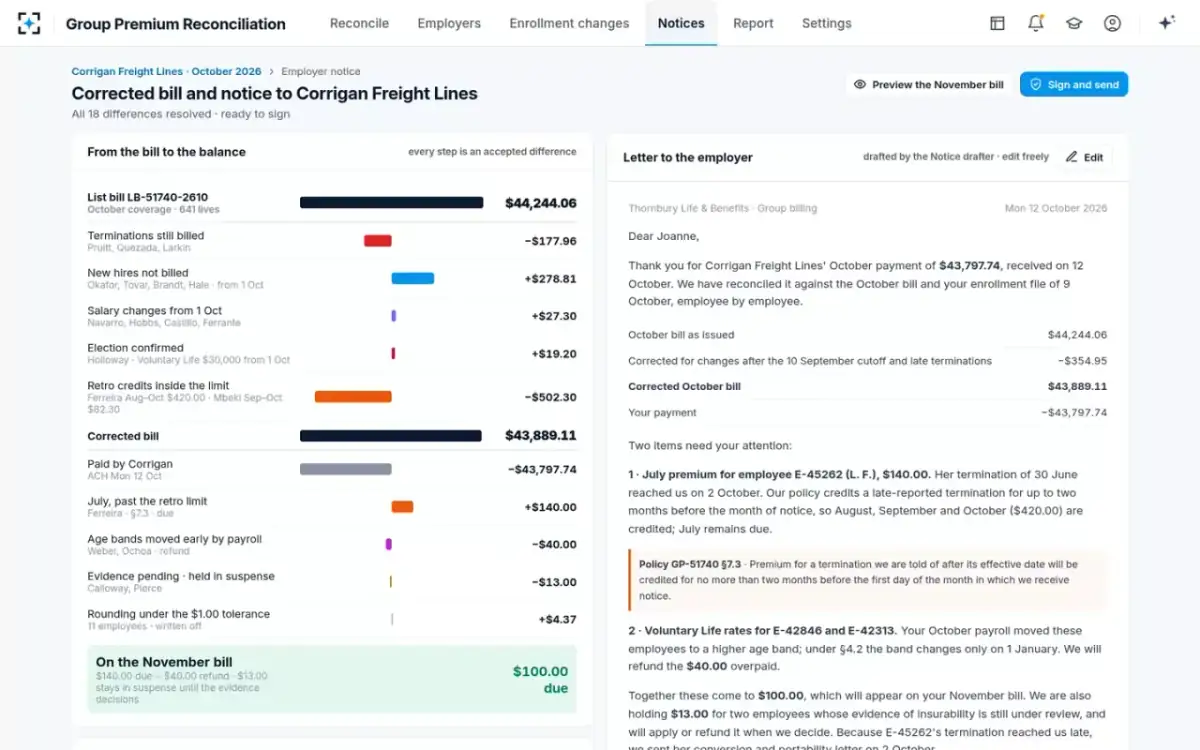
On Corrigan's October bill, that meant 616 employees matched to the cent, 11 within the $1.00 tolerance, and 18 differences each with a cause; 16 routine fixes accepted together, one retro termination credited inside the limit, and a corrected bill of $43,889.11 with $100.00 carried to November. The notice the analyst signed quotes the clause for every amount the employer did not expect.
The corrected bill and the letter, ready for the analyst to sign
Where the solution does not fit is just as specific. It is not a billing system, and a carrier without one still needs one. It is built for group life, disability and supplemental coverage billed to employers; property and casualty billing exceptions such as unapplied cash and cancellation notices are a different problem, covered in P&C insurance billing software. A carrier weighing it should run it on a quarter of closed bills first, as set out in testing benefits reconciliation software.
Questions people ask
What is premium billing?
Premium billing is invoicing and collecting insurance premiums. In group benefits the carrier bills the employer, as policyholder, for every covered employee, by list bill or by accepting the employer's own self-bill calculation; individual products are billed to the insured directly.
Do I need to replace my billing system to reconcile payments better?
Usually not. Reconciliation needs the billing system's line-level bill as an input, plus the employer's payment and enrollment history. Group Premium Reconciliation reads the list bill from the billing system already in place and returns the corrected bill and its reasons.
Can a billing system handle age-banded voluntary life?
A billing system can rate it if configured to; the question is which date moves the band. The contract names it, often the anniversary, and payroll may use the birthday instead. On Corrigan's October payment that mismatch overpaid $40.00 for two employees, refunded on the notice.
Why do billing systems and payments disagree every month?
Because the bill is priced from enrollment at a cutoff and the payment from payroll after it. Every addition, termination and salary change in between is a difference; on Corrigan's account there were 14 such changes in one month.
Does reconciliation software post adjustments to the billing system?
In Group Premium Reconciliation the agents propose and the analyst accepts and signs; no agent posts cash, edits enrollment or sends anything to the employer. The signed corrected bill and its reasons are what the billing team carries into the billing system.