A retro termination in insurance is an end of coverage whose effective date is in the past, most often because an employer told the carrier about a termination weeks or months after it happened. For a group carrier it raises two separate questions. The first is money: how many months of premium the employer gets back, which the group policy's retro limit answers. The second is coverage: whether insurance can lawfully end on a date already gone, which federal rules answer differently for health, disability and life. Group Premium Reconciliation, Botminds' solution for reconciling employer premium payments, gives the first question to an agent, the Retro credit calculator, which applies the contract's limit and cites the clause; it never posts a credit, and anything past the limit goes to a person.
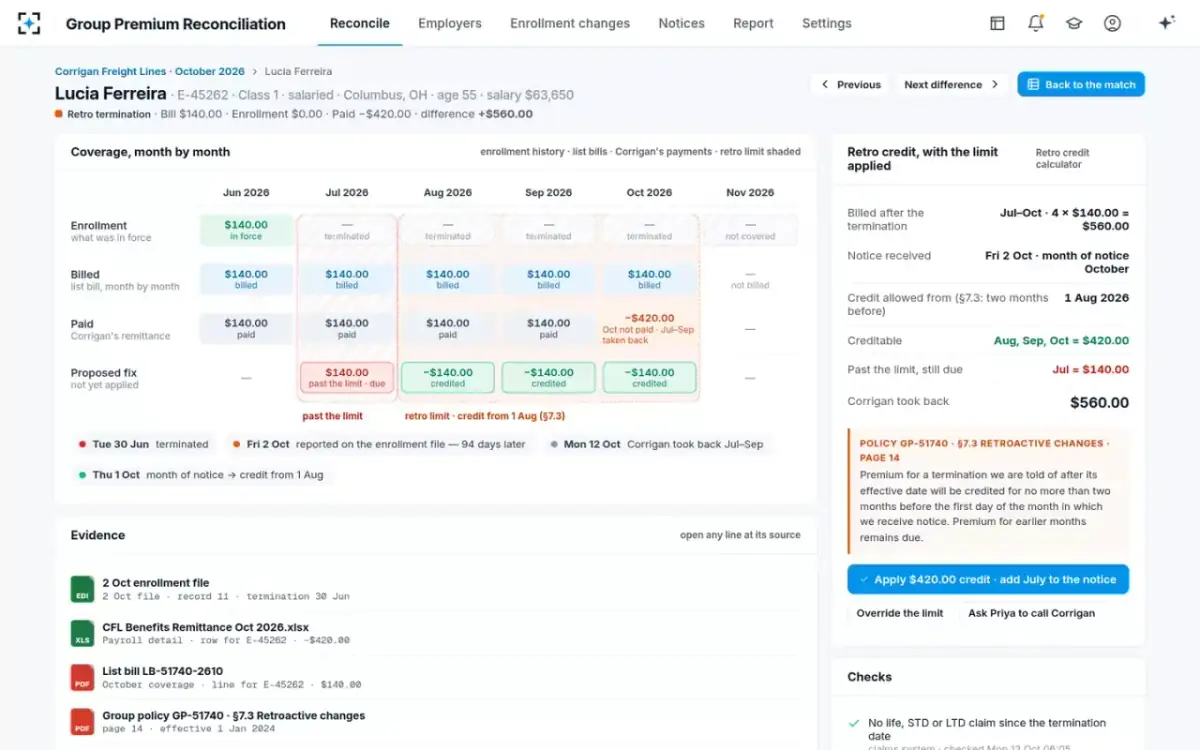
The example on this page is fictional sample data from the solution: Corrigan Freight Lines, a self-bill employer with 645 employees, and its October 2026 payment. One of the 18 differences on that payment is a dispatcher in Columbus, Lucia Ferreira, who was terminated on 30 June and reported on the 2 October enrollment file, 94 days later.
One retro termination credit in Group Premium Reconciliation, step by step
Agent
Remittance readerReads Corrigan's spreadsheet: under "Less: late terminations", L. Ferreira termed 6/30, $140.00 taken off October and $420.00 taken back for July, August and September. Total taken: $560.00.
Never: posts cash or changes the amount received
Agent
Enrollment history keeperFinds the termination on the 2 October file, entry 11, effective 30 June. Coverage was in force in June and billed every month since, at $140.00 across Basic Life and AD&D, STD, LTD and Voluntary Life.
Never: edits enrollment
Agent
Retro credit calculatorReads policy GP-51740 §7.3: credit no more than two months before the first day of the month of notice. Notice came in October, so credit runs from 1 August: August, September, October, $420.00. July, $140.00, remains due.
Never: credits past the contract limit
Agent
Retro credit calculatorChecks the claims system: no life, STD or LTD claim since 30 June. Checks that the conversion and portability letter went out on 2 October.
Never: skips the claim check
A person decides
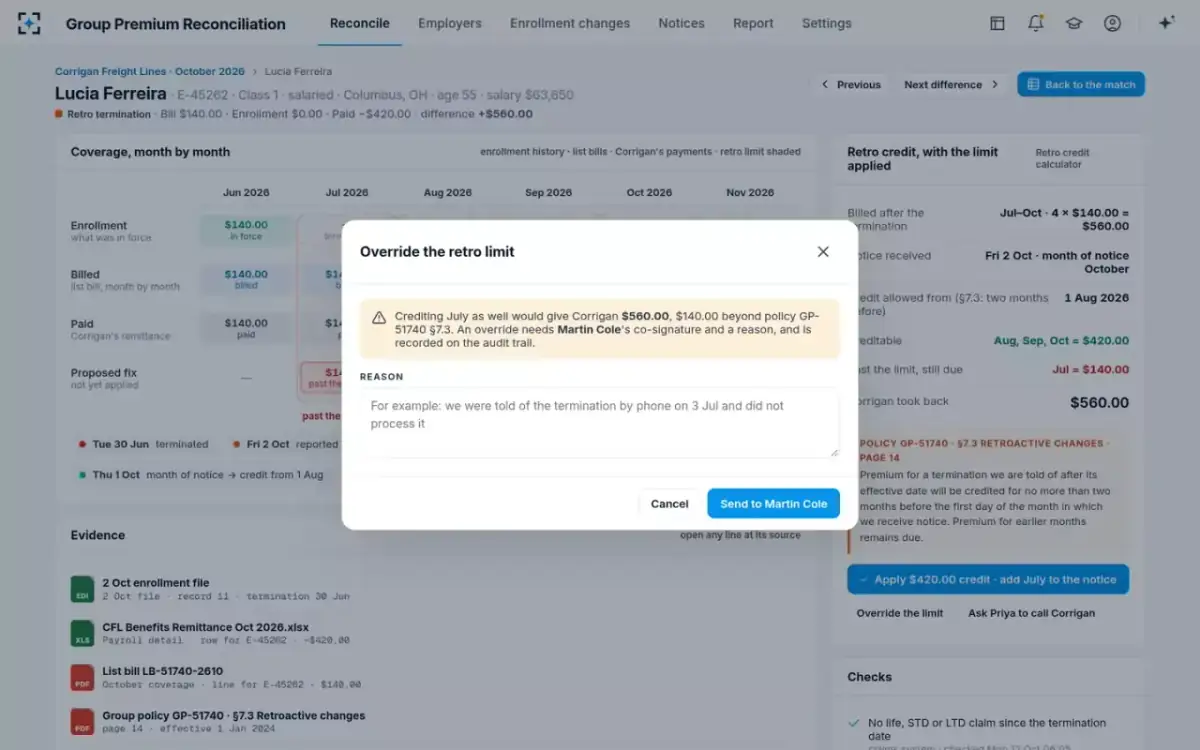
Senior group billing analystOpens the month-by-month timeline, reads the clause, applies the $420.00 credit and adds July's $140.00 to the employer notice. Crediting July too would need the controller's co-signature and a reason.
What is a retro termination in insurance?
A retro termination is a termination of coverage entered with an effective date before the day it is processed. In group benefits it usually starts with the employer: the employee left, payroll stopped, and the change reached the carrier on a later enrollment file. Until it arrives the carrier keeps billing, and a self-bill employer usually takes the months back on its next payment.
The delay is built into how employers and carriers exchange data, and regulators know it. In their 2010 guidance on the Affordable Care Act's rescission rule, the Departments of Labor, Health and Human Services and the Treasury noted that "some employers' human resource departments may reconcile lists of eligible individuals with their plan or issuer via data feed only once per month." A monthly feed means a termination can be four or five weeks old before the carrier sees it, and a missed file makes it older. Lucia Ferreira's was 94 days old.
Can coverage be terminated retroactively?
Yes, in some cases, and the rules depend on the line of coverage. For group health coverage, federal law bans a retroactive cancellation, called a rescission, except for fraud or intentional misrepresentation, but a retroactive end for failure to pay premiums is not a rescission (the exception's wording is quoted in employer did not pay the health insurance premium), and neither is an end back to the termination date when the former employee paid nothing after leaving. For disability coverage, a retroactive cancellation other than for non-payment counts as a claims decision with its own notice. For group life there is no federal rescission rule; the policy and state law govern.
Can coverage end on a date already past? Health, disability and life answer differently
Group health: A plan or issuer "must not rescind coverage" once a person is covered, except for fraud or intentional misrepresentation, with 30 days' advance written notice.
Group disability and group life: Disability: a rescission is an "adverse benefit determination", so it carries the claims-procedure notice and appeal rights. Life: no federal rescission rule; the policy and state law govern.
Group health: A retroactive end caused by premiums or contributions not paid on time is not a rescission.
Group disability and group life: Disability: the same exception, written into the definition of rescission. Life: the grace period in the state's standard provisions applies.
Group health: Not a rescission when the plan covers only active employees, the former employee paid no premium after leaving, and the delay is administrative (2010 FAQ).
Group disability and group life: Usually a billing question about which months are credited. If the person kept paying, or was never eligible, treat it as a coverage decision.
Group health: A part-time worker kept on the plan and paying premiums: the plan "cannot rescind" and may cancel only going forward.
Group disability and group life: Disability: a retroactive cancellation here is a rescission and an adverse benefit determination. Life: check the policy's eligibility and premium-acceptance terms.
The health rule is the one most people meet, and it is why "can an employer retroactively cancel health insurance" is a common question. The regulation's own example is close to a billing desk's daily work: an employee moved to part-time, no longer eligible, kept on the plan, "collecting premiums from B and paying claims submitted by B." The conclusion: the plan "cannot rescind B's coverage" and may cancel it prospectively. Under the health rule, a plan that keeps taking premium for months it later wants to unwind can end that coverage only going forward.
How far back can an employer terminate coverage? The retro limit
As far back as the group policy's retro limit allows, and no further for premium purposes. A retro limit is a clause that caps how many months of premium a carrier credits for a termination it was told about late. Two forms are common: a count of months before the month of notice, or a number of days before the date of notice. Premium for months beyond the limit remains due, whatever the employee's termination date.
The sample policy's clause, section 7.3 of GP-51740, is the first form: premium for a late-reported termination "will be credited for no more than two months before the first day of the month in which we receive notice." The arithmetic is simple once the month of notice is fixed. Notice arrived on 2 October, so the month of notice is October, the first day of it is 1 October, and two months before that is 1 August. August, September and October are credited; July is not.
Lucia Ferreira's coverage in Group Premium Reconciliation, June to November, with the retro limit applied
| Month | Enrollment | Billed | Paid by Corrigan | Proposed fix |
|---|---|---|---|---|
| June 2026 | In force | $140.00 | $140.00 | None |
| July 2026 | Terminated | $140.00 | $140.00, taken back on 12 Oct | $140.00 due: past the limit |
| August 2026 | Terminated | $140.00 | $140.00, taken back on 12 Oct | $140.00 credited |
| September 2026 | Terminated | $140.00 | $140.00, taken back on 12 Oct | $140.00 credited |
| October 2026 | Terminated | $140.00 | Not paid | $140.00 credited |
| November 2026 | Not covered | Not billed | None | None |
Limits vary by contract, and a book carries several. In the sample settings the default is two months before the month of notice, three groups are on 60 days and one school district is on three months. A 60-day limit counted from the date of notice would have reached back only to 3 August, which is why the analyst works from the contract the employer signed, not from the carrier's usual wording.
Do employers get a refund for terminated employees?
Yes, for the months inside the retro limit; the months outside it stay due. Most self-bill employers do not wait for a refund: they take the months back on their next payment, as Corrigan did, and the carrier then decides how much of that deduction to accept. On Corrigan's October payment two late terminations were taken back. Owen Mbeki's, terminated 31 August and reported on 2 October, was inside the limit, and its $82.30 credit was accepted with the routine fixes. Lucia Ferreira's was not.
The employees' side is separate. Premium the employer withheld from a former employee's pay after coverage ended is a plan asset under the Department of Labor's rule, and returning it is the employer's job, not the carrier's. A carrier's notice that names which months were credited gives the employer what it needs to do that.
The coverage timeline the analyst reads before applying the credit
The checks before any credit: claims and the conversion notice
Two checks come before the money, and both are about the person, not the bill. The first is claims: if a life, short-term disability or long-term disability claim has arrived since the termination date, the termination and the claim must be decided together, not by a billing entry. In the sample, the calculator found no claim since 30 June.
The second is the right to convert group life to an individual policy, which runs from the termination, not from the day the carrier hears of it. State standard provisions typically give the employee a fixed window to apply: South Carolina's gives "thirty-one days after the termination". New York requires the employee to be told of the right "within fifteen days before or after the happening of the event"; a notice given 15 to 90 days late extends the window for 45 days after the notice, and if no notice is given within 90 days, the time to convert "shall expire at the end of such ninety days." A termination reported 94 days late, under a rule like New York's, reaches the carrier after the conversion window has closed. The solution checks that the conversion and portability letter went out; what that letter can still offer depends on the state.
Is a retro termination a rescission?
Sometimes. For health coverage a retroactive end for unpaid premium is not a rescission, and neither, under the 2010 FAQ, is an end back to the termination date for a former employee who paid nothing afterwards. A retroactive end of coverage someone kept paying for, or was wrongly given, can be. For disability coverage the regulation says it directly: "the term “adverse benefit determination” also means any rescission of disability coverage", and a rescission is a retroactive cancellation "except to the extent it is attributable to a failure to timely pay required premiums or contributions".
The Department of Labor's case files show what goes wrong when the date is treated as clerical. In one FY 2025 case, a former employer had kept a participant on dialysis on its health plan for two extra months and then "canceled his coverage back to his job's end date and said he had missed his chance to sign up for COBRA", leaving him with $200,000 of medical bills. Because the COBRA notice had not gone out on time, EBSA got him enrolled, his coverage restored and his claims reprocessed. A retro termination that removes coverage someone relied on is a decision about that person, and it should reach a person.
When the limit bends: overrides, and who signs
A contract limit should bend only for a reason that would survive an audit. The common legitimate one is that the carrier was told in time and failed to act: a phone call on 3 July that never became an enrollment change is the carrier's delay, not the employer's. Goodwill for a large account is a commercial decision, and it belongs to someone with authority over margin, not to the analyst working the bill.
Crediting past the limit needs the controller and a written reason
Counted across a book, the limit is worth knowing. The sample book's October report shows $1,262.40 of premium kept by retro limits and placed on employer notices. That figure is small beside the $869,285.22 billed, but every dollar of it is a dollar the employer will question, which is why the notice quotes the clause.
"Premium for a termination we are told of after its effective date will be credited for no more than two months before the first day of the month in which we receive notice. Premium for earlier months remains due."
Policy GP-51740 §7.3, the fictional sample policy, as the notice quotes it
What the retro credit agent never does
The Retro credit calculator proposes; it does not decide. It never credits beyond the contract limit, never applies a credit to cash, and never skips the claim check. Across the agents, a difference that cannot be evidenced stays labelled unexplained rather than being given a cause. An override goes to the controller with the reason attached, and every proposal carries the enrollment file and entry, the remittance line and the clause, so the analyst can open the source before accepting it.
That matters most on a desk where retro terminations are a minority with a large tail. In the sample book's October report there were 21, behind terminations still billed (62) and new hires not billed (52), but each one took longer than any routine fix. On Corrigan's bill, 16 routine fixes were accepted together in one click; the single retro termination left took the analyst's attention. The full set of causes and who settles each is in the group insurance billing analyst's month, and how an employer's own payment file reports these months is in 820 remittance advice.
Questions people ask
How do you calculate a retro termination credit?
Fix the month of notice (the month the carrier received the termination), apply the contract's limit to find the first creditable month, and credit each billed month from there to the current bill. Under a "two months before the month of notice" clause, notice in October credits from 1 August. Months before that remain due.
What is a retro add?
The mirror case: an addition reported after its effective date, billed back to that date. On Corrigan's October bill four new hires effective 1 October arrived after the 10 September cutoff and were added for $278.81. How far back a late addition is billed is set by the contract; the solution applies each contract's retro limit to late-reported additions as well as terminations.
Can an employer retroactively cancel health insurance?
Only within federal limits. A retroactive cancellation of group health coverage is a rescission, allowed only for fraud or intentional misrepresentation and with 30 days' notice, unless it is for failure to pay premiums. The Departments also said in 2010 that ending coverage back to the termination date for an active-employee-only plan, where the person paid nothing after leaving, is not a rescission.
Does a retro termination affect COBRA?
It can. COBRA notices run on deadlines from the qualifying event, so a termination entered late can mean a late notice. In one FY 2025 case EBSA got a participant enrolled after his former employer cancelled his coverage back to his job's end date without sending the COBRA notice on time.
Who approves a credit beyond the retro limit?
Someone above the billing analyst, with a written reason. In the sample settings of Group Premium Reconciliation that is the finance controller, whose co-signature is required for any retro override, and the reason is kept on the audit trail with the decision.