Benefits reconciliation software matches, for each employee and each coverage, what was billed, what enrollment says and what was paid, and explains every difference so that a person can fix it. The best way to choose it is not a demonstration on the vendor's data but a pilot on your own closed bills: three months that your team has already reconciled, where every difference, credit and notice is known. Run the software blind on those months and you can measure, against an answer key, how much it matched, what it found, what it invented and whether its credits were right. Group Premium Reconciliation is Botminds' software for group life and disability carriers reconciling employer premium payments; this page sets out the pilot we would want any such tool, ours included, to pass.
The examples come from fictional sample data in the solution: a book of 26 employer groups with 13,337 covered employees, and one self-bill employer, Corrigan Freight Lines, whose October 2026 payment of $43,797.74 against a $44,244.06 bill is worked through in the other guides in this series.
A four-week pilot of benefits reconciliation software on a closed quarter
- Load files and contract settingsWeek 1
- Blind run on three closed months3 days
- Seeded cases run4 days
- Rerun after fixesWeeks 3–4
- Assemble files and the answer keyWeek 1
- Score the blind run6 days
- Review seeded cases5 days
- Decide4 days
What is benefits reconciliation software?
Benefits reconciliation software compares three views of the same month, the bill, the enrollment and the payment, line by line, and produces a list of differences with causes and proposed fixes. Two kinds go by the same name. Employer-side tools help an HR or benefits team reconcile carriers' invoices against payroll deductions. Carrier-side tools, which this page is about, help a group carrier's billing team reconcile each employer's payment against its own list bill and the enrollment it holds.
The carrier-side problem is harder because the carrier receives what the employer sends. Payments arrive as X12 820s, spreadsheets in each employer's own layout or PDFs; enrollment arrives as 834 files or carrier layouts, often several a month per employer. The federal agencies that wrote the health rescission rule acknowledged in their 2010 guidance that some employers send eligibility to their carrier by data feed only monthly, so the bill is always a little behind. Software that only works on clean, current data does not solve that.
Why test on closed bills: the answers are already known
A closed bill has an answer key. Your team has already decided every difference on it: which terminations were credited and for how many months, which new hires were billed, which amounts were held, what was written off and what the employer was told. Run the software on those months without showing it the answers, and every one of its proposals can be scored right or wrong.
A live book cannot give that. On a live bill a proposal looks reasonable or it does not, and a reviewer's view of "reasonable" is shaped by what the software shows. A closed quarter also puts no employer at risk: nothing the software proposes reaches a corrected bill or a notice. Choose three months that include at least one month-end with write-offs, at least one large self-bill employer and at least one employer on a non-default retro limit.
What data does benefits reconciliation software need?
It needs the same files your analysts use, as received, not cleaned up for the pilot. Cleaning the data for the vendor tests the cleaning.
What to hand a benefits reconciliation pilot, for each employer and month
- The list bill, by employee and coverage
Not the invoice total. The line detail the billing system produced at the cutoff.
- Employer remittances as received
820 files, spreadsheets and PDFs in their original layouts, with the ACH traces they arrived with.
- Every enrollment file in date order
Including rejected entries and the files that arrived after each cutoff. Corrigan's October had six after 10 September.
- Rate tables and coverage amounts
Classes, age bands, salary-based amounts and the rate units each uses.
- The group policies and amendments
The retro clause, the age-band rule and the grace period for each group, so proposals can cite them.
- Claims since each termination
Life, short-term and long-term disability, so a retro credit is never proposed against an open claim.
- The answer key
Corrected bills, credits, write-offs and notices your team issued for the same months. Kept from the software until scoring.
Two items on that list are not billing data, and both are deliberate. The policies let the software show the clause behind each proposal, which is what an analyst needs to accept it and what an employer needs to accept the notice. The claims check matters because a retroactive cancellation of disability coverage, other than for unpaid premium, is a "rescission" and an adverse benefit determination under the Department of Labor's claims rule; a tool that ends coverage retroactively without looking for a claim is making a claims decision without knowing it.
What match rate should benefits reconciliation reach? Four numbers, not one
Measure four numbers, because a match rate on its own rewards a tolerance set too wide. Count, for the closed quarter: the share of employee-coverage lines the software matched without a person; the share of the answer key's real differences it found; the number of differences it raised that the answer key says were not there; and the share of retro credits it got right to the cent and the month.
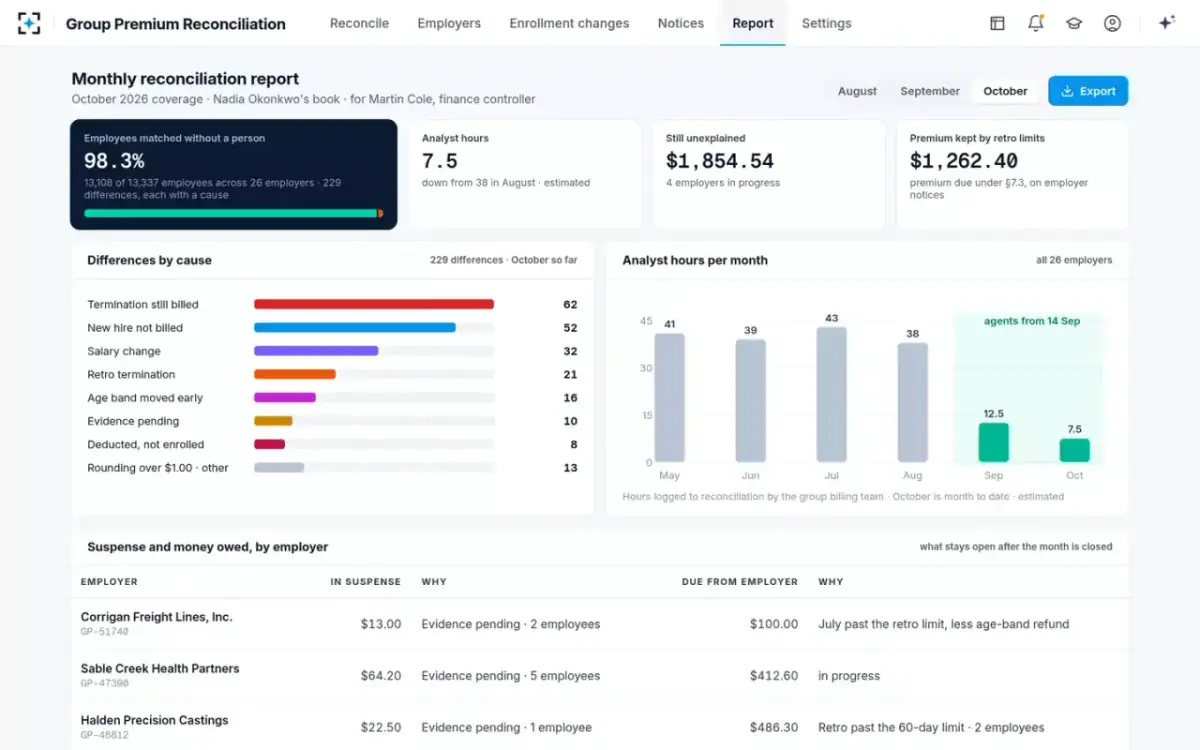
For scale, on Corrigan's October bill Group Premium Reconciliation matched 627 of 645 employees without a person: 616 to the cent and 11 within the $1.00 tolerance. Across the sample book the October report shows 13,108 of 13,337 employees, 98.3%. Those are results on fictional sample data; the design target is 97% of employees matched without a person. A pilot on your bills will give your number, and the other three numbers matter more than it does.
Where 645 employees landed on one self-bill employer's bill in Group Premium Reconciliation
The thin slice at the end is the point of the software. Lucia Ferreira's retro termination past the contract limit went to the analyst with the clause and a month-by-month timeline. Grace Holloway's $19.20 deduction for a rejected voluntary life election went to the enrollment specialist. Neither was eligible for a batch accept, whatever its size.
Can reconciliation software handle self-bill employers? The cases to seed
Yes, if it reads the employer's own adjustments and checks them, rather than taking the net amount. The way to find out is to seed the closed quarter with cases whose right answer you know, including the ones your team finds hardest. Each case below is one the software must get right before it touches a live book.
Seeded cases for a self-bill pilot, and the right outcome for each
| Case to seed | What the employer did | The right outcome |
|---|---|---|
| Late termination inside the retro limit | Took back two months | Credit both months, citing the clause |
| Late termination past the limit | Took back four months | Credit the months inside the limit; list the rest as due, citing the clause |
| Age band moved on the birthday | Paid the higher band early | Refund the difference if the contract moves bands at the anniversary |
| Evidence of insurability pending | Paid for the full elected amount | Hold the excess over the guaranteed amount in suspense; do not earn it |
| Election rejected, payroll still deducting | Paid for coverage that does not exist | Send to a person, one at a time; never batch |
| Salary change after the cutoff | Paid on the new salary | Bill the change from its effective date |
| Two employees with the same name | Listed both | Match each on ID and date of birth; never merge them |
| A difference the employer did not itemise | Netted it into one line | Split it into its causes, or leave it unexplained |
What should benefits reconciliation software never do?
It should never post cash, change enrollment, send anything to an employer, match on name alone, credit past a contract limit without a written, approved override, or give a cause it cannot evidence. Each of those is a control a carrier already has, and software that bypasses one moves a decision from a person to a configuration.
Two of the six deserve a pilot test of their own. Ask the vendor to show what happens when a line cannot be matched on the key: it should stay open for a person, not fall back to a name. And ask what happens when a difference has no evidence: it should be labelled unexplained, not given the most likely cause. In Group Premium Reconciliation both are fixed behaviours, and the rules that are settings, such as tolerances, cutoffs, retro limits and co-signers, are versioned and kept on the audit trail.
The settings a pilot should ask to see, versioned and on the audit trail
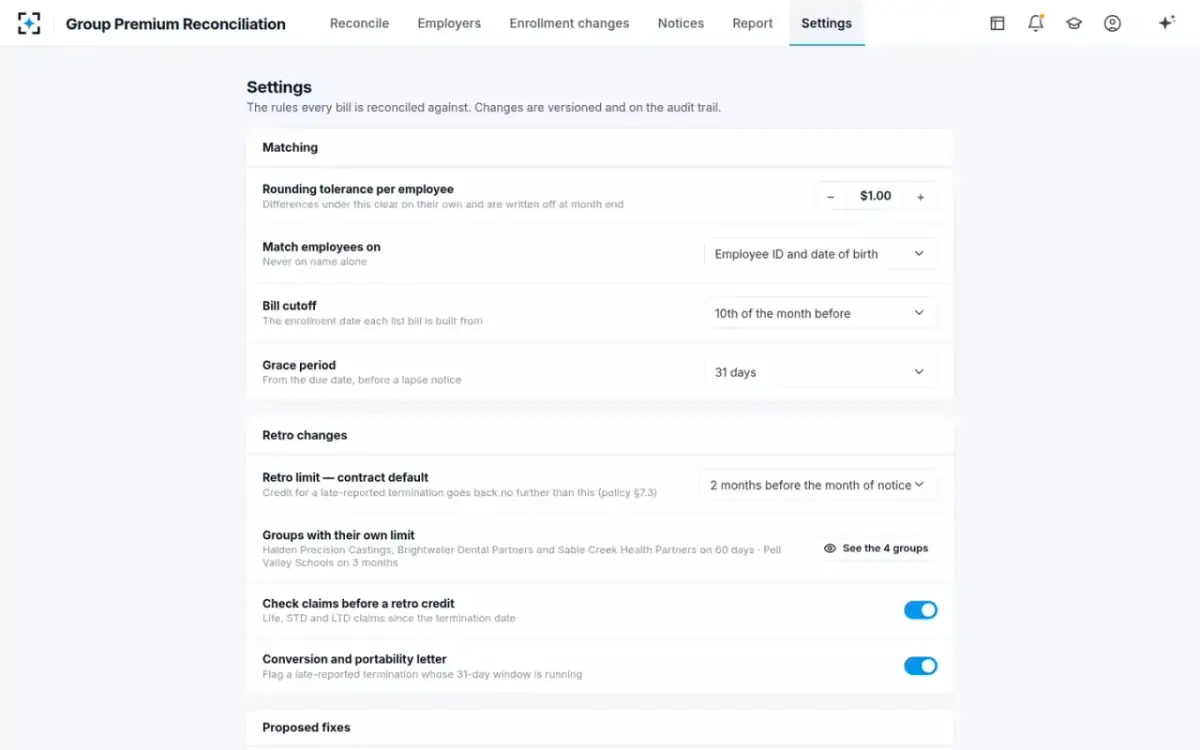
The premium itself sets one more limit. Amounts employees pay through payroll become plan assets under the Department of Labor's rule as soon as they can reasonably be separated from the employer's own money (29 CFR 2510.3-102; the billing analyst's month quotes the rule and its 90-day limit). Software that holds a deduction with no coverage behind it in suspense, and puts it in front of a person, protects the carrier and the employee at once.
Pass marks for a benefits reconciliation pilot
Set the pass marks before the run, not after. The table gives the marks we would set for a carrier-side tool on a closed quarter; adjust them to your book, but write them down first.
Pass marks for a pilot on closed bills
| Measure | How to score it | Suggested pass mark |
|---|---|---|
| Real differences found | Answer-key differences the software raised, ÷ all answer-key differences | All of them, or each miss explained |
| Differences invented | Differences raised that the answer key says were not there | Few enough that reviewing them is quicker than finding the real ones |
| Retro credits right | Credits matching the answer key to the cent and the month | All of them |
| Matched without a person | Employee-coverage lines cleared automatically ÷ all lines | Your number, compared with the hours it saves |
| Unexplained left over | Differences labelled unexplained ÷ all differences | Lower than your quarter-end write-off list |
| Evidence | Proposals whose cited file, line and clause open and support them | All of them |
A pilot can also fail usefully. If the blind run finds differences the answer key missed, such as a credit given past a retro limit or a new hire never billed, those are findings about the closed quarter, and worth more than the pilot cost. The sample book's October report shows $1,262.40 of premium kept in one month by applying retro limits that, by hand, are easy to miss.
How long does a reconciliation pilot take?
About four weeks of elapsed time, most of it the carrier's. The first week goes on assembling the files and the answer key, and getting the contract settings right for each group. The blind run itself takes days. Scoring and the seeded cases take the rest, and the decision at the end should be made on the four numbers, not on the demonstration.
What lengthens a pilot is access, not software: enrollment files that have aged off a transfer server, remittances scattered across a shared mailbox, policies held only as scanned PDFs. A carrier that can produce a closed quarter's files in a week can finish in four.
What a controller sees at the end of a month in Group Premium Reconciliation
Where Group Premium Reconciliation fits, and where it does not
Group Premium Reconciliation fits a carrier or administrator billing group life, disability and supplemental coverage to employers, with a mix of list-bill and self-bill employers and enrollment arriving as 834s or carrier layouts. Six agents match every employee across bill, enrollment and payment; the billing analyst resolves what differs and signs. It does not post cash, change enrollment or send to employers, and it does not replace the billing system that produces the list bill; how the two divide the work is set out in premium billing systems and where they stop.
It is not the tool for every reconciliation with "premium" in its name. A delegated program reconciling a managing general agent's bordereaux has its own solution, Premium Bordereaux Reconciliation, and its own premium reconciliation software comparison; reinsurance premium between cedant, broker and reinsurer is covered in reinsurance premium reconciliation; and unapplied cash and cancellation notices on property and casualty policies belong to P&C billing exception software. An employer reconciling its own carriers' invoices is better served by the line-by-line template in the employee benefits reconciliation template.
Questions people ask
Does benefits reconciliation software post the cash?
It should not. Cash application is a separate control at most carriers, and a tool that posts cash and decides differences combines two duties. Group Premium Reconciliation reads the payment and ties it to the ACH trace but never posts it or changes the amount received.
Does it need 834 files?
It needs enrollment in some form, in date order, including rejected entries. The X12 834 is the common format, but HIPAA requires it only of health plans, so life and disability carriers often receive carrier layouts or spreadsheets instead; a pilot should include whatever your employers actually send.
How do you count a false difference?
Score each difference the software raised against the answer key. If your team found no difference on that employee and coverage that month, and the evidence the software cites does not show one, it is false. If the evidence shows a real difference your team missed, it is a finding, not a false positive.
Can it handle employers who change their spreadsheet layout?
Seed one. Take a closed month and give the pilot a remittance in a different layout from the one before. The software should read it and tie it to the cash without a mapping change; if it cannot, every new employer will cost a setup project.
What does benefits reconciliation software cost?
No public body publishes prices, and vendors price differently. Compare the cost with the four terms that a reconciliation by hand already costs: analyst hours, write-offs, credits past contract limits and premium never billed. A pilot on closed bills gives you the last three for your own book.