An 820 remittance advice is the electronic detail that travels with a group premium payment: the X12 820 transaction, whose group-insurance version is titled "Payroll Deducted and Other Group Premium Payment for Insurance Products". It tells the carrier how much an employer paid and, employee by employee, what each amount is for. What it cannot tell the carrier is whether those amounts are correct, and an 820 whose total equals the bill can still contain a terminated employee paid for and a new hire left out, cancelling each other to the cent. Group Premium Reconciliation, Botminds' solution for reconciling employer premium payments, reads the 820 or the employer's spreadsheet line by line and checks every employee against the bill and the enrollment the carrier holds, so a balanced payment is not mistaken for a reconciled one.
The example below is fictional sample data from the solution: Corrigan Freight Lines, a 645-employee employer with four coverages each, paying its October 2026 premium by ACH with a self-bill spreadsheet. Its payment was short by $446.32. That number is the least informative thing about it.
Corrigan's payment was $446.32 short; underneath it were $1,198.57 of differences
What is an 820 remittance advice?
An 820 remittance advice is the X12 Payment Order/Remittance Advice transaction used to pay premiums and explain the payment. The federal definition of the health plan premium payment transaction lists what it can carry: "(a) Payment. (b) Information about the transfer of funds. (c) Detailed remittance information about individuals for whom premiums are being paid." and payment processing information, including payroll deductions and other group premium payments. The remittance detail, part (c), is what a billing analyst works from.
The X12 implementation guide that group carriers use describes its purpose in one line: to "Transmit payroll deducted premiums for a wide variety of insurance products, to include life, health, property and casualty, and disability." Version 5010, technical report 005010X218, has been the adopted version for health plans since 1 January 2012 under 45 CFR 162.1702.
Is the 820 required by HIPAA?
Only for health plans, and even there the employer is not the party HIPAA binds. The standard applies to covered entities, which are health plans, health care clearinghouses and certain providers; CMS says the 820 standard "applies to all HIPAA covered entities". An employer paying premiums is not one. What HIPAA does require is that "If an entity requests a health plan to conduct a transaction as a standard transaction, the health plan must do so."
Group life and disability carriers sit outside that rule altogether. A HIPAA health plan is one that "provides, or pays the cost of, medical care"; group life pays neither, and "Disability income coverage" is an excepted benefit in 45 CFR 146.145, outside the definition. A life and disability carrier that accepts 820s does so by agreement with each employer, which is why many employers send spreadsheets instead. Corrigan's October remittance was an Excel workbook with two tabs.
What does an 820 file contain, and what does it leave out?
An 820 contains the payment, how it was sent, and a line for each person paid for. It does not contain the reason any line differs from the bill, the enrollment behind it, or the contract rule that decides what is owed. Those come from the carrier's own files.
What a premium remittance carries, and what the billing analyst still needs
| Part of the remittance | What it tells the carrier | What it does not tell the carrier |
|---|---|---|
| Payment | The amount sent, which should tie to the cash received | Whether the amount was owed |
| Transfer of funds | How and when the money moved, the trace to match it to the bank | Which bill or month it settles, unless the employer says |
| Detail about individuals | Each employee paid for, and the amount | Whether that employee is enrolled, in which coverage, at which amount |
| Payroll deduction information | That the money was withheld from pay | Whether the deduction matches coverage that exists |
| Employer adjustments | Lines the employer chose to itemise | Lines it did not: Corrigan's "Other differences, not itemised", $67.83 |
What is the difference between an 834 and an 820?
The 834 says who is covered; the 820 says what was paid for whom. Both go from the employer, as sponsor, to the carrier. The 834, Benefit Enrollment and Maintenance, adds, changes and ends coverage; the 820 pays for it. A carrier reconciling a group premium needs both, plus its own bill, because each is a different party's view of the same month.
834 and 820 side by side: enrollment and payment for the same employee
834 enrollment: Establish, change or end coverage for each person.
820 premium payment: Pay premiums and explain the payment, person by person.
834 enrollment: Whenever the employer sends a change, or a periodic full file.
820 premium payment: With each payment, usually monthly.
834 enrollment: What the employer told the carrier, and when.
820 premium payment: What the employer paid, and for whom.
834 enrollment: A change sent after the bill cutoff, or rejected for a missing field.
820 premium payment: A deduction for coverage that was never enrolled, or a rate payroll changed early.
834 enrollment: Standard for health plans: ASC X12 834, 005010X220.
820 premium payment: Standard for health plans: ASC X12 820, 005010X218.
The 834 side is its own subject, with its own reasons for going wrong; it is set out in 834 file format for group life and disability. The 835 is a different transaction again: it is a health plan's payment and remittance advice to a health care provider for claims, "from a health plan to a health care provider", and never carries premium.
Do life and disability carriers use 820 files?
Some do, and they rarely get only 820s. The X12 guide was written for life and disability as well as health, so a carrier can accept it, but no federal rule makes an employer send it for those lines. In practice a group life and disability carrier receives a mix: 820s from employers whose payroll or benefits system produces them, spreadsheets in each employer's own layout, and PDFs. In the sample case Corrigan sent a two-tab spreadsheet; the solution reads 820s, spreadsheets and PDFs the same way, and ties each to the ACH trace.
A mixed intake is the reason a reconciliation built on one format breaks. The checks that matter are the same whichever file arrives, so they belong to the reconciliation, not to the file reader.
How a balanced 820 can still be wrong
A balanced 820 is one whose total equals the bill. It can be wrong in two ways that cancel. A termination the carrier still billed, if the employer pays it, is premium for coverage that ended; a new hire the carrier did not bill, if the employer leaves it off, is coverage that is not being paid for. If the two amounts happen to be equal, the payment matches the bill exactly and is applied as paid in full.
Take two lines from Corrigan's bill as an illustration. Dale Pruitt, terminated 18 September, was still billed $88.37 for October. Marco Tovar, hired effective 1 October, was not billed and was paid for at $143.95. Corrigan caught both, so they showed. A list-bill employer that simply pays the bill as sent would have paid Pruitt's $88.37 and nothing for Tovar, and its 820 would have balanced. The error would surface months later, as a refund request for Pruitt or, worse, as a claim for Tovar with no premium behind it.
Balancing is a property of the total; correctness is a property of each line. The Corrigan payment shows the scale: $1,198.57 of differences netted to $446.32. A desk that investigates only payments that miss the bill, and only by the amount they miss it, sees less than half of what is there.
How do you reconcile an 820 file?
Reconcile an 820 employee by employee, not by total: tie it to the cash, match every line to the bill on a reliable key, compare each line with enrollment for the coverage month, and give every difference a cause before accepting or rejecting it. The checks below are the ones that find offsetting errors.
Ten checks behind a balanced 820, in the order Group Premium Reconciliation runs them
- Tie the remittance total to the cash received
Match the ACH trace and amount before reading any lines. A remittance that does not tie to cash is a different problem.
- Match every line on employee ID and date of birth
Never on name alone: two employees can share one, and payroll spells it differently from enrollment.
- Compare each line with enrollment for the coverage month
Not with enrollment at the bill cutoff. Corrigan's six files after 10 September carried 14 changes the bill did not.
- Find employees paid for but not billed, and billed but not paid for
New hires, terminations and reinstatements. These are the pairs that cancel.
- Check salary-based amounts against the latest salary
Life and disability amounts move with pay; four Corrigan employees' raises from 1 October changed $27.30.
- Check age-band timing against the contract
Birthday, anniversary or year end give three different amounts for the same person.
- Separate amounts for coverage awaiting evidence of insurability
Premium above the guaranteed amount while evidence is pending is held, not earned.
- Flag deductions with no enrollment behind them
A rejected or missing election with payroll still deducting goes to the enrollment specialist, one at a time.
- Apply the retro limit to late terminations the employer took back
Credit the months inside the contract's limit; list the rest as due, with the clause.
- Clear only what is under the per-employee tolerance
Rounding is cents per employee. A tolerance applied to the total hides real differences.
Age bands, salary changes and the three birthday rules
The quietest differences on an 820 come from dates, because payroll and the carrier can be using different ones for the same rule. Age-banded rates for supplemental life move at a date the contract names: the birthday, the policy anniversary or the start of the year. The IRS adds a third convention for imputed income on group-term life above $50,000: the employee's age on the last day of the tax year, used for every month (26 CFR 1.79-3; the imputed income calculator works an example). A payroll system configured for one and a contract written for another produce small, steady differences that look like rounding.
On Corrigan's payment, payroll moved two employees into a higher voluntary life band before the 1 January anniversary their contract specifies, overpaying $40.00. Corrigan did not itemise it; the line sat inside "Other differences, not itemised", $67.83, with two evidence-pending amounts (+$13.00), one election never enrolled (+$19.20) and 11 rounding differences (−$4.37). An 820 would have carried the same amounts without the label, line by line. The rule was found by comparing each line with the contract, not with the total.
Where Group Premium Reconciliation reads the remittance
The solution's Remittance reader takes the 820, spreadsheet or PDF and the ACH trace, extracts every employee line and every adjustment the employer wrote, and ties the summary to the cash. It never posts cash or changes the amount received. Its reading notes sit beside the employer's own lines, so the analyst sees where Corrigan was right as well as where it was not.
Corrigan's self-bill remittance, read line by line, with the agents' notes
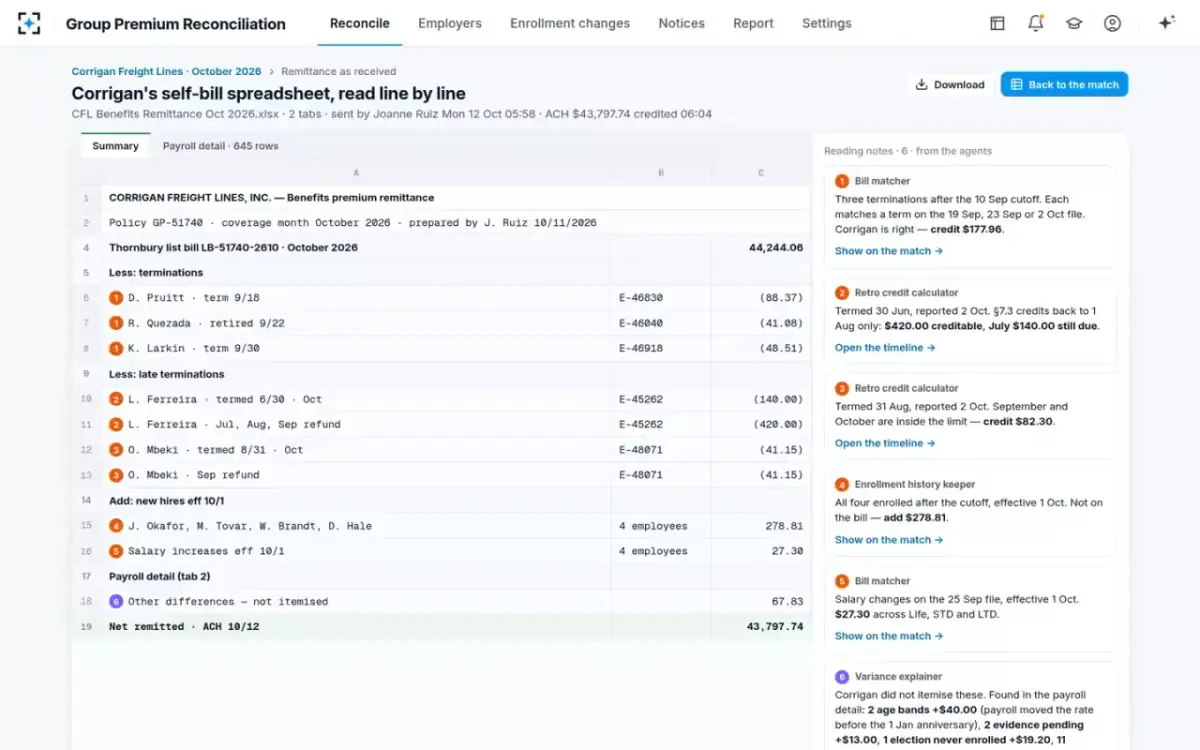
The Bill matcher then sets bill, enrollment and payment side by side for every employee and coverage and clears differences under the $1.00 per-employee tolerance; on Corrigan's bill, 616 employees matched to the cent and 11 within the tolerance. The Variance explainer labels the rest with a cause and its evidence, and what it cannot evidence stays "unexplained".
Only the lines that differ, with bill, enrollment and paid side by side
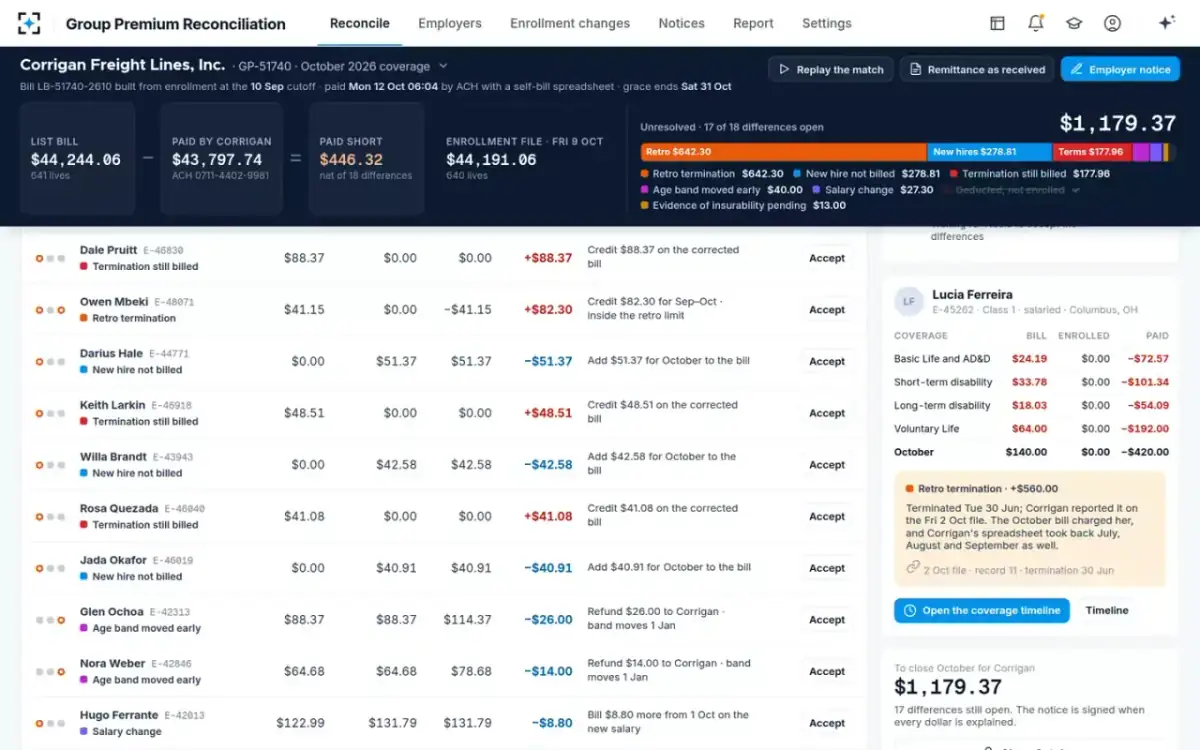
What comes out is not a matched total but 18 explained lines and a corrected bill. When the employer's payment is wrong for reasons of its own, such as deducting premium it never sends, the problem moves from billing to the rules on employers who did not pay the premium.
Questions people ask
What is an 820 payment order remittance advice?
It is the full name of the X12 transaction set: Payment Order/Remittance Advice (820). The payment order part moves or instructs the money; the remittance advice part explains it. Group premium payments use one implementation of it, "Payroll Deducted and Other Group Premium Payment for Insurance Products".
What is the difference between the 820 and the 835?
The 820 pays premiums to a plan or carrier; the 835 pays claims from a health plan to a health care provider. Both are remittance advices, flowing in opposite directions around the same plan. A group billing team works with the 820 and never with the 835.
Who sends an 820?
The party paying the premium: an employer, its payroll provider or benefits administrator, or a government agency. X12 notes the guide was also designed for premium payments "between federal and state governments, government agencies, and private industry".
Can an 820 include adjustments for earlier months?
Employers routinely take back earlier months on a current payment, as Corrigan did for a June termination reported in October. Whatever the file format, the carrier must decide each such adjustment against the contract; an 820 line that takes back a month does not make the month creditable.
What tolerance should a carrier use when matching an 820?
A small per-employee tolerance, never one on the total. The sample settings clear differences under $1.00 per employee and allow $0.00 to $5.00. On Corrigan's bill, 11 employees were within the tolerance for −$4.37 in all, written off on the employer notice.