The NAIC's Unfair Life, Accident and Health Claims Settlement Practices Model Regulation (Model #903) gives a life insurer five clocks on a death claim: claim forms within 15 days of notice, an investigation begun within 15 days of proof of loss, payment within 30 days of accepting liability, an answer to any written communication within 15 days, and a written explanation once a claim is 30 days past proof, then a letter every 45 days. States adopt it in their own words, and several go further: Texas sets business-day decision and payment deadlines with 18% a year in statutory damages, and California gives 40 days from proof of claim to accept or deny. The hard part for a claims desk is not knowing the clocks. It is proving, file by file, which event started each one, when a death claim's documents arrive by mail, email and phone across weeks. Botminds' Death Claims Processing reads each document the day it arrives and keeps the claim's checklist and its clock dates current, so the examiner and the compliance team see the same dates an examiner would.
This guide is written for the vice president of life claims, the claims compliance officer and the senior examiner. It describes the rules as published; it is not legal advice on any claim or state. The worked example is a sample claim in the solution, on fictional people and a fictional carrier.
Model #903's clocks on a death claim, and the event that starts each
| Duty | Deadline | Starts from | Section |
|---|---|---|---|
| Send claim forms, instructions and reasonable assistance | 15 days | Notification of claim | §4A |
| Begin any necessary investigation | 15 days | Proof of loss received | §4B |
| Affirm or deny liability | A reasonable time | Proof of loss received | §4D |
| Offer payment of an undisputed amount | 30 days | Affirmation of liability | §4D |
| Pay the undisputed portions of a partly disputed claim | 30 days | Affirmation of liability | §4D |
| Written explanation for the delay | At 30 days | Proof of loss received | §4G |
| Letter giving reasons more time is needed | At 45 days, then every 45 | Initial notification | §4G |
| Acknowledge and respond to written communications | 15 days | Each communication | §4H |
| Written notice of denial, citing the provision | 15 days | The determination | §4I |
What does the Unfair Life, Accident and Health Claims Settlement Practices Model Regulation require?
It requires a life, accident or health insurer to move a claim on fixed calendar clocks and to keep a claim file from which a regulator can rebuild every step. Its stated purpose is "to set forth minimum standards for the investigation and disposition of life, accident and health claims", and its provisions "are intended to define procedures and practices which constitute unfair claims practices" (§2). It is adopted under a state's Unfair Claims Settlement Practices Act, so a missed clock is measured against that act, and it expressly creates no private cause of action. The NAIC adopted it in 1990 and amended it in 1991; property and casualty claims have a separate model, covered in the guide to the unfair claims settlement practices act.
For a death claim, four of its provisions do most of the work. Section 4A puts the first move on the insurer: forms and instructions within 15 days of being told. Section 4C stops an insurer making a family prove the same death twice: proof submitted on one policy satisfies the claimant's obligation "under any and all similar policies issued by that insurer and specifically identified by the insured". Section 4D makes the insurer pay what is not disputed within 30 days even while another part of the claim is argued. And section 4G makes delay visible: a written explanation at 30 days after proof of loss, and a letter every 45 days from the first notice while the investigation stays open.
Proof of loss: the definition that decides the calendar
Most of the model's clocks run from proof of loss, so the definition sets the calendar. The model defines it as "written proofs, such as claim forms, medical bills, medical authorizations or other reasonable evidence of the claim that is ordinarily required of all insureds or beneficiaries submitting the claims" (§3J). Two words carry weight: "reasonable" and "ordinarily". A requirement the insurer asks of every beneficiary is part of proof of loss; an item asked of one family only, without a reason in the file, is the kind an examiner questions.
On a death claim, the ordinary requirements are a certified death certificate, a claimant statement from each beneficiary, proof of identity and a taxpayer form for each payee, and any court or trust papers the designation makes necessary. California says it more sharply: an insurer "shall not persist in seeking information not reasonably required for or material to the resolution of a claim dispute" (10 CCR §2695.7(d)). Texas puts the duty on the first request: within 15 days of notice the insurer must ask for "all items, statements, and forms that the insurer reasonably believes, at that time, will be required" (§542.055(a)). A desk that sends a complete list on day one starts its decision clock sooner and defends it better.
Proof is also per payee. A claim with three beneficiaries can hold complete proof for two and none for the third, and the model's undisputed-portion rule points toward paying the two. That is a design choice for the desk, not only a legal one: the checklist has to track items by person, or the whole claim waits for the slowest family member.
How states turn the model into death claim deadlines
States adopt Model #903 with edits, and the edits change the deadline, the unit of time and the penalty. Texas writes its clocks into the Insurance Code and applies them by name to stock and mutual life companies and fraternal benefit societies (§542.052). California writes them into its Fair Claims Settlement Practices Regulations, which reach life claims alongside other lines. Florida and New York put the cost of delay into interest on the proceeds. The table sets four states beside the model; each has further rules for other lines and exceptions in its own text.
The same death claim under the model and four states
| Step | Model #903 | Texas | California | Florida and New York |
|---|---|---|---|---|
| Forms and acknowledgment | 15 days from notice | 15 days from notice: acknowledge, investigate, request all items (§542.055) | 15 calendar days from notice: acknowledge, forms, begin investigating (§2695.5(e)) | Follow their own claims statutes; not shown here |
| Decide | A reasonable time after proof of loss | 15 business days from all items received; 45 more days if the reasons are given in time (§542.056) | 40 calendar days from proof of claim (§2695.7(b)) | — |
| Pay | 30 days from accepting liability | 5 business days from notice of acceptance (§542.057) | 30 calendar days from acceptance (§2695.7(h)) | — |
| Outer limit on settlement | — | Two months from proof of death and of the claimant’s right (§1101.011) | — | — |
| Status letters while open | At 30 days from proof; every 45 days from notice | Reasons for more time within the decision period | Every 30 calendar days until decided (§2695.7(c)(1)) | — |
| Cost of delay | Measured under the state’s unfair claims act | 18% a year in damages plus attorney’s fees (§542.060) | Not set in these sections | Interest: Florida from written due proof of death; New York daily from the date of death |
Texas deserves the closest reading because its deadlines are short and its remedy is automatic. The insurer must decide within 15 business days after it "receives all items, statements, and forms required by the insurer to secure final proof of loss", and if it cannot, it must say why within that same period and then decide by the 45th day (§542.056). Once it accepts, payment is due "not later than the fifth business day after the date notice is made" (§542.057). An insurer that misses a step owes, on top of the claim, "interest on the amount of the claim at the rate of 18 percent a year as damages, together with reasonable and necessary attorney's fees" (§542.060(a)). The cost of one missed date on one file is worked in the guide to Texas Insurance Code 542.060.
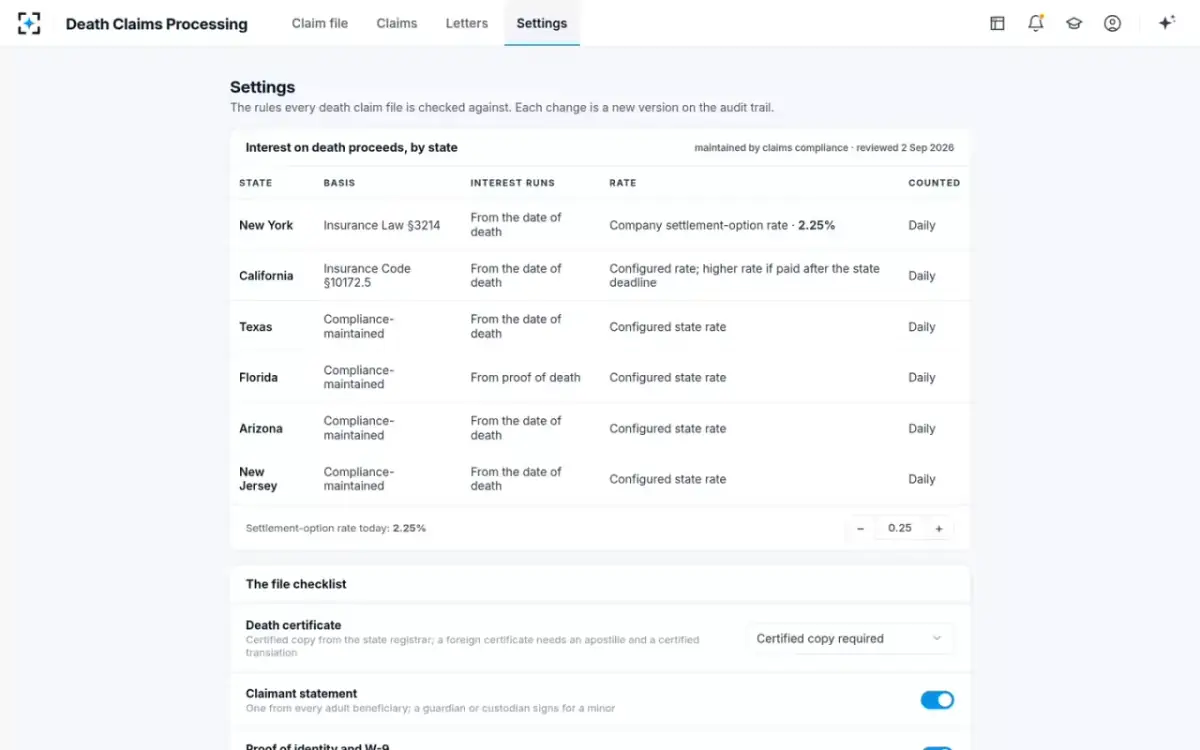
Interest is the other lever. New York requires interest on the proceeds "computed daily at the rate of interest currently paid by the insurer on proceeds left under the interest settlement option, from the date of the death of an insured" (§3214(c)). Florida requires lump-sum proceeds to carry interest at no less than Moody's corporate bond yield average "from the date the insurer receives written due proof of death" (§627.4615). Texas runs interest from due proof of loss until the insurer accepts and offers to pay (§1103.104). Each start date differs, so the same claim owes different interest in different states; the arithmetic for four states is in interest on life insurance proceeds.
What happens to the clocks when a second claimant appears?
A second claimant does not stop the clocks; it changes which one applies. Texas gives a life insurer that receives notice of "an adverse, bona fide claim" 90 days from receiving all requested items to pay or to "properly file an interpleader action and tender the benefits into the registry of the court", and damages run if it takes longer (§542.058(c)). The model reaches the same result by another route: only the disputed portion may wait, and the undisputed portion is due within 30 days of affirming liability.
For the desk, the practical point is timing. The adverse claim has to be logged the day it arrives, with the person, the basis and the share it touches, because that date decides whether the 90-day interpleader clock or the ordinary decision clock governs. A former spouse named before a divorce, a late change of beneficiary signed in hospital, or an assignment to a funeral home each produces a different dispute. The steps from the adverse claim to the court deposit are followed through one claim in the life insurance interpleader process.
Which letters must a life insurer send, and when?
The model requires five letters on a claim that does not pay at once. The first is the claim packet: forms, instructions and "reasonable assistance" within 15 days of notice. The second is the delay explanation at 30 days after proof of loss, and the third is the reasons letter at 45 days from notice and every 45 days after. The fourth is the denial, sent within 15 days of the determination and citing "the policy provision, condition or exclusion upon which the denial is based" (§4I). The fifth comes after a rejection the claimant objects to: a letter saying the claimant may have the matter reviewed by the state department of insurance, with its address and telephone number (§4N).
California compresses the status letter to 30 days and sets its content: the notice "shall specify any additional information the insurer requires in order to make a determination and state any continuing reasons for the insurer's inability to make a determination" (10 CCR §2695.7(c)(1)). A letter that says only "your claim is under review" meets neither rule. The life claims chapter of the NAIC's examination standards adds a letter specific to death claims: the insurer must give the beneficiary, at the time a claim is made, written information on the settlement options available under the policy (Chapter 23, claims standard 3).
“If the investigation remains incomplete, the insurer shall, forty-five (45) days from the date of initial notification and every forty-five (45) days thereafter, send to the claimant a letter setting forth the reasons additional time is needed for investigation.”
NAIC Model #903, section 4G
How market conduct examiners test death claim timeliness
Examiners test the clocks by sampling claim files and rebuilding each one's dates. The NAIC's handbook lists the standards they apply to every line: initial contact "within the required time frame", "Timely investigations are conducted", "Claims are resolved in a timely manner", the insurer "responds to claims correspondence in a timely manner", and "Claim files are adequately documented" (Chapter 20, claims standards 1 to 5).
A published Massachusetts examination shows what the sample looks like. Examiners requested the universe of claims received or paid in the 2018 period and reviewed a random sample of 215 files across product lines, 25 of them individual life and 25 group life. They found two files that failed the prompt-investigation standard. In one, a claim on three policies, the insurer "paid beneficiaries on two of the policies in 2016 but failed to pay the third policy until 2018"; the other did not document the acknowledgment and the mailing of proof of loss forms. The recommendation was to "implement strategies to ensure that multiple policies held by a deceased policyholder settle promptly" (Massachusetts Division of Insurance, report, Standard VII-2).
One published market conduct exam, and what failed
215files
claim files sampled at random across product lines
25files
individual life claims in the sample, and 25 group life
2files
failed the prompt-investigation standard
2years
between paying two policies on one death and paying the third
Both failures were file failures. In the first, the policies had been found; the third simply did not settle with the other two. In the second, the steps may have been taken, but the file could not prove them. That is the gap a desk can close with process rather than headcount: every policy on the insured tied to one claim, and every letter and receipt dated in the file.
What the claim file must show an examiner
The model's file rule is short and strict. "Detailed documentation shall be contained in each claim file in order to permit reconstruction of the insurer's activities relative to each claim", and "Each document within the claim file shall be noted as to date received, date processed or date mailed" (§5B, §5C). The insurer must be able to produce, for open and closed files, the claim number, line, date of loss, and date of payment, denial or closure, for the current year and the two preceding years (§5A).
California asks for more: data "for all open and closed files for the current year and the four preceding years", and files in enough detail "that pertinent events and the dates of the events can be reconstructed" (10 CCR §2695.3). Both California and Texas require an acknowledgment given by phone to be noted with its date (§2695.5(e)(1); Tex. Ins. Code §542.055(c)). And the model bars a denial based on a telephone conversation or interview "unless the telephone conversation or personal interview is documented in the claim file" (§4J). A death claim worked by phone and email, with notes kept in a mailbox, fails these rules even when the money went out on time.
Model #903 against California: the same duties, tighter in the state
Model #903: Within a reasonable time after proof of loss
California, 10 CCR §2695: Within 40 calendar days of proof of claim
Model #903: Explanation at 30 days; letter every 45 days from notice
California, 10 CCR §2695: Written notice every 30 calendar days, naming the information still needed
Model #903: 15 days
California, 10 CCR §2695: 15 calendar days, a complete response
Model #903: Within 15 days, citing the provision
California, 10 CCR §2695: All bases, with the factual and legal basis for each
Model #903: Current year and two preceding
California, 10 CCR §2695: Current year and four preceding
Where the days go on one sample claim
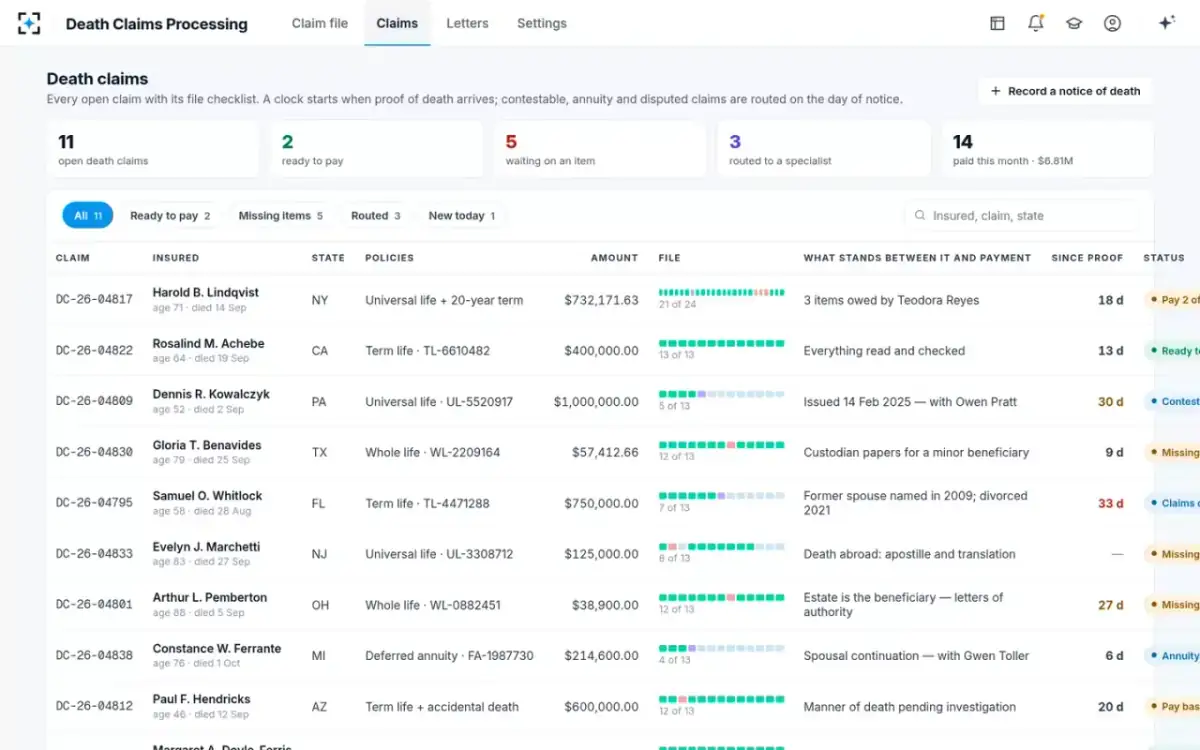
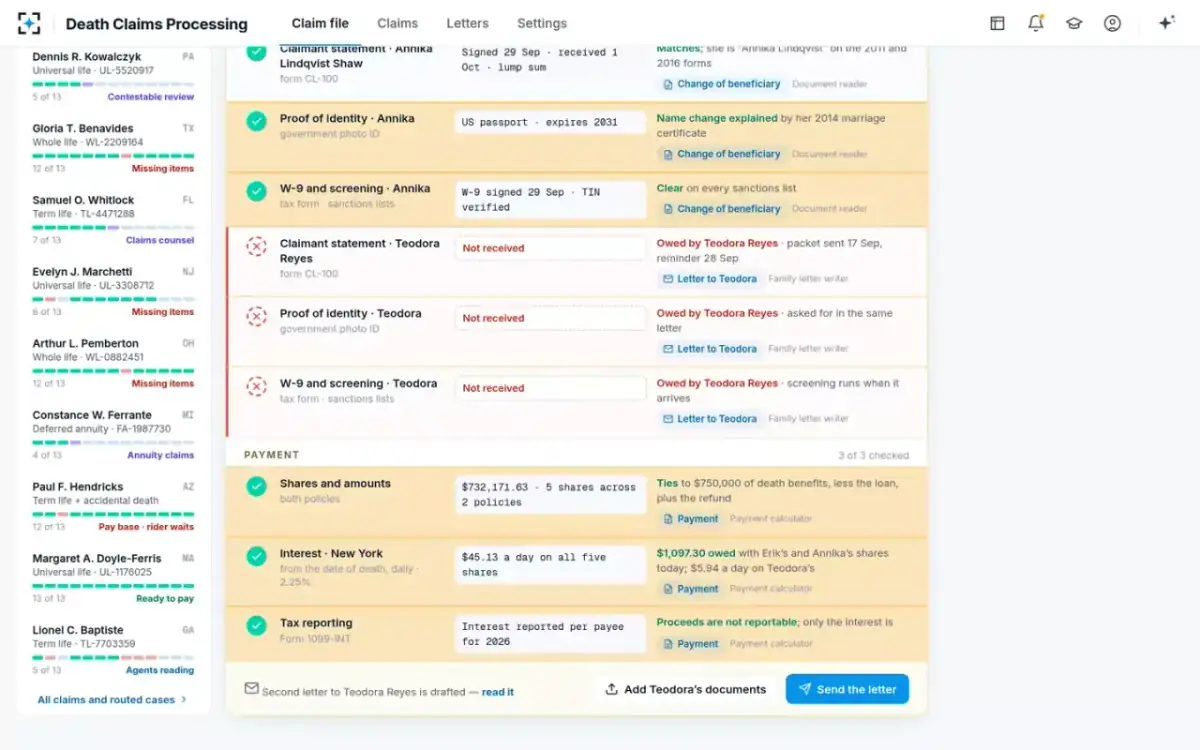
Take a sample claim in the solution, a New York death on a universal life and a 20-year term policy with three beneficiaries. Harold B. Lindqvist died on 14 September 2026; his son called on 16 September and the claim packet went out on 17 September, inside the 15-day forms clock. The certified death certificate reached the carrier on 24 September, which started the proof-of-loss clocks. Two of the three beneficiaries returned their statements, IDs and W-9s by 1 October; a reminder to the third went out on 28 September.
On 12 October the examiner approved the two complete shares, $318,417.30 each with New York interest, and the supervisor co-signed above the examiner's limit. The third share, $96,434.33, waited on three documents from its payee and kept accruing New York interest at $5.94 a day. That split is the Massachusetts finding run the other way: the complete shares were paid on their own proof, and the open one stayed visible on the desk's list with its days since proof.
The sample claim against the model's clocks
- Notice to proof of death (packet sent day 1)8 d
- Proof of death to two shares paid18 d
- Forms due15 d
- First reasons letter due if still openday 45
Days since proof, beside what each claim is waiting on
Running a death claim desk to the clocks: the controls
A desk stays inside these rules with a short set of controls, each of which an examiner can test. They are the controls the model and the state texts imply; the order below follows a claim from notice to closing.
Eight controls that keep a death claim inside the clocks
- Date the notice, whatever the channel
A call, web form, funeral home letter or agent email is a notification if it reasonably tells the insurer of the facts (Model #903 §3I). Log the date it arrived, not the date it was keyed.
- Search every policy on the insured at notice
Proof on one policy satisfies similar policies identified to the insurer (§4C). Settling all policies together is the fix the Massachusetts examiners asked for.
- Send one complete list of requirements
Texas expects every item reasonably foreseen at the first request (§542.055). A second request needs a reason in the file.
- Track proof by payee
Each beneficiary’s statement, ID and tax form is its own item, so complete shares can be paid while one waits.
- Run the state’s clock, in the state’s units
Business days in Texas, calendar days in California and the model. The governing state is a setting on the claim, not a memory.
- Generate the status letters from the file
The 30-day explanation and the 45-day letters (30-day in California) must name what is still needed and from whom.
- Log an adverse claim the day it arrives
It moves the claim to the interpleader clock in Texas and holds only the disputed share.
- Date every document and every letter
Received, processed or mailed (§5C), so the file reconstructs itself for the current year and the two (California: four) before it.
The controls are cheap to write and hard to run by hand. The dates live in a mailroom scan, an admin system and an examiner's inbox, and the clock that applies depends on the state of residence and on whether a dispute has arrived. That is where most missed dates come from, and it is the part a system can do reliably.
Where Death Claims Processing fits against the model's clocks
Death Claims Processing reads each document the day it arrives and checks it against the policy: the certificate, each claimant statement, each ID and tax form. The claim's checklist then shows, per payee, what is still missing, and the claims list shows days since proof for every open claim. The policy search runs on the insured's SSN, name variants and date of birth across the admin systems at notice, which is how the sample claim found a term policy the family had not mentioned. Letters to families are drafted from the file and sent only by the examiner.
State rules are settings that the carrier's claims compliance team maintains: interest by state, the file checklist, routing on the day of notice and the signing limits. Each change is versioned. Botminds estimates that on a typical claim with two policies and three payees, reading each document on arrival cuts elapsed time from about 25 days to about 13; most of what remains is the time families take to return forms, which no software removes.
What the claim is waiting on, by payee, on the day it is waiting
The limits matter as much as the reach. No agent pays, denies or decides a dispute: the examiner approves every payment, a supervisor co-signs above the limit, and a claim with a second claimant goes to claims counsel the day the conflict appears. The solution does not interpret a state's law; it applies the rule the compliance team has written, and a new state or a changed statute is a compliance decision first. A carrier that wants to know whether its rules are right should test its closed files against the state text, as an examiner would, before it automates anything.
State rules your claims compliance team owns, versioned
Questions people ask
Is the NAIC model regulation binding on a life insurer?
No, not by itself. Model #903 binds only as a state adopts it, by regulation or statute, and the adopted text governs. Texas and California, for example, set shorter or more specific deadlines than the model.
When does the clock start on a life insurance death claim?
The forms clock starts at notification of the claim, which can be a phone call. The investigation, explanation and decision clocks start at proof of loss, which the model defines as the reasonable evidence ordinarily required of all beneficiaries, typically a certified death certificate and the claimant's statement.
How long does a life insurer have to pay once it accepts a claim?
Under the model, 30 days from affirming liability when the amount is settled. Texas requires payment by the fifth business day after notice of acceptance, and California within 30 calendar days of acceptance.
Can a life insurer hold all shares when one beneficiary's documents are missing?
The model requires the undisputed portions of a claim to be paid within 30 days, and each payee's share usually rests on that payee's own proof. A Massachusetts examination faulted an insurer that paid two of three policies on one death in 2016 and the third in 2018.
How long must a life insurer keep claim data for examiners?
The model requires claim data for open and closed files for the current year and the two preceding years. California requires the current year and the four preceding years.
What is the penalty for a late death claim in Texas?
Interest on the claim at 18% a year as damages, plus reasonable attorney's fees, under Insurance Code §542.060. It applies when the insurer misses a prompt-payment step, including the 90-day deadline to pay or interplead a disputed life claim.