An insurance claims department structure for life death claims has four layers: an intake seat that takes the notice and never names a beneficiary, examiners who decide liability, payee and amount within a signing limit, a supervisor who co-signs above that limit, and specialists who take contestable, annuity and disputed claims on the day of notice. Claims are assigned by product, complexity and the examiner's authority limit, which is how one large mutual life insurer described its own desk to Massachusetts examiners. The hard part is sizing it. No regulator or independent study publishes a caseload per death claims examiner, death volumes rise each winter, and most of an examiner's hours go to reading documents and searching admin systems rather than deciding. Botminds' Death Claims Processing takes over that reading and searching, which changes how many open claims each seat carries without changing who signs.
This guide is for the head of life claims and the claims operations leader who own the desk's design, its staffing plan and its exam results. The worked example uses a sample claim and a sample desk in the solution, on fictional people and a fictional carrier.
The death claim desk: four seats, and what each one keeps
Today
Types the call note; is asked by families who the beneficiaries are, and may not say.
With agents
Logs the notice; the claim opens and the claim packet goes out the same day. Sees status, never beneficiaries.
Still theirs: the family’s first conversation and the date of notice
Today
Gathers certificates, statements, IDs and W-9s by letter and phone; searches each admin system; reads every beneficiary change by hand.
With agents
Opens a file already read and checked, with each missing item and the person who owes it named.
Still theirs: liability, payee and amount; the signature up to the limit
Today
Co-signs from a summary, then asks for the designation and the interest workings.
With agents
Co-signs with the proven designation, each share and the state interest by day on one screen.
Still theirs: the second signature above the examiner’s limit
Today
Receive contestable, annuity and disputed files when someone notices, often weeks in.
With agents
Receive them on the day of notice, with the documents attached.
Still theirs: contestable reviews, annuity claims, competing claimants
How is an insurance claims department structured for death claims?
Around signatures, not around tasks. Each seat on a death claim signs something different, and the structure works when each signature has one owner and a clear limit. Intake owns the date of notice, because every regulatory clock runs from it or from proof of loss. The examiner owns the decision on liability, the payee and the amount. The supervisor owns the second signature above a dollar limit. Specialists own the claims that leave the standard path.
A published Massachusetts examination shows the same shape at a large carrier. Claims "are received by mail, through the Company's 800 phone number, or on the Company's website", are "acknowledged within three business days", and the contract "is researched to determine its status, and to ascertain if other contracts are in-force". The claim is then "assigned to a claims examiner for investigation based on the product type and/or complexity level and the examiner's authority limit", contestable claims go to "a group of experienced claim examiners", and most annuity claims are processed by an outside administrator under "contractual service level agreements" (Massachusetts Division of Insurance, 2022-period report, section VII).
What each seat decides, what it never does, and what proves it
| Seat | Decides or signs | Never | What the file must show |
|---|---|---|---|
| Intake | The date and channel of notice; the claim packet sent | Names a beneficiary or a share to a caller | Date of notice; date the packet went out (Model #903 gives 15 days) |
| Life claim examiner | Liability, payee and amount; approves payments up to the limit | Pays on a designation the file does not prove | Each document dated received, processed or mailed; the designation in force at death |
| Claims supervisor | Co-signs payments above the examiner’s limit | Co-signs without the designation and the interest workings | Both signatures and the amount at each |
| Contestable specialist | Reviews claims inside the contestable period | Waits for the examiner to notice the issue date | Routing date, normally the day of notice |
| Claims counsel | Competing claimants, divorce after a designation, changes received after death | Leaves the undisputed shares waiting | Date the adverse claim arrived; share it touches |
Assigning death claims: product, complexity and authority
The assignment rule decides whether experienced examiners spend their week on the hard files or on the easy ones. A rule by product sends annuity death claims, with their spousal continuation and distribution choices, to an annuity team, and keeps individual and group life apart where the documents differ. A rule by complexity sends a claim with a foreign death certificate, an estate as beneficiary, a minor payee or a change of beneficiary signed shortly before death to a senior examiner. A rule by authority sends large claims to examiners who can sign them.
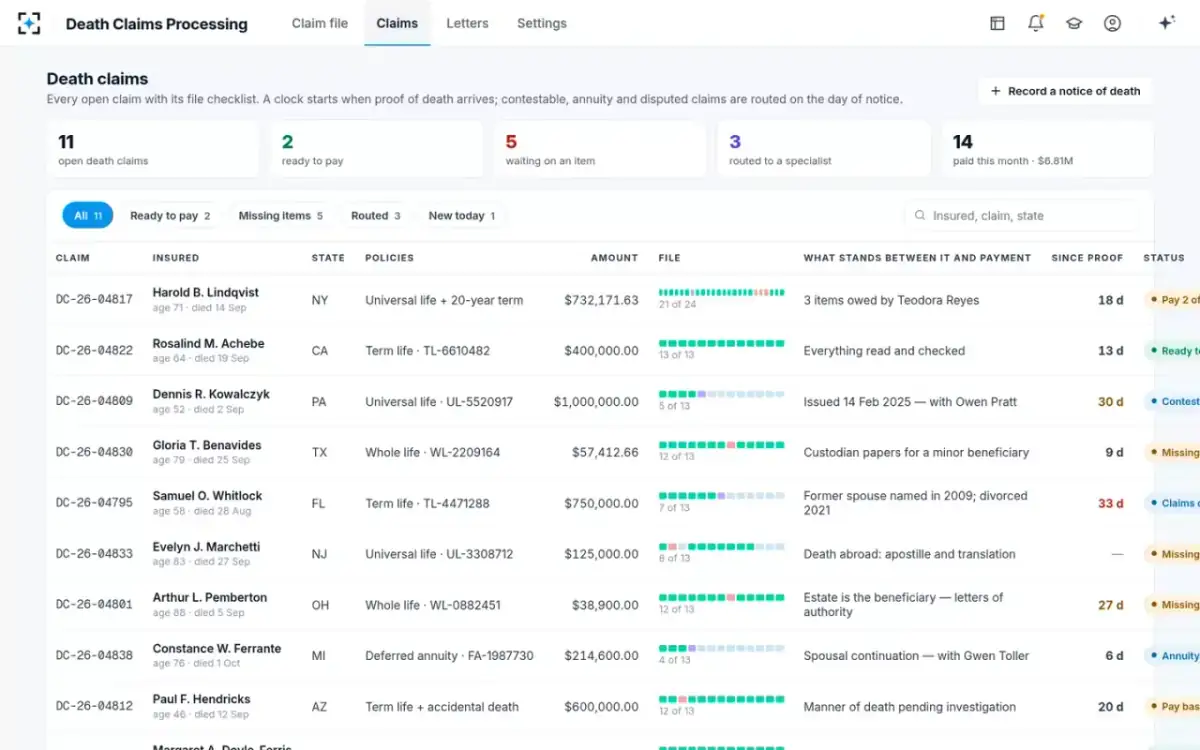
The complexity triggers can be read on the day of notice, before an examiner opens the file: the issue and reinstatement dates against the contestable period, the number of policies on the insured's Social Security number, the beneficiary type, the state of residence and the face amount. On the sample desk, 3 of 11 open claims were routed to a specialist on the day of notice, a contestable claim, an annuity spousal continuation and a claim with a former spouse named before a divorce, and the other eight stayed with examiners.
One desk's open death claims, sorted by what each is waiting on
How should authority limits be set on a death claim desk?
Set them where a second reader changes the outcome, and give that reader what she needs to check. A limit is a design choice, not a regulatory number. Too low, and the supervisor re-reads most of the book and becomes the queue; too high, and one person carries six-figure decisions alone. The solution offers examiner limits of $100,000, $250,000 or $500,000, and the sample carrier signs alone up to $250,000.
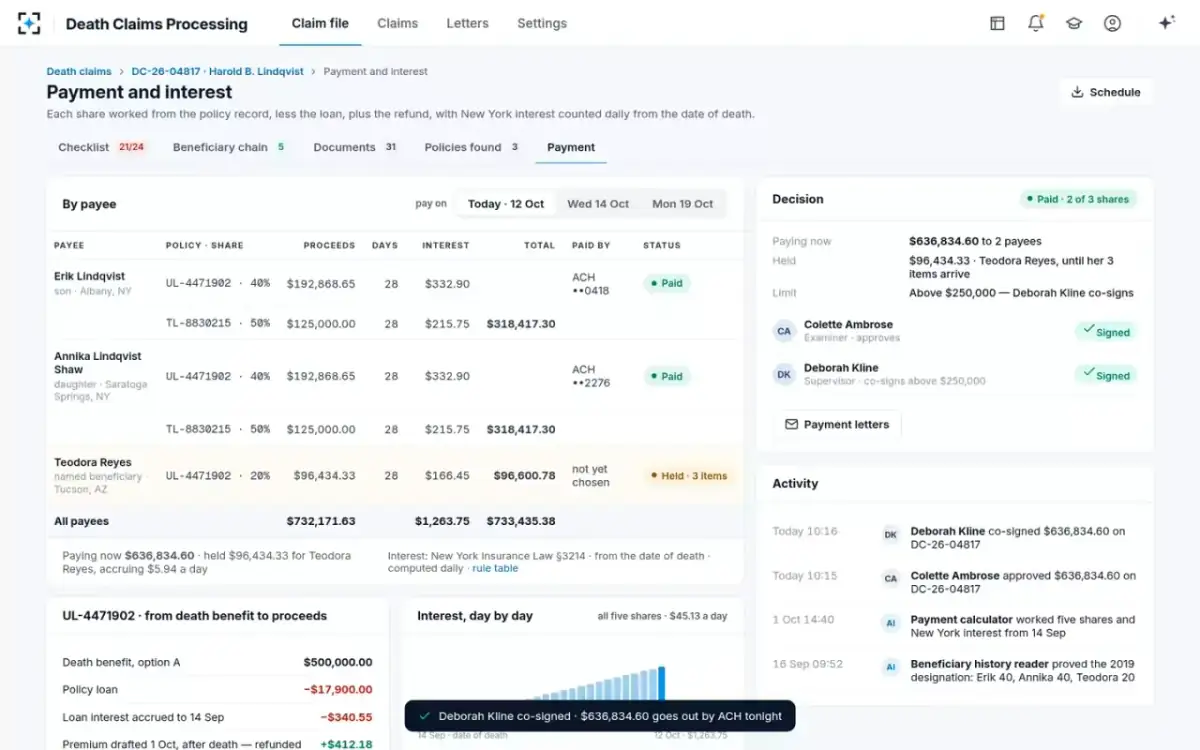
The co-signature is only a control if it checks the parts most likely to be wrong. On a death claim those are the designation in force at death, the shares, and the interest owed under the state rule, not the arithmetic of the face amount. On the sample claim, two shares of $318,417.30 each went to the supervisor because the payment, $636,834.60, was above the examiner's limit, and the co-signature screen carried the 2019 change of beneficiary, each share and the New York interest counted by day.
The second signature sees what it is signing
Limits also shape assignment. The Massachusetts report's carrier assigns by "the examiner's authority limit", which means the limit decides who can take a large claim at all. A desk with too few examiners at the higher limit builds a queue of large claims behind those few people, and large claims are the ones where a family is most likely to call a lawyer.
How many death claims can one examiner carry?
There is no published standard; a carrier has to measure its own. Neither the NAIC, the state examination reports nor independent research publish a caseload per life claims examiner, and the number depends on the mix of policies, payees, states and disputes. What a carrier can measure is the arithmetic behind the caseload: how many claims arrive, how long each stays open, and how many examiner hours each one needs.
The relationship between the first two is fixed. On average, the number of open claims equals the number arriving per day times the days each stays open, an identity from queueing theory known as Little's law. Take a desk receiving 200 death notices a month, an illustration rather than a benchmark: if a claim stays open 25 days, the desk carries about 165 open claims; at 13 days, about 85. Botminds estimates those two durations for a typical claim on two policies with three payees, by hand and with the solution. Halving days open halves the inventory every examiner has to track, chase and explain, without one fewer notice arriving.
A death claim desk's capacity, in four terms a carrier can measure
Arrivals
death notices per day
From the carrier’s own notices, by month, so the winter rise is visible
Claims operations
Days open
proof of death received → payment, per claim
Split into days waiting on the family and days waiting on the carrier
Claims operations
Open inventory
arrivals per day × days open
Little’s law: 6.6 a day × 25 days ≈ 165 open claims; × 13 days ≈ 85
Head of life claims
Examiner hours
arrivals × touches per claim × minutes per touch
Touches include each document read, each search, each letter and each status call
Head of life claims
The fourth term is where staffing plans go wrong. Examiner hours per claim depend on touches: each document read and checked, each admin system searched, each beneficiary change read in order, each letter and each call from a family asking for status. A claim that waits on one beneficiary's form still generates touches, because the family calls and the clocks require letters. The cheapest capacity a desk can buy is a lower count of touches per claim, not more examiners.
Death claim volume follows mortality: plan for winter
Death claims arrive with deaths, and US deaths are seasonal. In 2019, the last full year before the pandemic distorted the series, the CDC's National Center for Health Statistics counted 257,649 deaths in January and 227,280 in August. Per day, that is 8,311 in January and 7,332 in August, so a desk whose insured lives die at the national pattern receives about 13% more notices a day in midwinter than in late summer (CDC NCHS, 2019 monthly counts).
US deaths per day by month, 2019: the winter peak a claims desk absorbs
The seasonal rise lands when the desk is least able to absorb it, in the same weeks as year-end leave and the end-of-January deadline for sending Forms 1099 to payees. The days-open term makes it worse, because a desk that falls behind in January carries a larger inventory into February. Two levers help. Planning leave and training against the carrier's own monthly notice counts is the first. Cutting the carrier's share of days open is the second, so a backlog clears faster when it forms.
Where an examiner's days go on a death claim
Most of a death claim's elapsed time is waiting on the family, and most of the examiner's own time is reading and searching. On Botminds' estimate for a typical claim on two policies with three payees, the claim takes about 25 days by hand: 14 waiting for the certificate and claimant forms, 2 finding every policy and rider, 3 reading and checking documents, 4 proving the beneficiary from the change history, and one day each for shares and interest and for approval and payment. With the solution the same claim takes about 13 days, and 10 of them are the family's.
Days on a typical death claim, by hand and with Death Claims Processing
By hand · about 25 days
- Waiting on certificate and forms · 56%
- Finding policies, reading documents, proving the beneficiary · 36%
- Shares, interest, approval, payment · 8%
With the agents · about 13 days
- Waiting on certificate and forms · 77%
- Finding policies, reading documents, proving the beneficiary · 12%
- Shares, interest, approval, payment · 11%
The staffing consequence is that the scarce skill on the desk, reading a chain of beneficiary changes against the policy provisions and judging which one governs, is also the slowest manual step. A desk that frees its senior examiners from first reads can put them on the claims that need judgment: the unsigned change form, the late designation, the estate with no letters of authority. How the chain is proven, and how to sample it, is set out in proving the right payee.
What examiners test on a death claim desk
State examiners test the desk by sampling closed files and checking each step against the statute and the carrier's own procedures. The NAIC's handbook lists the claims standards they apply, among them that "Claim files are adequately documented", and, for life claims, that the insurer gives the beneficiary written information on the settlement options available under the policy at the time a claim is made (NAIC handbook, chapters 20 and 23). The model regulation requires each file to permit "reconstruction of the insurer's activities relative to each claim" (Model #903, §5B); its clocks are set out in the guide to the life claims settlement practices model regulation.
Two Massachusetts reports show what the samples find. In the 2022 period, examiners tested 140 claims, 40 of them paid life and long-term-care-rider claims, and found that "For six life claims, the Company failed to conduct Department of Revenue intercept checks for tax and child support amounts due"; the carrier answered with an updated claim checklist and, from April 2024, monthly audits (2022-period report). In the 2018 period, another carrier's sample of 215 claims included one death with three policies where two were paid in 2016 and the third in 2018 (2018-period report).
Two published exams: where death claim desks slip
6 of 40
life claims in one sample paid without the required state intercept check
215files
claims sampled in another exam, 25 of them individual life
2years
between paying two policies on one death and paying the third
Monthly
claim audits added after the intercept-check finding
Neither finding was a judgment error. Both were steps that a checklist should have carried: a state payee check before money moves, and every policy on the insured settled together. That is the structural lesson for a desk: put the steps an examiner can forget into the file's checklist, and sample the files monthly against it, as the carrier in the 2022 report now does. Quality results that feed "employee evaluation and training", in that report's words, close the loop between the sample and the seat.
Where Death Claims Processing changes the staffing math
The solution's seven agents take the reading, searching and arithmetic off the examiner's desk and leave every signature where it was. The policy finder searches each admin system on the insured's Social Security number, name variants and date of birth at notice. The document reader checks each certificate, statement, ID and W-9 on arrival against the policy. The beneficiary history reader orders every designation and change and shows the one in force at death. The payment calculator works each share and the state interest by day. Letters to families are drafted from the file and sent only by the examiner. Each agent, and the limit written into it, is described in life insurance claims processing, agent by agent.
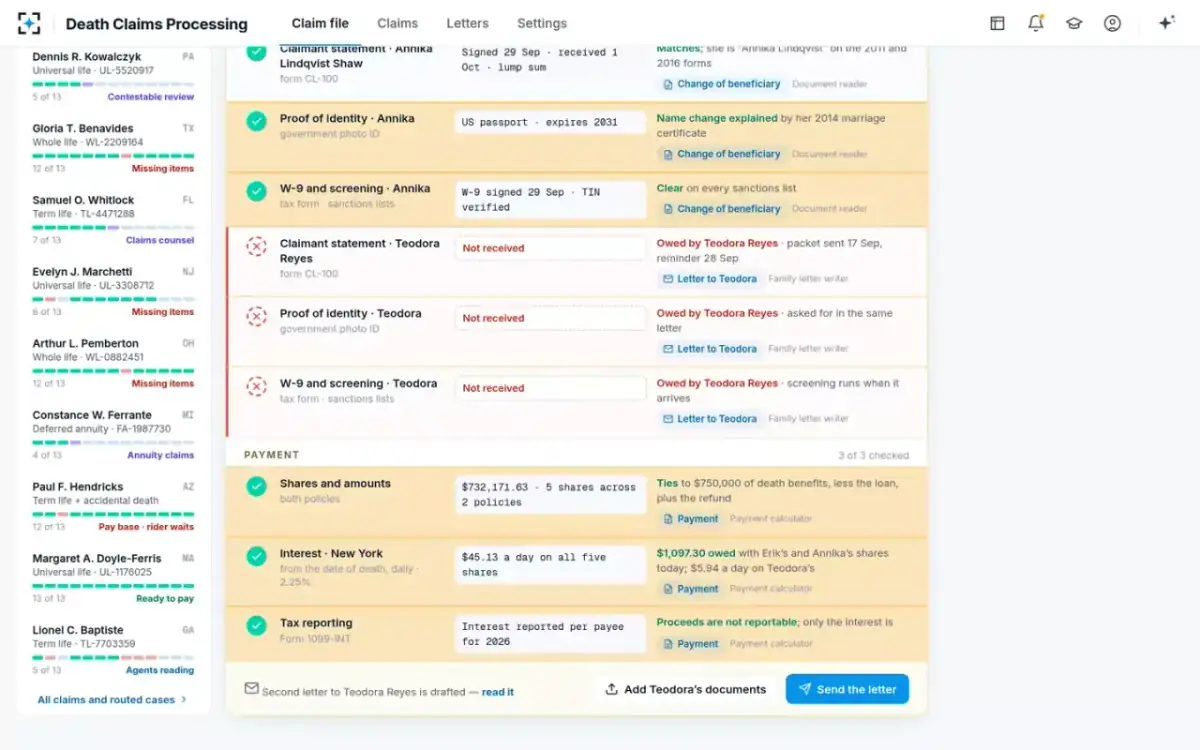
For a staffing plan, three things change and three do not. Touches per claim fall, because first reads and searches are done before the examiner opens the file. Days open on the carrier's side fall, which lowers open inventory by Little's law. And specialists receive their claims on the day of notice, so the routed share of the book stops ageing in an examiner's queue. What does not change: the family's time to return forms, the examiner's signature on every payment and the supervisor's co-signature above the limit. A carrier should size the desk on its own measured arrivals and days open, before and after, rather than on any vendor's ratio.
What the claim waits on, by person, before the examiner opens it
Questions people ask
How is a life insurance claims department organized?
Typically into intake, examiners, supervisors and specialist teams for contestable, annuity and disputed claims. One large mutual life insurer told Massachusetts examiners that it assigns claims by product type, complexity and the examiner's authority limit, with contestable claims reviewed by a group of experienced examiners.
What is an authority limit in claims?
It is the largest payment an examiner may approve alone; above it a supervisor co-signs. Limits are set by the carrier, not by regulation; the solution offers $100,000, $250,000 or $500,000, and its sample carrier uses $250,000.
Is there a standard caseload for a life claims examiner?
No regulator or independent study publishes one. A carrier can derive its own from arrivals per day and days open: by Little's law, a desk receiving 200 notices a month with claims open 25 days carries about 165 open claims.
Do death claims rise in winter?
Deaths do. In 2019 the CDC counted 8,311 US deaths a day in January against 7,332 in August, about 13% more, and a book of insured lives will broadly follow its own version of that pattern.
What do market conduct examiners check on a claims desk?
Timeliness of first contact, investigation, resolution and correspondence, the documentation in each file, and for life claims the settlement-options information given to beneficiaries. Massachusetts examiners sampled 140 claims in one 2022-period exam and 215 in a 2018-period exam.
Can automation reduce death claims staffing?
It reduces the examiner hours per claim, mostly in searching, reading and proving the beneficiary, and the days a claim stays open on the carrier's side. It does not remove the examiner's signature or the time families take to return forms, which on Botminds' estimate is most of a typical claim's remaining 13 days.