Life insurance claims processing is the work of taking a death claim from the first notice to the payment: opening the claim, finding every policy the insured held, collecting and checking the death certificate and claimant forms, proving who the beneficiary is, working each share with loans and interest, and getting the payment approved and the family told. Most of that is reading and searching across admin systems and scanned forms, which is why a death claim takes weeks; very little of it is judgement. Botminds' Death Claims Processing splits the work along that line. Seven agents do the reading, searching and arithmetic, each with a written limit, and the life claim examiner decides and signs.
This guide follows one sample claim through the solution. The insured, Harold B. Lindqvist of Albany, New York, died on 14 September 2026; his son called the fictional carrier, Larkhaven Life, two days later. Every person and figure in the story is sample data, not a customer result.
One death claim in Death Claims Processing, from the call to the payment
Agent
First notice readerTurns the call note into a claim and starts the file checklist for every contract on the insured’s Social Security number; sends the claim packet.
Never: tells a caller who the beneficiaries are
Agent
Policy finderSearches every admin system on the SSN, every name the insured used and the date of birth; returns each contract’s status at death.
Never: closes a partial match without a written reason
Agent
Document readerReads certificates, claimant statements, IDs and W-9s and checks each field against the policy, noting each mismatch with its page.
Never: accepts a copy where a certified original is required
Agent
Beneficiary history readerReads every designation and change in the policy’s life and proves the one in force on the date of death, with each share.
Never: resolves a dispute or a divorce question
Agent
Contestability and routing checkerChecks issue and reinstatement dates; routes contestable, annuity and disputed claims on the day of notice.
Never: denies a claim
Agent
Payment calculatorWorks each share: death benefit, loans and loan interest, premiums after death, and state interest counted daily.
Never: releases money
Agent
Family letter writerDrafts plain-words letters and status updates from what the file shows.
Never: sends without the examiner, or names another beneficiary’s share
A person decides
Examiner, and supervisor above the limitDecides liability, payee and amount; approves each payment; a supervisor co-signs above the signing limit.
What are the steps in life insurance claims processing?
A death claim has six steps whatever system runs it: notice, policy search, proof of death and claimant documents, beneficiary, amount, and approval with payment. The NAIC's model regulation for life and health claims puts clocks on the first and last: an insurer, on notice of a claim, must send the claim forms, instructions and reasonable help within 15 days, and once liability is affirmed must "offer payment within thirty (30) days" if the amount is set and not disputed. Everything in between is the file.
The steps overlap in practice, and the order matters less than the dependency. The beneficiary cannot be proven until the policies are found, the amount cannot be worked until the beneficiary is proven, and nothing can be paid until each payee's identity and tax form are in. A claims process stalls at whichever dependency is waiting on a person who has not been asked yet.
Which parts of a death claim can be automated, and which cannot?
The parts that can be automated are the ones with a right answer in a document: what a certificate says, which contracts sit on a Social Security number, which change form was signed and received first, what a share is worth on a given day. The parts that cannot are the ones the law leaves to judgement or to a court: whether a claim should be paid at all when the facts are in doubt, which of two claimants is entitled, and whether a policy should be investigated. The line is not about difficulty. Proving a designation across 22 years of forms is hard, but it has a right answer.
On a death claim, agents prepare and a person decides
The agents: Open the claim, start the checklist, send the packet within minutes of the call.
The examiner and specialists: Speak to the family; never a beneficiary’s name or share by phone.
The agents: Search every system on identity; explain every partial match in writing.
The examiner and specialists: Decide a match the evidence leaves open.
The agents: Read each field and check it against the policy; flag a copy where a certified original is required.
The examiner and specialists: Accept an exception, such as a delayed certificate, under the claims manual.
The agents: Order every designation and prove the one in force on the date of death.
The examiner and specialists: Disputes, divorce questions and changes received after death go to claims counsel.
The agents: Work each share, loan, refund and day of interest.
The examiner and specialists: Approve the payment; a supervisor co-signs above the limit.
The agents: Draft plain-words letters for every claimant.
The examiner and specialists: Read and send them.
Notice: a claim open in minutes, and no beneficiary named on the phone
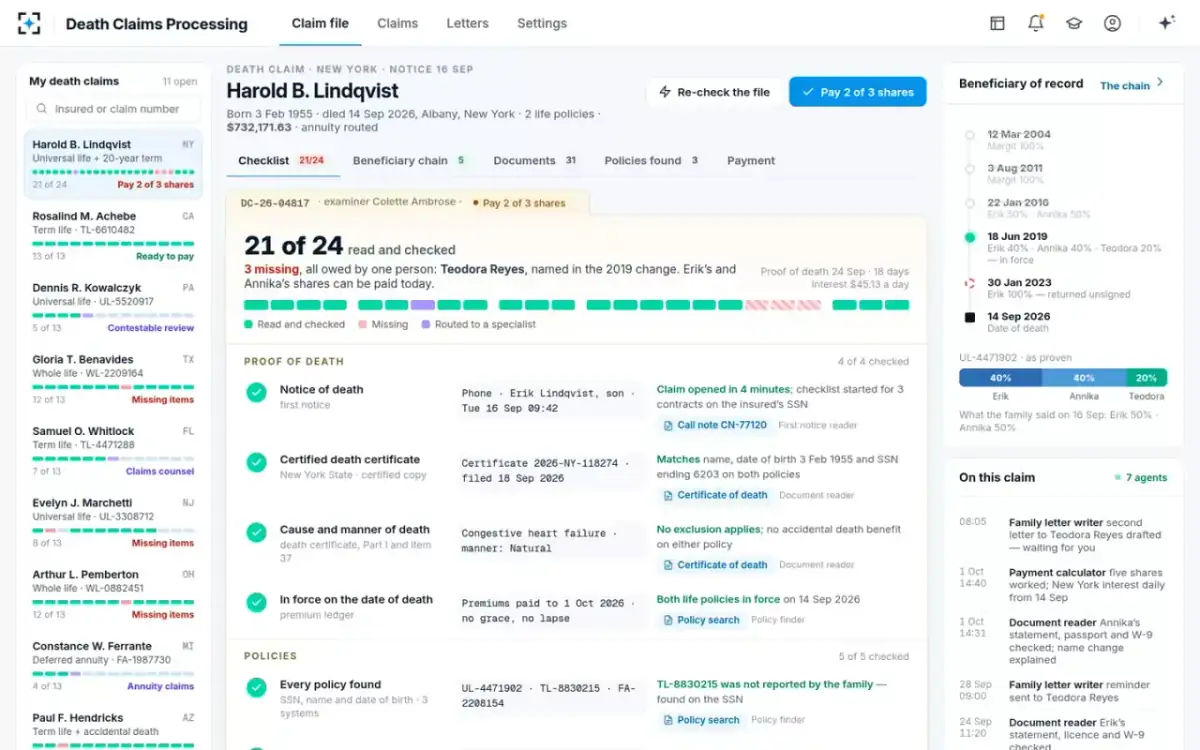
The first notice reader turns a call note, web form or email into a claim with a checklist. On the sample claim, Erik Lindqvist called on 16 September to report his father's death and one policy, and the claim, DC-26-04817, was open with its checklist started for three contracts four minutes later. He was told the claim packet would come by email and that beneficiaries are confirmed from the policy file, not by phone.
That last sentence is a rule, not courtesy. The caller is often a beneficiary, sometimes not, and occasionally someone with a reason to want to know. On the call note Erik said the money was "split between my sister and me". The policy file said otherwise, and a representative who repeated what the screen showed would have started a dispute before the certificate arrived.
The claim file: every item with what was read and what it was checked against
Can software find every policy on an insured?
Software can search every admin system on the insured's identity, which is more than a family can remember and more than a name search finds. The NAIC model expects the claim on one policy to count for the others: notice or proof of loss "submitted against one policy issued by that insurer shall fulfill the insured’s obligation under any and all similar policies issued by that insurer and specifically identified by the insured to the insurer" (Model #903, section 4C). Texas, when a Death Master File match turns up a death, requires the insurer to check its own records for any other product the deceased bought or was covered by (§1109.012).
The cost of missing one is real. Massachusetts examiners found a Boston Mutual Life claim file covering three policies where two were paid in 2016 and the third not until 2018. The search has to cope with how names are actually written, which is why the NCOIL model act asks insurers to account for nicknames, initials, maiden and married names, hyphens, a transposed month and day of birth and an "incomplete social security number".
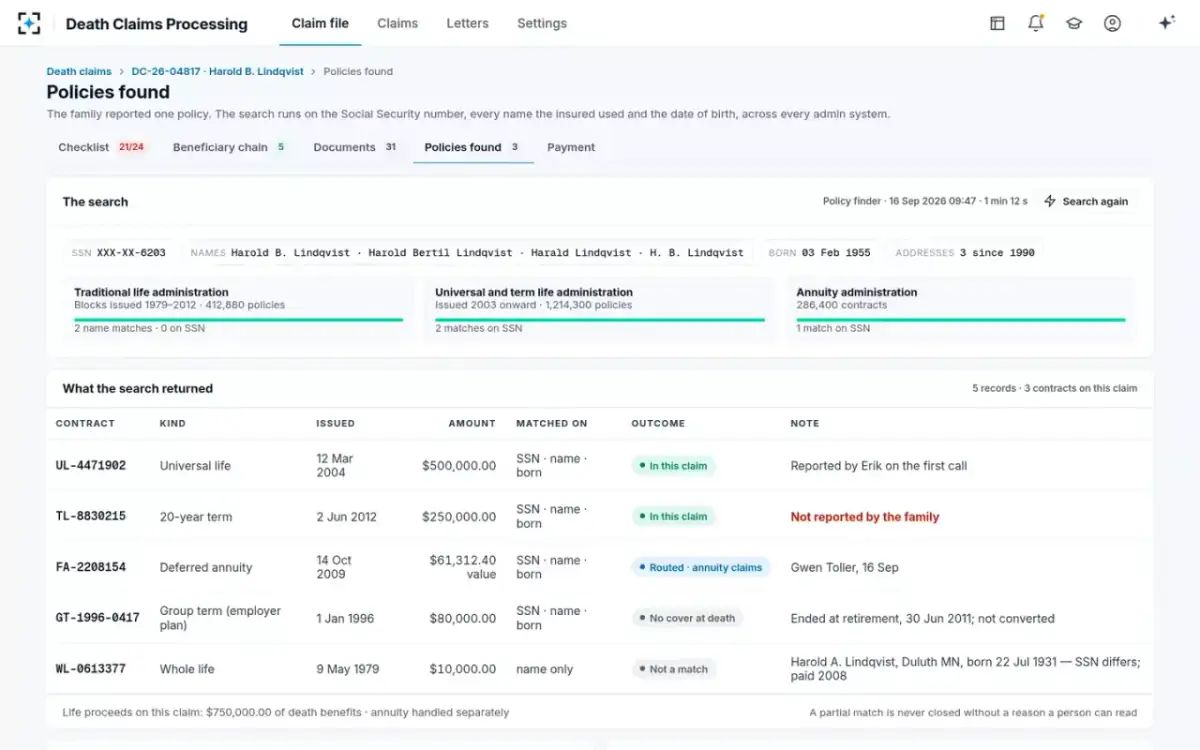
On the sample claim the policy finder searched the SSN, four name variants and the date of birth across three admin systems in 1 minute 12 seconds and returned five contracts. Two were in the claim: the universal life policy the family reported, and a 20-year term policy for $250,000 they did not. A deferred annuity went to annuity claims. A group term plan had ended at retirement in 2011. A 1979 whole life policy on another Harold Lindqvist, born in 1931 in Duluth, matched on name only and was ruled out because the SSN differed, with that reason written on the screen.
Five results, three contracts, and a written reason for every one ruled out
Documents: certified copies and a note in the margin
The document reader reads each certificate, claimant statement, ID and W-9 and checks every field against the policy, noting each mismatch with its page. The NAIC model's documentation rule is the standard it writes to: every document in the file carries the date it was received, processed or mailed. On the sample claim the certified New York certificate, filed 18 September, matched name, date of birth and Social Security number on both policies, and its cause of death, congestive heart failure with a natural manner, meant no accidental death benefit applied.
The limits matter more than the reading. The agent never accepts a copy where the claims manual requires a certified original, and treats a foreign certificate as needing an apostille and a certified translation. Annika Lindqvist Shaw's passport carried her married name; the agent matched it to the 2011 and 2016 forms through her 2014 marriage certificate and said so in the margin, so the examiner did not have to.
Beneficiary history: the check that costs the most when it is wrong
The beneficiary history reader reads every designation and change across the policy's life and proves the one in force on the date of death. On the universal life policy that meant five forms over 22 years. The 50/50 split Erik remembered was the 2016 designation; a 2019 change, signed, witnessed, received and recorded before the death, named Erik 40%, Annika 40% and a family friend, Teodora Reyes, 20%. A 2023 form leaving everything to Erik was returned for a missing signature and never came back.
Paying the remembered split would have sent $96,434.33 to the wrong people and left it owed again to Teodora Reyes, with interest. The tests behind that conclusion, and how to sample them across a book of claims, are in life insurance beneficiary designation: proving the right payee.
Routing on day one, and the payment math
The contestability and routing checker reads issue and reinstatement dates and sends claims that are not the examiner's on the day of notice. On the sample claim both life policies were issued in 2004 and 2012 and never reinstated, so neither was inside a two-year window; the annuity, $61,312.40 in contract value, went to annuity claims on 16 September and was paid separately. The agent never denies a claim. A routed claim waits with a named specialist, not in a queue nobody owns.
The payment calculator then works each share. The universal life policy's $500,000 death benefit pays $482,171.63 after a $17,900.00 loan and $340.55 of loan interest, plus a $412.18 premium drafted after death and refunded. New York interest runs from the date of death at the carrier's 2.25% settlement-option rate, counted daily. Erik and Annika each receive $318,417.30 on 12 October; Teodora's $96,434.33 is held while her documents are missing and accrues $5.94 a day. The model regulation already expects the undisputed parts of a claim to be paid within 30 days when another part is not ready, one of the clocks set out in the death claim clocks of the life claims model regulation. Interest on life insurance proceeds works the same claim under four states' rules.
The sample claim on 12 October, in four numbers
21of 24
file items read and checked before the examiner opened the claim
5
contracts returned by the policy search; 2 in the claim, 1 the family never mentioned
$96,434.33
that the remembered 50/50 split would have paid to the wrong people
$636,834.60
approved to two payees, co-signed above the $250,000 limit
Letters: plain words, and nothing sent until the examiner sends it
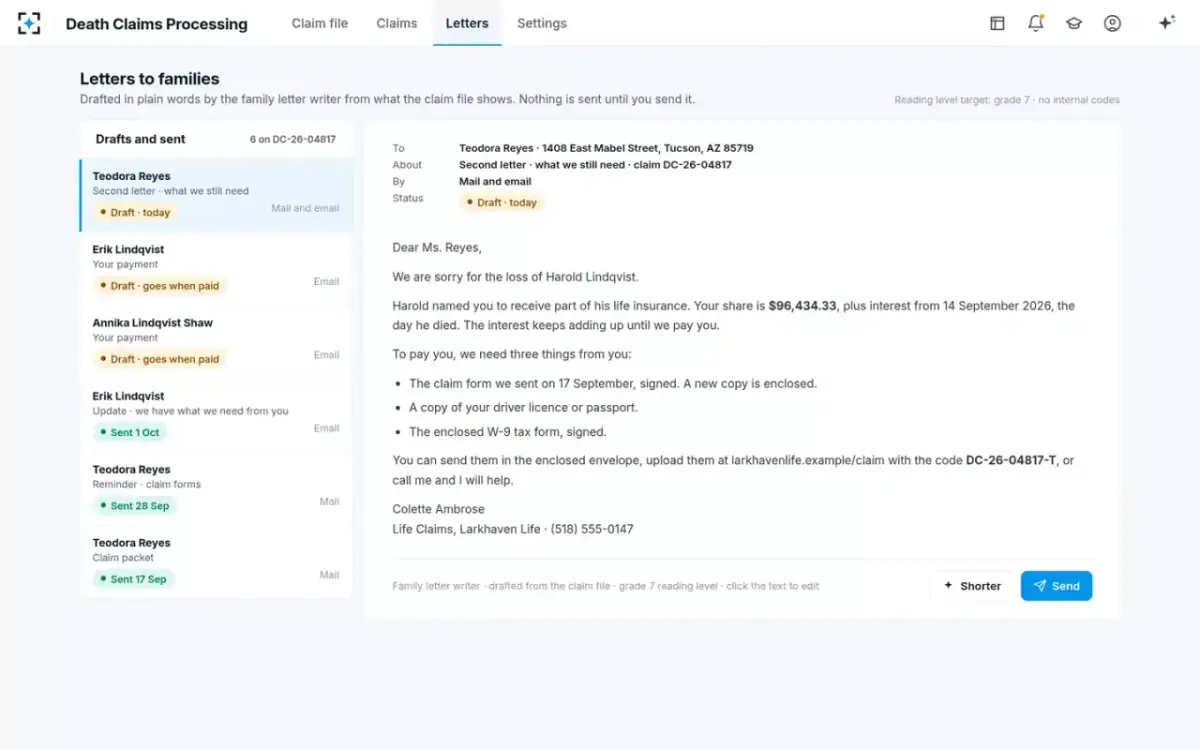
The family letter writer drafts every claimant's letters from the file: the packet, reminders for missing items after 10 and 21 days, and payment letters. On the sample claim, the second letter to Teodora Reyes tells her what Harold left her, $96,434.33 plus interest from the day he died, lists the three things still needed and offers three ways to send them. It is written to a grade 7 reading level with no internal codes, and it sits as a draft until Colette Ambrose, the examiner, presses Send.
Two limits keep the letters safe. No letter names another beneficiary's share, so a family member reading over a shoulder learns nothing they are not entitled to. And no letter goes out on its own, because an examiner may know something the file does not yet show. Regulators test letters too: the NAIC's 2024 examination standards include giving the beneficiary written information on settlement options at the time a claim is made.
A plain-words letter that waits for the examiner
Does AI deny life insurance claims?
In this solution, no: the agents never deny a claim, and every payment is approved by a named examiner. That is a design choice that tracks the law's demands on a denial. The NAIC model requires written notice of denial within 15 days of the decision and says "The insurer shall reference the policy provision, condition or exclusion upon which the denial is based." It also bars denying a claim on a phone call or interview that is not documented in the claim file, a rule that shapes how contestable investigations are recorded (claims investigation software for contestable claims).
A denial is a legal position, and it belongs to a person who can defend it. State insurance regulators also expect insurers that use AI to govern it under existing unfair claims rules; how that guidance works, state by state, is set out in NAIC AI bulletin requirements, and the property side of the same debate in insurance companies using AI to deny claims.
“Show me the designation in force on the date of death and the interest by day. Then I sign.”
Deborah Kline, the sample claim’s life claims supervisor (fictional)
Straight-through processing: where it fits on a death claim
Straight-through processing, a claim paid with no person touching it, fits a death claim poorly, because the slowest inputs come from people: a certified certificate, a signed claimant statement and a W-9 from each payee. What can go straight through is the preparation. On the sample claim the file was read and checked before the examiner opened it, and the examiner's work was to confirm and sign rather than to search and compute.
That is a different promise from no-touch payment, and a safer one to buy. A carrier that wants to pay small, clean claims faster can set the signing rules to match, but the evidence standard does not change with the amount: the payee is the one the file proves, not the one a caller names.
How to evaluate life insurance claims software
Evaluate life claims software on whether it proves its work, not on how much it automates. The questions below come straight from the failure points above. Ask a vendor to answer each on a sample of your own closed claims, where you already know the right answer.
Ten questions to ask any life claims processing vendor
- Does it search on SSN, name variants and date of birth across every admin system?
And does it write down why each partial match was ruled in or out?
- Does every checked item cite the document and page it came from?
An examiner, a supervisor or a market conduct examiner must be able to open it.
- Does it read every beneficiary change, with signed, received and recorded dates?
Or only the latest form on file?
- Does it flag a difference between what the caller said and what the file proves?
The remembered split is the most common wrong answer.
- Does it route contestable, annuity and disputed claims on the day of notice?
To a named person, with the documents attached.
- Does it work interest by your state rule table, and can your compliance team change it?
With each change kept as a new version.
- Can it pay complete shares while another payee’s documents are missing?
Without losing track of the held share’s interest.
- Who signs, and can any agent deny a claim or release money?
The right answers are a named examiner, and no.
- What does a family letter say, and who sends it?
Plain words, no other beneficiary’s share, sent by the examiner.
- What does it connect to on day one?
Admin systems, imaging, premium and loan history, payments and payee screening.
Where the solution fits is the reading and checking between notice and signature. It does not replace a policy admin system, an imaging system or a payment platform; it reads from them and writes back the decision. It does not investigate contestable claims or fraud, and it does not decide disputes. What it needs from each system, and why replacing the admin system is the wrong first project, is set out in a claims system for life insurers.
Questions people ask
How long does life insurance claims processing take?
No regulator or independent study publishes an industry-wide figure, so measure it on your own claims. The NAIC model gives the outer clocks: claim forms within 15 days of notice and payment within 30 days of affirming liability. Botminds estimates a typical two-policy, three-payee claim at about 25 days by hand and about 13 with the agents, most of it waiting on the family’s forms.
Can AI find life insurance policies the family does not know about?
Within the carrier’s own systems, yes, when it searches on the Social Security number, name variants and date of birth rather than the name the caller gives. On the sample claim that search found a $250,000 term policy the family never reported. Policies at other carriers are a different search, through the NAIC Life Insurance Policy Locator.
Who approves an automated life claim payment?
In this solution, a named examiner approves every payment, and a supervisor co-signs above the examiner’s signing limit, $250,000 in the sample. The payment calculator prepares the amounts; it cannot release money.
What does a life insurance claims processor do?
A claims processor or examiner opens the claim, gathers and checks the certificate and claimant forms, searches for every policy, confirms the beneficiary and works the payment. In this solution the agents do the gathering, reading and arithmetic, and the examiner decides and signs.
Does automation change what the beneficiary must send?
No. The policy and the carrier’s claims rules decide what is needed; on the sample claim that is a certified death certificate, and a claimant statement, proof of identity and a W-9 from each payee. What changes is how fast the carrier reads them and how clearly it says what is still missing, and from whom.