Whether an ex-spouse is still the life insurance beneficiary after a divorce depends on the state's law and the policy, and in many states the answer is no even when nobody changed the form. A revocation upon divorce statute treats a designation of a spouse as revoked when the marriage ends, so the money goes to the contingent beneficiary or the estate unless the decree, a later form or another exception says otherwise. The U.S. Supreme Court counted 26 states with such laws in 2018 and upheld applying them to policies bought before the law changed. For a family the result can be a surprise; for a claims examiner it is a question the file has to answer before anyone is paid. Botminds' Death Claims Processing reads the designation history and flags a divorce after a spouse was named, and those claims go to claims counsel rather than being decided by an agent.
This guide describes the rules; it is not legal advice on any one family's situation. Claims examples come from the solution's sample book, on fictional people and a fictional carrier.
Same divorce, same unchanged form, two different answers
Individual policy, revocation state: State law reads the designation as if the former spouse had died before the divorce.
Employer plan governed by ERISA: The plan documents; the Supreme Court held a state revocation statute pre-empted.
Individual policy, revocation state: Usually takes nothing, unless an exception applies.
Employer plan governed by ERISA: Paid as the plan documents direct, if the designation names her.
Individual policy, revocation state: The contingent beneficiary, or the estate if there is none.
Employer plan governed by ERISA: Not the question the administrator asks; it follows the plan.
Individual policy, revocation state: File a new beneficiary form after the decree.
Employer plan governed by ERISA: File a new beneficiary form under the plan’s procedure.
Does divorce remove an ex-spouse as beneficiary?
In a state with a revocation-on-divorce statute, yes by default: the divorce revokes a revocable designation of the former spouse, and the policy pays as if that spouse had died. In a state without one, a divorce alone may leave the old designation standing, though a particular decree can change it. The Supreme Court described the spread of these laws in Sveen v. Melin: states "followed the lead of the Uniform Probate Code, a model statute amended in 1990 to include a provision revoking on divorce not just testamentary bequests but also beneficiary designations to a former spouse," and "26 States have by now adopted revocation-on-divorce laws substantially similar to the Code’s."
The count is from 2018 and the Court did not list the states in its text, so a claims team should read the statute of the state whose law governs each claim rather than rely on a list. The same check matters for the reverse case: in a state without such a law, an ex-spouse named on an unchanged form may still be the payee.
What is a revocation-on-divorce statute?
It is a default rule that cancels a designation in favour of a spouse when the marriage ends, on the theory that most people would not want an ex-spouse to inherit. Minnesota's, enacted in 2002 to track the Uniform Probate Code, shows the shape. Unless the governing instrument, a court order, a property settlement contract or a retirement plan document says otherwise, "the dissolution or annulment of a marriage revokes any revocable" disposition or "beneficiary designation" to "the individual's former spouse or any members of the former spouse's family who are not also members of the individual's family" (§524.2-804, subd. 1).
Three details in that text change claims. The revocation reaches the former spouse's relatives, so a stepchild named alongside the ex-spouse may be cut out too. The policy is then read "as if the former spouse died immediately before the dissolution or annulment" (subd. 2), which sends the money to the contingent beneficiary. And remarriage to the same person revives the designation (subd. 3).
Which states revoke beneficiaries on divorce? Three statutes compared
Statutes in Minnesota, New York and Texas all revoke, but each words its exceptions differently, and a claims examiner has to read the one that applies. New York's covers "beneficiary designation in a life insurance policy" expressly and, to the extent permitted by law, pension and retirement plans (EPTL §5-1.4). Texas's is written for life insurance alone and lists three ways the former spouse can still take (Family Code §9.301).
Revocation on divorce in three states: what is revoked, what saves the designation, who is protected
| Minnesota §524.2-804 | New York EPTL §5-1.4 | Texas Family Code §9.301 | |
|---|---|---|---|
| What is revoked | Revocable designations to the former spouse and the spouse’s relatives who are not the insured’s | Revocable dispositions to the former spouse, including a life insurance beneficiary designation | A pre-decree designation of the spouse under a life policy in force at the decree |
| What keeps it | Express terms of the instrument, a court order, a marital property contract, a plan document | Express terms of a governing instrument | The decree names the former spouse; the insured re-names her after the decree; or she takes in trust for a child or dependant |
| If revoked, who takes | As if the former spouse died just before the divorce | Set by the section’s later paragraphs; read them with the policy | The named alternative beneficiary, or else the insured’s estate |
| Insurer protection | Not liable for good-faith payment before written notice of the divorce reaches its main office | Not liable for good-faith payment before written notice of the divorce | Liable to the right payee only if written notice reached its home office before payment and it did not interplead |
Sveen v. Melin: the policy bought before the law
The leading case is about a policy older than the statute that revoked it. Mark Sveen married Kaye Melin in 1997 and the next year bought a life policy naming her as primary beneficiary and his two children from a prior marriage as contingent beneficiaries. Minnesota adopted its revocation statute in 2002. The marriage ended in 2007, the decree said nothing about the policy, and Sveen did not change the form. He died in 2011, and Melin and his children made competing claims.
The district court awarded the money to the children; the Eighth Circuit reversed, holding that applying the 2002 law to a 1998 policy violated the Contracts Clause. The Supreme Court reversed again on 11 June 2018: "The retroactive application of Minnesota’s statute does not violate the Contracts Clause." Its reasoning rested on how little the law asked of the policyholder.
“If the law’s presumption about what an insured wants after divorcing is wrong, the insured may overthrow it simply by sending a change-of-beneficiary form to his insurer.”
Sveen v. Melin, 584 U.S. ___ (2018), opinion of the Court
The dissent pointed to the cost of that default. It quoted Melin's testimony that she and Sveen had agreed, repeatedly, to keep each other as primary beneficiaries despite the divorce. In the lower courts the case carried the insurer's name, Metropolitan Life Insurance Co. v. Melin: a carrier that pays on the face of a form, in the wrong state, pays the wrong person.
Sveen v. Melin in five dates
1998
policy bought, the spouse named primary and two children contingent
2002
Minnesota adopts revocation on divorce
2007
divorce; the decree is silent and the form unchanged
2011
death; the former spouse and the children both claim
What if the divorce decree says keep life insurance?
Then the decree is usually the exception that keeps the former spouse as beneficiary, but only in the way each statute allows. Texas says the pre-decree designation is not effective unless "the decree designates the insured's former spouse as the beneficiary", the insured re-designates her after the decree, or she is designated "to receive the proceeds in trust for, on behalf of, or for the benefit of a child or a dependent of either former spouse" (§9.301(a)). Minnesota's exceptions include "a court order" and "a contract relating to the division of the marital property" (§524.2-804).
A decree that orders the insured to keep coverage for a child's support, without naming who the beneficiary must be, is harder, and it is the kind of question an examiner should not settle. The examiner's job is to put the decree, the policy and the designation history side by side and send the file to claims counsel, and, where two people claim, to see that the money goes to a court rather than to whichever person writes first.
Can an ex-wife still claim the life insurance?
She can claim, and she will be paid if the governing law and the file support her. That happens when the policy is in a state without a revocation statute, when an exception applies (the decree names her, she was re-designated after the divorce, or she holds the proceeds in trust for a child under Texas law), or when the policy is an employer plan governed by ERISA and the plan documents name her. Where those facts are disputed, the insurer's safe course is the one the statutes point to. Texas protects an insurer that has "interpleaded the proceeds into the registry of a court" (§9.301(c)), and Minnesota lets a payor that has received written notice deposit the money with the probate court and be discharged (§524.2-804, subd. 5).
That deposit is a proceeding of its own, with its own clocks; it is followed step by step through one fictional dispute in the life insurance interpleader process.
Does revocation on divorce apply to employer group life insurance?
Not to a plan governed by ERISA. In Egelhoff v. Egelhoff a Washington statute revoked a spouse's designation on divorce for nonprobate assets, including life insurance and employee benefit plans. The Supreme Court held it "expressly pre-empted" for ERISA plans because it "binds plan administrators to a particular choice of rules for determining beneficiary status," requiring them to pay "the beneficiaries chosen by state law, rather than to those identified in the plan documents." Eight years later the Court described the result as a rule that the administrator follows the plan documents, in Kennedy v. Plan Administrator for DuPont.
Group life under employer plans is claimed through the employer's carrier and administered under its own rules, from enrollment to grace periods; the group side of that work is covered by guides such as group life insurance grace period. An individual policy the insured owned is read under state law.
How an examiner proves the payee when a divorce is on the file
The examiner proves the payee by establishing four facts in order: whether a spouse was ever designated, whether and when the marriage ended, which state's law governs, and whether any exception applies. The order matters because the first fact is in the policy file and the last ones are not; an examiner who starts with the decree has nothing to read it against.
A divorce on the file: who reads what, and who decides
Agent
Read every designationFind each designation in the policy’s life and note any that names a spouse, with signed, received and recorded dates.
Agent
Find the divorceLook for a decree, a name change, or a claimant statement that mentions one; note the date against the designation dates.
Never: decide whether the divorce revoked the designation
Agent
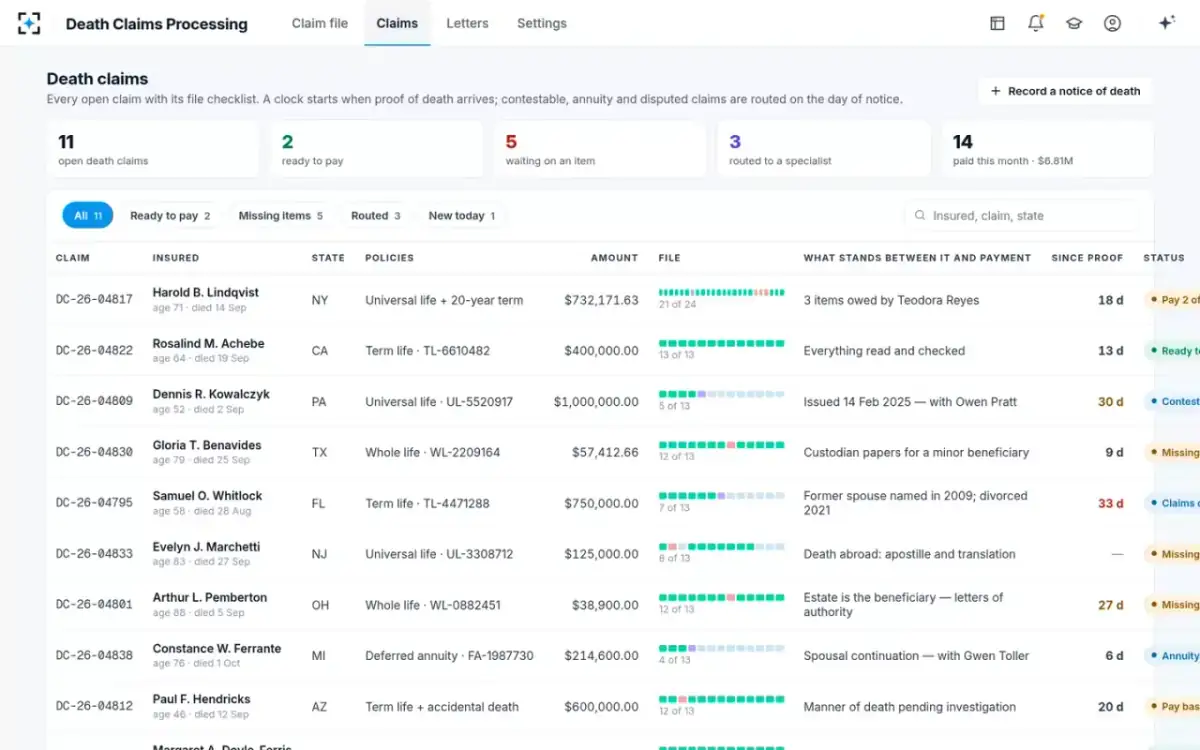
Flag and routeFlag a designation of a spouse that predates a divorce; route the claim to claims counsel on the day it appears, with the chain attached.
A person decides
Claims counselReads the governing statute and decree, decides whether an exception applies, and decides whether to pay or deposit with a court.
A person decides
ExaminerPays on counsel’s decision; the payment calculator works the shares and any interest.
Notice rules make speed matter. All three statutes protect an insurer that pays in good faith before written notice of the divorce reaches it. Once notice arrives, Minnesota makes the payor liable for any payment it then makes, and Texas protects only an insurer that had not received notice or that interpleaded. A claims desk that logs notice the day it arrives, and stops the payment line on that claim, keeps the protection the statutes offer.
A former spouse named in 2009, a divorce in 2021: routed to claims counsel
Changing the beneficiary after divorce: the form that ends the question
The one step that removes the doubt is a new beneficiary form filed after the decree, under the policy's or plan's procedure, naming whoever the insured now wants, including the former spouse if that is the intent. The Supreme Court's own answer in Sveen was that the form is easy. For a claims operation the lesson is the reverse: every unchanged form after a divorce is a claim that will need a lawyer, and the cost lands at the worst time for the family.
Carriers can lower that cost before a death. A change form that asks whether the owner is divorced, and a reminder after a name or address change that the beneficiary may be out of date, are cheap. At claim time, what matters is reading the whole history rather than the last form, which is the approach set out in life insurance beneficiary designation: proving the right payee.
Questions people ask
Can the insured change the beneficiary after divorce?
Yes, the policy owner can file a new beneficiary form at any time under the policy’s procedure, unless a decree or settlement restricts it. The Supreme Court in Sveen called it a simple act: sending a change-of-beneficiary form to the insurer.
What happens when the insured never changed the beneficiary after divorce?
In a state with a revocation statute, the former spouse’s designation is generally treated as revoked and the contingent beneficiary or the estate takes. In a state without one, or under an employer plan governed by ERISA, the former spouse may still be paid as named.
What are the life insurance beneficiary rules after divorce in Texas?
Texas Family Code §9.301 makes a pre-decree designation of the spouse ineffective unless the decree names her, the insured re-designates her after the decree, or she takes in trust for a child or dependent. If revoked, the proceeds go to the named alternative beneficiary or else to the insured’s estate.
Does revocation on divorce also remove the ex-spouse’s family?
In Minnesota, yes: the statute revokes designations to the former spouse’s relatives who are not also the insured’s relatives. Other states word it differently, so the governing statute has to be read.
Can a remarriage bring back the old designation?
Under Minnesota’s statute, remarrying the same former spouse revives provisions the divorce revoked. Most claim files will not show a remarriage unless someone reports it, which is one more reason these claims go to claims counsel.