A life insurance beneficiary designation is the policy owner's written instruction naming who receives the death benefit, and the one that governs a claim is the designation in force on the date of death under the policy's own change rules. It is not always the most recent form in the file, and it is often not the split the family describes on the phone. Getting it wrong is the most expensive error in a death claim, because an insurer that pays the wrong person can owe the money again. Botminds' Death Claims Processing treats the payee as something to prove from documents: an agent reads every designation in the policy's life and shows the examiner the one in force, with its evidence. This guide sets out the tests behind that proof and how to measure that they work.
The examples come from a sample claim in the solution, on fictional people and a fictional carrier. Harold B. Lindqvist died on 14 September 2026 holding a universal life policy with five designations in 22 years.
Eight tests a payee must pass before money moves
- The insured is the person who died
Name, date of birth and Social Security number on a certified certificate, against the policy.
- Every designation in the policy’s life is in the file
Application, changes, and forms returned or never completed.
- Each change is valid under the policy
Signed by the owner, witnessed where required, shares that add to 100%.
- They are ordered by the policy’s own rule
Signed, received and recorded dates, judged as of the date of death.
- Classes and survivorship are applied
Primary, contingent, per stirpes, and who outlived whom.
- No exception route applies
Divorce after the designation, an adverse claim, the cause of death, a minor payee.
- The payee is the person named
Identity and claimant statement against the designation, with name changes explained.
- The shares add to the net proceeds
Each share on the right policy, after loans and refunds.
Who is the beneficiary on a life insurance policy?
The beneficiary is whoever the owner named in writing and filed with the insurer, as the policy allows. Texas states the rule for its life insurers in one sentence: if an individual obtains a policy, "designates in writing a beneficiary to receive the proceeds of the policy, and files the written designation with the company, the company shall pay the proceeds that become due on the death of the insured to the designated beneficiary" (Tex. Ins. Code §1103.102). The next section gives the insurer its protection: absent notice of an adverse claim before payment, a company that pays the designated beneficiary "is discharged from all liability under the policy" (§1103.103).
That protection is narrower than it sounds. It covers paying the designated beneficiary, meaning the one the file actually proves, not the one a caller describes. On the sample claim the son said on the first call that the money was "split between my sister and me". That was true of the 2016 designation. It had been replaced in 2019.
What the family said against what the file proves, on one policy
What the family said · first call: 50%, $241,085.82
What the file proves · 2019 change: 40%, $192,868.65
What the family said · first call: 50%, $241,085.82
What the file proves · 2019 change: 40%, $192,868.65
What the family said · first call: Not mentioned
What the file proves · 2019 change: 20%, $96,434.33
What the family said · first call: The 2016 designation, from memory
What the file proves · 2019 change: Signed 18 Jun, received 21 Jun, recorded 25 Jun 2019
Does the last beneficiary form always win?
No. The designation that wins is the last change the policy treats as effective, and a form can be the most recent in the file without ever taking effect. Each policy sets the conditions in its change-of-beneficiary provision. The sample policy's (section 9.2) says the last change signed by the owner and received before death governs, and that a recorded change takes effect as of the date it was signed. Other forms word it differently, and older blocks carry older wording, which is why an examiner reads the provision in the policy itself rather than a summary of it.
On the sample claim the last form in the file, dated 30 January 2023, named Erik as the sole beneficiary. Page 2, the owner's signature, was blank. Larkhaven Life returned it on 9 February 2023 asking for a signature, and it never came back. The sample carrier's claims manual applies substantial compliance, the doctrine that can give effect to a change the owner tried and failed to complete, only when the owner did everything he could to finish it. Forty-three months with nothing more done does not meet that test, so the 2019 change governs.
The most recent form in the file, and why it never took effect
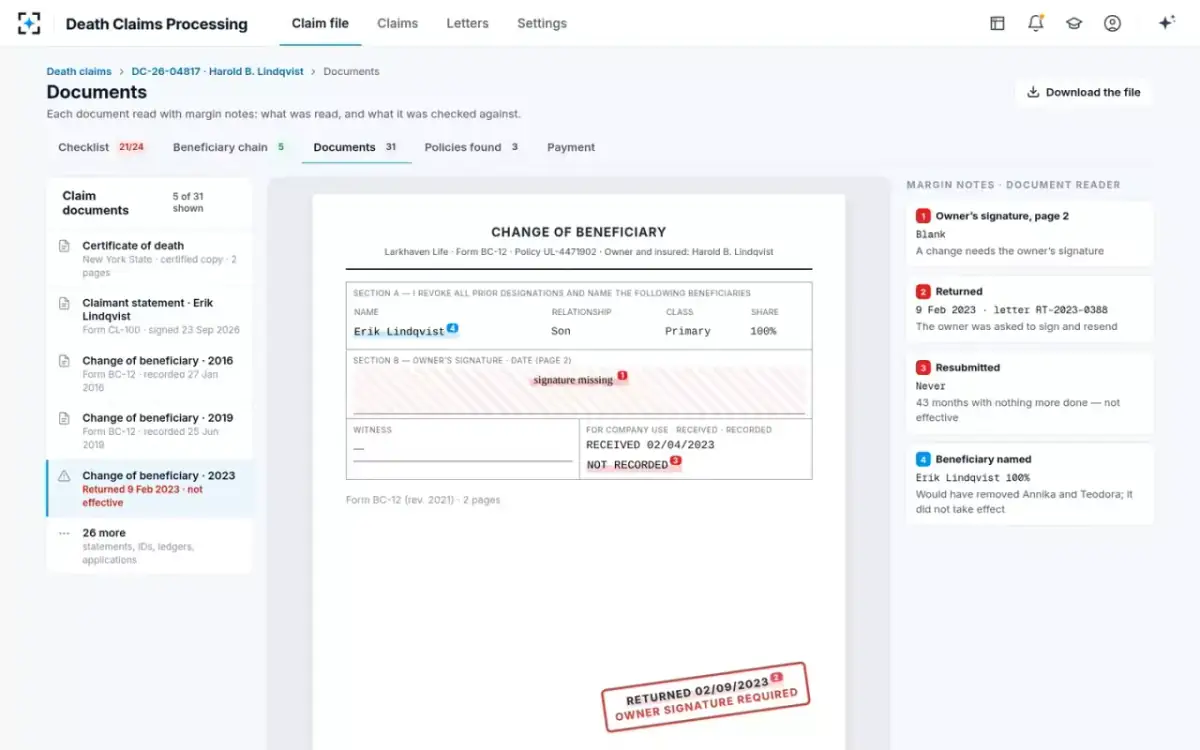
Substantial compliance is a doctrine of state case law, and it is exactly the kind of question that does not belong to software. The solution flags the 2023 form and shows why the sample carrier's rule was not met; if a family member argued otherwise, the file would go to claims counsel, and a file with two claimants is where an interpleader begins.
Primary, contingent and per stirpes: reading the classes
A primary beneficiary takes first; a contingent beneficiary takes only if no primary survives the insured; and "per stirpes" tells the insurer how to divide a share when a beneficiary has died leaving children. Minnesota's probate code defines it: where an instrument calls for distribution "per stirpes," the property "is divided into as many equal shares as there are (i) surviving children of the designated ancestor and (ii) deceased children who left surviving descendants" (§524.2-709). Each surviving child takes a share; a deceased child's share passes down to that child's descendants in the same way.
The sample claim's term policy shows the contingent rule at work. Its 2012 application named Harold's wife, Margit, as primary and "children of the insured, equally" as contingent. Margit died in November 2015 and the designation was never changed, so on his death the contingent class took: Erik and Annika, $125,000.00 each. Had one of them died before Harold leaving children, the policy's own wording, not a per stirpes default, would decide whether those grandchildren took the share.
Survivorship is decided by statute when deaths are close together. Texas says that if the insured and a beneficiary "die within a period of less than 120 hours, the insured is considered to have survived the beneficiary" for the beneficiary's rights under the policy (Tex. Est. Code §121.153). The chapter does not apply where an insurance contract provides otherwise, so the policy's own survivorship clause is the first place to look.
What if the beneficiary designation is unclear or missing?
An unclear or missing designation is resolved first by the policy's own wording on who takes when no named beneficiary survives, and then by state law, never by the examiner's sense of what the insured wanted. State statutes fill some of the gaps. In Texas, when a beneficiary forfeits under the slayer rule and no contingent beneficiary is entitled, "the nearest relative of the insured is entitled to receive those proceeds" (§1103.152).
Where the words themselves are ambiguous (a "wife" not named, "my children" when a stepchild was raised as one, a trust that no longer exists), the payee is a legal question. The solution's beneficiary history reader marks it and sends it to claims counsel; it never resolves it. What it does do is put every designation, with its dates and signatures, in one place, so counsel starts from evidence rather than from the box of microfiche.
Can a will override a beneficiary designation?
For the insurer, the designation filed with it decides whom to pay unless someone with a bona fide claim gives notice first, and Texas writes that rule into statute: the section quoted above directs the company to the designated beneficiary and discharges it for paying that person. A will can still matter: a claimant who relies on one may send the insurer notice of an adverse claim, and in Texas a company need not pay the designated beneficiary once someone with a genuine legal claim to the money gives notice of it (§1103.102(b)), the first step in the life insurance interpleader process.
Employer plans add a federal rule. For a plan governed by ERISA (a savings plan, in that case), the Supreme Court held that the administrator "did its ERISA duty by paying the SIP benefits to Liv in conformity with the plan documents," and that "ERISA provides no exception to the plan administrator’s duty to act in accordance with plan documents" (Kennedy, 2009). Group life claims under employer plans belong to the group benefits desk, and their rules differ from individual policies.
The exception routes: divorce, slayer, simultaneous death and minors
Four facts change who is paid even when the designation is clear, and each should route the claim away from the standard path. Divorce after the designation can revoke a former spouse's designation by statute in many states; life insurance beneficiary after divorce covers the 26 states the Supreme Court counted in 2018 and the exceptions. A beneficiary who killed the insured forfeits: in Texas, a beneficiary "forfeits the beneficiary's interest in the policy or contract if the beneficiary is a principal or an accomplice in wilfully bringing about the death of the insured" (§1103.151).
Close deaths bring in the 120-hour rule above. A minor cannot simply be sent a check. Texas lets a debtor who owes $250,000 or less to an incapacitated resident with no guardian of the estate, which the section's own wording shows includes a minor, pay the county clerk instead, giving the payee's name, Social Security number, the nature of the disability, address and, for a minor, age (Tex. Est. Code §1355.001). On the sample carrier's claims screen, a Texas whole life claim is waiting on exactly that: custodian papers for a minor beneficiary.
How do insurers verify beneficiaries? An accuracy framework
Insurers verify a beneficiary by passing the claim through a fixed set of tests, each tied to the document that answers it and the error it prevents. Written down, the tests become a framework a claims auditor can re-perform. The table below is that framework, with the result each test produced on the sample claim.
The payee tests, the evidence each needs, and the error each prevents
Identity of the insured
EvidenceCertified certificate against the policy: name, date of birth, SSN
Error it preventsPaying on the wrong person’s death
On the sample claimMatched on both policies
Every designation found
EvidenceApplication, every change form, returned mail, imaging
Error it preventsA later change missed in a returned-mail folder
On the sample claim5 forms over 22 years, one from the returned-mail folder
Each change valid
EvidenceOwner’s signature against the specimen, witness, shares adding to 100%
Error it preventsTreating an unsigned form as effective
On the sample claim2023 form: page 2 unsigned, not effective
Order by the policy’s rule
EvidenceSigned, received and recorded dates under the change provision
Error it preventsOrdering by the date someone typed the form
On the sample claim2019 change governs: signed 18 Jun, recorded 25 Jun 2019
Class and survivorship
EvidencePrimary and contingent classes, per stirpes wording, dates of death
Error it preventsPaying a predeceased primary’s estate
On the sample claimTerm policy: primary died 2015, contingent class takes
Exception routes cleared
EvidenceDivorce after the designation, adverse claims, cause of death, minors
Error it preventsPaying into a dispute the file already showed
On the sample claimNone; would have gone to claims counsel
Payee is the person named
EvidenceID and claimant statement against the designation, name changes explained
Error it preventsPaying the right name to the wrong person
On the sample claimMarried name matched through a 2014 certificate
Shares add to the proceeds
EvidenceEach share against the net death benefit
Error it preventsRounding or a share applied to the wrong policy
On the sample claim40 / 40 / 20 on $482,171.63
The second test is the one manual processes most often skip. The sample file's five designations sat in two places: four in the policy file and one, the 2023 form, in a returned-mail folder. An examiner who searched the policy file alone would have found the 2019 change and got the right answer for the wrong reason. One who found the 2023 form without its return letter might have paid Erik everything.
Measuring payee accuracy: sample paid claims the way examiners do
"Proven" becomes a number when someone re-performs the tests on a sample of paid claims and counts the failures. State examiners already work this way. The NAIC's examination standards include that "Claims are properly handled in accordance with policy provisions and applicable statutes" (2024 summary), and the model claims regulation requires claim data to be retrievable for "the current year and the two (2) preceding years" (Model #903), so the population for a look-back exists.
A useful design has four parts. Define an error precisely: a payment to anyone other than the payee the tests prove, or in a different share. Stratify the paid claims, because the risk is not even: claims with more than one designation, a contingent or estate payee, a change within a few years of death, or a divorce in the file deserve a heavier sample. Re-perform all eight tests from the documents, not from the examiner's notes. Then report the result with its uncertainty. Zero errors in 100 files does not prove a zero error rate; at 95% confidence it is consistent with a true rate as high as about 3% (our arithmetic: 1 − 0.051/100). For the sample sizes that bound an error rate more tightly, see the claims audit sample size calculator.
One policy, one payee question, in numbers
5forms
designations on one policy across 22 years
43months
since the unsigned 2023 change was returned, with nothing more done
3
beneficiaries under the change in force, against 2 the family named
$96,434.33
paid to the wrong people on the remembered split
Where Death Claims Processing proves the payee
In Death Claims Processing, the beneficiary history reader does the second to fifth tests and the document reader the first and seventh; the examiner reads the result and signs. On the sample claim it found the five forms, read each for signer, witness and the signed, received and recorded dates, ordered them under the policy's change provision as of 14 September 2026, and flagged the difference from what Erik reported. By the reading log on the screen it took about three minutes, 09:49 to 09:52. The examiner's job was to check the conclusion against the forms and sign, and every step she needed was on one screen.
Every designation in order, the rules applied, and the difference from the first call
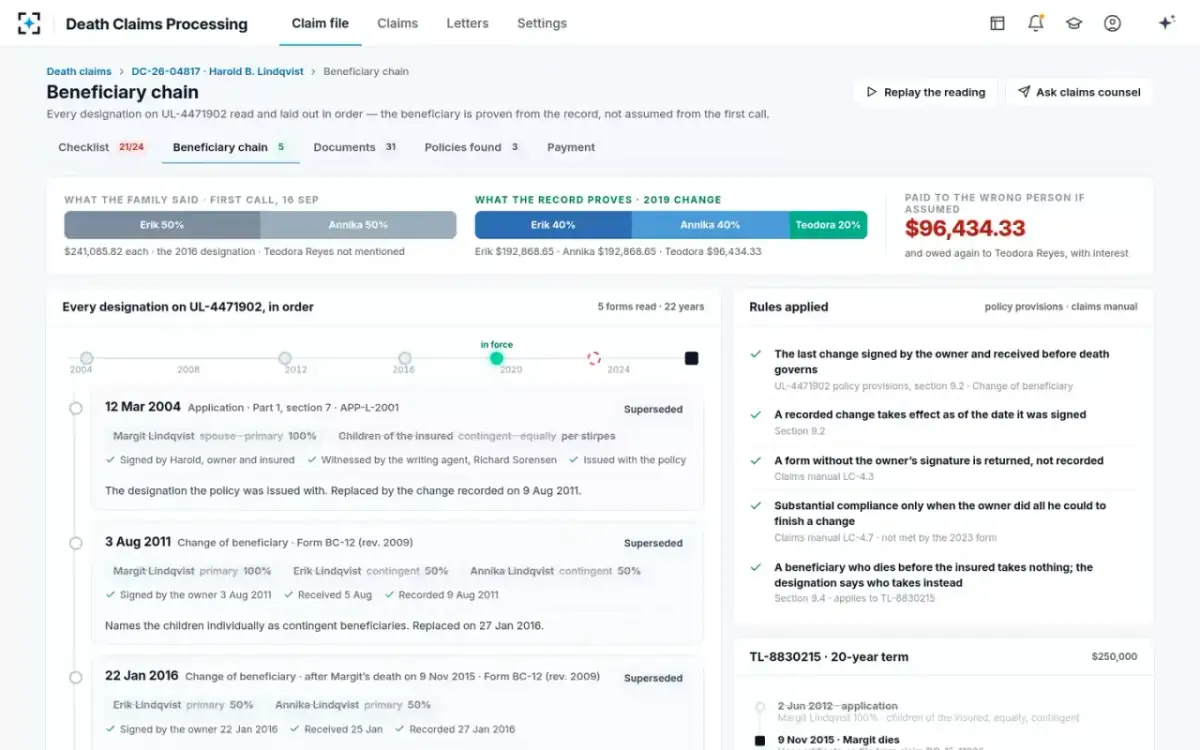
Two limits keep the agent honest. It never resolves a dispute, a divorce question or an unclear designation; those go to claims counsel with the chain attached. And it always flags a difference between what a claimant reported and what the file proves, because that difference is the early sign of a second claimant. How the rest of the claim moves around this check is set out in life insurance claims processing, agent by agent.
Questions people ask
What is a contingent beneficiary?
A contingent beneficiary takes the death benefit only if no primary beneficiary survives the insured. On the sample term policy the primary, the insured’s wife, died in 2015, so the contingent class, the children equally, took $125,000.00 each.
What does per stirpes mean on a beneficiary designation?
It means a share passes down a family branch. Minnesota’s code divides the property into equal shares for each surviving child and each deceased child who left descendants, and a deceased child’s share is divided among that child’s descendants the same way. A designation that says “children, per stirpes” therefore reaches grandchildren where a child has died.
What happens if the beneficiary dies before the insured?
The beneficiary takes nothing, and the share passes as the designation directs: to the other primary beneficiaries, to the contingent class, or to whoever the policy names when no beneficiary survives. Where both die within a short time, Texas treats the insured as surviving a beneficiary who dies within 120 hours, unless the policy says otherwise.
Can you change a life insurance beneficiary after the insured dies?
No one can make a new designation after death. A change form signed before death but received after it raises a question of policy wording and state law; in Death Claims Processing it goes to claims counsel and is never decided by an agent.
How do I fill out a life insurance beneficiary designation correctly?
Name each person with a full name and date of birth, state each share so the shares add to 100%, name contingent beneficiaries, sign every page that asks for the owner’s signature, and keep the insurer’s confirmation. The sample 2023 form failed on one item: the owner’s signature on page 2.