Interest on life insurance proceeds is the amount a life insurer must add to a death benefit for the time between a fixed point, the date of death or the date proof of death arrives, and the date it pays or offers to pay. State law sets the rule, and the four states compared here disagree on both the start and the rate: New York counts daily from the date of death, California owes interest only if the claim takes more than 30 days, and Texas and Florida start the meter when proof of death arrives. For a claims team that makes every day of delay a dollar figure that differs by state and by payee. Botminds' Death Claims Processing works that figure from a rule table the carrier's compliance team keeps, payee by payee and day by day, so the examiner signs a number rather than computing one.
The worked example on this page is a sample claim from the solution, on fictional people and a fictional carrier: two policies paying $732,171.63 after a loan and a refund, a death on 14 September 2026, proof of death received on 24 September and payment on 12 October.
Interest on death proceeds in four states: when it starts, when it stops, at what rate
StartsDate of death
StopsDate of payment
RateThe rate the insurer currently pays on proceeds left under its interest settlement option
AlsoCounted daily; this section’s interest does not run for any period interest is owed under interpleader law
StartsDate of death, but only if not paid within 30 days of the death
StopsPayment
RateNot less than the current rate on death proceeds left on deposit
AlsoBeneficiaries must be told interest will be paid, and at what rate
StartsReceipt of due proof of loss
StopsAcceptance of the claim and the offer to pay
RateThe policy’s rate, or else the rate on proceeds left on deposit
AlsoInterest is paid with the proceeds
StartsReceipt of written due proof of death
StopsPayment (lump-sum policies)
RateAt least Moody’s Corporate Bond Yield Average, monthly average corporate, on the day the claim was received
AlsoAn 8% floor applies if the index method changes substantially
Do life insurance companies pay interest on death benefits?
Yes, in states whose law requires it, and the law, not the insurer's goodwill, decides how much. New York's statute is the most direct. When no lawsuit has been filed, interest on the principal paid to the beneficiary "shall be computed daily at the rate of interest currently paid by the insurer on proceeds left under the interest settlement option, from the date of the death of an insured" to the date of payment, and it "shall be added to and be a part of the total sum paid." If the beneficiary sues and wins, New York sets interest from the date of death to the verdict.
The interest is part of the claim, not a courtesy line. An examiner who pays the principal on time but leaves out the statutory interest has underpaid the claim, and the shortfall is still owed to the payee. Under the NCOIL model act on unclaimed benefits, statutory interest is also kept apart from what is handed to the state as unclaimed property: interest payable under the state's insurance interest law "shall not be payable as unclaimed property" (NCOIL model, section 4C).
When does interest start on a life insurance claim? Date of death or proof of death
It starts at one of two events, and which one depends on the state. New York and California count from the date of death; Texas and Florida count from the day the insurer receives proof. Texas puts it in one sentence: interest "accrues from the date the company that issues the policy receives due proof of loss until the date the company accepts the claim and offers to pay." Florida requires a lump-sum payment to include interest "from the date the insurer receives written due proof of death of the insured" (§627.4615).
California's rule is a cliff rather than a meter. An insurer that "fails or refuses to pay the proceeds of, or payments under, any policy of life insurance issued by it within 30 days after the date of death of the insured shall pay interest" from the date of death (§10172.5(a)). Paid on day 30, the claim owes nothing; paid on day 31, it owes 31 days. The same section adds that, whenever possible, payment should be made within those 30 days.
The start date is where rule tables go wrong. A table that starts Texas interest at death overpays every Texas payee by the days between death and proof; one that starts New York interest at proof underpays every New York payee. Either way the error repeats on every claim until someone reads the statute again.
What interest rate is paid on death proceeds?
Three of the four states tie the rate to the insurer's own deposit or settlement-option rate, and one ties it to a market index. New York uses the rate the insurer currently pays on proceeds left under its interest settlement option; California, not less than its current rate on death proceeds left on deposit; Texas, the rate in the policy or, if the policy has none, the rate on proceeds left on deposit. Florida sets a floor at Moody's Corporate Bond Yield Average, monthly average corporate, "as of the day the claim was received", and falls back to "not less than 8 percent" if the index method changes substantially.
That makes the settlement-option rate a regulated number in practice even though the carrier sets it. In the sample, the carrier's rate is 2.25%, set in the solution's settings in steps of a quarter point by the claims compliance team. Florida's index is a published bond yield average the carrier does not set, so a Florida claim's rate depends on the day the claim was received, and the carrier's table has to carry that month's figure.
One claim, four states: the same $732,171.63 worked four ways
Worked under each rule, the sample claim owes between nothing and $1,263.75 of interest on 12 October. The principal is $732,171.63: $482,171.63 from a universal life policy after its loan and refund, and $250,000 from a term policy. At 2.25% that is $45.13 a day. From death on 14 September, 12 October is day 28; from proof on 24 September, it is day 18.
Interest owed on the sample claim if paid on 12 October, by state rule
Three lessons sit in those bars. The start event moves the bill more than the rate: New York and Texas use the same rate here, and the ten days between death and proof are $451.34. California rewards paying inside 30 days and punishes missing it by a day with the whole period. And Florida prices its interest off a market index rather than the carrier's own rate, so a Florida claim's interest moves with bond yields: every point of the index is $361.07 on this claim.
How is death claim interest calculated, payee by payee?
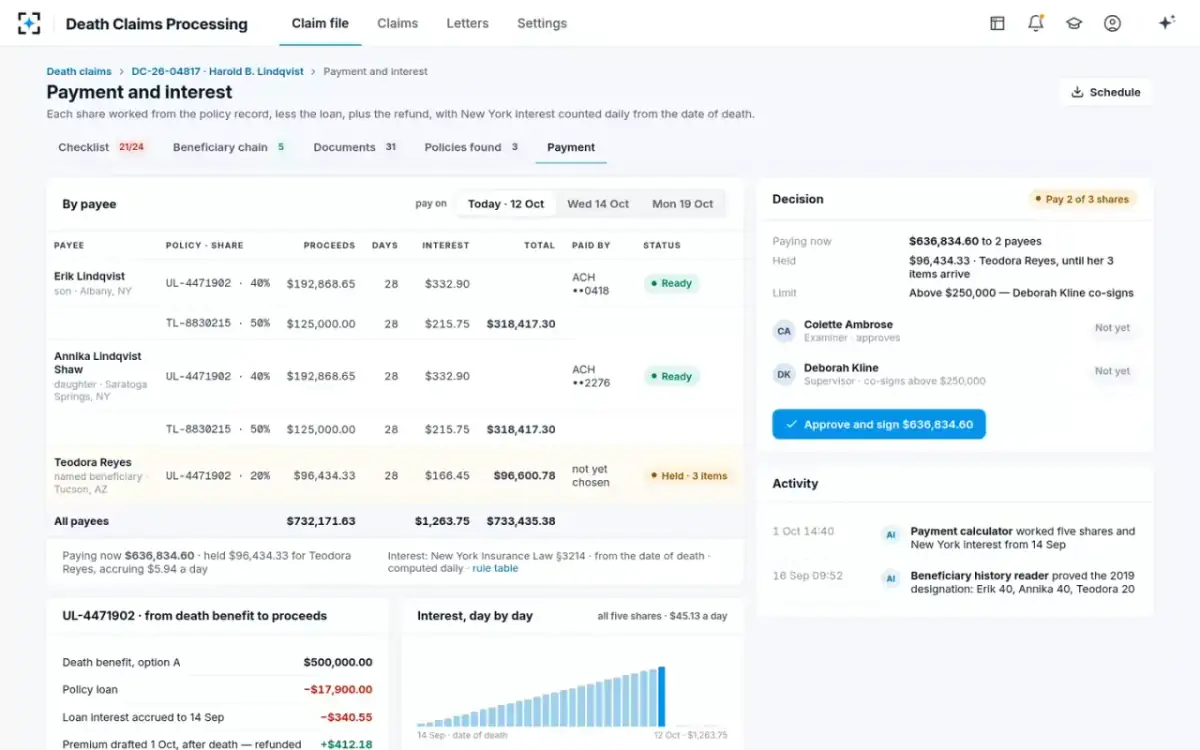
Interest is calculated on each payee's share, from that payee's start date to that payee's payment date, because shares are often paid on different days. In the sample, Erik and Annika Lindqvist were paid on 12 October; Teodora Reyes, named in the same 2019 designation for 20% of the universal life policy, had not yet sent her claimant statement, ID and W-9. Under New York's rule her $96,434.33 keeps earning interest until she is paid, at $5.94 a day.
The sample claim’s interest on 12 October, share by share (New York rule)
| Payee and share | Principal | Days | Interest | Status |
|---|---|---|---|---|
| Erik · 40% of universal life | $192,868.65 | 28 | $332.90 | Paid by ACH |
| Erik · 50% of term | $125,000.00 | 28 | $215.75 | Paid by ACH |
| Annika · 40% of universal life | $192,868.65 | 28 | $332.90 | Paid by ACH |
| Annika · 50% of term | $125,000.00 | 28 | $215.75 | Paid by ACH |
| Teodora Reyes · 20% of universal life | $96,434.33 | 28 so far | $166.45 so far | Held: 3 items owed; $5.94 a day |
The arithmetic is simple; the bookkeeping is not. A spreadsheet that computes interest at payment time has to know each share's principal after loans and refunds, each payee's state rule, and the date each was paid. Hold one share for a month and the interest on it has to be recomputed on the day it is released, not copied from the day the others were paid. The payment calculator agent does that recomputation on every share, every day, and the examiner sees the running figure.
Each share, each day, with the statute the interest rests on
What happens to interest during a dispute or an interpleader?
A dispute does not stop interest automatically; the state rule and the court do. New York's statute switches its own interest off for any period in which interpleader law already requires the insurer to pay interest (§3214(d)). Texas ends interest under §1103.104 on the date the company accepts the claim and offers to pay, and separately requires a life insurer facing a bona fide adverse claim to pay or file an interpleader and deposit the benefits "not later than the 90th day" after it has all the items it requested (§542.058(c)).
Miss that Texas deadline and the cost changes scale: the delay carries the statutory damages of §542.060, 18% a year plus attorney's fees, until the claim is paid or the interpleader is properly filed. What that rate does to a single late file is worked in Texas Insurance Code 542.060; how the deposit itself works is in the life insurance interpleader process.
Interest “shall be added to and be a part of the total sum paid.”
New York Insurance Law §3214(c)
Is interest on life insurance proceeds taxable?
The death benefit generally is not income to the beneficiary, but the interest is. The IRS tells beneficiaries paid in a lump sum to "include in your income only the benefits that are more than the amount payable to you at the time of the insured person’s death", and that statutory interest added after death is exactly that excess. For proceeds left with the insurer to earn interest, Publication 525 is blunter: "the interest you’re paid is taxable."
Reporting is the insurer's side. The IRS instructions for Form 1099-INT name "interest on delayed death benefits paid by a life insurance company" among the interest a payer reports when it reaches a dollar threshold (Rev. January 2024), and for tax years beginning after 2025 the minimum threshold for certain information returns rose from $600 to $2,000 (Publication 1099, 2026). Which threshold applies to a given payment is a question for the carrier's tax team. The payment calculator flags every interest amount for tax reporting and leaves the filing rule to the people who own it.
The sample claim’s interest at a glance
$45.13
a day on all five shares at the 2.25% settlement-option rate
$1,263.75
owed under New York’s rule on day 28, all shares together
$5.94
a day still accruing on the one share held for missing documents
$451.34
the ten days between death and proof, at the same rate
What a day of delay costs a claims operation
A day of delay costs the daily interest on every unpaid share in a date-of-death state, nothing in California until day 30 and then the whole period, and the daily interest from proof in Texas and Florida. On a book, that turns into a simple model a finance team can run on its own data: for each open claim, principal times the state rate divided by 365, summed across claims, is the interest the carrier is adding every day it does not pay. The figure that matters is not the total but the part caused by the carrier rather than the family.
That split is why the solution counts days from proof of death, and shows what stands between each claim and payment. On the sample claim, two shares were complete on 12 October and paid that day; the interest on them stopped. The third waited on documents only its payee could send, and the letters asking for them went out on 17 and 28 September. Interest on a share held for the payee is a cost of the law; interest on a share held because nobody read the file is a cost of the process.
Where the rule table lives, and who may change it
In Death Claims Processing the interest rules are settings the carrier's claims compliance team maintains, one rule per state: when interest starts, the rate and how it is counted. Each change is a new version on the audit trail, so an examiner can see which rule applied to a claim paid last year. The agents apply the table; they do not interpret statutes, and a state the table does not cover is a gap the compliance team fills, not one an agent guesses at. How long each state allows before the interest question even arises is covered in the life claims settlement practices model regulation and its state versions.
Questions people ask
Does interest accrue from the date of death?
In New York, yes, counted daily to the date of payment. In California it runs from the date of death only if the claim is not paid within 30 days of the death. In Texas and Florida it runs from the date the insurer receives proof of death, not the death itself.
Will I get a 1099-INT for life insurance interest?
The IRS instructions list interest on delayed death benefits paid by a life insurer as reportable interest above a dollar threshold, and the threshold for certain information returns rose from $600 to $2,000 for tax years after 2025. Whether or not a form arrives, the interest is taxable income to the beneficiary under Publication 525.
Does the beneficiary have to ask for the interest?
No. Where a statute requires it, the insurer adds it: New York’s law says interest is added to and part of the total sum paid. California also requires the insurer to notify named beneficiaries that interest will be paid and to state the rate.
Does choosing an installment option change the interest?
It can. California’s section does not require statutory interest where the beneficiary elects in writing to receive the proceeds other than as a lump sum. Interest earned under a settlement option is then the option’s own interest, which Publication 525 treats as taxable.
Why did my interest start later than the date of death?
Because your state may count from proof of death. Texas runs interest from the date the insurer receives due proof of loss, and Florida from the date it receives written due proof of death, so the days spent getting a certified certificate to the insurer earn no statutory interest there.