An unclaimed life insurance benefits act is a state law that requires life insurers to check their in-force policies, annuities and retained asset accounts against the Social Security Death Master File, and when a policyholder appears to have died, to confirm the death, find the beneficiaries and pay them, or hand the money to the state as unclaimed property if no one can be found. The template is a model written by state legislators, the NCOIL Model Unclaimed Life Insurance Benefits Act, first adopted in 2011; Texas's 2017 law follows its wording closely. Before these laws a death claim started when a family called; under them it can start with a match in the insurer's own data. That is why the work is hard: a match is a lead, not a proof, and a beneficiary nobody has heard from may have moved twice. Botminds' Death Claims Processing takes over once a death is known, by a call or a confirmed match, and builds the same file either way: every policy on the insured's Social Security number, the beneficiary proven, each share worked.
This guide is written for claims compliance and unclaimed-property teams, and for families looking for a policy. It describes the rules, not legal advice on any one claim.
After a Death Master File match: the clocks in two rulebooks
- Confirm90 d
- After a failed good-faith search: unclaimed on the third anniversary3 years
- Wait90 d
- Thorough search, completed within 1 year of the noticeto 1 year
- Then report as unclaimed, dormancy counted from the date of deathstate rule
What is the unclaimed life insurance benefits act?
It is a model law, and the state laws built from it, that turn the Death Master File from an insurer's tool into an insurer's duty. The NCOIL model's purpose clause says the act requires "recognition of the escheat or unclaimed property statutes of the adopting state" and "complete and proper disclosure, transparency, and accountability relating to any method of payment for life insurance death benefits" (NCOIL model, section 2). NCOIL, the National Council of Insurance Legislators, adopted it in November 2011, amended it in 2014, and readopted it in 2019 and in April 2024.
Its core is section 4. An insurer "shall perform a comparison of its insureds’ in-force Policies, Contracts, and Retained Asset Accounts against a Death Master File, on at least a semi-annual basis," using the full file once and update files after that. Within 90 days of a match it must document a good-faith effort to confirm the death against other records, decide whether benefits are due and, if they are, find the beneficiaries and send them claim forms. States enact their own versions: Texas did so in 2017 as subchapter A-1 of Insurance Code chapter 1109, and New York's is Insurance Law §3240.
How the duty arose: a database used in one direction
The duty arose because insurers used the Death Master File to stop paying the dead before they used it to pay their beneficiaries. California's insurance commissioner said so directly when announcing a settlement with Allianz Life in January 2015: the database "provides insurers with the names of people in the United States who are deceased", but in some cases it was "only being used by insurers for purposes that only benefit the insurers, such as identifying deceased annuitants and cutting off annuity payments" (California Department of Insurance).
“To date, 16 life insurers have agreed to reforms in using the Death Master database to search for deceased policyholders and make benefit payments.”
California Department of Insurance, 8 January 2015
The same release said the national investigation California and other states were leading had already led insurers to return "more than $1 billion to beneficiaries nationwide," and that Allianz would "compare all company records against the Death Master database to determine if there are unclaimed death benefits". The reforms ran through multistate regulatory settlement agreements. New York added its own enforcement: in January 2019 the Department of Financial Services fined MetLife $19.75 million over several failures, including its procedures for Death Master File searches, and required it to set aside "$63 million set aside for expected death claims or escheatment" under a matching process the Department prescribed.
Do life insurers check the Death Master File? How often, and against what
Under these laws, yes, on a fixed schedule, and the schedules differ. The NCOIL model and Texas require at least a semiannual comparison; New York requires a cross-check "no less frequently than quarterly," with the full file used at least once a year, subject to the exceptions in its own subsection (g) (§3240(d)). Texas adds that each comparison must include policies "that have lapsed since the previous comparison" and must be run electronically where records are electronic, then against the most easily accessible records for the rest (§1109.011).
The matching duty in three rulebooks
| NCOIL model (2024) | Texas ch. 1109 | New York §3240 | |
|---|---|---|---|
| How often | At least semi-annually | At least semiannually | At least quarterly, with exceptions in (g) |
| Which file | Full file once, then update files | Full file first, then update files | Updates allowed if the full file is run at least once a year |
| Name and date variants | Nicknames, initials, married names, hyphens, transposed month and day, incomplete SSN | The same list, as procedures the insurer must implement | Not quoted here |
| After a match | Within 90 days: confirm, decide if due, locate, send forms | Within 90 days: confirm, check other products, decide if due; then locate | Confirm and begin to locate beneficiaries within 90 days |
| Charges to beneficiaries | None for the search or verification | None for the comparison or verification | Not quoted here |
What is the limited access Death Master File?
It is the Social Security death data as released by the Commerce Department's National Technical Information Service, with recent deaths restricted. Since 2013, federal law bars disclosure of a death on the file "at any time during the 3-calendar-year period beginning on the date of the individual’s death" to anyone not certified (42 U.S.C. §1306c). Certification requires a fraud prevention interest or a business purpose grounded in law or fiduciary duty, plus safeguards, and NTIS renews certification and subscription annually (NTIS).
For an unclaimed-benefit program the restriction has a practical edge. The deaths most likely to have living, findable beneficiaries are the recent ones, and those are exactly the deaths an uncertified matcher cannot see. The NCOIL model and Texas both accept "any other database or service that is at least as comprehensive" as the Social Security file, which leaves the carrier to show that whatever it uses is.
A match is a lead: confirming the death without a certificate
A Death Master File match proves only that a record matched, so every statute asks for confirmation before anything else. The NCOIL model requires "a good faith effort, which shall be documented by the insurer, to confirm the death of the insured or retained asset account holder against other available records and information" (section 4(A)(1)(a)). Texas adds the reverse case: if the insurer cannot confirm the death, it "may consider the relevant policy, contract, or account to remain in force according to its terms" (§1109.012(d)).
Matching rules cut both ways. Allowing for nicknames, married names and transposed dates finds more true deaths and more false ones, which is why a written reason for every partial match matters. On the solution's sample claim, the policy search ran on the Social Security number, four name variants and the date of birth across three admin systems, found a $250,000 term policy the family never mentioned, and ruled out a 1979 whole life policy on a different Harold Lindqvist because his Social Security number and date of birth did not match. The people and carrier are fictional.
Every contract on the insured, and a written reason for the one ruled out
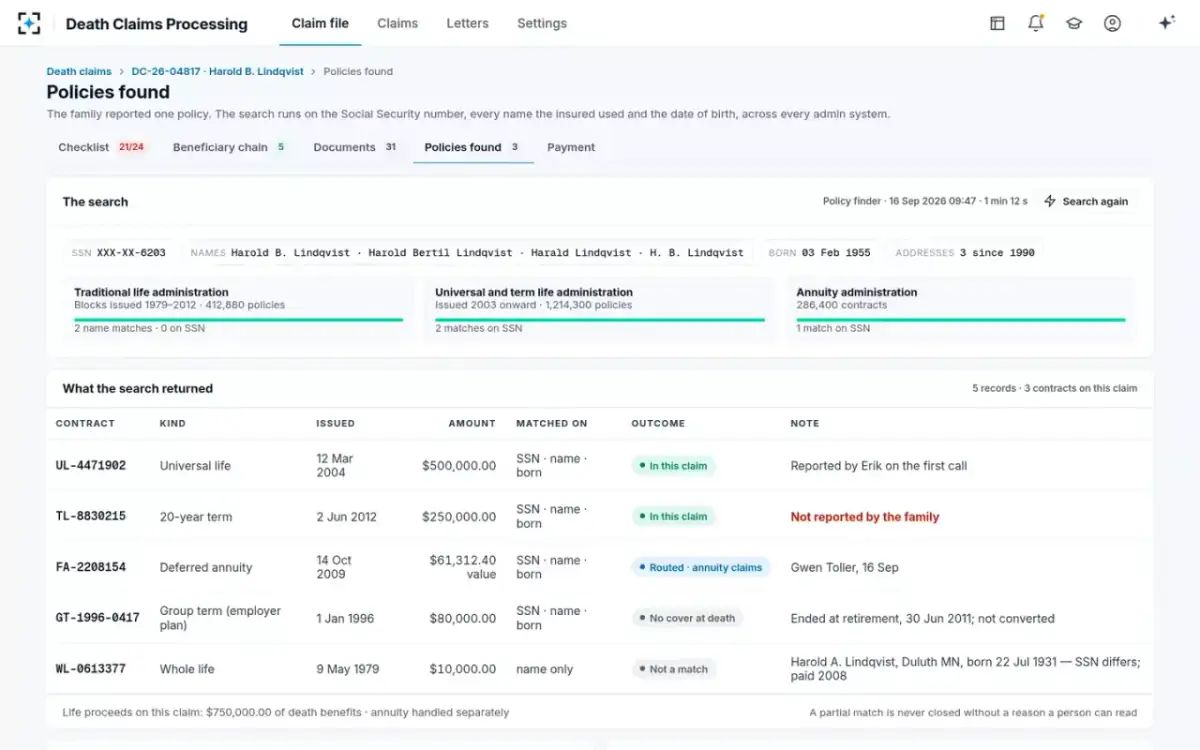
Ninety days after a match: confirm, look for other policies, find the beneficiary
Within 90 days of a match the insurer must confirm the death and decide whether anything is owed, and in Texas it must also look for the dead person's other policies. The Texas text requires the insurer to "review the insurer's records to determine whether the deceased individual had purchased or was otherwise covered by any of the insurer's other products" (§1109.012(a)(2)). New York requires the insurer to "begin to locate beneficiaries within ninety days after the identification of a potential match" (§3240(f)).
Finding a beneficiary is defined with unusual precision in the settlement agreements. The Standard Insurance agreement calls it a "Thorough Search": at least two letters to the address on file, then "at least one online locator tool" and two more letters to any likely new address, then two telephone attempts, then two emails, with the whole search "completed within one (1) year from the Date of Death Notice" (settlement agreement). Each step is a dated entry in the file, because the examiners who check compliance check the dates.
What a match program has to be able to show an examiner
- Every comparison run, with its date and the file version used
Full file and update files, on the statutory schedule.
- The name and date variants applied
Nicknames, initials, married names, hyphens, transposed month and day, incomplete SSN.
- A documented confirmation for each match
Or a documented failure to confirm, with the policy left in force.
- The search for the insured’s other products
Every contract on the person, not only the one that matched.
- Each beneficiary contact attempt, dated
Letters, locator searches, calls and emails, in the order the rule requires.
- No fees charged to beneficiaries
For the comparison or for verifying the match.
- The date proceeds became unclaimed and were reported
And the statutory interest kept out of the amount handed to the state.
What happens to unclaimed life insurance?
If no beneficiary can be found, the proceeds go to the state as unclaimed property, where the beneficiary can still claim them. In Texas, after a confirmed match, the proceeds become unclaimed "on the third anniversary of the date on which, according to the insurer's records, the insurer completed a good faith effort" that failed to locate a beneficiary, and are reported and delivered to the comptroller (§1109.013). The settlement agreements run dormancy "from the Date of Death".
Two details protect beneficiaries. The money handed over includes "any accrued contractual interest", but in Texas unclaimed proceeds "do not include any statutory interest under Section 1103.104", and the NCOIL model likewise keeps statutory interest from being "payable as unclaimed property". And neither the insurer nor its vendor may charge a beneficiary for the search: Texas forbids "any fees or costs associated with conducting a Death Master File comparison" or verifying a match (§1109.012(f)). The statutory interest rules themselves are compared state by state in interest on life insurance proceeds.
How do I find a life insurance policy of a deceased parent?
Start with the NAIC Life Insurance Policy Locator, a free service run by the state insurance regulators' association: you submit a request with the deceased person's details, participating insurers search their records, and if a policy is found and you are the beneficiary, the insurer contacts you. By the NAIC's count, the tool has received more than 1.5 million search requests and insurers have reported more than 780,000 matches "totaling $16,991,229,586 through July 31, 2026" (NAIC, September 2026).
The NAIC Life Insurance Policy Locator, through July 2026
1.5M+
policy search requests since the free tool launched in November 2016
780,000
and more matches with life policies or annuities reported by insurers
$16.99B
in benefits matched through 31 July 2026
90+bus. days
a search may take to complete
Two cautions from the NAIC's own description. "Searches may take 90 business days or more to complete." And silence is not an answer: a requester "will not receive a response" if no match is found, if they are not the beneficiary, or if they lack legal authority to receive the information (NAIC, 2025). A family that suspects a specific carrier can also ask it directly, and money already handed to a state can be claimed through that state's unclaimed property program.
Where Death Claims Processing fits in an unclaimed-benefit program
The solution fits after the death is known. It does not run Death Master File comparisons or hold a subscription; a carrier's match program, or its certified vendor, does that. Once a death is confirmed, the work is the work of any death claim: find every contract on the person, which Texas requires for a match; read the designation history and prove the beneficiary; work the shares and statutory interest; and write to the beneficiary in plain words.
The parts that unclaimed-benefit rules make harder are the parts the agents do: searching every admin system on identity rather than the matched policy alone, and keeping every step dated and cited so an examiner can reconstruct it. How those systems connect, including Death Master File data, is set out in a claims system for life insurers; how the beneficiary is proven when the family is not the one calling is in proving the right payee.
Questions people ask
Is the NAIC policy locator free?
Yes. The NAIC describes it as a free tool, launched in November 2016. Requests go through a secure portal, and participating insurers search their records and contact the beneficiary directly if they find a policy.
How long does the NAIC locator take?
The NAIC says searches may take 90 business days or more. A requester who hears nothing may not have been matched, may not be the beneficiary, or may lack legal authority to receive the information, because the tool sends no response in those cases.
Do life insurers have to look for beneficiaries?
In states with an unclaimed benefits law, yes. Texas and the NCOIL model require a documented good-faith effort to locate beneficiaries after a confirmed match, and New York requires the insurer to begin locating them within 90 days of a potential match.
Can an insurer charge a beneficiary for finding them?
Not for the Death Master File work. The NCOIL model bars an insurer or its service provider from charging beneficiaries for a Death Master File search or for verifying a match, and Texas writes the same bar into §1109.012(f).
What happens if the death match is wrong?
The insurer must confirm the death against other records before acting on a match. In Texas, if it cannot confirm the death, it may treat the policy as still in force under its terms.