The life insurance interpleader process is how an insurer facing two or more conflicting claims to the same death benefit hands the money and the decision to a court: it files a suit naming every claimant, deposits the proceeds into the court's registry, and asks to be discharged while the claimants argue it out. Federal law allows it for any policy of $500 or more when at least two claimants are citizens of different states, and state courts offer their own version. It exists because an insurer that guesses wrong pays twice. The process has its own deadlines, and Texas puts one in its insurance code: a life insurer with notice of a bona fide adverse claim must pay or file an interpleader within 90 days of receiving the items it asked for. Botminds' Death Claims Processing does not decide disputes; it assembles the designation history and the dates that claims counsel needs, and routes the claim the day the conflict appears.
The case on this page is fictional, written to show the steps: the insured, the claimants, the carrier and every date are invented, and none of them come from a real file. The statutes and court rules are real and linked where they appear. It describes the process, not legal advice on any claim.
One disputed claim, from the death to the deposit: 76 days
- To the adverse claim17 d
- Last items13 d
- Items in to deposit46 d
- Pay or interplead by 1 July90 d
What is interpleader in life insurance?
Interpleader is a lawsuit in which the party holding money, here the insurer, asks a court to decide which of several claimants is entitled to it, and is released once it pays the money in. The federal statute gives district courts jurisdiction where a party has issued a "policy of insurance, or other instrument of value or amount of $500 or more" and "Two or more adverse claimants, of diverse citizenship" "are claiming or may claim to be entitled to such money or property", provided the insurer "has deposited such money or property" into "the registry of the court" or posted a bond.
Federal Rule 22 offers a second route, rule interpleader, for "Persons with claims that may expose a plaintiff to double or multiple liability" (Rule 22(a)), and state courts have their own procedures. The choice belongs to counsel. What matters to the claim desk is that each route ends the same way for the carrier: the money leaves its books, and the claimants' dispute is no longer its dispute.
The claim: one policy, two signatures, two claimants
Leonard Haskett, 74, of San Antonio, Texas, died in hospital on 3 March 2026. He held a $300,000 universal life policy with a fictional carrier, Cobalt Ridge Life, with no loan. His 2012 application named his daughter, Marisa Haskett Dunleavy of Columbus, Ohio, as sole beneficiary. A change form signed on 17 February 2026, while he was in hospital, named his partner of nine years, Celia Ortiz of San Antonio, as sole beneficiary instead. Cobalt Ridge received it on 24 February and recorded it on 26 February, before his death.
On the face of the file, the 2026 change governs. Ms. Ortiz gave notice of the death on 6 March, and the carrier sent claim forms on 9 March. On 20 March a letter from Ms. Dunleavy's lawyer arrived: it said her father lacked the capacity to sign on 17 February and that the change was procured by undue influence, and it asked the carrier not to pay. The examiner could see a valid-looking form. She could not see her late policyholder's mind.
When does a life insurance company file interpleader?
An insurer files when a second person makes a claim it cannot safely dismiss and cannot itself resolve, which in Texas the statute frames as notice of a bona fide adverse claim. The Texas Insurance Code relieves a life insurer of its duty to pay the designated beneficiary "if the company receives notice of an adverse claim to the proceeds from a person who has a bona fide legal claim to all or part of the proceeds" (§1103.102(b)), and protects a company that pays the designated beneficiary only "In the absence of notice" (§1103.103). After 20 March, paying Ms. Ortiz on the face of the form no longer carried that protection.
The same code sets the outer date. A life insurer that receives notice of an adverse, bona fide claim before its payment deadline "shall pay the claim or properly file an interpleader action and tender the benefits into the registry of the court not later than the 90th day after the date the insurer receives all items, statements, and forms reasonably requested" (§542.058(c)). Cobalt Ridge had the certified certificate, Ms. Ortiz's claimant statement, ID and W-9 on 2 April, so its date was 1 July. A life insurer that delays past it owes the statutory damages of §542.060 "until the claim is paid or an interpleader is properly filed."
A life insurer “shall pay the claim or properly file an interpleader action and tender the benefits into the registry of the court not later than the 90th day.”
Tex. Ins. Code §542.058(c)
What the examiner documents before counsel files
The examiner documents everything that counsel will need to describe the dispute to a court without taking a side: the policy, the designation history, the dates each form was signed, received and recorded, each claimant's identity and address, and the money. Counsel needs the claimants' states of residence for federal jurisdiction and venue, and the exact amount for the deposit. The insurer's role in the suit is that of a stakeholder, so the file should be complete and neutral.
The examiner’s file for an interpleader, before counsel drafts the complaint
- The policy and its change-of-beneficiary provision
Including the conditions for a change to take effect.
- Every designation, with signed, received and recorded dates
Here the 2012 application and the 2026 change, with who witnessed what.
- The adverse claim and when it arrived
The 20 March letter, with the grounds it states, logged on arrival.
- Each claimant’s full name, address and state of residence
Texas and Ohio here, which decides the federal route and the venue.
- The date the last requested item arrived
2 April here, which starts the Texas 90 days.
- The amount to deposit, with interest worked to the deposit date
Principal, any loan, refunds, and statutory interest by the state rule.
- Every letter sent to each claimant
Including the written notice that the carrier needs more time.
- Nothing that weighs the merits
Capacity and undue influence are for the court; the file states facts and dates.
Cobalt Ridge also had a letter to send in the meantime. Under Texas law an insurer that cannot accept or reject a claim within 15 business days of receiving the items must, within that period, notify the claimant of the reasons it needs more time (§542.056(d)). The examiner wrote to both claimants on 21 April that the claim was subject to competing claims and was with counsel, and said nothing about either side's case.
Which court hears a life insurance interpleader?
A federal district court can hear it under the interpleader statute when the money is $500 or more and at least two claimants are from different states; otherwise it goes to state court or to federal court on ordinary jurisdiction under Rule 22. The diversity needed is minimal. The Supreme Court has said the statute "has been uniformly construed to require only 'minimal diversity,' that is, diversity of citizenship between two or more claimants, without regard to the circumstance that other rival claimants may be co-citizens" (State Farm v. Tashire, 1967).
Venue follows the claimants: a statutory interpleader "may be brought in the judicial district in which one or more of the claimants reside" (§1397). With one claimant in Texas and one in Ohio, Cobalt Ridge's counsel could file in the federal district for San Antonio or for Columbus, and chose San Antonio, where the insured lived and died and the hospital witnesses are.
Three routes to the same deposit, and what each needs
| Route | Needs | Notable feature |
|---|---|---|
| Statutory interpleader, 28 U.S.C. §1335 | $500 or more; two or more adverse claimants of diverse citizenship (minimal diversity); deposit or bond | Court may restrain other suits nationwide and discharge the insurer (§2361); venue where any claimant lives (§1397) |
| Rule interpleader, Federal Rule 22 | Ordinary federal jurisdiction over the case | Available even where claims are adverse and independent, or the insurer denies some liability |
| State court interpleader | The state’s own procedure | Texas’s divorce statute refers to interpleading proceeds into a court’s registry under the Texas Rules of Civil Procedure |
Depositing the money: the registry, the injunction and the discharge
The deposit is what turns the insurer from a defendant in two suits into a stakeholder in one. Money paid into a federal court is deposited "with the Treasurer of the United States or a designated depositary, in the name and to the credit of such court" (§2041). The court may then restrain the claimants "from instituting or prosecuting any proceeding in any State or United States court affecting the property" and "may discharge the plaintiff from further liability" (§2361).
Cobalt Ridge filed on 18 May 2026, 46 days after the last item arrived and 44 days before its Texas deadline, and deposited $300,945.21: the $300,000 death benefit and $945.21 of interest. The court's order restrained both claimants from suing the carrier elsewhere, and on 22 July it discharged Cobalt Ridge. The question of Leonard Haskett's capacity on 17 February now belongs to Celia Ortiz, Marisa Haskett Dunleavy and the court.
What happens to interest during interpleader?
Interest is set by the state's rule up to the deposit and by the court after it. In Texas, interest on life proceeds runs from the day the insurer receives due proof of loss to the day it accepts the claim and offers to pay (§1103.104), at the policy's rate or the carrier's rate on proceeds left on deposit. Cobalt Ridge's counsel treated the deposit as the tender and worked interest from 2 April to 18 May, 46 days, at the fictional carrier's 2.5% deposit rate: $945.21 (our arithmetic).
New York writes the handover into its interest statute, which counts daily from the date of death: the section "shall not require the payment of interest for any period during which an insurer is required to pay interest under any state or federal law pertaining to interpleader" (§3214(d)). The bigger interest risk in Texas is the deadline itself: past the 90th day, the carrier owes 18% a year in damages until it pays or files. How state interest rules compare on an ordinary claim is worked in interest on life insurance proceeds.
How long does an interpleader take?
No regulator or independent study publishes how long life insurance interpleaders last, and the length depends on the claimants, not the insurer. For the carrier, the part that matters is the time to deposit and discharge. In the fictional case that was 76 days from death to deposit and 65 more to discharge; the claimants' own case could take far longer, and the money waits in the registry while it does.
Claimants have their own clocks once served. Federal Rule 12 gives a defendant 21 days after service of the summons and complaint to answer, "Unless another time is specified by a federal statute" (Rule 12(a)), and in statutory interpleader the court's process is "returnable at such time as the court or judge thereof directs" (§2361). A claimant served with an interpleader complaint is being asked to state a claim to the money, and the papers say when.
The dispute file, seat by seat: what changes when agents assemble it
Today
Rebuilds the designation history from the policy file and imaging after the adverse claim arrives, often weeks in.
With agents
Has the full history, every date and both claimants’ details on the day the letter is logged.
Still theirs: the notices to claimants; the decision to route
Today
Asks the examiner for the chronology, the addresses and the amount, and waits.
With agents
Starts from a neutral file with the designation chain, the 90-day date and the interest worked to any deposit date.
Still theirs: the choice of route and court; the complaint
Today
Learns of the dispute when the deadline is close.
With agents
Sees the routed claim and its 90-day date on the claims list from the day of notice.
Still theirs: oversight of the deadline
What Death Claims Processing does in a dispute, and what it never does
In a dispute, the solution's agents do the reading and counting that counsel needs and stop there. The beneficiary history reader lays out every designation with its signer, witness and signed, received and recorded dates, and flags any difference between what a claimant says and what the file proves. The routing checker sends the claim to claims counsel on the day of notice of the conflict. The payment calculator works the deposit amount with interest to any date counsel picks. None of them decides between claimants, and none of them denies a claim.
The chain counsel starts from: every designation, its dates and the rules applied
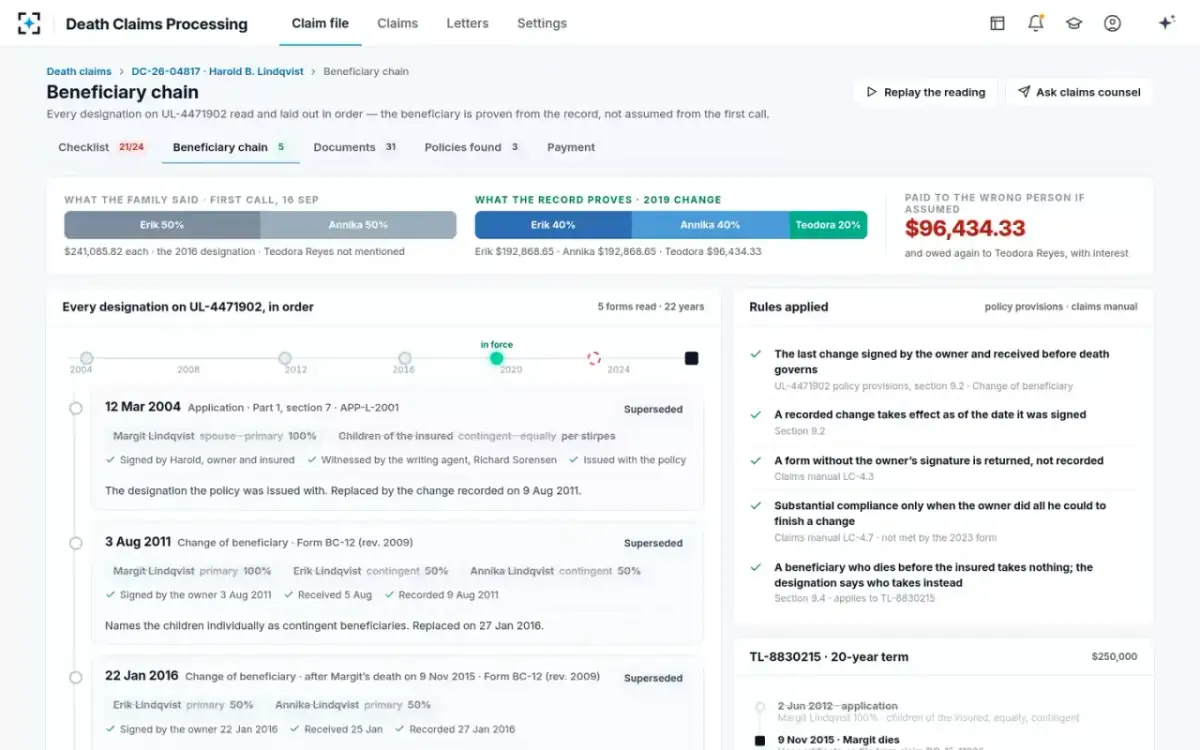
The design follows from the stakes. Texas protects an insurer that pays its designated beneficiary without notice of an adverse claim; once notice arrives, the protection moves to the interpleader. A system that let an agent pick a winner would turn the carrier back into a party. The broader set of claims that go to counsel, including a divorce after a spouse was named, is covered in life insurance beneficiary after divorce, and the tests that prove an ordinary payee in proving the right payee.
Questions people ask
How do I respond to an interpleader complaint?
The complaint names you as a claimant who may be entitled to the money and asks you to state your claim to the court. Federal Rule 12 sets 21 days after service to answer unless a statute or the court sets another time, and in statutory interpleader the court’s process sets its own return date. A lawyer can advise on any particular case.
Who pays the attorney fees in an interpleader?
The federal interpleader statutes quoted here, §§1335, 1397 and 2361, do not set a rule on fees. Whether any party’s costs come out of the deposited fund is for the court in each case.
Can the insurer keep the money while the beneficiaries dispute it?
Not indefinitely. In Texas a life insurer with notice of a bona fide adverse claim must pay or file an interpleader and deposit the benefits within 90 days of receiving the items it requested, and owes statutory damages if it delays past that. Once deposited, the money sits in the court’s registry.
Does an interpleader hold up every beneficiary’s share?
It need not. Only the disputed proceeds have to go to the court; the NAIC model expects insurers to pay portions of a claim that are not in dispute within 30 days. On a policy split among several beneficiaries, undisputed shares can be paid while one is contested.
Can the claimants settle instead?
Yes. Claimants can agree how to divide the money, and the federal deposit statute allows money in the registry to be delivered to its rightful owners “according to agreement of parties, under the direction of the court.”