A claims system for life insurers is the software a claims desk uses to open, document, decide and pay death claims, and in many life carriers it cannot be one system, because the policies it pays sit on several. A carrier that has written whole life since the 1970s, universal life since the 2000s and annuities alongside them may run each block on its own admin platform, as the sample carrier on this page does, and a single death can touch all three. The practical question for a claims leader is therefore not which admin system to replace, but how the claim desk reads all of them on the day of notice and writes back only what changed. Botminds' Death Claims Processing is built that way: seven agents read across the systems the carrier already runs and hand the examiner a checked file, and the admin systems stay the system of record for each contract (why those systems often hold the values but not the contract text is covered in life insurance policy administration systems).
The figures and screens on this page come from a sample claim in the solution, on a fictional carrier and fictional people; the regulatory facts are linked where they appear.
The six systems a death claim reads, and what it writes back to each
Policy admin systems, one per block
ReadsContracts on the SSN, status at death, paid-to date, riders, loans, assignments, beneficiary designations
Writes backClaim status and settlement on each contract
Imaging and the mailroom
ReadsApplications, change forms, certificates, claimant statements, IDs, W-9s, returned mail
Writes backWhich document proved which item
Premium and loan history
ReadsPremiums drafted after death, loan principal and interest to the date of death
Writes backRefunds and loan payoffs on the claim
Death data
ReadsA notice from a call or form; Death Master File matches where the carrier is a certified subscriber
Writes backNothing; matches are confirmed, not taken as proof
Payee screening
ReadsName and TIN results, sanctions screening, state intercept checks
Writes backA cleared or held flag per payee
Payments and tax reporting
ReadsPayee bank details and payment method
Writes backApproved amounts, interest by payee, Form 712 and interest reporting data
What claims system do life insurers use?
The working answer is several at once: the claim desk works in a claims or workflow tool, and the contracts it pays sit in whichever admin system holds each block. The admin landscape is the part that decides how hard a claim is. On the sample claim, the policy search ran across three: a traditional life system holding blocks issued from 1979 to 2012 (412,880 policies), a universal and term life system for business issued from 2003 (1,214,300 policies) and an annuity system (286,400 contracts). The insured's five results came from all three.
Regulators have heard the same story from the industry. In the NAIC's survey of 161 life insurers, those not using, planning or exploring AI and machine learning gave three reasons, and one was their reliance on legacy systems and IT. The survey's chart of where life insurers' models are in use lists marketing (36%), underwriting (34%), pricing (18%) and risk management (11%), shares of models rather than of insurers. Death claims are where the old blocks still matter most, because the policy that pays may be forty years old.
Life insurers and their systems, as the NAIC survey found them
161
life insurers responded to the NAIC’s AI/ML survey, run under the examination authority of 14 states
58%
use, plan to use or explore AI/ML, against 88% of auto and 70% of home insurers
42%
do not; reliance on legacy systems and IT is among their three named reasons
14
states whose market examination authority the survey ran under
Why replacing the admin system is the wrong first project
Replacing a policy admin system to fix death claims moves the problem to a migration that takes years and still leaves the closed blocks somewhere. A death claim needs whatever is true of the contract on the date of death, including the beneficiary changes recorded under it over decades, so a conversion that drops the change history, the returned-mail folder or the scanned application has made claims harder, not easier.
State law already expects carriers to work with files as they are. Texas, writing its Death Master File duty in 2017, told insurers to run the comparison "electronically to the extent the insurer's records are available in electronic format, and then use the most easily accessible insurer records for any records that are not available electronically", and let the commissioner approve "a plan and timeline for an insurer to convert the insurer's files to searchable electronic format" (Tex. Ins. Code §§1109.011, 1109.015). The rule accepts that some files are not yet searchable. A claim desk has to as well, and it is better served by a layer that reads every block than by waiting for one platform.
What integrations does a life claims system need?
A life claims system needs read access to every admin block, imaging, premium and loan history and death data, and write access to claim status, payments and tax reporting. The figure at the top of this page lists the six. The principle behind it is narrow writing: the claim desk records its decision and the money, and every fact it relied on stays in the system that owns it, cited in the claim file.
Narrow writing is also what makes a claims layer safe to add. If the agents can only read policies and propose a settlement for a person to approve, a mistake in the connection shows up as a wrong number on the examiner's screen, not as a changed policy. In the solution no agent writes to an admin system or releases money; the examiner approves, and the payment goes through the carrier's own payment run.
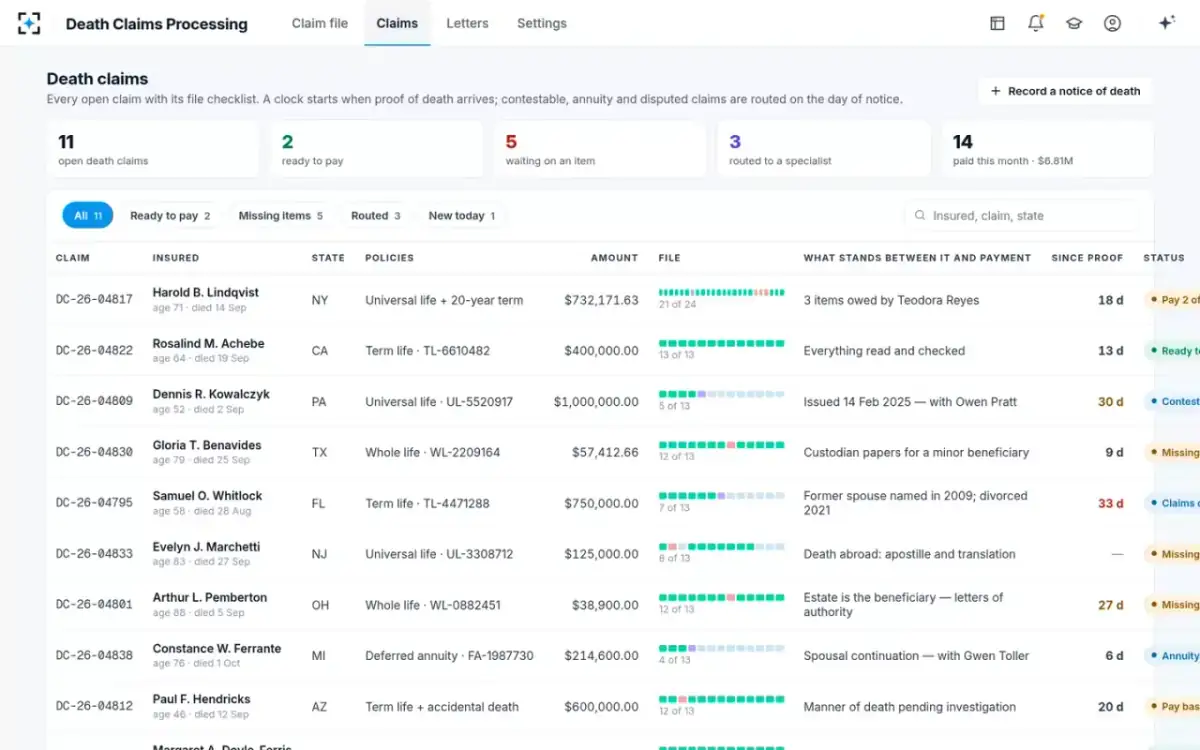
One list across every block: what stands between each claim and payment
What is a LADMF subscription, and who may hold one?
A LADMF subscription is certified access to the Limited Access Death Master File, the Social Security death data the Commerce Department releases through NTIS. Since the Bipartisan Budget Act of 2013, the Secretary of Commerce may not disclose a death on the Death Master File to anyone who is not certified until three calendar years after the death. To be certified, an applicant must have "a legitimate fraud prevention interest" or "a legitimate business purpose pursuant to a law, governmental rule, regulation, or fiduciary duty", and must have systems to safeguard the data under requirements similar to those for federal tax information.
NTIS runs the program under regulations at 15 C.F.R. Part 1110, and the operational detail matters to an IT plan: subscribers "renew your Certification and Subscription annually and your Attestation and Firewall every 3 years", and the statute provides for "periodic and unscheduled audits of certified persons". A carrier whose unclaimed-benefit duty depends on matching recent deaths needs the subscription; a carrier that buys matching from a vendor needs the vendor's certification on file. Either way, a match is a lead to confirm, not proof of death; the duties that follow a match are covered in the unclaimed life insurance benefits act.
How do you search policies across admin systems?
You search on identity, not on the name a caller gives: the Social Security number, every name the insured used and the date of birth, run against every block and returned with each contract's status on the date of death. Name variants are where searches fail, and the unclaimed-benefit statutes list them: Texas requires procedures that account for common nicknames, initials, compound and married names, hyphens and apostrophes, a transposed month and day of birth, and "an incomplete social security number" (§1109.011(d)).
On the sample claim, the policy finder ran the SSN, four name variants (Harold B. Lindqvist, Harold Bertil Lindqvist, Harald Lindqvist, H. B. Lindqvist) and the date of birth across the three systems in 1 minute 12 seconds. A 1979 whole life policy matched on name only; the agent ruled it out because the SSN, the date of birth and the city belonged to another man, and wrote that down. A search that cannot explain a partial match leaves the examiner to repeat it.
Payee checks before money moves: TIN, backup withholding and intercepts
Every payee has to clear tax and screening checks before payment, and a claims system that does not run them pushes them onto the examiner's last day. Interest on a delayed death claim is reportable on Form 1099-INT above a dollar threshold, and a payer that files it can use the IRS's TIN Matching service to check name and taxpayer number combinations "with IRS records before submitting the forms" (Publication 1099). A payee who has not furnished a taxpayer identification number in the required manner can trigger backup withholding at 24% on reportable payments.
States add their own checks. Massachusetts examiners faulted Massachusetts Mutual Life, in an exam of its 2022 business, for paying six life claims without first running the Department of Revenue intercept for tax and child support debts that state law requires; the company ran them afterwards and found nothing due, but the finding stood. In the solution, each payee's W-9, TIN check and sanctions screening are items on the file checklist, and the rule table can carry a state's intercept as one more.
How do life insurers issue Form 712?
The insurer completes Form 712, the IRS "Life Insurance Statement", for a policy on the decedent's life, and the executor files it "with Form 706, United States Estate (and Generation-Skipping Transfer) Tax Return". Its lines are the claim's own arithmetic: face amount, additional insurance, "Principal of any indebtedness to the company", "Interest on indebtedness (line 19) accrued to date of death", returned premium and the "Amount of proceeds if payable in one sum".
The form ends with a certification by "The undersigned officer of the above-named insurance company", and it asks for the "Names of companies with which decedent carried other policies and amount of such policies if this information is disclosed by your records." A claims system that has already worked the loan, loan interest to the date of death and the premium refund has the numbers for lines 19 to 24. On the sample universal life policy those are a $17,900.00 loan, $340.55 of loan interest and a $412.18 refund against a $500,000 face amount, so the form is a report of work already done, not a second calculation.
What to write back, and where the claim file stays
Write back the decision, the money and the status of each contract; keep the claim file in a form a regulator can reconstruct. The NAIC model asks for documentation from which a regulator can rebuild what the insurer did on each claim, with every document dated as received, processed or mailed (Model #903). Written in 1997, it also says claim files "must be accessible" and "capable of duplication to hard copy", and encourages states to accommodate paperless systems.
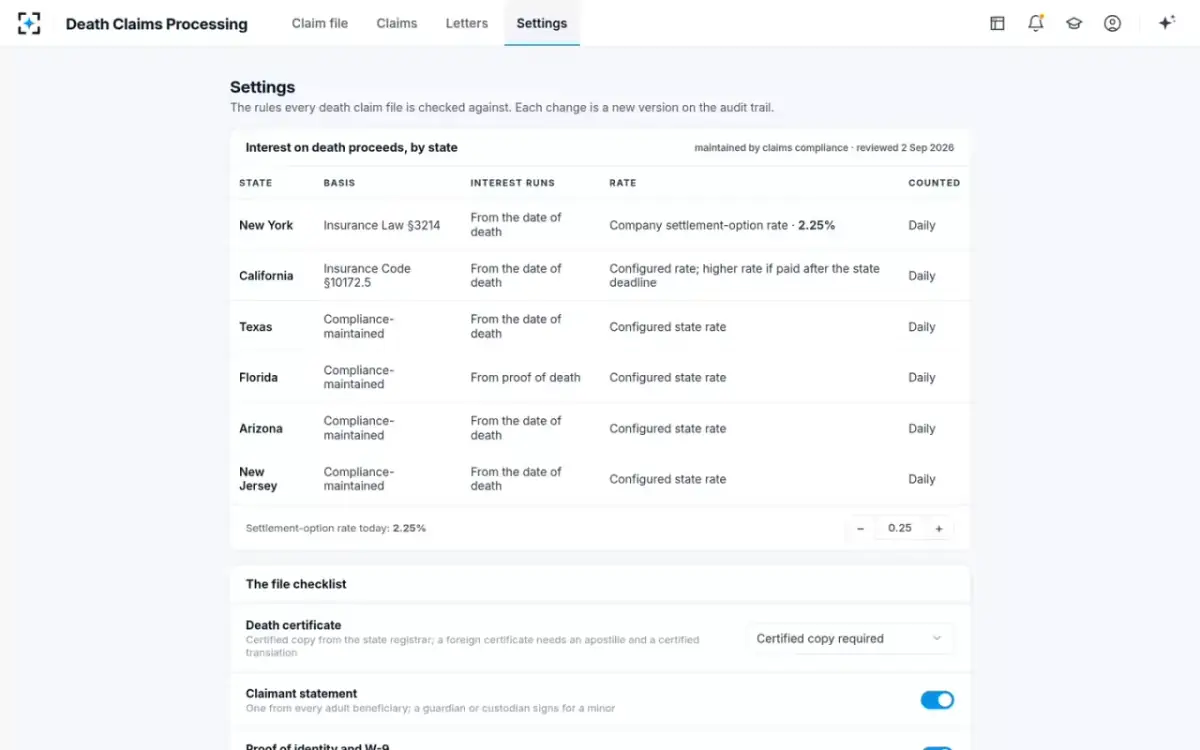
In the solution every checklist item shows the value read, what it was checked against and the document it came from, and every agent step and signature sits on the claim's activity list with who and when. Rules, such as the interest table and the signing limits, are settings the carrier's compliance team owns, and each change is a new version. That is what a claims system adds to the admin systems underneath it: not another copy of the policy, but the proof of what was done with it.
The rules the claim desk runs on, owned by compliance and versioned
How long does it take to implement a claims system for life insurers?
Implementation time is set by the connections and by how fast the carrier can prove the results on its own claims, not by software installation. We do not publish a typical duration, because it depends on how many admin blocks there are and how their data is reached. What we can set out is the order of work and what each phase must prove before the next begins.
A go-live in five phases, each with something to prove
| Phase | Work | Proven when |
|---|---|---|
| 1 · Read-only on closed claims | Connect admin blocks, imaging and premium history; run the agents on a sample of paid claims | The policies found, designations proven and amounts match what was actually paid, or the differences are explained |
| 2 · Rules from your manual | Load the state interest table, the file checklist, routing and signing limits | Compliance signs off each rule against its statute or manual section |
| 3 · Shadow on new claims | Agents prepare files beside the existing process; examiners compare | Examiners agree with the prepared file without re-doing it |
| 4 · Letters and payments | Turn on drafted letters and payment preparation, still sent and approved by people | Letters pass the carrier’s review; payments reconcile to the payment run |
| 5 · Live, with measures | Examiners work from the prepared file | Days from proof of death to payment, and payee errors on a sample, are reported each month |
Phase 1 is the one that earns trust. A carrier knows the right answer on a closed claim, so the comparison is objective: did the agents find the same policies, prove the same payee and reach the same amount, and where they did not, who was right? The payee test in phase 1 is the framework in proving the right payee. What each agent does during phases 3 and 4 is in life insurance claims processing, agent by agent.
What to ask any life claims system vendor
Ask about connections and evidence before features. A life claims system that reads one admin system well and the others through a nightly extract will miss the term policy the family did not mention; one that cannot show where each fact came from will not survive a market conduct exam.
Questions for a life claims system, before you sign
- Which of our admin blocks can it read on the day of notice, and how?
Live reads, extracts or files, block by block, including closed blocks.
- What does it write back, and to which systems?
The narrower the better: claim status, settlement and payment, not policy data.
- Does it search on SSN, name variants and date of birth across every block?
With a written reason for every partial match ruled out.
- How does it handle Death Master File matches?
Whose certification covers the data, and how a match is confirmed before it becomes a claim.
- Do payee checks run before approval?
TIN, sanctions screening and any state intercept, per payee.
- Can it produce Form 712 figures from the same calculation that paid the claim?
One set of numbers, not two.
- Who owns the rules, and are changes versioned?
Interest by state, checklist items, routing and signing limits.
- Will you prove it on our closed claims first?
Read-only, on claims where we already know the right answer.
Botminds' answer to the last question is yes: we run Death Claims Processing on a sample of the carrier's own closed death claims before anything else changes. It does not replace a policy admin system, an imaging platform or a payment system, and it does not take on contestable investigations or fraud referrals, which have their own teams and rules.
Questions people ask
Can death claims run on our policy admin system?
The contract data stays there, and the admin system remains the system of record for each policy. The claim itself, with its documents, payee proof, interest and approvals, usually needs a layer that reads every block at once, because one death can touch policies on several systems.
What is the Limited Access Death Master File?
It is the Social Security Administration’s death data as released by NTIS, with deaths from the last three calendar years available only to certified subscribers. Certification requires a fraud prevention interest or a business purpose grounded in law or fiduciary duty, plus safeguards, and it is renewed annually.
Who signs Form 712?
An officer of the insurance company certifies it, in the form’s words “The undersigned officer of the above-named insurance company” or an appropriate federal agency or retirement system official. The executor then files it with the estate tax return.
What is a life claims management system?
It is the software a life claims desk uses to manage death and other life claims from notice to payment: the file, the documents, the payee, the amount and the approvals. Death Claims Processing adds agents that do the reading and checking inside that work, beside the admin systems.
Do we need a LADMF subscription for death claims?
Not for claims a family reports: a certified death certificate proves those deaths. You need certified access, directly or through a certified vendor, if you match your in-force policies against recent deaths, as state unclaimed-benefit laws require.