AI for life insurance claims is software that reads and prepares death claims so that examiners decide faster, and it has to differ from the AI built for auto and property claims, because a death claim asks a different question. On an auto or property claim the central question is what the damage costs, so most claims AI estimates from photographs, routes files and flags fraud. A life insurance death claim has no damage to price. Its questions are who died, which policies they held, who the beneficiary is under the designation in force on the date of death, and how much each person receives with the interest state law adds. Software built for the first kind of claim does not answer the second. Botminds' Death Claims Processing is built for the second: seven agents find every policy, read every document, prove the payee and work the interest, and the examiner signs every payment.
The regulator figures on this page come from NAIC surveys of auto and life insurers; the life examples come from a sample claim in the solution, on fictional people and a fictional carrier.
The same word, two different jobs: AI on an auto claim and on a death claim
Auto physical damage claim: What does the damage cost to repair, or is the car a total loss?
Life insurance death claim: Who is entitled to the death benefit, and how much does each payee receive?
Auto physical damage claim: Photos, estimates, repair invoices, valuation data
Life insurance death claim: Death certificate, policies on several admin systems, decades of beneficiary forms, claimant statements
Auto physical damage claim: Evaluates images of the loss, suggests settlement amounts, assigns files
Life insurance death claim: Finds every policy on the insured, reads every designation, works shares and interest
Auto physical damage claim: An estimate that is too high or too low, corrected by a supplement or negotiation
Life insurance death claim: Paying the wrong person, which can mean paying the same benefit twice
Auto physical damage claim: State claim-handling rules and estimating practice
Life insurance death claim: Designation and revocation statutes, state interest on death proceeds, unclaimed-benefit duties
Auto physical damage claim: Approval of the settlement; disputes and fraud
Life insurance death claim: Liability, the payee, approval of every payment; disputes to counsel
What is AI for insurance claims?
It is any model or agent used in claims handling, and in auto insurance it is already common. The NAIC's 2022 survey of 193 private passenger auto insurers found claims to be the operation with the most AI and machine learning use: 70% of companies used it there, ahead of marketing at 50% and fraud detection at 49%, and 80% once models under construction were counted (NAIC auto survey). In absolute terms, 135 of the 193 reported using it in claims and 20 more were building it.
The same survey shows what that use looks like. The most common use was supporting adjusters with information; next came deciding claim assignment (58 companies), evaluating images of the loss (55) and determining settlement amounts (50). Nine companies used models to approve claims. None reported using them to deny claims. Writing in their own words, insurers added triage, total-loss recognition, physical damage assessment and fast-track processing.
How auto insurers said they use AI/ML in claims, by number of companies
How is AI used on an auto or property claim?
On an auto or property claim, AI mostly turns pictures and data into a number and a route. The BLS, describing why claims jobs are projected to shrink, gives the example of software that evaluates photographs of damaged property and calculates an estimated claim amount (BLS). The estimate is checked against repair prices and policy limits, the file is assigned by complexity, and a person approves the settlement.
Those uses suit property claims because the evidence is physical and the error is reversible: a repair shop finds hidden damage and files a supplement, or the owner disputes the valuation and the number moves. The property side of the category is covered in depth elsewhere, for example in AI car repair estimates and in AI agents for total loss claims.
What a death claim asks instead
A death claim asks four questions, none of which a photograph can answer. Is the person who died the insured, by name, date of birth and Social Security number on a certified certificate? Which contracts were in force on the date of death, including ones the family never mentioned? Who is the beneficiary under the designation in force on that date? And what does each payee receive after loans and refunds, plus the interest the insured's state requires?
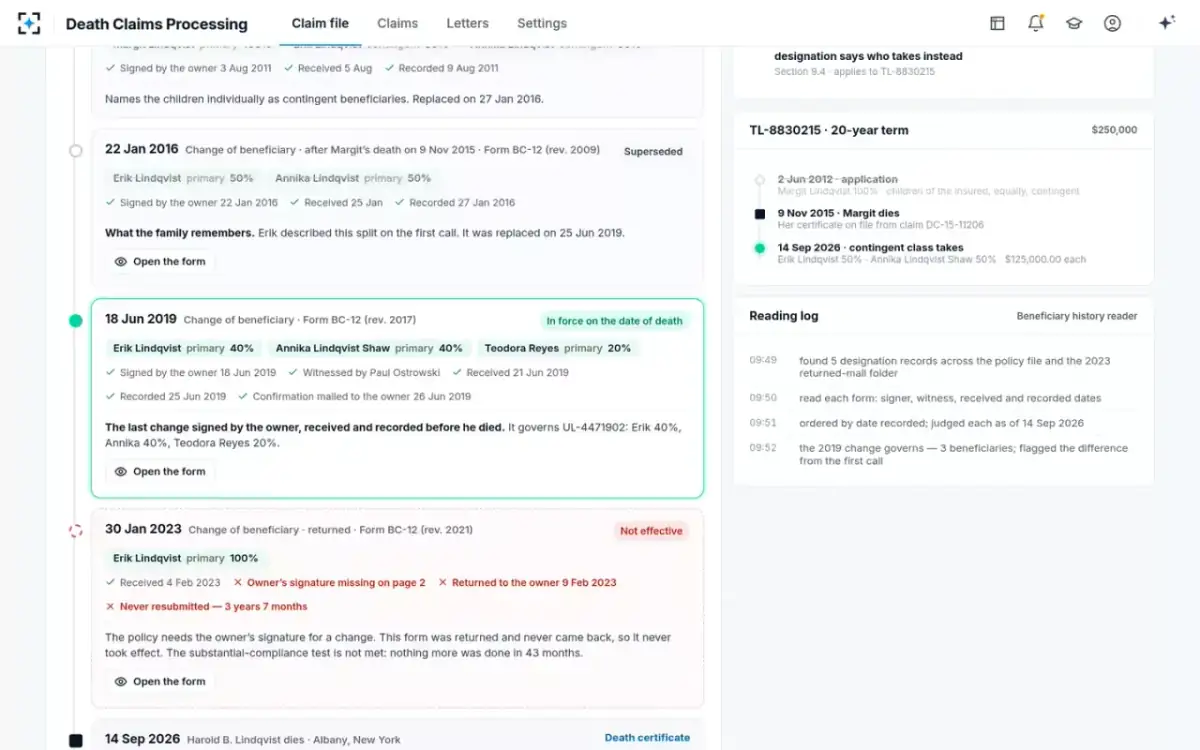
Each is a reading-and-proof problem. On the solution's sample claim, the policy search found a $250,000 term policy the family had not reported; the beneficiary history reader read five designations across 22 years and found that a 2019 change, not the 50/50 split the son described, governed a $500,000 policy; and the payment calculator worked New York interest from the date of death, $45.13 a day across five shares. A model trained to price dents has nothing to contribute to any of it.
The work AI does on a death claim: reading a designation history, not pricing a loss
Can AI process life insurance claims? Where life insurers are today
It can prepare them, and the industry is earlier on this road than auto. In the NAIC's 2023 survey of 161 life insurers, 58% said they use, plan to use or explore AI and machine learning, against 88% of auto insurers and 70% of home insurers (NAIC life survey). The life survey's chart of models in use lists marketing (36%), underwriting (34%), pricing (18%) and risk management (11%), as shares of models, and the insurers not using AI gave legacy systems as one of their reasons.
Life insurers are later to AI than auto and home insurers
58%
of 161 life insurers use, plan to use or explore AI/ML
88%
of 193 auto insurers, in the NAIC’s earlier auto survey
70%
of 194 home insurers, in the NAIC’s home survey
70%
of auto insurers used AI/ML in claims operations specifically
That gap is an opportunity only if the tools fit the work. A life carrier that buys a claims AI built for property gets a model looking for images on a claim that has none. The useful starting point on a death claim is not prediction at all; it is reading every document the carrier already holds, on every admin system, and showing where each fact came from.
A wrong estimate and a wrong payee are different mistakes
An estimating error costs a margin; a payee error can cost the whole benefit again. The protection a life insurer has for paying is tied to paying the right person. Texas discharges a company "from all liability under the policy" when it pays the designated beneficiary, but only "In the absence of notice" of an adverse claim before payment (§1103.103). Minnesota's revocation-on-divorce statute protects a payor that pays in good faith before written notice of a divorce, and says a payor "is liable for a payment made or other action taken after" it receives written notice of a claimed revocation (§524.2-804, subd. 5).
So the design question for life claims AI is not how accurate the model is on average, but whether any single payment can go out on an assumption. On the sample claim, paying the split the family remembered would have sent $96,434.33 to the wrong people and left it owed again, with interest, to the beneficiary the 2019 form named. That is why the solution proves the payee from documents and why the examiner, not an agent, signs. The tests behind that proof are in proving the right payee.
“The last change signed by the owner, received and recorded before he died.”
The beneficiary chain on the sample claim (fictional)
Is AI claims handling regulated?
Yes: claims made with AI are judged by the same claims rules as claims made without it, and state regulators have said so. The NAIC's 2023 model bulletin on insurers' use of AI names claim management among the stages where insurers deploy AI and states that decisions supported by AI must still comply with the unfair trade practices and unfair claims settlement practices laws, whatever method produced them (NAIC model bulletin). How states have adopted it, and what it asks of an insurer's governance, is set out in NAIC AI bulletin requirements.
For life claims the older rules are specific. The NAIC's model regulation for life and health claims requires a denial notice within 15 days of the decision that names the policy provision, condition or exclusion relied on (why the agents never deny a claim), and claim files detailed enough for a regulator to rebuild every step the insurer took (Model #903). An AI tool on a life claim desk has to leave that trail: what it read, what it concluded, and who decided.
Does AI make claims decisions?
In auto insurance, rarely and only in one direction: nine of 193 surveyed auto insurers used models to approve claims, and none used them to deny. In Death Claims Processing, no agent decides at all. The agents prepare; the examiner approves every payment, a supervisor co-signs above the examiner's limit ($250,000 in the sample), and disputes, divorce questions and changes received after death go to claims counsel. No agent denies a claim, releases money or sends a letter.
24 of 24 read and checked; the payment still waits for a person
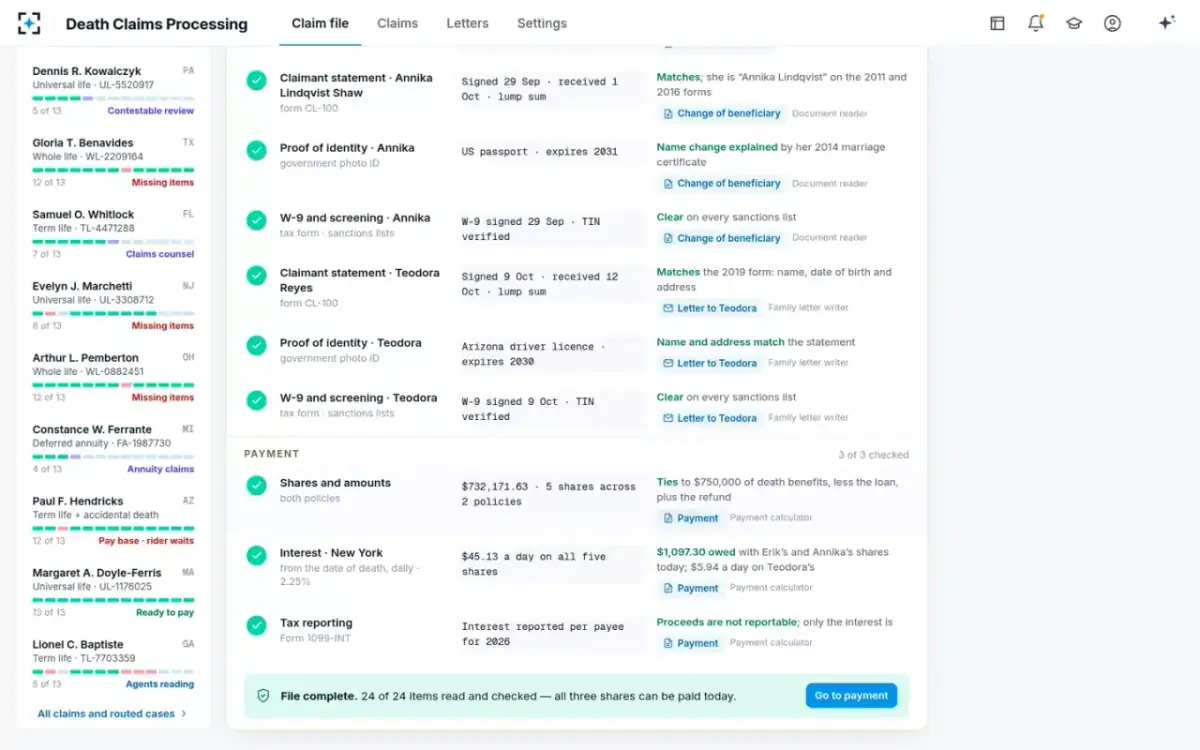
That division is not modesty about the technology. Liability, the payee and the amount are legal positions the carrier has to defend to a beneficiary, a regulator or a court, and the person who signs is the person who can. What the agents change is what that person sees when they sign: a file where every item shows the value read, what it was checked against and the document it came from. Each agent's job and limit is set out in life insurance claims processing, agent by agent.
How to choose AI tools for claims processing on a life desk
Choose on the questions a death claim asks, not on a demo built for property. A vendor that leads with image recognition, severity scores or fraud models is selling a property claims tool, whatever its brochure calls it. The checklist below is what a life claims leader should see answered on the carrier's own closed claims before buying.
Buying AI for life claims: what to test before you sign
- Policy search on identity across every admin system
SSN, name variants and date of birth, with a written reason for each partial match.
- Beneficiary proof from the full designation history
Every change with signed, received and recorded dates, not the latest form alone.
- A flag when the caller’s story differs from the file
The early sign of a second claimant.
- State interest worked per payee, per day
From a rule table compliance owns, with every change versioned.
- Citations on every checked item
The document and page each fact came from, for examiners and regulators.
- No agent approves, denies or pays
Named people sign; disputes route to counsel on the day they appear.
- Plain-words letters that wait for a person
No other beneficiary’s share named; nothing sent automatically.
- A trial on your closed claims
Where the right answer is known, so accuracy is measured, not promised.
What a trial of AI on closed death claims should measure
A trial should measure the four answers a death claim needs, on claims where the carrier already knows them. Take a sample of paid death claims, stratified so it over-represents the hard ones: more than one policy on the insured, more than one designation on a policy, a contingent or estate payee, a divorce or a name change in the file, a payee in another state. Run the tool read-only and compare what it concludes with what the carrier actually did, item by item.
Four counts tell a claims leader most of what matters. Policies found: did the search return every contract that was eventually paid, and did it rule out every false match with a reason? Payee: does its proven designation and share agree with the payment made, and where it differs, who was right? Amount: does each share, loan deduction, refund and day of state interest agree to the cent? Evidence: can a reviewer open the document behind every checked item? A disagreement is not automatically the tool's error; on a sample like this, some will be the carrier's, which is the most useful thing a trial can find.
Report the counts with their uncertainty rather than as a single accuracy figure. A payee check that agrees on all 300 sampled claims is still consistent, at 95% confidence, with a true error rate of about 1% (our arithmetic), so a carrier that needs more assurance needs a bigger sample or a stratum of the riskiest files. Time saved is worth measuring too, but last: a faster wrong payee is not a saving.
Where Death Claims Processing fits, and where it does not
Death Claims Processing fits the individual life and annuity death claim desk, from the notice of death to the signed payment. It reads beside the admin systems a carrier already runs and does not replace them. It is not a property or auto claims tool, it does not score claims for fraud (that belongs to a special investigations unit, as in AI in insurance fraud detection), and it does not investigate contestable claims; it routes them to the carrier's contestable specialist on the day of notice.
For a claims leader comparing categories, the test is simple: ask what question the tool answers. If the answer is "what is this loss worth", it was built for property. If it is "who is entitled, to how much, proven from what", it was built for a death claim. What such a tool connects to is in a claims system for life insurers.
Questions people ask
What is the difference between P&C and life claims?
A property and casualty claim asks what a loss costs and whether the policy covers it. A life death claim usually has a fixed benefit and asks who died, which policies were in force, who the beneficiary is and what interest the state adds, so the evidence is identity documents and beneficiary forms rather than photos and estimates.
Can AI deny a life insurance claim?
In Death Claims Processing, no agent can deny a claim. More broadly, NAIC model rules require a denial notice that cites the policy provision relied on, and the NAIC’s AI bulletin says AI-supported decisions must still meet unfair claims practices law.
Do insurers use AI for claims processing?
In auto insurance, widely: 135 of 193 insurers in the NAIC’s 2022 survey used AI or machine learning in claims, mostly to inform adjusters, assign files, evaluate images and set settlement amounts. Life insurers report less AI use overall, 58% using, planning or exploring it in the NAIC’s 2023 survey.
What AI tools are there for life insurance claims?
Tools for life claims are reading and proof tools: policy search across admin systems, document reading against the policy, beneficiary designation analysis and payment calculation with state interest. Death Claims Processing combines them as seven agents with written limits, and a person approves every payment.
Is AI for insurance claims accurate enough to trust?
Accuracy should be measured, not assumed: run the tool on closed claims where the right answer is known and count the differences. On a death claim, the measure that matters most is payee accuracy, because a wrong payee can mean paying twice.