Claims investigation software companies sell four different products under one name: fraud case management for special investigation units, medical records retrieval services, medical record review tools that build a dated chronology, and contestable review tools that set each life insurance application answer against the medical records and test whether a wrong answer mattered. A life claims team looking for help with contestable death claims, those where the insured died within two years of issue, needs the last kind, usually alongside a retrieval service. What decides how fast any of them goes live is not the vendor. It is the insurer's own paperwork: valid authorizations, dated versions of the underwriting manual and application forms, state-by-state rules and letters counsel will sign. Contestable Claim Review is Botminds' software for this work, and this guide uses it as the worked example while setting out questions any vendor should answer.
We do not name or rank companies here, and nothing in this guide is a measured implementation time. The ten weeks below are a plan we suggest for one product line in one or two states; a carrier with many forms and states should expect longer. Where the guide shows the solution, the data are fictional sample claims.
Four kinds of claims investigation software, and what each leaves to you
| Kind | What it does well | What a contestable desk still has to do |
|---|---|---|
| Fraud and SIU case management | Referral intake, case assignment, investigator notes, law-enforcement and regulator reporting | Read the medical records against the application, test materiality, draft the beneficiary letter |
| Medical records retrieval services | Request, chase and deliver records from providers under the authorization | Read the pages, date the events, compare them with each answer |
| Medical record review and chronology tools | A dated, searchable timeline of diagnoses, tests and treatment, often with summaries | Apply each question’s look-back window, re-underwrite on the manual at issue, apply the state’s standard |
| Contestable review tools | Answer-by-answer comparison with the records, a materiality test on the issue-date manual, cited letters for approval | Obtain the records (alone or through a retrieval service); decide, confirm and approve |
What is claims investigation software, for a life contestable desk?
For a life contestable desk, claims investigation software is anything that shortens the path from a death inside the contestable period to a defensible pay-or-rescind decision. That path has three stretches: getting the records, reading them against the application, and testing whether a wrong answer was material. Most products cover one stretch; few cover all three, and none should decide.
The desk is small and the files are long, which shapes what helps. A contestable file can run to hundreds of pages from a family doctor, specialists, a pharmacy and the hospital where the insured died. Life insurers have been cautious adopters of the tools that read such files: in the NAIC's survey of 161 life insurers, 58% reported using, planning or exploring AI and machine learning, against 88% of auto insurers, and the survey found their models mainly in marketing and underwriting (NAIC, 2023).
Who sells claims investigation software? Four kinds of company
Special investigation and fraud platforms, records retrieval firms, medical review and chronology vendors, and builders of contestable review tools, plus core claims administration systems that add modules from one or more of these. The table above is the map. The practical question is which stretch of the path your desk loses the most days on.
If the days go to waiting for records, a retrieval service or a tool with a retrieval agent is the first buy. If they go to reading, a chronology tool helps, but only as far as the timeline; the comparison with the application and the materiality test stay manual. If they go to the back-and-forth between examiner, underwriting, medical director and counsel, the gap is the materiality test and the cited letter, which is what a contestable review tool exists for. A desk worried about organised fraud needs the special investigations route: what to look for there is set out in the guide to insurance fraud detection software.
Twelve questions to put to any claims investigation software company
- Does every finding cite its page and line?
Counsel will need the page behind each sentence of the letter; a summary without citations cannot be defended.
- Does it read look-back windows from the form version the insured signed?
Application forms change; a “past 5 years” question on one version may be “past 10 years” on the next.
- Can it test materiality on the manual version in force at issue?
And show the sections it applied, finding by finding and together.
- Does it set the pharmacy’s own record against the prescription report?
Fills paid outside a drug plan can be missing from the report run at issue.
- What does it do with an unreadable page?
It should send it to a person, not guess.
- Does it ever call a misstatement intentional or fraudulent?
It should not. Intent is for counsel and, where a state requires it, a court.
- Who can approve what?
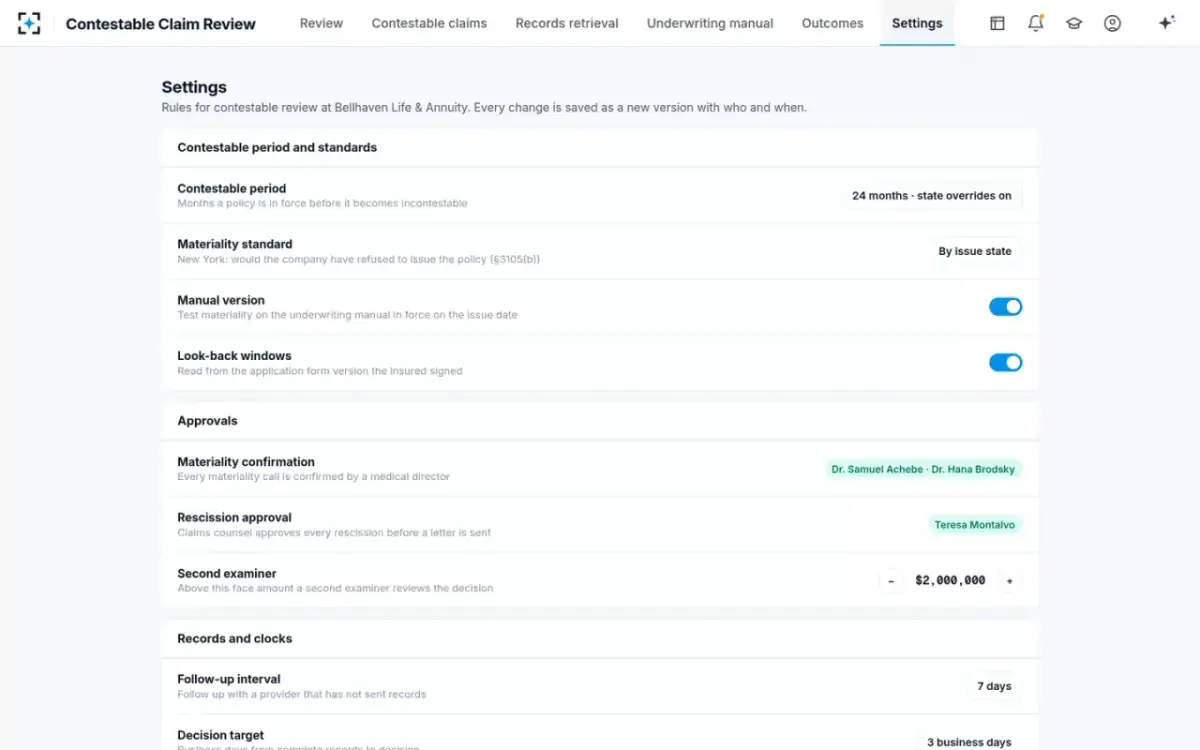
Named approvers per state for materiality and rescission, and a second examiner above a face amount you set.
- Can you change the state rules yourself, with a history?
Contestable period overrides, materiality standard by issue state, follow-up intervals, decision targets.
- What authorizations does it handle, and how?
The insured’s application authorization, the estate’s, and the provider’s own forms.
- Can you run it on your own closed files before you buy?
A seeded test on decided files is the only accuracy evidence that fits your forms.
- Where does the data live, and who can see it?
Medical records, prescription histories and bureau reports are sensitive; ask for the controls in writing.
- What does it never do?
A good answer is a short list: never decides, never sends, never accuses, never requests without an authorization.
How to choose claims investigation software for contestable claims
Choose on evidence from your own files, not on demonstrations. Ask each shortlisted company to run its product on ten to twelve closed contestable files you have already decided, with known misstatements planted in copies, and score the result: what it found, what it missed, what it flagged that was fine, and whether every flag's page says what the flag says. The method is in testing a claim review tool.
Then weigh the fit with how your desk decides. A tool that recommends pay or rescind but cannot show the manual sections behind the recommendation leaves your medical director re-doing the work. A tool that drafts letters but cannot cite each statement leaves counsel re-reading the file. A tool that cannot hold per-state rules will be right in the state it was demonstrated in and wrong in the next.
What records retrieval integrations are needed?
Four, in practice: the underwriting file at issue, the providers' medical records, the pharmacy's dispensing records, and the consumer reports bought at issue. Each arrives under a different permission, and the go-live has to settle each before a live file can start.
Provider records arrive under a HIPAA authorization. A valid one must, among other things, describe the information it releases specifically enough to identify it and carry an expiration date or event (45 CFR 164.508); what else the authorization must contain, and what governs the records once an insurer holds them, is set out in HIPAA authorization for life insurance. The authorization signed with the application may still be valid at the claim. Where a state adopted NAIC's privacy model, an authorization signed with a life application may last no longer than 30 months from signature (Model #670 §6.G); California, Massachusetts, Georgia and North Carolina are among the states the NAIC lists as having adopted it (NAIC state page). Thirty months outlasts a 24-month contestable period, which is why an application authorization can often still be used at a contestable claim; when it cannot, the estate's personal representative can sign a new one (45 CFR 164.502(g)(4)).
Prescription histories and medical bureau files are consumer reports. The CFPB lists MIB, Inc. and Milliman IntelliScript among the specialty consumer reporting companies serving life underwriting (CFPB), and the FTC said in 2007 that the prescription profiles insurers buy "are consumer reports" (FTC). That brings the Fair Credit Reporting Act with them: a user that takes adverse action based on a consumer report must give notice and name the reporting agency (15 U.S.C. §1681m). A contestable tool that uses those reports at claim should record which report, run when, supported each finding.
The carrier's own rules, versioned: periods, standards, approvers, clocks
Ten weeks to the first live file, week by week
The order of work is set by dependencies, not by the software. Authorizations and state rules come first because nothing can be requested without them; the manual and form versions next, because the test is meaningless without the right ones; letters and approvers after that; a seeded test on closed files before any live claim; and a parallel run on the first live files before the old process stops.
Ten weeks from contract to the first live contestable file: a suggested plan
- PermissionsWk 1–2
- RetrievalWk 3–4
- Manual and formsWk 5–6
- LettersWk 7
- Seeded testWk 8–9
- Live fileWk 10
- Operations, privacyWk 1–4
- UnderwritingWk 5–6
- CounselWk 7
- Quality, examinersWk 8–10
Weeks one and two settle permissions: the authorization templates for the estate and for provider forms, which states' rules apply to the book, and who may approve materiality and rescission in each. Weeks three and four connect retrieval: the providers and pharmacies the desk most often requests from, the follow-up interval, and the logging of each page received. Weeks five and six belong to the chief underwriter, who loads each manual version with its dates in force and maps each application form version's questions to their look-back windows.
Week seven is counsel's: letter templates per state, the notices each state requires, and the approval chain. Weeks eight and nine are the seeded test on closed files, scored and reviewed. Week ten runs the first live files in parallel with the existing process, and the examiners compare. Weeks five and six are the ones to protect: where a manual's version history was never written down, reconstructing which version was in force on which date is slow, and it is worth starting that work in week one.
What does claims counsel need from software?
Counsel needs a record that will survive a court and a market conduct examiner: each finding cited to a page, the manual and sections applied, the standard of the issue state, a named approver at each step with a time, and a letter where every statement has a source. And counsel needs the software to stop before the decisions that are counsel's.
Several of those needs are written into rules. NAIC's life and health claims model forbids denying "a claim upon information obtained in a telephone conversation or personal interview with any source unless the telephone conversation or personal interview is documented in the claim file" (Model #903 §4.J), which is why a recorded application interview should be on the file with timestamps. New York makes the application part of the contract only "if a copy of such application is attached to the policy when issued" (§3203(a)(4)), and Texas requires the application and the questions and answers to accompany the policy (§705.103); whether the signed application was attached is a check counsel will want on every file. And New York's regulator penalised one insurer whose denial letters did not refer in writing to the policy provisions relied on (DFS, 2016).
Who does what during the go-live
Today
Owns the desk’s procedures, usually as documents and spreadsheets.
With agents
Sets the follow-up interval, decision target and second-examiner threshold as versioned settings.
Still theirs: the procedures, and the decision to go live
Today
Is asked on every contestable file which manual version was in force on the issue date.
With agents
Loads each manual version with its dates in force once, and maps form versions to look-back windows.
Still theirs: the manual
Today
Edits each rescission letter and checks each state’s route by hand.
With agents
Approves letter templates and notices per state, then approves each rescission and its letter.
Still theirs: every rescission approval
Today
Audit closed files after the fact.
With agents
Plant seeds in closed files, score the run, and compare the first live files with the old process.
Still theirs: the decision on every claim
Can investigation software read medical records?
Yes, and the reading is now the least of the problem. Software can read typed and scanned pages, date events and cite them; the open questions are whether it reads the right window, sets the pharmacy record against the report, sends unreadable pages to a person, and stops before the decision. Those are testable, which is why the seeded test belongs in weeks eight and nine rather than after go-live.
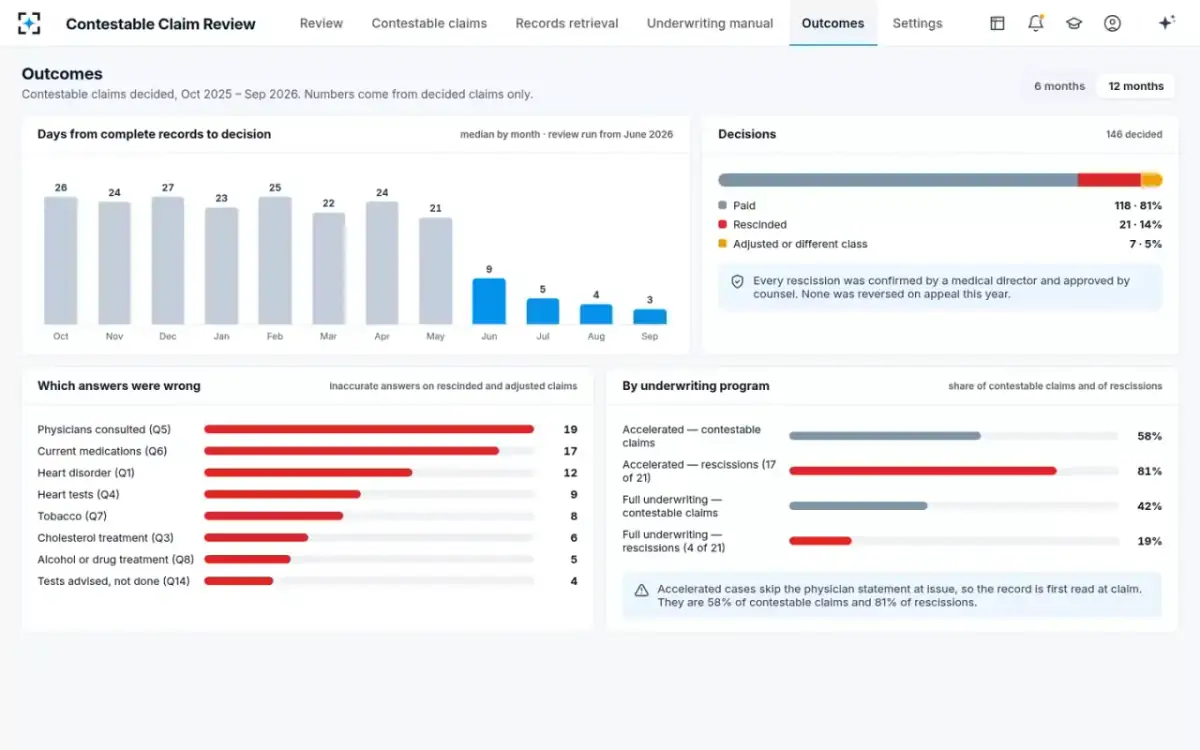
The outcomes a carrier measures afterwards should be chosen in week one, so the baseline exists before the tool changes it. In the solution's sample, the desk tracked days from complete records to decision, decisions by type, which answers were wrong on rescinded claims, and contestable claims and rescissions by underwriting program.
What a contestable desk can measure once the review runs
Where Contestable Claim Review fits, and where another product is the better buy
Contestable Claim Review is a contestable review tool with a retrieval agent: it requests each source under the signed authorization and chases it, reads every page, dates each event, matches every answer to its look-back window, tests materiality on the manual in force at issue and drafts a cited letter, while the examiner decides, the medical director confirms and counsel approves. It fits a desk whose days go to reading and to the round trip between examiner, underwriting and the medical director.
It is the wrong first buy for a desk whose problem is organised fraud, which needs special investigation tooling, or for a carrier that needs a whole claims administration system. Its connections to a carrier's retrieval vendors, pharmacies and bureau feeds have to be set up for that carrier, which is the work of weeks three and four. And the evidence a buyer should accept is the same as for any vendor: a run on your own decided files. What happens to the days after go-live is set out in how long a life insurance investigation takes.
Questions people ask
How long does it take to implement claims investigation software?
No regulator or independent study publishes a figure. Our suggested plan for one product line in one or two states is ten weeks to a first live file, with the manual's version history and the state-by-state letters usually the slowest parts; more states and form versions add time.
Is claims investigation software the same as fraud detection software?
Not for a life contestable desk. Fraud software manages suspicions and investigations of intent; a contestable review tests whether an application answer was wrong and whether it mattered, which in New York needs no intent at all.
Does the insured's application authorization still work after death?
Often, if it has not expired. HIPAA requires an expiration date or event, and NAIC's privacy model, where adopted, caps a life application authorization at 30 months; HIPAA also limits revoking an authorization obtained as a condition of insurance while the insurer may contest the policy.
Do we need a separate records retrieval vendor?
Not necessarily. A contestable review tool with a retrieval agent can request and chase records itself; a carrier with an existing retrieval contract can feed its deliveries in instead. Either way, someone must log every page received, because the review should not start until sources are complete.
What should the first measures be?
Days from complete records to decision, decisions by type, which answers were wrong on rescinded files, and contestable claims by underwriting program. Record a baseline before go-live, from the same closed files you use for the seeded test.