How long a life insurance investigation takes depends on why there is one. When the insured dies within two years of the policy's issue date, the insurer may check the application answers against the medical records before paying, and that contestable investigation usually runs for weeks: first gathering records from every doctor, pharmacy and hospital, then reading them, comparing them with the application and deciding whether any wrong answer mattered. No regulator or academic study publishes an average, but the model rules most states follow expect a written explanation to the beneficiary once a claim is 30 days old and unresolved. Contestable Claim Review is Botminds' software for this work: specialist agents gather and read the records and test each answer, so the examiner, the medical director and counsel decide sooner, and the beneficiary waits less.
This guide is for claims leaders and for the beneficiary waiting on one. It follows a fictional sample claim through the solution: Martin J. Ressler, 53, died on 28 August 2026, in month 18 of a $1,500,000 term policy, with his wife Elena as beneficiary and executor. Everything about the claim is invented; the clocks are real.
Where a contestable file's days go once the records are complete
Read and compared by hand · about 22 days
- Reading and dating the records · 36%
- Comparing each answer · 18%
- Re-underwriting on the manual at issue · 23%
- Medical director · 9%
- Letter and counsel · 14%
With the review run first · about 3 days
- Reading and dating · 16%
- Comparing · 17%
- Re-underwriting · 17%
- Medical director · 17%
- Letter and counsel · 33%
How long does a life insurance investigation take?
For a contestable claim, expect weeks rather than days, and longer when a provider is slow to send records. The investigation cannot finish before the last record arrives, so the slowest hospital or specialist sets the floor; after that, how long the file sits depends on how quickly people can read hundreds of pages and test each answer.
The sample claim shows the shape. The death certificate and the claimant's statement were on file by 9 September. Elena Ressler signed an authorization as executor on 11 September, and requests went to four providers that day and the next. The pharmacy answered in 13 days, the family doctor in 19, the cardiologist in 21 after two follow-ups, and the hospital, with 236 pages, 24 days after its request and two more follow-ups. The records were complete on 6 October, and the medical director confirmed his materiality call on 12 October: 33 days from the claim papers to a confirmed decision, of which 25 were waiting for records.
Forty-five days from death to a confirmed decision on the sample claim, and what filled them
- Death to authorization14 d
- Waiting for records25 d
- Review6 d
- Pharmacyday 13
- Family doctorday 19
- Last twoday 25
Why is my life insurance claim under investigation? What triggers a contestable review
The usual trigger is the date: the insured died within the contestable period, generally two years from the issue date, during which the insurer may contest the policy for a material misstatement in the application. A death in that window lets the insurer look; it does not by itself mean anything was wrong. New York's regulator has said life insurers may not contest such claims without actual evidence of misrepresentation, nor shift the burden of proof to beneficiaries (DFS, 2017).
The look is more likely, and more likely to find something, when the policy was issued without the medical evidence traditional underwriting collected. The NAIC describes accelerated underwriting as using external data such as prescription history and motor vehicle records to forgo the physical exam and process applications "in a matter of hours" (NAIC). The sample policy was issued that way, with no exam and no physician statement. The medical records nobody read at issue were read at the claim.
Other investigations have other triggers, such as an accidental death benefit, a cause of death an exclusion might reach, or signs of fraud, which follows its own route. This guide is about the contestable review, the one most beneficiaries meet.
What records do they request, and who has to sign for them?
The insurer asks for records from everyone who treated the insured in the application's look-back periods: primary care, specialists, the hospital where they died, and the pharmacy's own dispensing record, alongside the application, any recorded interview and the prescription and bureau reports run when the policy was issued. Medical providers release records under a signed HIPAA authorization, either the one the insured signed with the application or a new one from the estate's personal representative.
Every source requested under the signed authorization, chased until it arrives
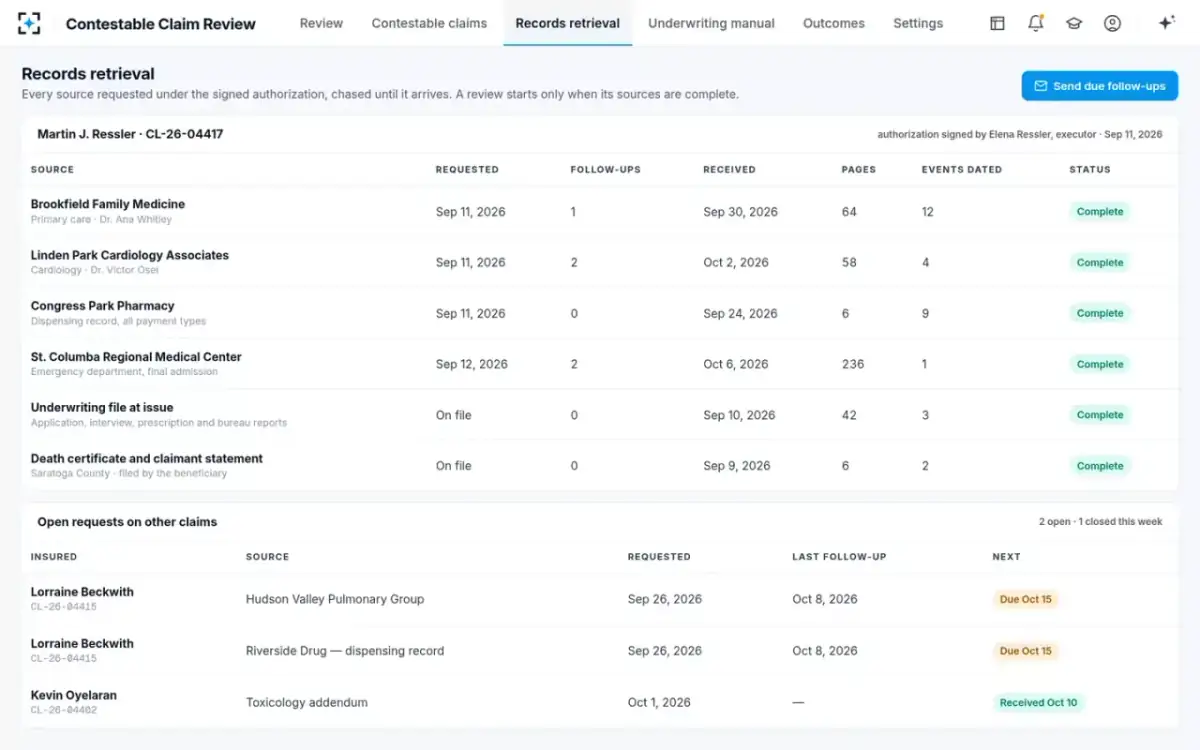
What the beneficiary must provide is narrower than many expect. The death certificate and the claim form, yes. The medical records, not necessarily: in New York a beneficiary may help the insurer gather them but is not required to, and an insurer cannot make producing them a condition of the claim (DFS, 2017).
How long can an insurer investigate a death? The clocks that keep running
There is rarely a fixed deadline for finishing, but there are deadlines for starting, explaining and deciding. The NAIC's life and health claims model, the template many states drew on, expects the insurer to send the beneficiary a reasonable written explanation once a claim has been unresolved for 30 days after proof of loss (Model #903 §4.G). California goes further and makes the notice recur: "Thereafter, the written notice shall be provided every thirty (30) calendar days until a determination is made or notice of legal action is served" (10 CCR §2695.7(c)(1)).
The clocks around a contestable investigation, and who they bind
| Rule | Clock | Binds |
|---|---|---|
| NAIC Model #903 §4.A | Claim forms and instructions within 15 days of notice of the claim | Insurer |
| NAIC Model #903 §4.B | Begin any necessary investigation within 15 days of proof of loss | Insurer |
| NAIC Model #903 §4.G | Written explanation at 30 days unresolved; a letter giving reasons 45 days from notice and every 45 days after | Insurer |
| NAIC Model #903 §4.I | Written denial within 15 days of the determination, citing the provision relied on | Insurer |
| Cal. regs. §2695.7(b), (c)(1) | Accept or deny within 40 days of proof of claim, or explain the need for more time, then every 30 days | Insurer (California) |
| 45 CFR 164.524 | Act on a records request within 30 days, with one extension of up to 30 days | Hospitals and doctors, for a personal representative’s request |
| Tex. Ins. Code §705.005 | Notice of refusing to be bound before the 91st day after discovering the falsity | Insurer (Texas); held not to apply to a life policy with a two-year incontestability clause and premiums duly paid |
Regulators test these clocks. Massachusetts examiners of one life insurer faulted it for lacking reasonable standards for prompt investigation in two claim files, and found that one file with three policies was paid on two in 2016 and on the third only in 2018 (Massachusetts Division of Insurance). The payment clocks on an ordinary death claim are set out in the life claims settlement practices model regulation and its state versions; how a state's claims rules are tested across a book of closed files is the subject of the unfair claims settlement practices act guide.
Does the insurer pay interest during an investigation?
If the claim is eventually paid, usually yes, and the investigation days are part of the period. States set the start differently. New York computes interest from the date of death (§3214); California charges it from the date of death when the insurer has not paid within 30 days of it (§10172.5); Texas runs it from receipt of due proof of loss until the claim is accepted and payment offered (ch. 1103); Florida from receipt of written due proof of death, at a rate tied to a corporate bond index (§627.4615). One claim worked through all four rules is in interest on life insurance proceeds.
Interest is not the only cost of a slow file, and for a modest policy it is the smaller one. A rescinded policy pays no death benefit and so no interest on it; the premiums go back instead. But every week the file stays open, the explanation letters keep falling due, people keep handling it, and a beneficiary who believes the delay is unfair keeps the option of complaining to the regulator.
The cost of one contestable file: days times what each day carries
The cost of one contestable file is the number of days it stays open multiplied by what each day carries: interest if the claim is paid, people's time, letters owed, and exposure if the decision turns out wrong. A desk can price its own files with four terms and its own numbers.
What one contestable file costs, term by term
Interest while open
face × state rate ÷ 365 × days
On the sample $1,500,000 face, an illustrative 3% rate is about $123 a day; the rate and start date are the state’s.
Finance
People’s time
hours × loaded hourly cost, per role
Examiner, underwriter, medical director, counsel. BLS puts the median wage of claims adjusters, examiners and investigators at $78,000 (May 2025).
Claims operations
Letters owed
1 at 30 days + 1 per 45 days after
Under Model #903 §4.G; California’s rule is every 30 days. Each letter must say why more time is needed.
Examiner
Exposure if wrong
probability × (benefit + interest + penalty)
A rescission without proof can end in payment plus a fine, as New York’s 2016 Columbian Mutual order did.
Counsel
On the sample claim, the 22 days of reading, comparing and re-underwriting in the by-hand estimate would have meant at least one explanation letter beyond the 30-day one and a medical director waiting on underwriting. In fact the medical director confirmed the materiality call six days after the records were complete. The point is not the sample's numbers but the shape: the records wait is largely outside the insurer's control, and the reading is not.
The sample claim's investigation, in four numbers
25days
waiting for the last of four providers to send records
412pages
from six sources, 236 of them from the hospital
5
follow-ups to the cardiologist, hospital and family doctor
3days
design target from complete records to a decision
Can I speed up a life insurance investigation?
A beneficiary can usually shorten the parts that depend on them, and can ask for the written status the rules require. Send the death certificate and claim form promptly. Give the insurer the names of the insured's doctors, pharmacies and hospitals, which spares it from discovering them one record at a time. If you are the executor and choose to sign a records authorization, sign it early; in New York you are not required to provide records yourself.
If the claim passes 30 days without a written explanation, ask for one in writing; most states' claims rules expect it, as the model does. If you think the delay is unreasonable, the state insurance department of the state where you live, or where the policy was issued, takes complaints. None of this changes what the records say, but it removes the waiting that is nobody's fault.
How Contestable Claim Review shortens the days after the records arrive
The solution cannot make a hospital send records faster, but it can chase them on a schedule and make sure the reading starts the hour the last page arrives. Its records retrieval agent sends each request under the signed authorization, follows up on the interval the carrier sets, and logs every page received. When sources are complete, the medical record reader, the pharmacy reconciler, the answer matcher and the materiality tester run in order; on the sample claim that took 41 minutes, a sample result.
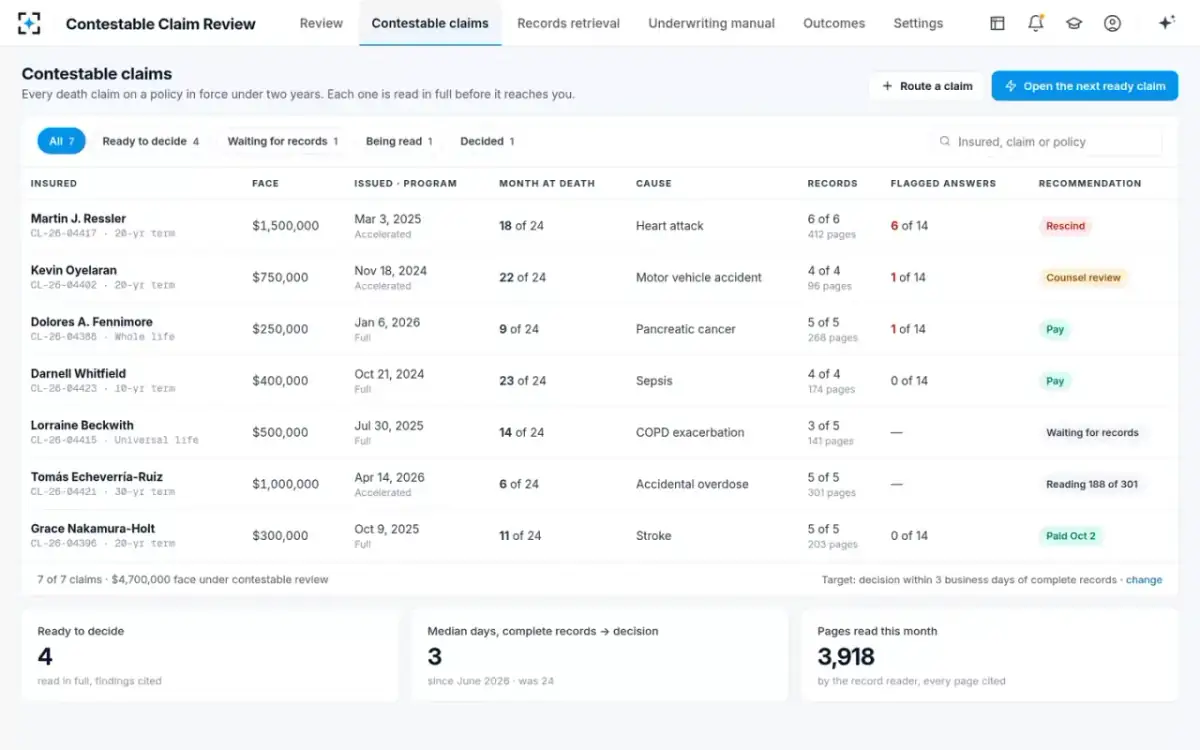
The people then work from a finished file: the examiner checks the flagged answers against their pages, the medical director confirms or rejects the materiality test, counsel approves any rescission and its letter. The design target is a decision within three business days of complete records, against the estimated 22 days of reading by hand. What the medical director's step involves is covered in life insurance medical director: who signs.
The contestable desk: every claim on its clock
Questions people ask
What is the life insurance claim investigation process?
On a contestable claim: the claim papers arrive, the insurer requests records from each provider under a signed authorization, reads them against the application answers, re-underwrites any wrong answers on the manual in force at issue, and decides to pay, adjust or seek rescission. Model #903 expects the investigation to begin within 15 days of proof of loss.
Can a life insurance company investigate after death if the policy is older than two years?
It can confirm the claim, the beneficiary and the cause of death, but it generally cannot contest the policy for a wrong application answer once the policy has been in force two years during the insured's lifetime. New York, California, Texas and Florida write that rule into their statutes, with exceptions such as nonpayment of premiums.
Do I have to give the insurer my parent's medical records?
In New York, no: the Department of Financial Services says beneficiaries may help but are not required to, and an insurer cannot require them to produce the records. Insurers can obtain records directly from providers under an authorization.
Why does the insurer need records from the pharmacy if it already ran a prescription report?
Because the report run at issue can miss fills. The Federal Trade Commission described one reporter's histories as coming from pharmacy benefit managers, so fills paid outside a drug plan may not appear; in the sample claim nine fills paid with a discount card appeared only in the pharmacy's own record.
How long does the medical records part usually take?
Insurers don't publish it. A provider answering a personal representative's own request under HIPAA has 30 days and one 30-day extension; in the sample claim the four providers answered between 13 and 25 days after the first requests went out.