A life insurance medical director is the physician on the insurer's staff who answers the medical questions underwriters and claim examiners cannot settle alone. On a contestable death claim, where the insured died within two years of issue and an application answer turns out to be wrong, the medical director's job narrows to one question: knowing the true medical history, would the company have issued this policy under the underwriting manual it used on the issue date? That confirmation sits between two other signatures. The examiner finds and decides; claims counsel approves any rescission and the letter that explains it. Skip one and the decision rarely survives a court or a regulator. Contestable Claim Review is Botminds' software for this work: specialist agents read every medical record, set each application answer against a dated history and re-underwrite the true facts, and the three people sign.
The hard part is not the medicine. It is the evidence. A materiality call that rests on a doctor's opinion alone has lost in New York's courts; one that rests on the underwriting manual, applied by a named physician to facts each traced to a page, has won. This guide takes a fictional sample claim as it runs through the solution: Martin J. Ressler, 53, who died of a heart attack in month 18 of a $1,500,000 term policy issued through an accelerated program. The carrier, people and policy are invented.
Three signatures before a rescission, and what the agents may never do
Agent
Retrieval, reading and matching agentsRequest every source under the signed authorization, date each diagnosis, test, prescription and visit to its page and line, and mark each application answer consistent, inaccurate or incomplete.
Never: call a misstatement intentional or fraudulent
Agent
Materiality testerRe-underwrites the true facts on the manual version in force on the issue date, finding by finding and together, and returns class, premium and sections.
Never: decides to rescind
A person decides
Examiner decidesReads the flagged answers against their pages and recommends pay, rescind or adjust. Signs only after the medical director has confirmed.
A person decides
Medical director confirms materialityApplies the issue state’s standard to the true facts on the manual at issue, and records the sections and the time.
A person decides
Claims counsel approvesApproves every rescission and its letter before anything leaves the building.
What does a life insurance medical director do on a contestable claim?
On a contestable claim the medical director confirms or rejects materiality: whether a misstated medical fact would have changed the underwriting decision under the issue state's legal standard. The medical director does not re-open the cause of death, does not judge whether the insured meant to deceive, and does not pay or deny the claim. Those belong to other people.
The question comes from statute. New York, whose law governs the sample policy, lets a misrepresentation void a policy only if knowing the facts would have led the insurer to refuse to make the contract, and it makes the insurer's own practice with similar risks admissible evidence of materiality (§3105(c)). The practice lives in the underwriting manual, the rule book that assigns an impairment to a class, a table rating, a postponement or a decline. So the medical director's real work on a contestable file is reading the true history against the right version of that manual.
Those two words, right version, carry most of the risk, because a manual is revised over the life of the policies it priced. In the sample claim the policy issued on 3 March 2025 under Underwriting Manual v2024.3, in force from 6 January to 29 June 2025; a later version would have read the same facts differently. The medical director who applies today's manual to a 2025 application is answering a question nobody asked.
Who decides to rescind a life insurance policy? Three signatures, three questions
The company decides, through people with separate duties: the examiner decides the claim, the medical director confirms whether the misstatement was material, and claims counsel approves any rescission. Each signature answers a different question, which is why a single signature cannot stand in for all three.
The examiner asks whether the record contradicts the application, answer by answer, inside each question's look-back window. The medical director asks whether the contradiction matters under the manual at issue. Counsel asks whether the decision and its letter will hold: whether the state's materiality standard is met, whether the state needs proof of intent, and whether the insurer may rescind on its own at all. In New York the last question has a short answer. After the insured's death, the Department of Financial Services says, the insurer may obtain a rescission only through a court action or with the agreement of every beneficiary, fully informed of the right to contest it (DFS, January 2017).
Carriers draw these lines differently. The Society of Actuaries' 2022 survey of accelerated underwriting, written by Milliman actuaries from the answers of 24 direct writers, records how some respondents handle a post-issue audit that finds a case should have been declined. One wrote: "Case is reviewed by an Assistant Chief Underwriter or Chief Underwriter then determined if it needs to be rescinded." Another: "We pursue rescission in all circumstances where we've obtained sign off following review by legal dept (sometimes they will recommend not to rescind)" (SOA survey, p. 58). Neither is wrong. Both show that the medical opinion and the legal sign-off are separate steps.
The four people who carry one contestable claim
Today
Eleven open files of 300–600 pages each, read and dated by hand, with the chronology in a spreadsheet.
With agents
Opens a claim already read in full, each answer set against the dated history with its page one click away.
Still theirs: the decision, and the signature that comes after the medical director’s
Today
Confirms every materiality call while waiting for underwriting to re-underwrite the case by hand.
With agents
Sees the true facts on the class ladder of the manual in force at issue, each finding’s outcome on its own, and the sections cited.
Still theirs: the materiality call
Today
Approves every rescission and asks that each sentence of the letter have a page behind it.
With agents
Receives a letter with every statement cited and the medical director’s confirmation already on the decision.
Still theirs: approval of every rescission and its letter
Today
Answers the same question on every file: which manual version was in force on the issue date?
With agents
Maintains the manual versions with their dates in force; the test reads only the version a claim was issued under.
Still theirs: the manual itself
What New York's appellate courts asked the medical director's file to show
They asked for documents. In New York's Appellate Division, an insurer wins materiality as a matter of law when it produces its underwriting manual, guidelines or rules for similar risks showing it would not have issued the same policy; it loses that point when it offers only an employee's say-so. The medical director's affidavit carries weight because it applies a written rule, not because a physician signed it.
The clearest life case is Neiditch. A $1,000,000 policy issued on 8 June 2012; the insured died on 23 November 2012 of an anaphylactic reaction, after hospitalizations for anaphylaxis the application had not fully disclosed. The insurer won by "submitting affidavits of its medical director and a senior underwriting consultant, as well as relevant portions of its underwriting manual" (Neiditch, 2019). The court added a point every medical director should know: that the policy was issued at a premium rate despite one disclosed hospitalization "does not negate the decedent's misrepresentations, nor does it change their materiality."
The losing cases fail for the opposite reason. In a marine policy case the same court held that "[c]onclusory statements by insurance company employees, unsupported by documentary evidence, are insufficient to establish materiality as a matter of law" (Novick, 2011). In a 2022 auto case an underwriting supervisor swore the insurer would have charged a higher premium, but the guidelines it submitted did not say so, and summary judgment was reversed (Rodriguez v Mercury).
Five New York appellate rulings on proof of materiality, and what each turned on
| Case | Policy | What the insurer produced | Result on materiality |
|---|---|---|---|
| Varshavskaya v MetLife (2009) | Life | Affidavit of its associate chief underwriter and portions of its underwriting manual (income misstated) | Material as a matter of law; claim dismissed |
| Smith v Guardian Life (2014) | Life | Prima facie showing the policies would not have issued; beneficiaries raised no triable issue | Rescission upheld; "[E]ven innocent misrepresentations, if material" suffice |
| Neiditch v William Penn Life (2019) | Life, $1,000,000 | Affidavits of its medical director and a senior underwriting consultant, plus the manual | Material as a matter of law; judgment for the insurer |
| Novick v Middlesex Mutual (2011) | Marine | Statements of its employees without supporting documents | Not shown; insurer’s motion denied |
| Rodriguez v Mercury (2022) | Auto | A supervisor’s affidavit of a higher premium; guidelines silent on the point | Not shown; dismissal reversed |
The chain skipped: Columbian Mutual's 257 rescinded policies
When the chain is skipped, the regulator rebuilds it at the insurer's cost. In December 2016 New York's Department of Financial Services ordered Columbian Mutual Life to pay the beneficiaries of 257 deceased policyholders whose small final-expense policies it and Unity Mutual, which it acquired in 2011, had denied or rescinded, and fined it $257,000.
Columbian Mutual, 2016: what rescinding without proof cost
257
deceased policyholders whose beneficiaries had to be paid
$257,000
fine, on top of the death benefits
162
claims rescinded, with $1,429,341 of face value
$70,477
premiums returned to beneficiaries of 123 of those policies
The findings read like a list of missing signatures. DFS found the insurers had been "rescinding policies without proving misrepresentation when policyholders died within a two-year contestable period", and "unilaterally rescinding policies without a judicial determination or settlement with beneficiaries" (DFS, 2016). Unity's practice was to close claims without payment when a death certificate or medical records were not provided. Denial letters did not cite the policy provision relied on. Each is a step a medical director's confirmation and a counsel's approval exist to catch: a materiality call with no manual behind it, a rescission with no legal route, a letter with no reasons.
A month later DFS turned the case into guidance for every life insurer in the state. It said an insurer may not make a beneficiary produce the deceased's medical records to pursue a misrepresentation inquiry (DFS, 2017; the superintendent's words are quoted in do life insurance companies check medical records after death?), and that a death inside the two years is not by itself a reason to withhold payment. The insurer has to find the evidence, then prove what it found mattered.
What a materiality confirmation should record, and what it should leave out
A confirmation should record the standard applied, the manual version and sections, the facts each traced to a page, and the outcome of each finding alone and together, with the physician's name and the time. It should leave out any judgment of the insured's honesty, because materiality and intent are different questions answered by different people.
Eight things a medical director's materiality confirmation should carry
- The legal standard of the issue state
New York asks whether the insurer would have refused the contract; other states word it differently, and some add intent or a link to the cause of death.
- The manual version in force on the issue date
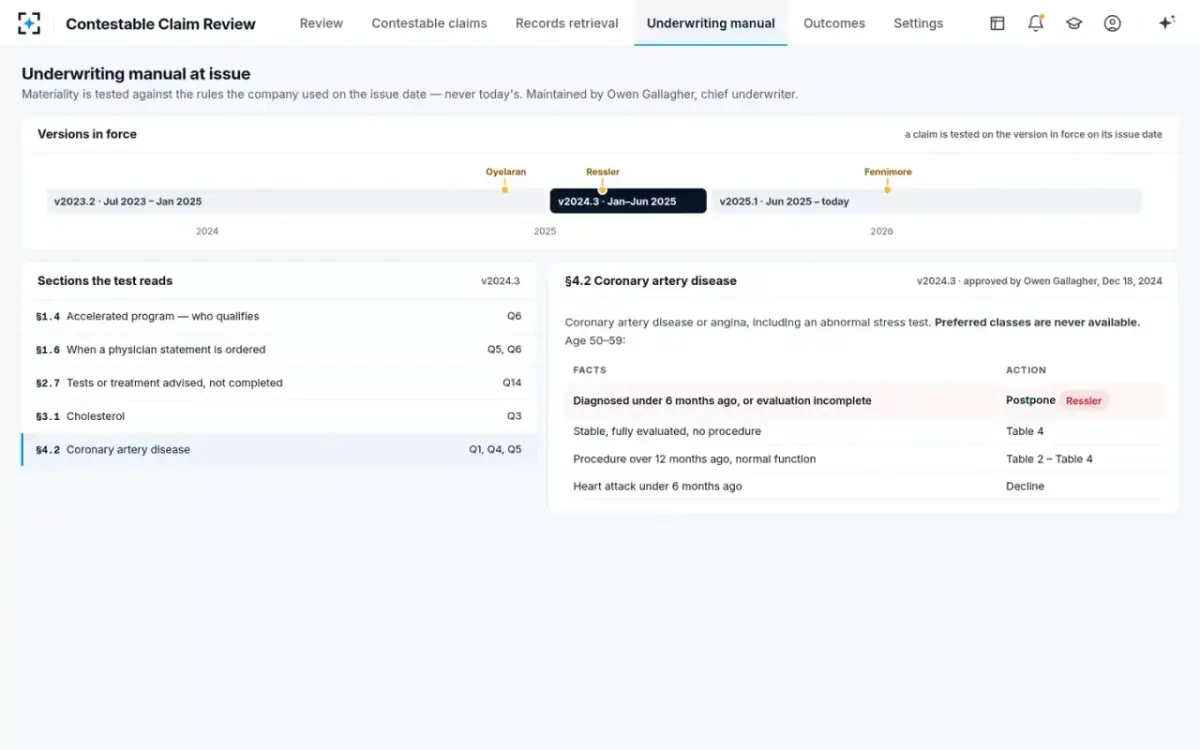
With its dates in force and who approved it. In the sample, v2024.3, approved 18 December 2024, in force 6 January to 29 June 2025.
- The sections applied, quoted
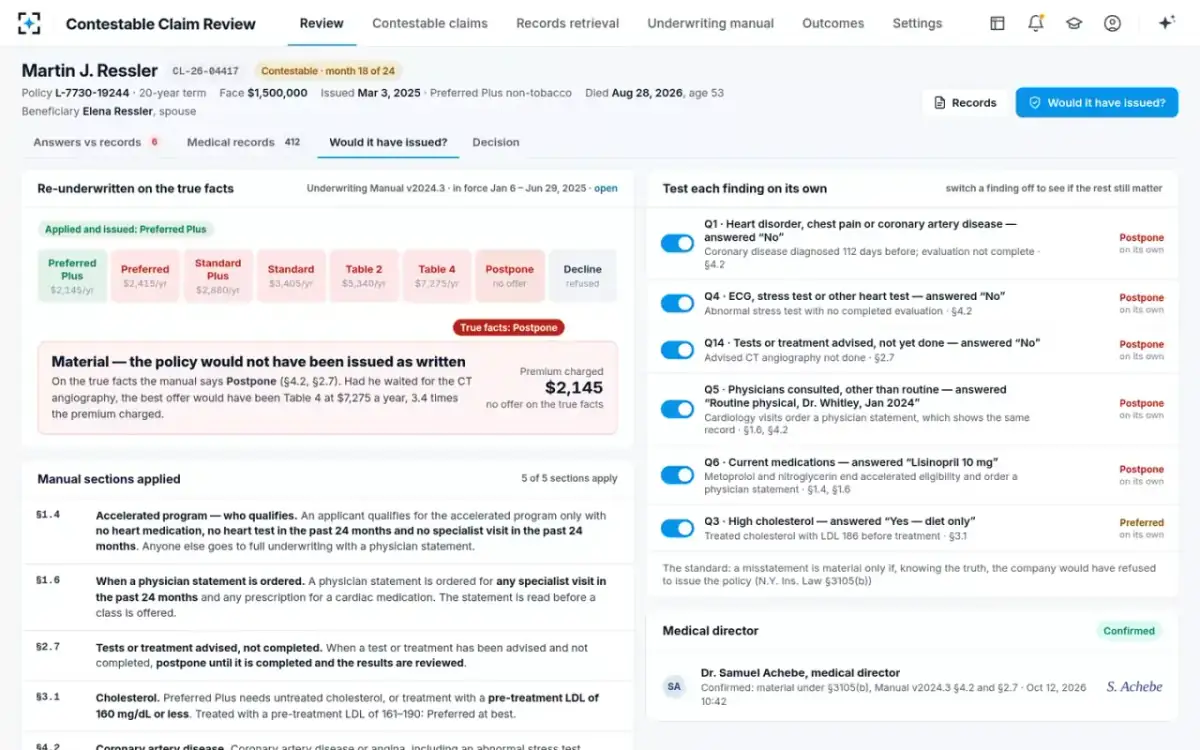
In the sample, §4.2 coronary artery disease with evaluation incomplete, and §2.7 tests advised and not done: both Postpone.
- The true facts, each with its page and line
An abnormal stress test on 14 October 2024 is a page in a cardiology file, not a phrase in a summary.
- Each finding tested on its own
Which misstatements alone would have changed the decision, and which would only have changed the price.
- All findings together
The class and premium the true facts would have earned, or postponement or decline.
- Nothing about intent
Whether the insured meant to mislead is for counsel and, where a state requires it, for a court.
- A name and a time
In the sample: Dr. Samuel Achebe, 12 October 2026, 10:42.
The intent line matters more than it looks. New York does not require intent: even innocent misstatements, if material, defeat recovery (Smith v Guardian). Texas does. Its Supreme Court held in 2023 that an insurer must still plead and prove "the insured intended to deceive or induce the insurer to issue the policy" before it can avoid a policy for an application misstatement (Arce, 2023). A medical director who writes "the insured concealed" has stepped into a question the record may not answer. The state-by-state tests are laid out in material misrepresentation in life insurance, in plain words, and a suspicion of fraud follows a separate route, set out in the guide to the SIU referral form.
Does a doctor review every life insurance claim?
Not as a rule. A death claim outside the two years turns on the policy, the death certificate and the claimant's statement; a physician sees a claim when a medical question decides it. On a contestable claim that usually means one or more application answers the records contradict, and the question whether the contradiction mattered.
How often that happens is not published. No regulator or independent study publishes a count of contestable claims or rescissions across the industry, and the SOA survey's authors, asked about the share of contestable claims paid, pending and denied in accelerated programs, wrote that "it is too early to determine the results" because many programs had very few claims (SOA survey, p. 75). What the survey does show is pressure in one direction: every one of the 24 companies said it rescinds accelerated policies for material misrepresentation, and the companies that audit accelerated policies after issue do it mostly with an attending physician statement, the very document the program skipped at issue. A medical history nobody read when the policy was sold gets read at the claim, by an examiner first and a medical director second.
How Contestable Claim Review prepares the file the medical director signs
It prepares the evidence, not the verdict. By the time the file reaches the medical director the agents have read every page, dated every event, matched every answer to its look-back window and run the materiality test on the issue-date manual. The medical director sees what the test applied and why, and either confirms or sends it back.
In the sample claim the records were complete on 6 October 2026: 412 pages from six sources, 31 dated events. The materiality tester applied v2024.3. Coronary artery disease with the evaluation incomplete is Postpone under §4.2; a CT angiogram advised and not done is Postpone under §2.7. Had the insured waited for the test, the best offer on the true facts would have been Table 4 at $7,275 a year, 3.4 times the $2,145 he was charged. The tester returned the class and the sections, never a decision.
The medical director's confirmation, with the standard, the sections and the time
The manual is a separate screen because it has a separate owner. The chief underwriter maintains each version with its dates in force, and each claim is tested only on the version it was issued under. When the sample desk held claims issued in 2024, 2025 and 2026, three versions were live at once in the test, each with its own sections.
Each claim tested on the manual version it was issued under
Time is the other thing the preparation changes. The solution's own estimate puts the medical director's step at about two days when underwriting re-underwrites the case by hand, and half a day once the test arrives with the file; it is an estimate of how the days divide, not a measured result. Where the days of a whole investigation go is the subject of how long a life insurance investigation takes.
“Would we have issued it, under the manual we used then?”
Dr. Samuel Achebe, medical director in the solution's sample claim
Where claims counsel comes in, and why the order matters
Counsel comes last, after the medical director has confirmed and the examiner has signed, and approves every rescission and its letter before anything is sent. The order matters because counsel's review depends on a finished record: a confirmed materiality call, the sections behind it, and a letter where each sentence cites a page.
Counsel reads for things the medicine cannot settle. Whether the issue state needs intent. Whether the state lets the insurer rescind by notice or only through a court or the beneficiaries' agreement, as New York's regulator says of claims after death. Whether the letter names in writing the policy provision relied on, which NAIC's life and health claims model requires of any denial (Model #903 §4.I) and which Columbian's letters lacked. In the solution, the letter drafter writes in plain words, cites each statement, and never sends; the examiner signs only after the medical director confirms; counsel approves; and a second examiner reviews decisions above a face amount the carrier sets, $2,000,000 in the sample. What the test itself does, finding by finding, is the subject of before you rescind a life insurance policy.
Questions people ask
What is a life insurance medical director's salary?
There is no official pay series for insurance medical directors as such. The Bureau of Labor Statistics reports a median annual wage of $275,930 for physicians and surgeons in May 2025 across all settings (BLS); insurer pay is set by each company.
What is a medical director referral?
It is an underwriter or examiner sending a case to the medical director for a medical opinion the manual cannot give alone. On a contestable claim the referral should arrive with the true facts traced to pages, the manual version in force at issue and the sections that might apply, so the physician confirms a test rather than starting one.
How long does a medical director review take?
No published source measures it. In the solution's own estimate it takes about two days when the case must first be re-underwritten by hand and about half a day when the materiality test arrives with the file; in the sample claim the confirmation came six days after the last records arrived, on 12 October 2026.
Does claims counsel approve claim denials?
Practice varies by carrier; New York, California, Texas and Florida's statutes do not require it. One respondent to the SOA's 2022 survey said it pursues rescission only after "sign off following review by legal dept"; in Contestable Claim Review counsel approves every rescission and its letter before it is sent.
Is the medical director the same person as the underwriter?
No. The underwriter applies the manual to place a case in a class; the medical director is a physician who interprets medical evidence the manual does not settle and, on a contestable claim, confirms materiality. In the New York case of Neiditch the insurer filed affidavits from both its medical director and a senior underwriting consultant.
Can a beneficiary see why the medical director found a misstatement material?
A beneficiary is entitled to the reasons. NAIC's life and health claims model requires a written denial to name the policy provision, condition or exclusion it rests on, and New York faulted Columbian Mutual for not giving beneficiaries specific reasons.