A contestable life insurance claim is the main occasion on which life insurance companies check medical records after death: the insured died within the policy's contestable period, which in New York, California and Texas is two years from the date of issue. In that window the insurer may compare the application with the deceased's medical records, and it may contest the claim only if it finds a misstatement that was material, one that would have changed its decision. After two years the policy is incontestable except for nonpayment of premium. The check is a second reading of records that could have been read when the policy was issued, and for policies issued through accelerated underwriting, often the first. Botminds' APS Summarization reads the attending physician statement at issue and writes every difference from the application down in neutral words, so the questions a claim examiner would ask are answered while the applicant is alive to answer them.
The same medical records, read at issue or at the claim
- Read at issue, amendedBefore issue
- Contestable period, nothing left to find24 months
- Issued on application data; records unread18 months
- Death; records requested and read at the claimClaim review
Do life insurance companies check medical records after death? When, and on what authority
They may check whenever the death falls inside the contestable period. The authority is the policy's own contestability clause, which state law requires. New York's statute requires every policy to become incontestable once it has been in force for two years from issue during the insured's lifetime; which clock applies in other states is set out in the contestability period by state. California's sets a ceiling of not more than two years, and Texas's requires that a policy in force for two years from issue during the insured's lifetime be incontestable except for nonpayment of premiums.
The records themselves come through the same channel as at issue. HIPAA continues to protect a deceased person's health information for 50 years after death, and an executor or administrator with authority under state law is treated as the personal representative who can sign for it (45 CFR 164.502(f) and (g)(4)). The authorization the insured signed at application can also matter: HIPAA's revocation rule preserves an insurer's right to contest where the authorization was a condition of getting coverage, which is set out in HIPAA authorization for life insurance.
What is the contestability period? Three state statutes
| State | The rule | Exceptions written into it |
|---|---|---|
| New York, Ins. Law § 3203 | Incontestable after in force during the insured’s life for two years from issue | Nonpayment of premiums; certain military-service conditions; increases on new evidence have their own two years |
| California, Ins. Code § 10113.5 | Incontestable after in force during the insured’s lifetime for not more than two years after issue | Nonpayment of premiums; certain supplemental benefits |
| Texas, Ins. Code § 1101.006 | A policy in force for two years from issue during the insured’s lifetime is incontestable | Nonpayment of premiums |
Can a claim be denied for something not on the application?
Only if the omission or misstatement was material, and the insurer bears the burden of showing it. New York's rule is the clearest: a misstatement is material only if the true facts would have led the insurer to refuse the policy (the test is worked through in material misrepresentation in life insurance). The same section lets the insurer's own practice with similar risks be admitted as evidence of materiality, which is why the underwriting manual matters at claim time as much as at issue.
That standard makes the claim-time read hard. The examiner must reconstruct what the underwriter would have done with records the underwriter never saw, years later, from a manual that may have changed. The applicant is not there to say whether "prediabetes, diet controlled" was a misunderstanding of a diagnosis or a choice. The neutral wording APS Summarization uses at issue, "answered" beside "records show", exists for the same reason: it never judges intent, because intent and materiality are decided later, by people, under the law.
Can an insurer make beneficiaries provide medical records?
In New York, no, and the regulator has said so in terms. In 2017 the Department of Financial Services issued guidance after an enforcement action against an insurer that, in the department's words, "improperly denied coverage and rescinded life insurance policies for 257 deceased policy holders". The guidance told insurers they may contest a claim within two years only with evidence of a material misrepresentation, and may not shift the burden of proof to beneficiaries.
"A life insurance company cannot require a beneficiary to produce a deceased policyholder’s medical records to pursue an alleged misrepresentation investigation or use illegal and unfair tactics to withhold and deny claim payments when those payments are due and most needed upon the insured’s death"
Maria T. Vullo, Superintendent, New York Department of Financial Services, January 2017
The department's guidance sets the insurer's limit: when an insurer investigates during the contestable period, beneficiaries may help and provide records, "but they are not required to do so." An insurer with actual evidence of a material misrepresentation may seek rescission in court and return the premiums, or settle with fully informed beneficiaries. Other states have their own rules; the principle that the insurer carries the burden runs through the materiality statutes.
Why accelerated underwriting leads to more claim reviews
Because the records that were not read at issue are still there at the claim. Accelerated programs issue policies on application data, prescription histories and other outside data, without an exam or fluids on many cases and usually without an APS. The Society of Actuaries Research Institute's 2022 survey of 24 direct writers, conducted by authors at Milliman, measured how far that has gone and how much is checked afterwards.
How much accelerated business is checked after issue
46%
average share of eligible policies expected to have fluids or exams waived, 2022
6%
average share of eligible policies given a post-issue audit, 2022
4%
average share held out at random for full underwriting, 2022, down from 8% in 2019
80%
of respondents used an APS as the primary post-issue audit tool
A post-issue audit is the issue-time read, done late, on a sample. The rest of the accelerated book carries its unread records into the contestable period, where a death triggers the read. And when a read finds something, the survey shows carriers act: all responding companies said they would rescind an accelerated policy for material misrepresentation, and 83% for material non-disclosure.
What is mortality slippage?
It is the extra mortality an accelerated program produces compared with full underwriting, because some risks that records or fluids would have found get through. The SOA survey frames it exactly that way, and notes the reverse case: "negative excess mortality shown below means that policies issued under an AU program are expected to have better (lower) mortality than the policies issued under similar programs with full underwriting." Carriers estimate it from random holdouts and post-issue audits, which is why both depend on reading an APS.
Slippage and claim reviews are two prices of the same choice. A carrier that reads fewer records at issue accepts some extra deaths in its pricing and some extra contestable claims in its claims department. Neither is wrong; both are cheaper to manage when the reading capacity exists to audit properly and to read at issue wherever the case size or the history warrants it.
At issue, the reading ends in a requirement, not a contest
The case for reading once, properly, at issue
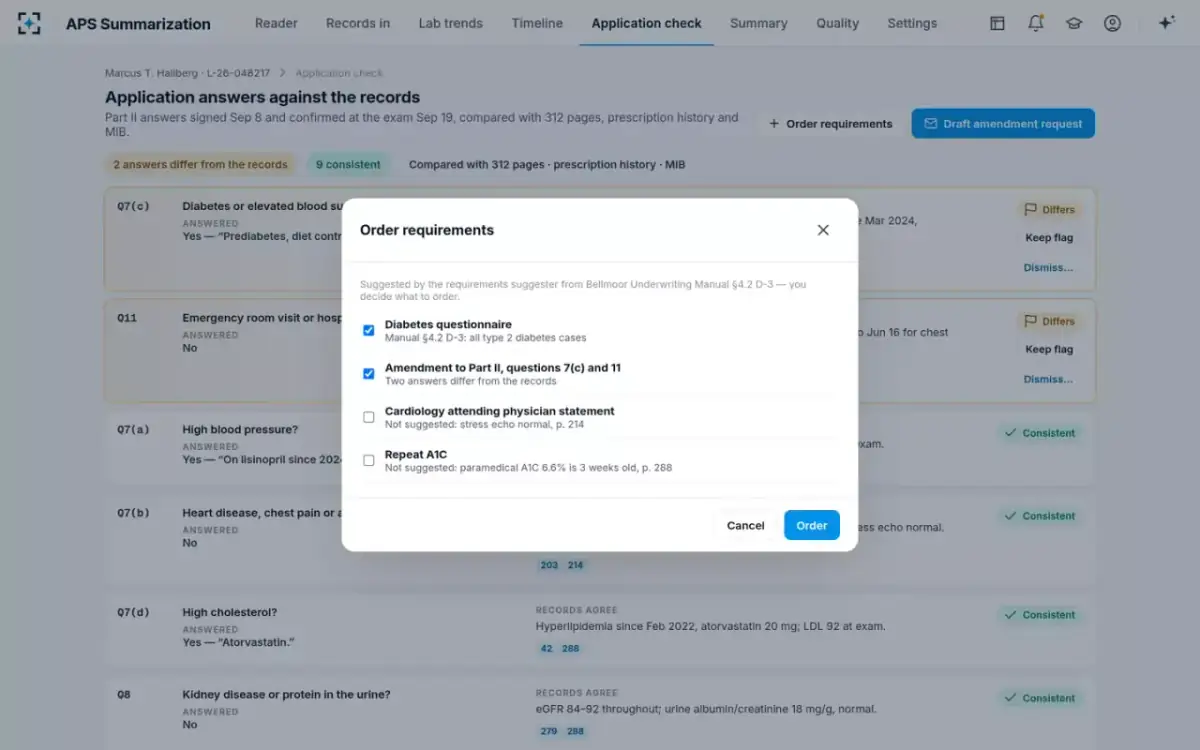
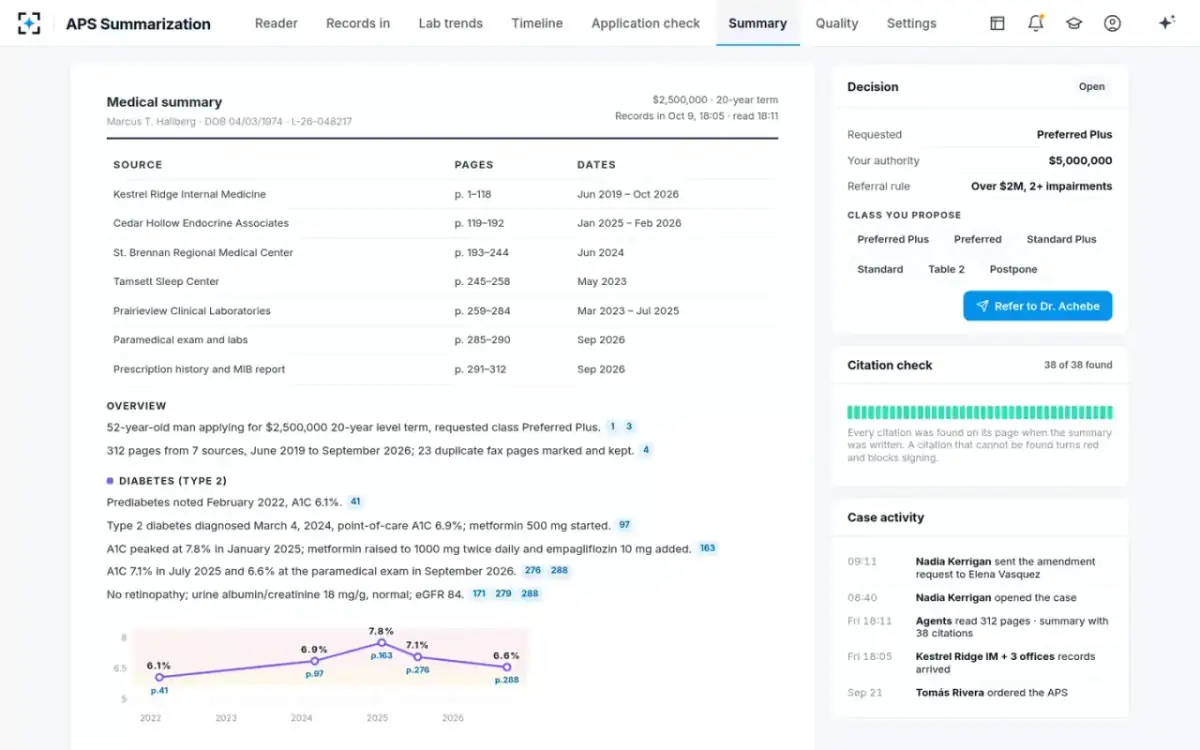
A difference found at issue is a conversation; the same difference found after death is a dispute. On the fictional sample case the records showed type 2 diabetes on two medicines where the applicant had answered "prediabetes, diet controlled", and an emergency visit for chest pain where he had answered "no". Found at issue, both became an amendment for him to review and sign, and the case was decided at Standard, subject to that amendment, rather than the Preferred Plus he asked for. Found after his death, the same facts would have started a contestable review in which nobody could ask him what he meant.
The same two differences, found at issue or found at the claim
Found after death, during the contestable period: Nobody; the applicant has died
Found at issue, by APS Summarization: The applicant, through the producer, before the policy is issued
Found after death, during the contestable period: Materiality review, possible rescission, possible litigation
Found at issue, by APS Summarization: An amendment and a questionnaire; a class the evidence supports
Found after death, during the contestable period: The insurer, which must prove materiality; the family in the middle
Found at issue, by APS Summarization: Nobody: the record is corrected before anything is owed
Found after death, during the contestable period: A delayed or contested claim
Found at issue, by APS Summarization: A policy priced on the facts, payable without a contest on these two points
Reading at issue is not free; it costs underwriting time and some weeks of waiting for records. The cost has fallen. Agents that read a 312-page file in about six minutes, cite every sentence to its page and set every answer beside the records change the arithmetic of which cases can afford a full read, a trade worked through in APS retrieval and summary services vs in-house vs agents.
How the claim examiner's read differs from the underwriter's
The examiner reads the same kind of records with a narrower question and a tighter clock. The underwriter asks what the risk is; the examiner asks whether any answer on the application was materially wrong on the day it was signed. The NAIC's model regulation on life and health claims expects an insurer to start any investigation within 15 days of receiving proof of loss, and to explain in writing if the claim is still unresolved after thirty (the death claim clocks, model and state). States adopt their own versions of those clocks.
Three things make the claim-time read harder than the issue-time read. Every finding has to be dated against the application's signature and each question's window, because a diagnosis made a week after signing was not something the applicant could disclose. The insurer's own practice on similar risks becomes evidence, which in New York the statute admits expressly, so the examiner needs the underwriting manual as it stood at issue, not as it stands now. And the records must be fetched again, through the estate's personal representative, months after the death. A summary written at issue, with every statement dated and cited and the settings that applied saved as a version, answers the first two questions before anyone asks them; for the third, the pages are already in the file.
Do insurers review medical history before paying every claim?
No. Outside the contestable period the policy is incontestable except for nonpayment, and a routine claim is paid on proof of death and the policy terms. Inside the period, practice varies by carrier, and the law limits it: a contest needs a material misstatement, and in New York the insurer cannot make the beneficiary prove there was none. The full sample case, including how the differences are worded and resolved at issue, is on the APS Summarization page.
What was read at issue, and what any later reader can check
Questions people ask
How long can an insurer investigate after death?
The contestable period sets when a misstatement can be raised: in New York, California and Texas, two years from issue during the insured's lifetime. Claim-handling rules then set the pace; the NAIC's model regulation on life and health claims expects a written explanation if a claim stays unresolved for 30 days after proof of loss.
Can life insurance deny a claim for pre-existing conditions?
Not for having them. A claim can be contested within the contestable period only if the application misstated something material, meaning the insurer would have refused the policy had it known. A condition disclosed and rated at issue is part of the contract.
What happens after the two-year contestable period?
The policy becomes incontestable, except for nonpayment of premiums and any exceptions the statute lists. The DFS's 2017 guidance puts it plainly: after the two-year period an insurer cannot claim material misrepresentation on the application as a basis for denying a claim.
Why do accelerated policies get reviewed at claim?
Because their medical records were often never read. In the SOA's 2022 survey of 24 companies, by Milliman authors, an average of 46% of eligible policies had exams or fluids waived, and only about 6% were audited after issue, usually with an APS.
Who signs for a deceased person's medical records?
Under HIPAA, the person with authority under state law to act for the estate, usually the executor or administrator, is treated as the personal representative. HIPAA protects a deceased person's health information for 50 years after death.