The life insurance contestability period is two years in New York, California, Texas and Florida: New York, Texas and Florida require an individual policy to become incontestable after it has been in force for two years from its date of issue during the insured's lifetime, and California sets "not more than two years". During that window the insurer may contest the policy for a material misstatement in the application; after it, the policy cannot be contested on that ground, except for nonpayment of premiums and a few exceptions each statute lists. The clock is not always the policy's issue date, though. An increase in coverage carries its own two years in New York, a reinstatement reopens a window in California, and an exclusion such as suicide runs on a separate clock of its own. Contestable Claim Review, Botminds' software for contestable death claims, holds a 24-month period with state overrides, and the first thing it checks on a claim is which clock applies.
This guide answers that question for examiners and for beneficiaries who have been told a claim is contestable. Where it uses the solution, the claim is fictional: a $1,500,000 term policy issued on 3 March 2025, whose insured died on 28 August 2026, in month 18.
Is this claim contestable? Four questions, in order
1Did the insured die within two years of the policy’s issue date?
Yes: the policy never completed two years in force during the insured’s lifetime. Go to 2.
No: the policy is generally incontestable for application misstatements. Exceptions remain: nonpayment of premium, listed benefits, an impostor in California. Go to 4.
2Is the misstatement in the original application, or in one for an increase or a reinstatement?
Original: the clock runs from the issue date.
Increase or reinstatement: a separate two-year clock may apply to that application only (New York for increases, California for reinstatements). Check it, then go to 3.
3Is the insurer contesting the application, or applying an exclusion?
The application: contestable. Test materiality under the issue state’s standard.
An exclusion such as suicide within two years: not a contest. California’s statute keeps exclusion defenses available at any time.
4Is anything else in issue?
Nonpayment or lapse, who the beneficiary is, or whether the policy was in force at all: these are not contests of the application.
Texas: a misrepresentation defense in a suit brought after the second anniversary survives only on the conditions in §705.104.
What is the contestability period by state?
In New York, California, Texas and Florida it is two years, counted from the date of issue and running only while the insured is alive. The wording differs in ways that matter at the edges, so the table below quotes what each statute keeps outside the rule.
The two-year incontestability rule in four states, and what each keeps outside it
| State | Period | Counted from | Written exceptions and extras |
|---|---|---|---|
| New York §3203(a)(3) | Two years, in force during the life of the insured | Date of issue; for an increase on evidence of insurability, the increase’s effective date | Nonpayment of premiums; policy conditions on armed-forces service; at the insurer’s option, disability and accidental death benefits |
| California §10113.5 | Not more than two years, in force during the lifetime of the insured | Date of issue; for a reinstatement, the same period after reinstatement | Nonpayment; supplemental benefits; an impostor in the application process means no contract was formed; exclusion defenses survive |
| Texas §1101.006 | Two years, in force during the lifetime of the insured | Date of issue | Nonpayment of premiums; §705.104 governs misrepresentation defenses in suits after the second anniversary |
| Florida §627.455 | 2 years, in force during the lifetime of the insured | Date of issue | Nonpayment; at the insurer’s option, disability benefits and additional accidental death benefits |
New York's text is the model of precision: a policy must provide "that the policy shall be incontestable after being in force during the life of the insured for a period of two years from its date of issue", and for an increase or change made on evidence of insurability, "the policy with respect to each such increase or change shall be incontestable after two years from the effective date of such increase or change" (§3203(a)(3)). The policy itself carries the clause. In a 2023 Texas case the policy read: "This Policy will be incontestable after it has been in force during the Insured’s lifetime for 2 years from the Issue Date except for nonpayment of premium" (Arce, footnote 1).
Can life insurance be denied after 2 years?
Yes, but not because of a wrong answer on the original application. Once the policy has been in force for two years during the insured's lifetime, New York, California, Texas and Florida bar contesting it on that ground. A claim can still be denied for reasons that are not contests of the application: the policy lapsed for nonpayment, the death falls within an exclusion, the person claiming is not the beneficiary, or, in California, an impostor took part in the application, in which case "no contract between the insurer and the named insured is formed" (§10113.5(b)).
The "two-year" myth runs the other way too. Beneficiaries sometimes hear that any death inside two years will be investigated and probably denied. A death inside the window lets the insurer look; it does not shift the burden. New York's regulator has said that "After the two-year contestable period, an insurer cannot claim material misrepresentation on an application as a basis for denying a beneficiary’s claim", and that inside the period an insurer needs actual evidence of a material misrepresentation (DFS, 2017). What counts as material is set out in material misrepresentation in life insurance, in plain words.
Texas adds a rule that sits beside the clause. A defense based on a misrepresentation in the application "is not valid or enforceable in a suit brought on the policy on or after the second anniversary of the date of issuance of the policy if premiums due on the policy during the two years have been paid", unless the insurer had notified the insured of its intention to rescind or proves the misrepresentation was material to the risk and intentionally made (§705.104). For a Texas claim filed late, the date of suit can matter as well as the date of death.
One policy, three clocks: the sample policy with a hypothetical increase
- Contestable24 months
- Incontestable from 3 Mar 2027after
- Before the increase12 m
- Increase contestable24 months
- Excluded24 months
- Coveredafter
Does the contestable period apply to increases?
In New York, yes, separately: an increase granted on a new application with evidence of insurability gets its own two years from its effective date, for that increase only. The original face keeps its original clock. A claim three years after issue but one year after an increase can therefore be contestable for the increase and incontestable for the rest.
The practical consequence for a claims desk is that "month at death" must be computed per layer of coverage, and the answers tested must be the ones given in the application for that layer. An increase application may ask different questions from the original, and its look-back windows run back from its own date. A review that tests the original application's answers against a death in the increase's window has tested the wrong document.
Does reinstatement restart the contestable period?
In California the statute answers directly: a reinstated policy "may be contested on account of fraud or misrepresentation of facts material to the reinstatement only for the same period following reinstatement, and with the same conditions and exceptions, as the policy provides with respect to contestability after original issuance" (§10113.5(a)). So the window reopens, but only for the reinstatement application's statements.
Elsewhere, read the policy's reinstatement provision and the state's law. New York requires a lapsed policy to be reinstatable within three years of default if the owner applies and "provides evidence of insurability, including good health, satisfactory to the insurer" (§3203(a)(10)), which creates exactly the kind of new statement a later contest could concern. A contestable review must know which application it is testing, and the date each was signed.
Life insurance contestability period in Florida and California
Florida's is two years. Every policy "shall provide that the policy shall be incontestable after it has been in force during the lifetime of the insured for a period of 2 years from its date of issue except for nonpayment of premiums", with the insurer free to except disability benefits and additional accidental death coverage (§627.455). Florida's misrepresentation statute then decides what can be contested inside those two years, and it reaches a misstatement that changed the premium as well as one that changed the decision to issue.
California's is "not more than two years" for an individual policy, which lets a carrier offer a shorter period but not a longer one. Its statute adds three rules New York, Texas and Florida do not spell out: reinstatements carry their own window, an impostor voids the contract from the start, and the section "shall not be construed to preclude at any time the assertion of defenses based upon policy provisions that exclude or restrict coverage" (§10113.5(c)). It does not apply to policies delivered on or before 31 December 1973.
The suicide clause runs on its own two years
A suicide exclusion is not a contest of the application, and it has its own clock. New York permits a policy to exclude "suicide within two years from the date of issue of the policy" (§3203(b)(1)(B)). When an excluded death happens while the policy has been in force for not more than two years, the insurer pays back "the amount of the gross premiums charged on the policy less dividends paid in cash or used in the payment of premiums thereon and less any indebtedness to the insurer on the policy" (§3203(b)(3)).
Other states set their own suicide-exclusion periods, and this guide quotes only New York's; a claim desk needs the issue state's statute and the policy form for each. What matters for a contestable review is to keep the two questions apart. A death that is both inside the exclusion period and inside the contestable period may give the insurer two separate grounds, each with its own proof and its own letter.
A misstated age is adjusted, not contested
A wrong date of birth is handled by a different rule from a wrong medical answer, and the two-year clock does not decide it. New York requires every policy to provide "that if the age of the insured has been misstated, any amount payable or benefit accruing under the policy shall be such as the premium would have purchased at the correct age" (§3203(a)(5)). The policy is not rescinded; the benefit is recalculated.
The arithmetic runs both ways. An insured who gave an age two years younger than the truth paid a premium priced for a younger life, so the death benefit shrinks to what that premium would have bought at the true age; one who overstated age receives more. For a claims desk the practical rule is to separate the age question from the medical questions at the start: age goes to the policy's adjustment clause, at any time, and medical answers go to the contestable review, inside the window. This is New York's rule; the issue state's statute and the policy form set it elsewhere.
What the examiner checks first, before calling a claim contestable
Before anyone reads a medical record, the desk should establish which clocks are running and which application each clock covers. Getting this wrong in one direction delays an incontestable claim for no reason; in the other, it pays a claim the insurer could have contested.
Seven checks before a death claim is treated as contestable
- The issue date on the policy, and the date of death
Month at death out of 24, counted per layer of coverage.
- The issue state and its statute
Two years in the four states above; California allows a shorter period. A state override in the rules, not a default.
- Every application on the policy, with its date
Original, increases and reinstatements; each may carry its own window.
- The form version of each application
The look-back windows of its questions come from the version signed.
- Premiums paid during the period
Nonpayment is outside the incontestability rule; in Texas, paid premiums are a condition of §705.104.
- Exclusions that might apply
Suicide and others: separate questions, not contests.
- Whether the application was attached to the policy
New York makes the attached application part of the entire contract (§3203(a)(4)).
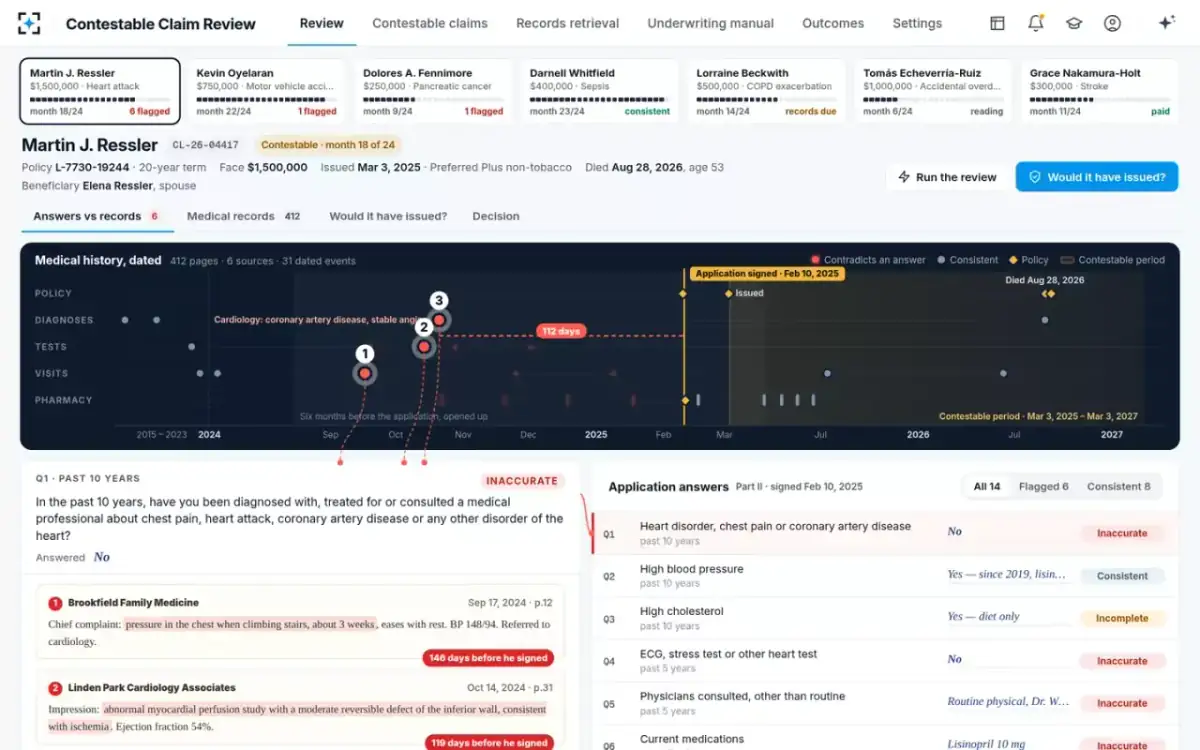
In Contestable Claim Review the contestable desk lists every death claim on a policy in force under two years, with the month at death out of 24 beside each, and the settings hold the 24-month period with state overrides. The sample claim sits at month 18; the review's dark timeline draws the contestable period as a band, with the application line and the death inside it.
The contestable period drawn on the dated medical history
How often contestable claims are denied is not published by any regulator. The SOA's 2022 accelerated underwriting survey, written by Milliman actuaries from 24 direct writers' answers, collected the shares of contestable claims paid, pending and denied in accelerated programs, and its authors judged the answers too thin to draw conclusions from, because many programs had very few claims (SOA survey, p. 75). What happens to a contestable claim once the clocks are settled is the subject of how long a life insurance investigation takes.
Questions people ask
What is the incontestability clause in life insurance?
It is the policy provision, required by state statute, that bars the insurer from contesting the policy for application misstatements once it has been in force for a set period, two years in the four states above, during the insured's lifetime. Nonpayment of premiums is the common exception.
What can an insurer contest after two years?
In New York, California, Texas and Florida, not the application, with listed exceptions: nonpayment, some disability and accidental death benefits at the insurer's option, an increase still inside its own window in New York, or a reinstatement inside its window in California. Exclusions and questions about the beneficiary are not contests of the application.
Does the contestability period reset if I change my policy?
For changes made on a new application with evidence of insurability, New York gives that change its own two years from its effective date; the rest of the policy keeps the original clock. California does the same for reinstatements.
Is the contestability period the same for group life insurance?
The statutes quoted here are for individual policies; group coverage has its own provisions and is outside this guide. Check the certificate and the state's group life statute.
If the insured died in month 23, can the insurer still contest after the two years pass?
The statutes require two years in force during the insured's lifetime, so a death in month 23 stops the policy from reaching incontestability even if the review runs past the anniversary. Texas adds a condition for suits brought after the second anniversary: the defense survives only if the insurer gave notice of its intention to rescind or proves the misstatement was material and intentional (§705.104).