A claim review tool for contestable life claims reads the medical records gathered after a death and tells the examiner which application answers the records contradict. The way to test one is a seeded test: take closed contestable files you have already decided, plant misstatements whose answers you know, add decoys that look wrong but are not, run the tool, and count what it finds, what it misses and what it wrongly flags. Vendor accuracy claims and published studies of medical summaries cannot do this for you, because neither measures your forms, your look-back windows or your records. Contestable Claim Review, Botminds' software for these claims, is built to be tested this way: its agents mark each application answer consistent, inaccurate or incomplete, with the pages behind each mark, so every result can be checked against the key.
What follows is a protocol a claims quality team can run in a few weeks on twenty seeds, with the arithmetic that says what twenty seeds can and cannot prove. Where the guide uses the solution's sample claim, that claim is fictional: Martin J. Ressler, who died in month 18 of a $1,500,000 accelerated-issue term policy, with 412 pages of records from six sources.
Twenty seeds and four decoys: what to plant in closed contestable files
How do you test a claim review tool?
You test it against a key. Pick closed contestable files whose outcome you trust, plant misstatements and decoys whose correct answers you write down first, give the tool the files exactly as an examiner would receive them, and score its marks against the key. A tool that cannot be scored this way, because it gives a narrative instead of a mark per answer with pages, cannot be tested at all.
Four counts matter. Recall: of the twenty planted misstatements, how many did it flag? False flags: of the four decoys, how many did it call inaccurate? Citation accuracy: for each flag, does the cited page actually say what the tool says it says? Hand-offs: when a page is unreadable, did it send the page to a person or guess? Each count answers a different worry a claims leader will be asked about by counsel, by a market conduct examiner or by a beneficiary's lawyer.
The examiner's own marks on the original files are the second key. Before planting anything, run the tool on ten unaltered closed files and compare its marks with the decided ones. Disagreements are not automatically the tool's errors; some will be things the original examiner missed. Each needs a person to read the page and decide which mark was right.
What is a seeded error test, and why closed contestable files are the right bench
A seeded error test plants known faults in real material and measures how many a checker finds. Closed contestable files are the right material because they contain everything the live work contains: the application and its form version, the recorded interview, the prescription and bureau reports run at issue, the records obtained at claim, and a decision someone already defended.
Seeding means editing copies, never the originals. To plant a "diagnosis only in a specialist letter", take a file where the answer was consistent and add, in a cardiology consultation note dated inside the question's look-back window, a sentence recording a diagnosis the application denied. To plant a "fill outside the plan", add a dispensing line to the pharmacy's own record that does not appear on the prescription report run at issue. Write each seed's correct mark, page and reason in the key before the run.
The decoys are the half of the test most vendors skip. A cardiac event dated eleven years before signing, against a question that asks about ten, is a decoy: an over-eager tool flags it, and a beneficiary's letter that rests on it would be wrong. New York treats a misstatement about treatment or consultation as one about the condition behind it (§3105(d)), so the window and the wording of each question decide what counts. A good tool reads the window from the form version the insured signed, not from the current form.
A seeded test protocol for a claims quality team
- Choose 10–12 closed files you would defend in court
A mix of paid and rescinded, accelerated and fully underwritten, with the form versions your book actually used.
- Run the tool on the unaltered copies first
Compare its marks with the decided ones, and have a person resolve each disagreement before seeding.
- Plant twenty seeds and four decoys in copies
Write the key first: question, correct mark, page, and a one-sentence reason.
- Give the tool the files as an examiner gets them
Same scans, same order, same missing pages. No clean-up the live desk would not have.
- Score four counts
Recall on seeds, false flags on decoys, citation accuracy on every flag, and hand-offs on unreadable pages.
- Read every miss and every false flag
A miss on a handwritten page and a miss on a typed one are different problems.
- Repeat after any change to the forms, the manual or the tool
A new application version changes look-back windows; a new tool version changes behaviour.
How accurate is AI claim review? What the published studies measure, and what they do not
Nobody has published the accuracy of AI on contestable life claims. The nearest peer-reviewed evidence measures clinical summarization, which is related but not the same task, and it should set expectations rather than replace your own test.
What peer-reviewed studies of AI on clinical text found, and what a claims test adds
45% + 36%
of model summaries rated equivalent or superior to experts’ by 10 physicians
Van Veen et al., Nature Medicine, 2024
1.47%
of sentences hallucinated across 12,999 clinician-annotated sentences
Asgari et al., 2025; authors build clinical documentation software
3.45%
of sentences omitted in the same study
Asgari et al., 2025
25%
of pharmacy dispensings missing from a commercial claims database
Cepeda et al., 2017; authors at Janssen and IMS
Van Veen and colleagues found that summaries from their best-adapted models were judged equivalent to medical experts' in 45% of cases and superior in 36% by a panel of ten physicians, and their safety analysis still catalogued fabricated information from both the models and the experts (Nature Medicine, 2024). Asgari and colleagues, who work for a company that builds clinical documentation software, measured a 1.47% hallucination rate and a 3.45% omission rate across 12,999 sentences in 18 experimental configurations (npj Digital Medicine, 2025). On a 412-page file, rates of that order would mean several wrong or missing sentences. That is why a contestable tool must cite a page for every mark, and why the test scores citations, not prose.
The other limit is the input. A tool cannot find what its sources do not contain. The Federal Trade Commission's 2007 complaint against one prescription-history reporter described it obtaining applicants' histories from pharmacy benefit managers (FTC), and fills paid without the drug plan can be absent. In a study by Cepeda and colleagues, authors at Janssen and IMS, a quarter of the dispensings in an independent pharmacy database were missing from a commercial claims database (2017). Three of the twenty seeds above exist to see whether the tool sets the pharmacy's own record against the report rather than trusting the report. Why those fills go missing is the subject of what the prescription history report misses.
What is a false positive in claim review, and why it costs more here
A false positive is an answer the tool marks inaccurate when the record supports it. On a contestable claim it is not a nuisance: it delays a payment a beneficiary is owed, and if it survives into a decision it becomes a rescission without proof. NAIC's model claims act counts refusing to pay a claim without a reasonable investigation as an unfair practice (Model #900 §4.F), and a flag nobody checked is not an investigation.
The costs run in both directions, which is why the test counts both. A missed misstatement pays a claim the policy was never priced for. A false flag holds a claim open: NAIC's life and health model expects a written explanation to the beneficiary once a claim is unresolved for 30 days and a further letter every 45 days while the investigation continues (Model #903 §4.G). Market conduct examiners test whether claims are handled according to the policy and the applicable statutes, HIPAA included (NAIC handbook). A tool with high recall and many false flags moves work from reading records to defending delays.
“If a court reads this letter, every sentence must have a page behind it.”
Teresa Montalvo, claims counsel in the solution's sample
How many files to test a claims tool? What twenty seeds can prove
Twenty seeds can show that a tool works roughly as claimed; they cannot show it is nearly perfect. If a tool finds all twenty, the most you can say with 95% confidence is that it misses fewer than about 14% of misstatements like these. To say fewer than 5%, you need about sixty seeds found without a miss.
The worst miss rate a perfect or near-perfect run still allows, at 95% confidence
| Seeds planted | None missed | One missed | Two missed |
|---|---|---|---|
| 10 | up to 25.9% | up to 39.4% | up to 50.7% |
| 20 | up to 13.9% | up to 21.6% | up to 28.3% |
| 40 | up to 7.2% | up to 11.3% | up to 14.9% |
| 60 | up to 4.9% | up to 7.7% | up to 10.1% |
| 100 | up to 3.0% | up to 4.7% | up to 6.2% |
Two practical consequences follow. First, start with twenty to learn the tool's failure modes, then grow the seed bank to sixty or more before relying on a single miss rate in a board paper. Second, keep a seed bank: each new application form, manual version or tool release gets the same seeds, so the comparison is like for like. The decoys need the same discipline; four decoys tell you almost nothing about the false-flag rate, which is why the unaltered closed files in step two matter.
Scoring the run: one row per seed, four rates per run
Score every seed and decoy on one sheet, one row each, before anyone discusses the result. A row records the seed's identifier, the question it tests, the page where it was planted, the correct mark from the key, the mark the tool gave, whether the page the tool cited says what the tool says, and, for unreadable pages, whether the tool handed the page to a person. A reviewer's note closes each row that is not a clean match.
The four rates a seeded run produces, and how each is computed
| Rate | Computed as | What a poor result usually means |
|---|---|---|
| Recall on seeds | Seeds marked inaccurate or incomplete ÷ seeds planted | The tool reads the wrong window, misses specialist letters or trusts the prescription report |
| False flags on decoys | Decoys marked inaccurate ÷ decoys planted | The tool ignores look-back windows or details the applicant gave |
| Citation accuracy | Flags whose cited page says what the flag says ÷ all flags | The tool summarises before it cites, so its pages drift from its claims |
| Hand-off rate | Unreadable pages sent to a person ÷ unreadable pages planted | The tool guesses at handwriting and poor scans |
Keep the sheet with the tool's version, the form and manual versions in force, and the reviewer's name. The sheet, not a dashboard, is what a quality committee, a regulator or a court can read later, and it is the baseline the next run on the next version is compared with.
Where Contestable Claim Review fits a seeded test, and where it does not
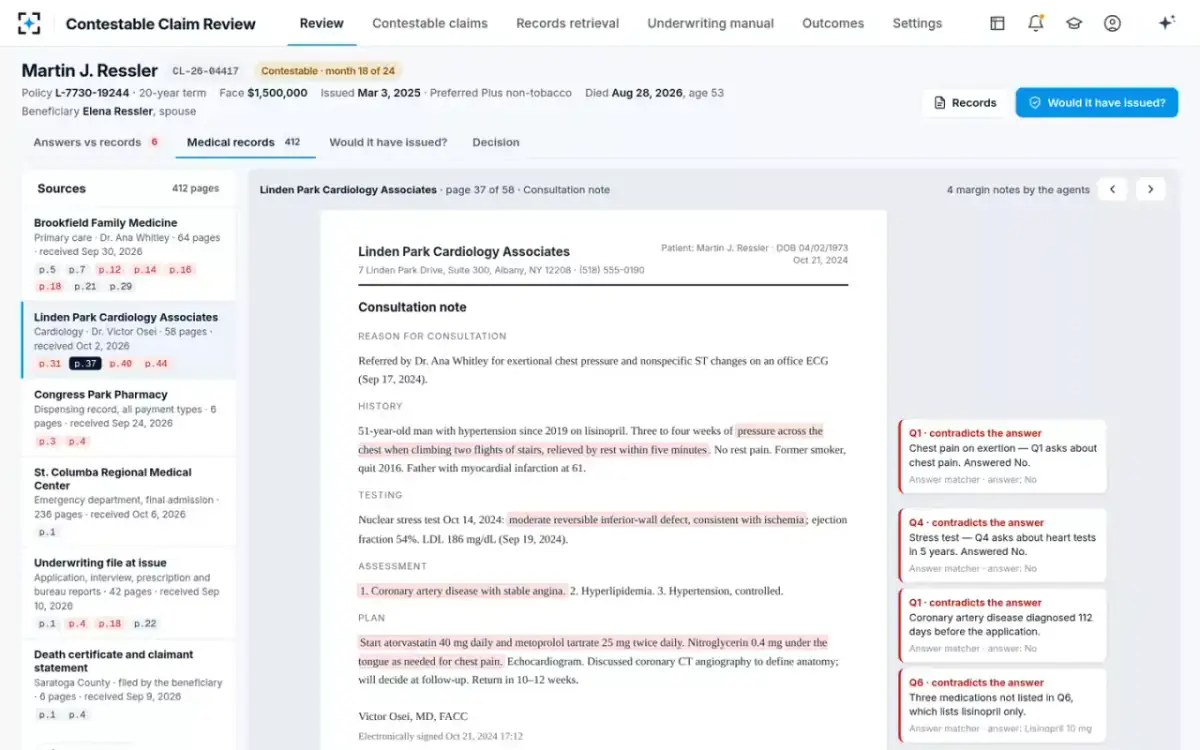
Contestable Claim Review fits the test because it produces exactly what the test scores: a mark per application answer, the look-back window it used, the pages behind each mark and a one-sentence reason. Its answer matcher never calls a misstatement intentional or fraudulent, its pharmacy reconciler never treats a missing fill as proof of no treatment, and its record reader sends illegible pages to a person. Each of those is a rule a seed can test.
The review run on the sample claim: what each agent found, in order
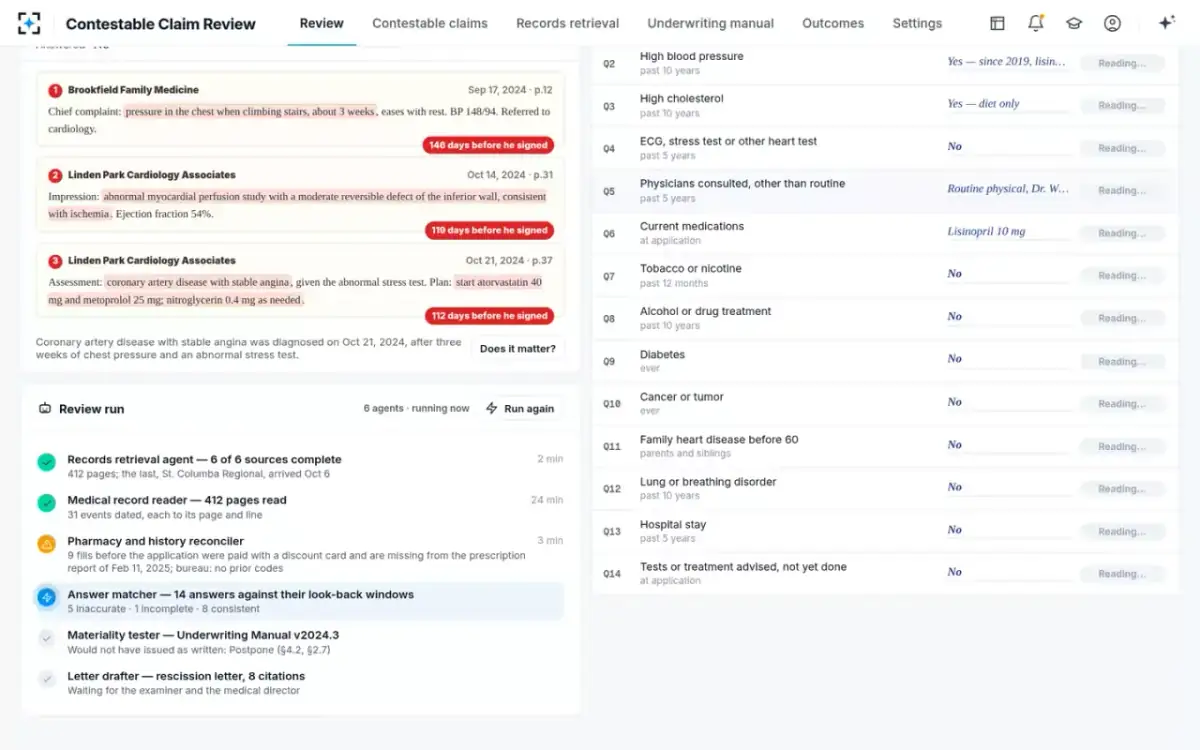
It does not fit everywhere, and a buyer should know where. Its connections to a carrier's records vendors, pharmacies and bureau feeds have to be set up for that carrier, and the figures in its demonstrations, such as the 41 minutes the sample review took, come from sample data, not from a customer's measured accuracy. It does not investigate fraud, which follows a separate route, and it does not decide materiality or rescission: the medical director and counsel do. The fair way to judge it is the way this guide describes, on your own decided files, which is what Botminds offers to do with a sample of a carrier's decided contestable files.
A flag the key can check: the page, the sentence and the answer it contradicts
Who validates a claims AI before it is used on live files?
The insurer does, under its own governance, and regulators expect to see the work. The NAIC's 2023 model bulletin on insurers' use of AI systems asks for a written program covering the whole insurance life cycle, claims administration included, with controls designed to prevent unfair claims settlement practices (NAIC model bulletin). What that program must contain, and where states have adopted it, is set out in NAIC AI bulletin requirements for insurance companies.
A seeded test is the kind of evidence such a program can file: a dated key, the tool version, the counts and a person's review of every miss. Keep it with the tool's change log. When a market conduct examiner or a court asks how the insurer knew the tool's marks were reliable on the day a claim was decided, the answer is the test that ran on that version. How the reviewed marks then become a materiality decision is covered in before you rescind a life insurance policy.
Questions people ask
Can AI find misrepresentation on a life insurance application?
It can find contradictions between the answers and the records, which is the first half. Whether a contradiction is a misrepresentation that matters is a materiality question for the medical director and counsel, and in Texas intent must also be proved; a tool that labels a misstatement fraudulent has gone past what the record shows.
What is claim review software?
In life claims, it is software that reads the records gathered for a claim and checks them against something: the application answers on a contestable claim, the policy terms on a coverage question. The useful test is whether every finding cites the page it rests on, so a person can check it.
How long does a seeded test take?
A first test of twenty seeds and four decoys on ten to twelve closed files is a few weeks of a quality analyst's time, most of it writing the key and reading misses. The arithmetic above says what that run can prove; growing to sixty seeds narrows the bound to about 5%.
Should decoys be included in the seed count?
No. Score decoys separately, as false flags, because they answer a different question. Four decoys are too few to estimate a false-flag rate; the run on unaltered closed files, compared with the decided marks, does more of that work.
What should a claim review tool do with an unreadable page?
Send it to a person and say so. A tool that guesses at a handwritten line can produce a confident mark with no basis; in Contestable Claim Review illegible pages go to a person, and the test's two handwritten-page seeds check exactly that.