Medical records review software reads medical records, often hundreds of pages from many providers, and turns them into a dated chronology of diagnoses, tests, treatment and prescriptions, usually with summaries and links back to the pages. Law firms, injury claims teams, disability insurers and life underwriters use it to stop reading records by hand. A contestable life insurance claim, where the insured died within two years of issue and the insurer may check the application against the records, needs the chronology and four things more: each question's look-back window from the form version the insured signed, an answer-by-answer comparison, a materiality test on the underwriting manual in force at issue, and a letter where every sentence has a page behind it. Today the examiner reads every page and builds the chronology by hand before any of that can start. Contestable Claim Review, Botminds' software for these claims, builds the chronology as its first step and the decision record after it, leaving the decisions to the examiner, the medical director and counsel.
This guide is for claims leaders choosing between the two categories, or deciding whether a chronology tool they already own is enough. It uses one fictional sample claim from the solution: 412 pages from six sources on Martin J. Ressler, who died in month 18 of a $1,500,000 term policy.
A chronology is not a decision: what each category produces from the same 412 pages
Chronology
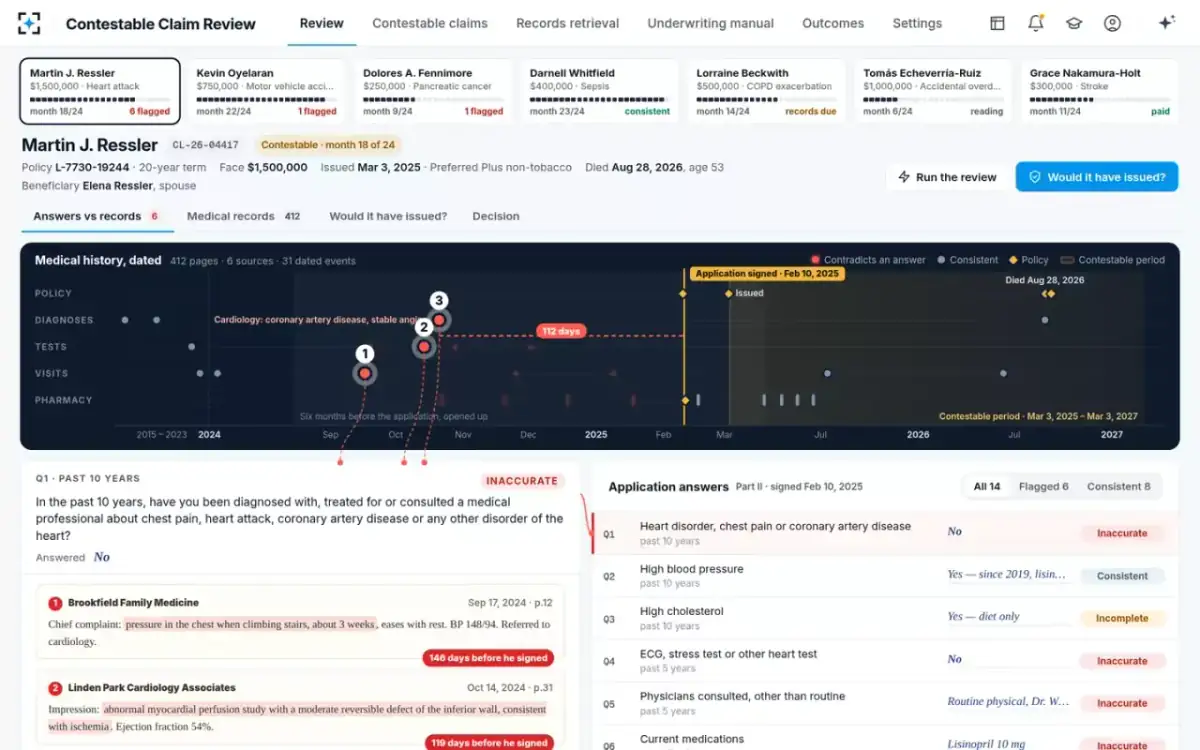
- 17 Sep 2024 · Family doctor: chest pressure on stairs, about three weeks; referred to cardiology. p.12
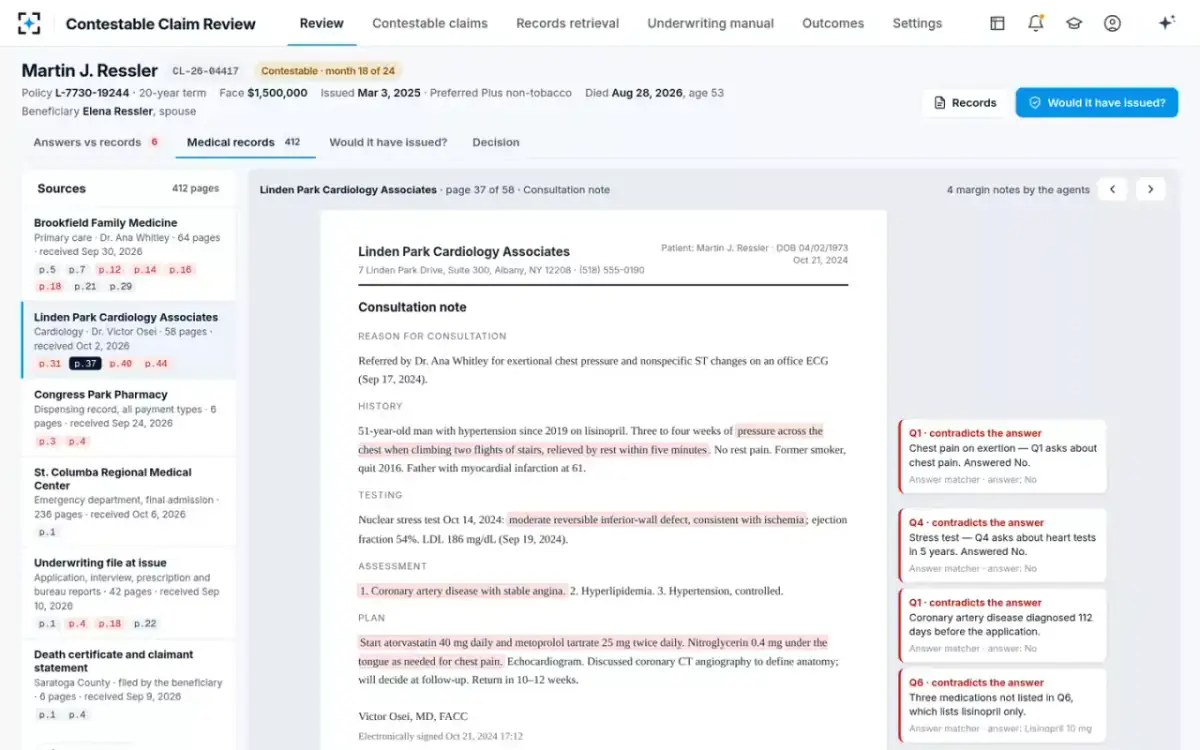
- 14 Oct 2024 · Cardiology: abnormal stress test, reversible inferior-wall defect. p.31
- 21 Oct 2024 · Cardiology: coronary artery disease with stable angina; statin, beta blocker, nitroglycerin started. p.37
- 22 Oct 2024 → · Pharmacy: fills paid with a discount card. pp.3–4
- 28 Aug 2026 · Hospital: final admission; death. p.1
Contestable decision
- Windows. Q1 asks about the past 10 years; Q4 about the past 5; Q6 about medications at application.
- Answers. Q1 “No”, Q4 “No”, Q6 “lisinopril 10 mg”: inaccurate, with pages.
- Materiality. Manual v2024.3, in force at issue: Postpone (§4.2, §2.7).
- People. Medical director confirms; examiner signs; counsel approves.
- Letter. Plain words, every statement cited, how to ask for a review.
What is medical records review software?
It is software that reads clinical documents and organises them: it extracts dated events, groups them by provider and type, summarises them, and links each item to its page. The better products also flag gaps in treatment, duplicates and pages they could not read. The output is a chronology and a summary a person can trust enough to stop re-reading the whole file.
The reading itself has become strong. In a study published in Nature Medicine, ten physicians judged summaries from the best-adapted language models equivalent to medical experts' in 45% of cases and better in 36%, and the authors' safety analysis still catalogued errors, fabricated information among them, as a challenge for models and experts alike (Van Veen et al., 2024). Strong reading with occasional invention is exactly the profile that makes citations to the page non-negotiable.
Who uses medical records review software?
Four groups, with different questions of the same pages. Lawyers and injury claims teams ask what happened, when, and what it cost; how that work is judged is covered in the guide to medical chronology software for injury claims. Disability insurers ask what the claimant can do. Life underwriters ask what risk the applicant carries today. Contestable life examiners ask something narrower and harder: what the applicant had been told and treated for before a specific date, and whether the answers given on that date match.
The people doing that work are under pressure to do more with software. The Bureau of Labor Statistics projects employment of claims adjusters, examiners and investigators to decline 6% from 2025 to 2035 (BLS), and of insurance underwriters 4%, with automated underwriting software as the reason (BLS). A tool that leaves the hardest part of a contestable file manual does not answer that pressure.
What is the difference between a medical chronology and a claim review?
A chronology says what the records contain, in date order. A contestable claim review says whether specific application answers were true when given, whether any false answer mattered under the insurer's rules at issue, and what the insurer may do about it. The first is description. The second is a decision that a medical director confirms, counsel approves and a court may read.
Medical records review software and a contestable claim review, line by line
Medical records review software: What happened, when, and who treated it?
Contestable claim review: What had the applicant been diagnosed with, tested for or treated for before signing, inside each question’s window?
Medical records review software: The whole record, or a date range the user picks.
Contestable claim review: Each question’s look-back window, read from the application form version the insured signed.
Medical records review software: Events and summaries.
Contestable claim review: A mark per application answer, consistent, inaccurate or incomplete, with pages and a one-sentence reason.
Medical records review software: Usually none.
Contestable claim review: The recorded interview, the prescription and bureau reports run at issue, the pharmacy’s own dispensing log.
Medical records review software: None; it describes.
Contestable claim review: The underwriting manual in force on the issue date, and the issue state’s materiality standard.
Medical records review software: A chronology to read.
Contestable claim review: A test to confirm, a recommendation to sign, a cited letter to approve.
Medical records review software: Invent or drop an event.
Contestable claim review: All of that, and also decide, accuse, or send anything.
Four things a contestable review needs that a chronology does not
First, look-back windows from the right form. Application questions ask about different periods, ten years for one, five for another, "at application" for medications, and the periods change between form versions. New York even widens a question's reach: a misstatement that the applicant had no treatment or consultation is judged as one about the condition behind it (§3105(d)). A chronology does not know which events a given question reaches.
Second, the comparison itself. Each answer, as signed and as spoken in the recorded interview, set against the events inside its window, with the pages. Third, materiality on the manual in force at issue. Courts in New York have accepted proof of materiality where an insurer produced its underwriting documents: in one 2019 case the evidence "included the affidavit of a senior vice president of corporate underwriting and a copy of the underwriting guidelines, which established that the plaintiff's misrepresentation induced the defendants to issue a policy it otherwise would not have issued" (2900 Stillwell). A chronology is evidence of facts; it is not evidence of what the insurer would have done.
Fourth, the record that people sign. A materiality call confirmed by a named medical director with the sections and time; an examiner's signature after it; counsel's approval of every rescission; a letter in plain words where each statement cites its page. Market conduct examiners check, among other things, that the application answers which become part of the contract are complete and accurate (NAIC handbook); the contestable file is where the insurer shows its own reading of that information was careful too.
The sample file, from pages to a decision record
412pages
from six sources, read and dated
31
events, each cited to its page and line
14
application answers set against their windows; 6 flagged
5
manual sections the materiality test applied
How accurate is AI medical record review?
Accurate enough to change the work, not accurate enough to go unchecked. Published studies measure summarization, where models now rival experts on completeness and still occasionally invent or omit; none measures the contestable task. The only accuracy figure that should move a purchase is one measured on your own decided files, with known misstatements planted in copies and every flag's page checked. That method, with the arithmetic of how many seeds a result needs, is in testing a claim review tool.
Every event on one dated history, with the application line and each answer tied to its pages
Is medical record review software HIPAA compliant?
The useful question is narrower. HIPAA binds health care providers and health plans and the vendors that work for them; it governs how the providers release records to a life insurer, which happens under an authorization that must meet HIPAA's requirements (45 CFR 164.508). Once the records are in the insurer's file, the insurer's own privacy and data security obligations apply, and so do the vendor's contract terms.
So a buyer should ask where the records are stored and processed, who at the vendor can see them, how long they are kept and how they are destroyed, whether every view and change is logged, and whether the vendor trains its models on the insurer's files. HHS notes that HIPAA sets no retention period for medical records, leaving it largely to state law (HHS), so the insurer must set its own for the claim file. A vendor's "HIPAA compliant" badge answers none of these questions on its own.
Best medical record review software for insurance: what to look for
For insurance use, the best product is the one whose every statement can be traced to a page and whose output fits the decision your desk makes. For an injury claim that may be a chronology. For a contestable life claim it is a decision record. The checklist works for both.
Eight things to check in any medical records review software for insurance
- Every statement cites a page and line
Open a dozen at random during the trial and read the page.
- Unreadable pages go to a person
Ask how the product marks handwriting and poor scans, and what it does with them.
- It never infers a diagnosis the record does not state
A chronology that “concludes” is harder to defend than one that quotes.
- It can read windows from your form versions
Essential for contestable work; irrelevant for injury chronologies.
- It can set other sources against the records
The recorded interview, prescription and bureau reports, the pharmacy’s own record.
- It can apply your manual, by version
And show the sections, finding by finding and together.
- It stops before decisions
No paying, rescinding, accusing or sending. Named people approve.
- It can be tested on your closed files before you buy
With known misstatements planted and every flag checked.
Where Contestable Claim Review fits, and where a chronology tool is enough
Contestable Claim Review fits a life claims desk that reviews deaths inside the contestable period and loses its days to reading, comparing and re-underwriting. Six agents read every page and date each event, reconcile the pharmacy and bureau records with the report run at issue, match every answer to its window, test materiality on the issue-date manual and draft the letter; the examiner decides, the medical director confirms and counsel approves.
A chronology tool is enough where the decision does not turn on an application: an injury claim, a disability claim's history, an underwriter's first read of an attending physician statement. It is also enough as a first step for a contestable desk that already has a strong materiality process and only wants faster reading, provided the chronology cites pages. A carrier in that position should still test it on closed contestable files, and should expect the four missing steps to stay manual. Where the remaining days go on a contestable file is set out in how long a life insurance investigation takes.
The page behind the finding: the cardiology note, highlighted, with the answers it contradicts
Questions people ask
What is medical record review for insurance companies?
The reading of claimants' or applicants' medical records to answer an insurance question: what an injury cost, what a disabled claimant can do, what risk an applicant carries, or, on a contestable life claim, whether the application answers were true and whether a false one mattered.
Can medical records review software replace a nurse or examiner?
It replaces much of the reading, not the judgement. On a contestable claim the examiner still decides, a medical director confirms materiality and counsel approves any rescission; the software's job is to give each of them a file where every fact is one click from its page.
Is medical records review software for providers the same thing?
No. Provider-side review software supports clinical or billing review inside a hospital or practice. Insurance-side tools read records a provider released, under an authorization, for a coverage or claim question.
Do I need a separate tool for chronologies and for contestable claims?
Not if the contestable tool builds the chronology as its first step, as Contestable Claim Review does. If you already own a chronology tool, the question is whether the four contestable steps can sit on top of its output with page citations intact.
How do I compare vendors fairly?
Run each on the same closed files with the same planted misstatements, score what each finds, misses and wrongly flags, and check every cited page. A demonstration on the vendor's own sample shows the interface, not the accuracy on your forms.