To rescind a life insurance policy is to treat it as if it had never existed: the insurer refunds the premiums and owes no death benefit. An insurer may do that only inside the contestable period, usually two years from issue, and only for a misstatement on the application that was material, meaning the insurer would not have issued the same policy had it known the truth. Everything turns on proving that last point. Contestable Claim Review, Botminds' software for contestable death claims, gives the proof to a dedicated agent, the materiality tester, which re-underwrites the true facts on the underwriting manual in force on the issue date and returns a class, a premium and the manual sections, never a decision. This guide follows that agent through a fictional sample claim and marks the points where people, not the agent, decide.
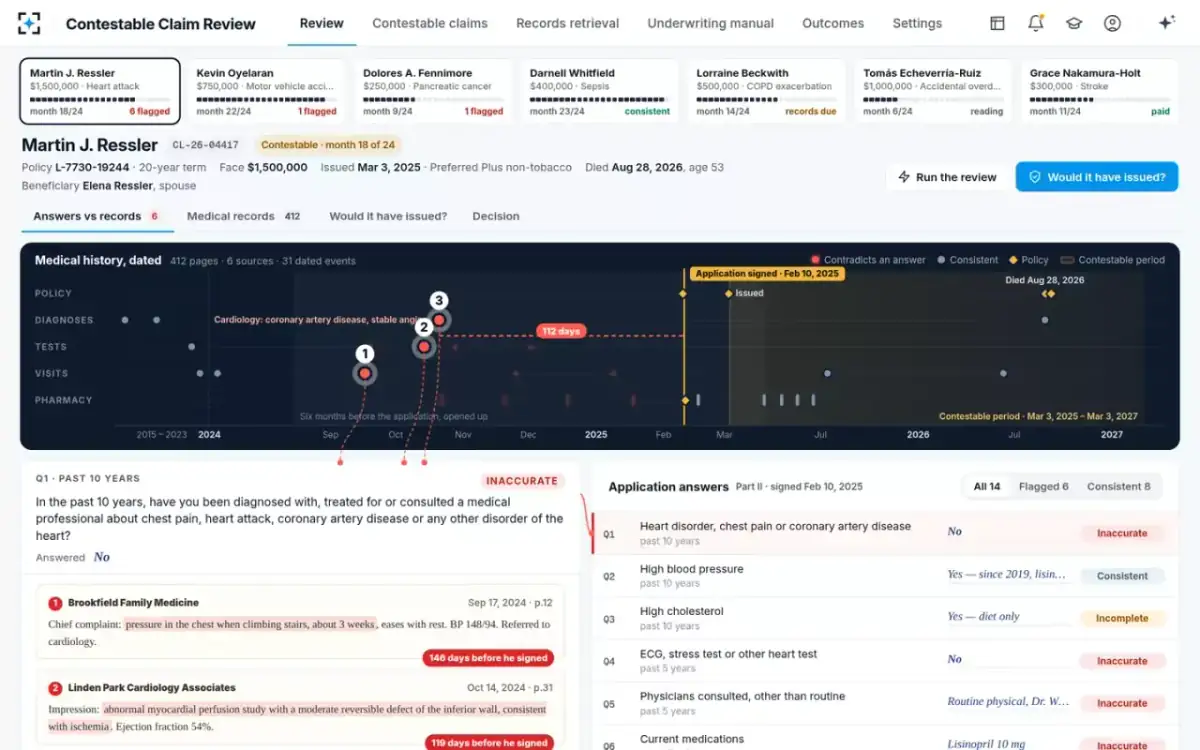
The sample: Martin J. Ressler, 53, died of a heart attack on 28 August 2026, month 18 of a $1,500,000 20-year term policy issued Preferred Plus through an accelerated program, with no medical exam and no physician statement. His application, signed on 10 February 2025, answered "No" to a question about chest pain and heart disease in the past ten years. The carrier, people and policy are invented; the rules are real.
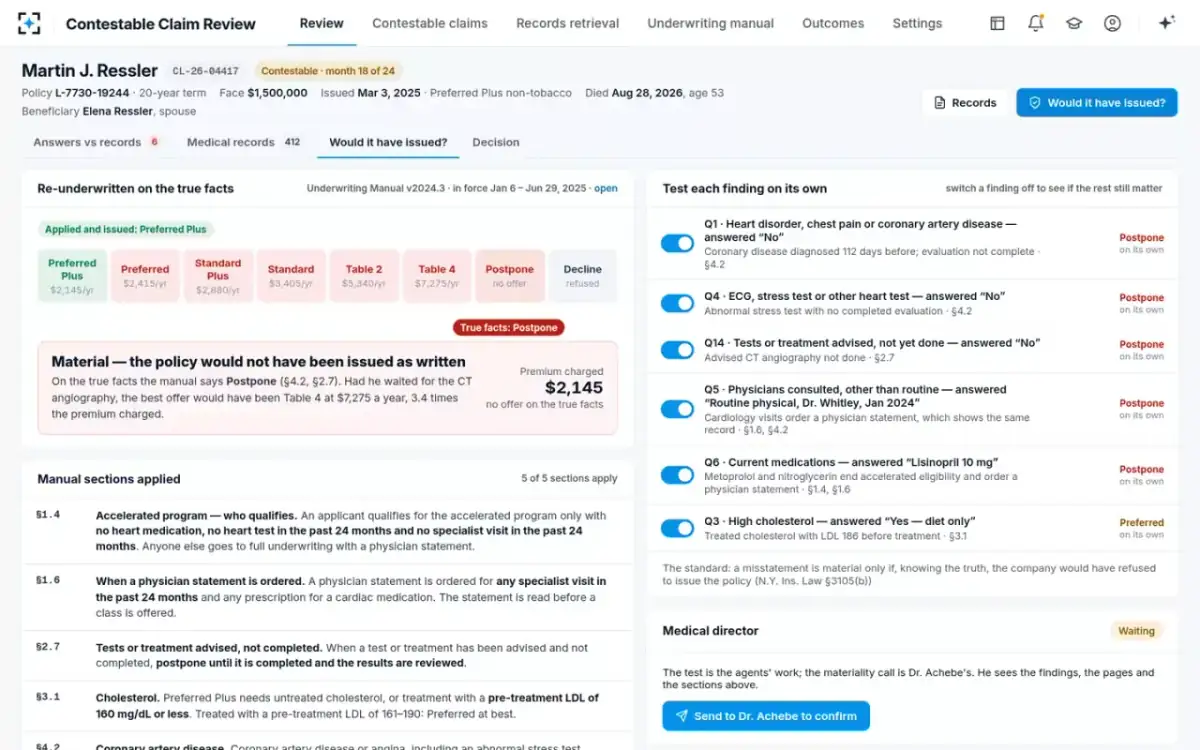
Would we have issued it? Where the true facts land on the sample manual's class ladder
Preferred Plus
$2,145
Applied and issued
Preferred
$2,415
Standard Plus
$2,880
Standard
$3,405
Table 2
$5,340
Table 4
$7,275
Postpone
no offer
True facts
Decline
refused
Postpone under §4.2 (coronary disease, evaluation incomplete) and §2.7 (a test advised and not done). Had he waited for the CT angiogram, the best offer would have been Table 4 at $7,275, 3.4 times the premium charged.
Can a life insurance company rescind a policy?
Yes, within limits. Inside the contestable period an insurer may rescind for a material misrepresentation in the application; after the period the policy is incontestable except for the narrow grounds a state's statute keeps, such as nonpayment of premiums (N.Y. Ins. Law §3203(a)(3)). Within the period, three things must be true: the answer was wrong, the wrong answer was material under the issue state's standard, and the insurer used the route its state allows.
Insurers do use it. Every one of the 24 direct writers in the Society of Actuaries' 2022 accelerated underwriting survey, which Milliman actuaries wrote for the SOA Research Institute, said it rescinds accelerated policies for material misrepresentation, and 20 of them for material nondisclosure. Asked what they do when a post-issue audit finds a case should have been declined, the 15 that answered split: "Two-thirds indicated they rescind a policy in some circumstances and one-third indicated they rescind a policy in all circumstances" (SOA survey, pp. 58–59). None said never.
The opposite duty is just as firm. NAIC's model unfair claims act lists "Refusing to pay claims without conducting a reasonable investigation" among unfair practices (Model #900 §4.F). A rescission is the strongest refusal there is, so it carries the heaviest burden of investigation.
What does rescind mean in insurance, and how is it different from denying a claim?
Rescission unwinds the contract from the start; a denial keeps the contract and says this claim is not covered by it. New York's Appellate Division puts it plainly: material misrepresentations, "if proven, would void the . . . insurance policy ab initio" (Smith v Guardian, 2014). That is why the premiums go back.
Rescission and claim denial are different acts with different proof
Rescission: The policy never validly existed, because the application misstated a material fact.
Claim denial: The policy exists, but this loss falls outside it, for example under an exclusion.
Rescission: Inside the contestable period, for misstatements in the application.
Claim denial: At any time the policy is in force, on the policy’s own terms.
Rescission: A misstatement, and that it was material under the issue state’s test; in Texas, intent as well.
Claim denial: That the policy terms exclude or do not cover the loss.
Rescission: Returned, because there was no contract to pay for.
Claim denial: Kept; coverage was in force.
Rescission: In New York after a death, a court or every fully informed beneficiary must agree.
Claim denial: By the insurer, subject to the beneficiary’s complaint or suit.
The difference shows up in the beneficiary's letter. A denial cites the policy provision that excludes the loss. A rescission has to show the application answer, the record that contradicts it, and why the truth would have changed the underwriting decision. A reader who searches "what does policy rescinded mean" after receiving one should be able to find all three in the letter itself.
Do they refund premiums when they rescind?
Yes. Rescission returns the parties to where they started, so the insurer refunds the premiums paid. New York's regulator describes the route after a death this way: "If an insurer has actual evidence of a material misrepresentation, the insurer may obtain a rescission of the policy through a court action and return premiums to the covered policyholder’s estate" (DFS, 2017).
The sample shows the arithmetic. Eighteen monthly premiums of $187.69 come to $3,378.42; the sample carrier's rule adds simple interest from each payment date, $91.22, for $3,469.64 to the estate, against a $1,500,000 face. Whether interest is owed on a refund, and at what rate, is a question for each state's law and the carrier's counsel; the solution treats it as a setting, not a rule.
What makes a misrepresentation material? The question the tester answers
A misrepresentation is material when the truth would have changed the underwriting decision in a way the issue state's law counts. New York's courts ask whether the insurer "would not have issued the same policy if the correct information had been disclosed in the application", and want "underwriting manuals, bulletins, or rules pertaining to similar risks" to show it (Varshavskaya, 2009). Florida's statute is broader: a misstatement counts if the insurer in good faith "would not have issued the policy or contract, would not have issued it at the same premium rate, would not have issued a policy or contract in as large an amount, or would not have provided coverage with respect to the hazard resulting in the loss" (Fla. Stat. §627.409(1)(b)).
Both tests have the same engine: take the facts the application should have shown, run them through the insurer's own rules, and compare the outcome with the policy actually issued. That is a mechanical task with a judgment at the end, which is why it suits an agent with a person signing. The doctrine itself, state by state, is set out in material misrepresentation in life insurance, in plain words.
What the materiality tester needs before it runs
- The true facts, each with its page and line
From the medical record reader and the answer matcher: in the sample, chest pressure on 17 September 2024, an abnormal stress test on 14 October and coronary artery disease diagnosed on 21 October, 112 days before he signed.
- The application answers as signed and as spoken
The form version he signed sets each question’s look-back window; the recorded interview shows how each question was read to him.
- The manual version in force on the issue date
Not the current one. The sample policy issued on 3 March 2025 under v2024.3.
- The program rules
Who qualified for the accelerated program and when a physician statement would have been ordered: §1.4 and §1.6 in the sample.
- The issue state’s materiality standard
Refusal to issue in New York; refusal or a different premium in Florida; intent too in Texas.
- The premium table for each class
So the result can be stated as a class and a price, not an adjective.
The manual in force on the issue date, not today's
The test must use the rules the insurer actually applied, because the legal question is what this insurer would have done then. A manual written after issue may be stricter or looser on the same impairment; using it proves nothing about the decision under review, and a court that sees a later version will discount it.
The manual is also the same rulebook whether a case was accelerated or fully underwritten. Only one of the seven reinsurers in the SOA survey had updated its manual for accelerated programs, and one respondent explained why: the manual prices the mortality of an impairment, and the route by which the evidence arrived does not change that (SOA survey, p. 103; how a manual turns impairments into a class is shown in the numerical rating system in life insurance). For a contestable file that is useful: the accelerated program changed what evidence the insurer collected at issue, not what the evidence would have meant.
Consistency is a legal duty as well as good practice. NAIC's unfair trade practices model (Model #880) forbids charging different rates to people of the same class and the same life expectancy; how an auditor tests for that across underwriters is shown in what an underwriting auditor tests. Testing every contestable file on the written manual, rather than on an examiner's sense of the case, keeps the claim decision consistent with what the insurer did for every other applicant with the same facts.
Re-underwritten on the true facts, on the manual used that day
Finding by finding, then all together
The tester runs each flagged answer through the manual on its own, then all of them together, because the two results answer different questions. Together they say what the true applicant would have been offered. One at a time they say which misstatements the case actually rests on, and which are noise a beneficiary's lawyer will point to.
In the sample, six answers were flagged. Several of them, including the heart-disease answer (Q1), the heart-test answer (Q4) and the answer about tests advised and not done (Q14), each lead to Postpone on their own: the coronary disease alone was enough. The cholesterol answer behaves differently. He answered "Yes, diet only" when an LDL of 186 had been treated; on its own that moves him from Preferred Plus to Preferred, $2,415 a year against $2,145.
What the same 53-year-old would have paid on each rung of the sample manual
Whether a class change like that is material is a legal question, and the states answer it differently. Florida's statute names a different premium rate as enough. New York's courts ask whether the insurer would have issued the same policy and insist the guidelines show it: in 2022 an insurer that said it would have issued "a different policy with a higher premium" lost summary judgment because its guidelines did not show that rate difference (Rodriguez v Mercury). The tester reports the class and the price; counsel decides what the issue state makes of them. A rescission that stands on the findings that each stop the policy is easier to defend than one that leans on a price difference.
“I don’t need a summary. I need the page that proves it.”
Rachel Lindqvist, senior contestable claim examiner in the solution's sample
What the materiality tester never does
It never decides. The tester returns a class, a premium and the sections it applied; a medical director confirms materiality, the examiner signs, and claims counsel approves any rescission. It also never uses a manual other than the one in force at issue, and it has no view on whether the insured meant to mislead.
The intent line is not a formality. In Texas a policy cannot be avoided for an application misstatement unless the insurer pleads and proves intent to deceive, a rule the state Supreme Court reaffirmed in 2023 for a policy whose insured died 13 days after issue (Arce). An agent that labelled a misstatement "concealment" would be writing a conclusion only a court can reach. In the solution the answer matcher marks each answer consistent, inaccurate or incomplete, with pages, and the tester works only from those marks. How a desk checks that those marks are right before trusting them is the subject of testing a claim review tool.
The flagged answer, the events that contradict it, and the pages
Can a policy be rescinded after death?
Yes, if the death falls inside the contestable period, but the route depends on the state. New York's Department of Financial Services is explicit: "If the insurer proves a material misrepresentation following an insured’s death, the insurer may obtain a rescission of the policy only in a court action or by agreement of all fully informed beneficiaries" (DFS, 2017). A letter from the insurer is the start of that process in New York, not the end of it.
Other states set different procedural traps. Texas generally bars a misrepresentation defense unless the insurer gave notice that it refused to be bound before the 91st day after discovering the falsity (§705.005); its Supreme Court held that rule did not apply to a life policy with a compliant two-year incontestability clause and premiums duly paid (Arce). Counsel needs the state's route on the file before the letter is drafted, which is why the solution keeps the materiality standard and the approvers as per-state settings.
In the sample, the decision went to the medical director, who confirmed materiality on 12 October 2026, then to the examiner and to claims counsel. The confirmation, and what the medical director should and should not put in it, is covered in life insurance medical director: who signs.
Questions people ask
Can a life insurance company rescind a policy after two years?
Generally not for a misstatement in the application. New York, California, Texas and Florida require the policy to become incontestable after two years in force during the insured's lifetime, except for nonpayment of premiums and a few other listed exceptions; a death inside the two years means the policy never reached that point.
How do insurers decide materiality?
By re-underwriting: they apply the underwriting manual in force at issue to the true facts and compare the result with the policy issued. New York's courts accept that as proof when the insurer produces the manual or guidelines, and reject employees' conclusions without them.
Is a rescission the same as fraud?
No. In New York even innocent misstatements, if material, support rescission. In Texas the insurer must also prove intent to deceive. Fraud is a separate question with its own investigation route.
What happens to the premiums if a policy is rescinded?
They are returned. New York's regulator describes the insurer returning premiums to the policyholder's estate when it rescinds after a death; in the sample claim the refund was $3,378.42 of premiums plus $91.22 of interest under the sample carrier's rule.
Can an insurer rescind because the premium would have been higher?
It depends on the state. Florida's statute counts a misstatement that would have changed the premium rate; New York's courts ask whether the insurer would have issued the same policy and require the guidelines to show the difference.
Does the cause of death have to match the misstatement?
Not in New York, California or Florida. Missouri and Kansas are the exceptions: a misrepresentation in a life application is not material unless the matter misrepresented actually contributed to the event on which the policy became payable.