The numerical rating system in life insurance is the arithmetic an underwriter uses to turn an applicant's impairments into a rating class. Each unfavorable finding adds debits, each favorable one earns credits, and the net total, read as extra mortality against a standard of 100%, is rounded to a class: standard, or a table rating such as Table 2 or Table 4. The hard part is not the sum. It is finding the right number for each line, because the point values live in a reinsurer's underwriting manual, the insurer's own guidelines and the memos that amended them, and two of those sources often disagree. Botminds' Life Underwriting Manual Search answers rating questions from those sources with the section and page behind every debit and credit.
The worked example on this page is a fictional sample case as it runs through the solution, with a fictional reinsurer manual and fictional company guidelines: Daniel Whitcombe, 52, non-tobacco, applying for $1.5 million of 20-year term with type 2 diabetes. The research figures come from the Society of Actuaries and the Journal of Insurance Medicine, linked where they appear.
One rating, line by line: what each debit and credit is, and the page that set it
Type 2 diabetes
Facts readOnset at 45, now 52; HbA1c 7.6%; metformin only
Source and pageReinsurer manual §D-12, table D-12b, p. 418
Points+75
Build, read for a diabetic
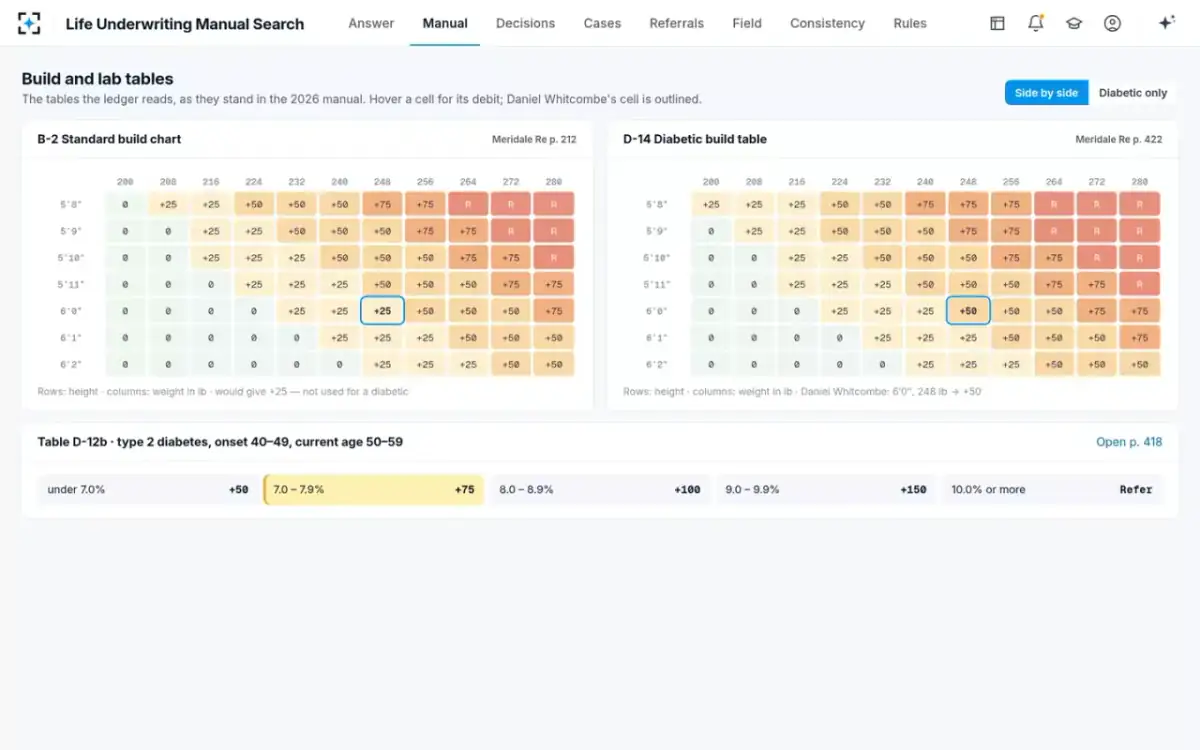
Facts read6 ft 0 in, 248 lb, BMI 33.6; diabetic build table
Source and pageManual §D-14, p. 422, sent there by rule §D-12.6
Points+50
Standard build chart
Facts readWould give +25; not used for an applicant with diabetes
Source and pageManual §B-2, p. 212
Pointsset aside
Credits
Facts readMicroalbumin normal, eGFR 88, quarterly follow-up for years; manual allows −50
Source and pageManual §D-12.5, capped by memo UW-26-07
Points−25
Total and class
Facts readRounded under the insurer's guidelines: +86 to +110 is Table 4
Source and pageCompany guidelines v14 §1.4, p. 9
Points+100 · Table 4
What is the numerical rating system in life insurance?
It is a scoring convention that expresses each risk factor as a deviation from standard mortality and adds the deviations up. A debit of +25 means, roughly, a quarter more deaths than the insurer expects of its standard class; a credit of −25 means a quarter fewer. The total is the applicant's expected mortality relative to standard, and the class follows from it.
A 2026 article in the Journal of Insurance Medicine puts the link between the two units in one clause: in life insurance underwriting, "the magnitude of risk is derived from the mortality ratio and subsequent debits, eg, a mortality ratio of 200% is approximately 100 debits" (Iacovino, Journal of Insurance Medicine, 2026). Medical directors work in mortality ratios when they study an impairment; underwriters work in debits when they apply the result. The manual is where one is turned into the other.
A mortality ratio of 200% is approximately 100 debits.
Iacovino, Journal of Insurance Medicine (2026)
The word "approximately" matters: debits are a convenience for adding risks up, not a measurement. The article's own subject shows where they come from. It takes published figures on years of life lost to bipolar disorder, converts them into mortality ratios, and from those into debits for medical risk underwriting. A manual is many such conversions, one per impairment, printed by band of age, duration and severity.
How do debits and credits work in life underwriting?
Debits are added for each finding that raises expected mortality; credits are subtracted for findings that lower it, but usually only against debits in the same area and only up to a limit. A Society of Actuaries tool for preferred-class mortality describes the rule plainly. Under a "no net ratable disease" standard, an applicant with a history of a disease is disqualified from a preferred class only if there is "any net positive debits minus credits in the underwriting review process. In other words, underwriting credits are allowed as offsets to any assessed debits" (SOA Underwriting Criteria Team, Relative Risk Tool documentation, 2016).
In the sample case the credits are the line most likely to be misread. The manual allows two credits for a diabetic with normal kidney tests and years of regular follow-up, together −50. The insurer's own memo, issued after its mortality study found two-credit diabetic cases running worse than expected, caps all credits for an applicant with diabetes at −25. The worksheet therefore carries −25 and shows the manual's −50 struck through, with the memo beside it. An underwriter working from the manual alone would land a whole table lower.
Debits also move with age. In the Society of Actuaries' 2002 preferred underwriting survey, one company described its build criteria this way: "Fewer debits are assigned at age 50, and fewer still at age 70 and above" (SOA Preferred Underwriting Survey Subcommittee, report on 2002 practices). The same height and weight is not the same number at 35 and at 65, which is why the debit calculator reads the row for the applicant's age band rather than a single figure for the condition.
What does +50 mean in life insurance?
A +50 is fifty debits: an expected mortality about half again as high as the insurer's standard class, which on most scales rounds to Table 2. A table rating raises the mortality part of the price; how much the premium rises depends on the rates the insurer files for each table. Nor is +50 the same at every insurer, because "standard" is each company's own class and each manual sets its own bands.
In the sample case +50 is one line, the build. At 6 feet and 248 pounds the applicant's body mass index is 33.6. The standard build chart would have given +25; the manual's combination rule for diabetes sends him to the diabetic build table instead, where 33.0 to 35.9 is +50. On its own, that +50 would place an otherwise healthy applicant at Table 2 under the sample insurer's bands. Added to the diabetes line it is part of a total that settles at Table 4.
How are table ratings calculated from the total?
The net total is rounded to a class with a banding rule, usually in steps of 25 debits. A Society of Actuaries survey of simplified issue products says so directly, noting that "one table equals 25 debits" in the products it covered (SOA Simplified Issue Survey Subcommittee, 2008). Table 1 is then about 125% of standard mortality, Table 2 about 150%, Table 4 about 200%, and so on.
The sample insurer's rounding bands: from a net total to a class
| Net total | Class | Mortality, % of standard |
|---|---|---|
| +20 or less | Standard | 100% |
| +21 to +35 | Table 1 | 125% |
| +36 to +60 | Table 2 | 150% |
| +61 to +85 | Table 3 | 175% |
| +86 to +110 | Table 4 | 200% |
| +111 to +135 | Table 5 | 225% |
| +136 to +160 | Table 6 | 250% |
| +161 to +210 | Table 8 | 300% |
| Over +210 | Refer | Decline or medical director |
Two details trip people up. The first is the band edge. A total of +110 is Table 4 and +111 is Table 5, so a single misread row near an edge moves the class, and the premium, by a full table. The second is that rounding belongs to the insurer, not the reinsurer: the sample insurer rounds under its own guidelines, and its authority grid then says who may sign at each class.
What is 100% mortality, and 100% of what?
A rating of 100% means the applicant is expected to die at the rate of the insurer's standard class, and that class is defined by the insurer. It is not population mortality, and it is not the same group of lives at two companies. The Society of Actuaries' relative risk documentation warns that "the use of the word standard must be interpreted very carefully in this document and in the industry in general," because a preferred program's lowest class is often also called standard.
That ambiguity is why debits are relative. A +100 doubles whatever the insurer's standard is. For a company whose standard class excludes everyone who qualifies for preferred, 200% of that residual class is a different number of expected deaths from 200% of a blended standard. What one table either way costs takes that question into pricing.
Why the sum is not always the answer: combination rules
Adding debits assumes the risks are independent, and the manuals know they often are not. The Society of Actuaries' relative risk tool states its own simplification openly: "there could be actual overlaps of the impact of both the relative risks and prevalences among many of the criteria. However, the formulas assume completely independent relationships." A manual corrects for overlap with written combination rules.
Two ways to rate diabetes with a heavy build
Adding the separate lines: Table D-12b row for onset 40–49, age 50–59, HbA1c 7.0–7.9%: +75.
Applying the combination rule: Same row, same +75.
Adding the separate lines: Standard build chart at BMI 33.6: +25.
Applying the combination rule: §D-12.6 sends a diabetic to the diabetic build table: +50. The +25 is set aside, not added.
Adding the separate lines: Manual credits for normal kidney tests and follow-up: −50.
Applying the combination rule: Memo UW-26-07 caps diabetic credits at −25.
Adding the separate lines: +50: Table 2.
Applying the combination rule: +100: Table 4.
The left column is not careless arithmetic; every number in it is printed somewhere in the sources. It is wrong because two of the numbers come from the wrong place. That is the strongest argument for citing the page on every line: a reviewer can see in seconds that the build came from the standard chart, and the rule that should have sent it elsewhere. The combination rules for diabetes, build and blood pressure are worked through in how the underwriting manual's combination rules are applied.
Knock-out or debit-credit: two ways the same system awards preferred
Preferred classes use the numbers differently from table ratings. Some insurers use knock-out criteria, where any one finding outside a limit removes the applicant from a class; others use debit-credit, where points are added and the class depends on the net. The Society of Actuaries' relative risk tool was built to handle "both knock-out and debit-credit qualification approaches, as well as those using a combination of the two."
Knock-out and debit-credit preferred criteria, side by side
Knock-out: Each criterion has a limit; one miss removes the applicant from the class.
Debit-credit: Each finding scores points; the net total decides the class.
Knock-out: Usually earn nothing; a clean result is simply not a miss.
Debit-credit: Can earn credits that offset debits elsewhere, within the rules.
Knock-out: A stretch allowance or an underwriter exception on one criterion.
Debit-credit: A cap on credits, or a maximum debit on any one item.
Knock-out: —
Debit-credit: One company in 2002: "Greater than 25 debits will prevent preferred class."
Both structures sit on top of the same standard-or-rated decision. The relative risk documentation is explicit that only lives first judged standard qualify for a preferred program at all; the numerical rating system decides whether a case is rated, and the preferred program sorts the standard lives that remain.
Who sets the debits, and why the page has to be cited
The debits come from the reinsurer's manual, adjusted by the insurer's own guidelines and memos; no statute or regulator publishes them. In the Society of Actuaries' 2022 accelerated underwriting survey, a survey of 24 direct companies and seven reinsurers written by authors from Milliman, all seven reinsurers had an underwriting manual; only one had updated it for accelerated programs, and three did not think an update necessary (SOA Research Institute, 2022).
Because the values are proprietary and layered, the right citation is three-deep: the manual's section and page, the guideline that departs from it, and the memo in force. The sample insurer's order of precedence puts its guidelines first, then memos in force with the newest first, then the primary reinsurer's 2026 manual, then a secondary reinsurer's guide where the primary is silent. An answer that cites only the manual can be correct as printed and wrong for the company. The same ladder decides a contestable claim years later, when the question becomes what the insurer would have charged had it known the truth (the materiality test before a rescission).
The build tables the worksheet reads, with the applicant's cell outlined
One case, three questions, three totals
On a live case the total moves as facts arrive, and a good worksheet says when it is still provisional. In the sample case the underwriter asks three questions in plain words. The first gives the diabetes line and leaves build open; the second adds build; the third adds the kidney tests and the follow-up.
The running total settles only when the last fact is in
The middle bar is the one that teaches. With build added and no credits yet, the case reads Table 5, above the Underwriter II's authority. The third question brings it back to Table 4, inside it. An underwriter who stopped at the second answer would have referred a case they could decide; one who skipped the memo would have offered Table 3. In the sample run the three answers took 14 seconds in all, with four pages cited from three sources.
That is the job Botminds' Life Underwriting Manual Search was built for: a question reader takes the facts, a manual searcher finds the governing page in the right order of precedence, a debit calculator reads the row exactly as printed, and a combination checker applies the written rules and rounds the total. The underwriter decides. See it on the full sample case at Life Underwriting Manual Search.
Questions people ask
What is a debit in underwriting?
A debit is a unit of extra expected mortality, roughly one percentage point above the insurer's standard class. A +75 for a condition means the manual expects about 75% more deaths than standard among applicants with that finding. Debits are added across impairments, subject to the manual's combination rules.
How do credits offset debits?
Credits are subtracted from debits for favorable findings, such as good control of a condition or normal test results. Manuals usually limit them, for example to the same impairment or to a maximum, and insurers can cap them further by memo. In the sample case the manual's −50 is capped at −25 by the insurer's memo.
Is +100 always Table 4?
Usually, on scales where one table equals 25 debits, but the rounding band is the insurer's choice. In the sample insurer's guidelines Table 4 runs from +86 to +110. Another company could set different edges or skip some tables altogether.
Where do debit values come from?
From mortality studies of each impairment, converted into mortality ratios and then into debits, the kind of conversion the Journal of Insurance Medicine publishes condition by condition. The resulting manuals are proprietary and no regulator publishes them. Insurers adopt them with departures written in their own guidelines.
Does the numerical rating system apply to accelerated underwriting?
The manual still sets the mortality for each impairment, whatever the route to the evidence. A reinsurer told the Society of Actuaries' 2022 accelerated underwriting survey (24 direct companies and seven reinsurers, written by Milliman authors) that the manual "provides guidance on evaluating the mortality associated with various risks/impairments", and that the route to the evidence, accelerated or full, does not change it.