An AI underwriting copilot is an assistant that sits beside a life underwriter and answers rating questions from the insurer's own sources: the reinsurer's underwriting manual, the company's guidelines, the memos in force and past medical director decisions. Going live with one is less a software project than a rules project. The copilot must read the sources in the order the chief underwriter sets, apply the company's rounding bands, combination rules and authority grid, and prove on decided cases that it gives the answer the rules require before any underwriter relies on it. This guide sets out an eight-week plan for that work, with Botminds' Life Underwriting Manual Search as the example: two weeks for sources, two for rules, two for replaying decided cases and two live behind the medical director. It is written for life underwriting; an assistant for an MGA working to a binder's guidelines is a different build, covered in AI underwriting assistant tools for MGAs.
The examples come from a fictional sample insurer, with fictional reinsurer manuals, guidelines and memos, as they run through the solution. The eight weeks are a plan, not a measured result: the time depends on how many sources there are and how well the memos have been kept. The regulatory references are New York's and Colorado's, linked where they appear.
Eight weeks from your manual to live answers, in four stages
- Sources and precedenceWeeks 1–2
- Rules and authorityWeeks 3–4
- Replay decided casesWeeks 5–6
- Live behind the medical directorWeeks 7–8
What is an AI underwriting copilot?
A copilot answers the underwriter's question and shows its working; it does not take the decision. In life underwriting the question is usually how to rate an impairment, or a combination of them, and the working is a list of debits and credits, each with the page that set it, a total, and the class the insurer's bands give it.
That is a narrower job than the word "AI" suggests, and the narrowness is the point. A copilot that answers from its general training will produce plausible ratings that no page supports; a copilot that answers only from the insurer's sources, and says Refer where the sources stop, produces ratings an auditor can rebuild. The difference between the two is the subject of a buyer's test of AI in life insurance underwriting; this guide is about getting the second kind live.
Can a copilot use our reinsurer manual?
Yes, if the insurer's agreement with the reinsurer allows the manual to be loaded into a system the insurer controls, and that is the first thing to check. The manual is the reinsurer's work; the copilot needs the current edition, page for page, and any secondary guide the insurer uses where the primary manual is silent.
Manuals change slowly, which helps. In the Society of Actuaries' 2022 accelerated underwriting survey, a survey of 24 direct companies and seven reinsurers written by authors from Milliman, the reinsurers were asked about updates: "In terms of updating the underwriting manual in general, one reinsurer indicated they planned to update it in the next year and one was not sure" (SOA Research Institute, 2022). The insurer's own guidelines and memos change much faster. The fictional sample insurer has 61 memos in force, and one of them, a March 2026 cap on credits for diabetics, moves its most common combined rating by a full table.
What the insurer brings to the first week
Week one is collection. The copilot can only read what it is given, and the gaps found here, such as a memo no one can date or a guideline that exists in two versions, are cheaper to fix now than in the replay.
What the insurer brings to start an AI underwriting copilot
- The reinsurer manuals, current editions
The primary manual and any secondary guide, complete, with the right to load them confirmed under the reinsurance agreement.
- Your underwriting guidelines, every version in force
Where you depart from the manual, with the version number and effective date.
- Every memo, with dates and what it replaced
Including superseded memos: they stay readable and marked, so old cases can be explained.
- The rounding bands and the authority grid
Which totals map to which class, and who may sign at each class and amount.
- Your combination rules
Where two impairments are not simply added: which table applies, which credits are capped, which pairs add an extra debit.
- A sample of medical director decisions
With the facts, the outcome and the doctor's note, for the precedent search and for the replay.
- The age and amount requirements grid
So the requirements drafted for each case match what your underwriters would order.
- Your decisions on the field preview and the log
Whether agents see a likely range at all, and how long questions and answers are kept.
Weeks 1–2: load the sources and set the order of precedence
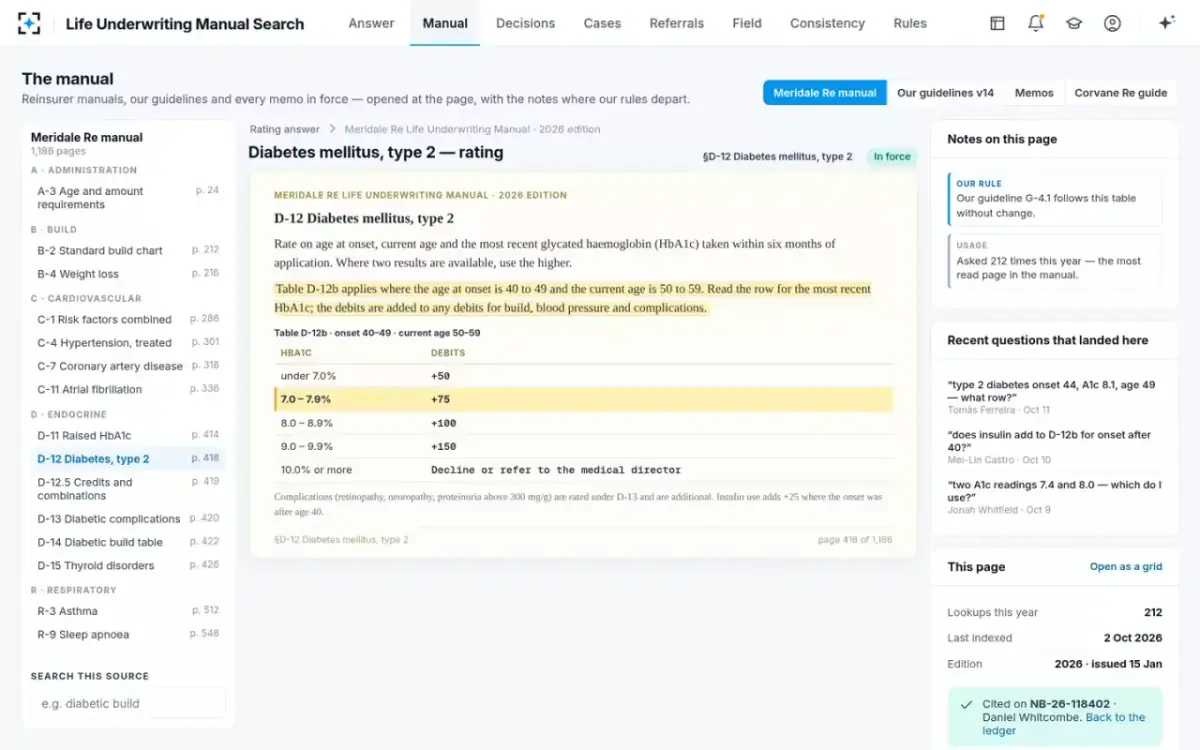
The first two weeks load every source at the page level and settle one question the copilot will ask on every case: when two sources disagree, which wins? In the sample insurer the chief underwriter's order is the company's guidelines first, then memos in force with the newest first, then the primary reinsurer's 2026 manual, then a secondary reinsurer's guide only where the primary is silent.
The test at the end of week two is mechanical: every section of the manual opens at its printed page, every memo shows what it replaced, and the notes where the company's guidelines depart from the manual sit on the manual pages they modify. In the sample, the manual's diabetes page carries the note that the company's guideline follows the table without change, and the credits line cites the memo that caps it.
The manual as loaded: sections, pages and the notes where the insurer departs
Weeks 3–4: encode the rounding, the combination rules and the authority grid
Weeks three and four turn the chief underwriter's rules into settings, each saved as a new version of the guidelines. Four kinds matter: the rounding bands, the combination rules, the authority grid and the field preview.
The chief underwriter's settings, as one sample insurer set them
| Setting | Sample value | Why it is a setting |
|---|---|---|
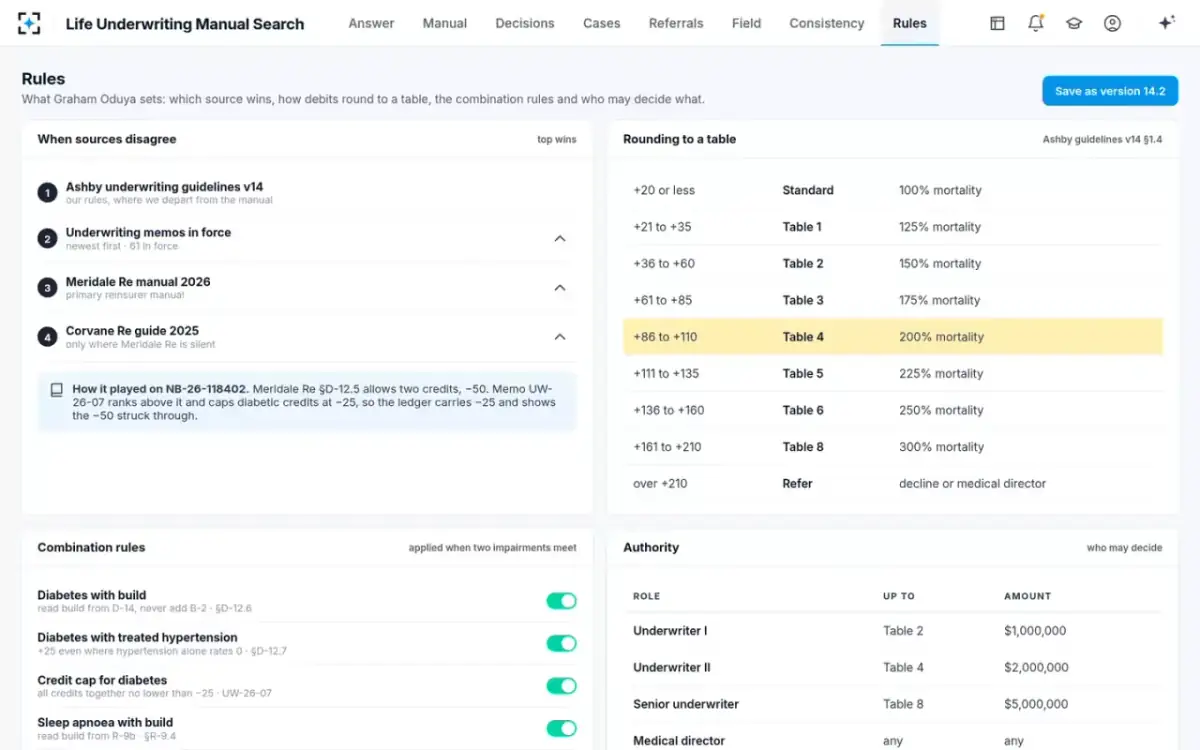
| When sources disagree | Guidelines v14, then memos in force (newest first), then the primary reinsurer manual, then the secondary guide | The same question has different answers in different sources. |
| Rounding to a table | +86 to +110 is Table 4, 200% mortality; over +210 goes to the medical director or is declined | Rounding is the insurer's rule, not the reinsurer's. |
| Diabetes with build | Read build from the diabetic table, never add the standard chart | Two of five underwriters missed it in the sample insurer's May consistency test. |
| Credit cap for diabetes | All credits together no lower than −25, by memo | A memo that moves the most common combined rating. |
| Authority | Underwriter II: Table 4 and $2,000,000 | Decides who may sign, and when the copilot says a case is above authority. |
| Field preview | Ranges only; never manual text | What agents may see before they quote. |
| Question log | Every question, the pages returned and the decision, kept 7 years | What an auditor or examiner will ask for. |
Combination rules deserve most of the time. They are where the manual is not simply added up, and they are often scattered across sections and memos. In the sample, the rule that sends a diabetic to the diabetic build table changes the build debit from +25 to +50; the rule for diabetes with treated hypertension adds +25 even where hypertension alone would rate nothing. Each must be found, written as a setting and tied to its page, or the copilot will add lines the manual says not to add.
Rules: which source wins, how totals round, the combination rules and who decides
Who approves underwriting rule changes?
The chief underwriter, under whatever governance the insurer has for its guidelines; the copilot changes nothing on its own. What the copilot changes is the evidence trail. Each change to precedence, rounding, combination rules or authority becomes a new version with a date and an approver, which is what regulators now ask insurers to keep for AI used in underwriting.
documented explanation of any changes, associated rationale for such changes, and parties responsible for the approval of such changes
NY DFS, Insurance Circular Letter No. 7 (2024), on the process for tracking changes to AI systems
The same New York letter expects training for staff who use such systems, tailored to their responsibilities, and lists among the documentation it may ask for a description of testing, at least annually, of the system's output. Colorado reaches life insurers through statute and regulation: SB21-169, signed in July 2021, restricts insurers' use of external consumer data, algorithms and predictive models that unfairly discriminate (Colorado General Assembly, SB21-169), and the Division of Insurance's amended Regulation 10-1-1, effective 15 October 2025, sets governance and risk management requirements for insurers offering individual life insurance among others (Colorado Division of Insurance). Our compliance guides cover Colorado's amended Regulation 10-1-1 and the NAIC AI bulletin in full.
Weeks 5–6: replay decided cases before anyone relies on it
The replay is the go-live test: run decided cases through the copilot with the sources as they stood on each decision date, and compare every line, not only the class. A copilot that gets the class right for the wrong reason will get the next case wrong.
How to test an underwriting copilot on your own decided cases
- Choose cases for coverage, not convenience
Every common combination, every memo in force, totals near each band edge, and cases above authority.
- Freeze the sources at each decision date
A case decided under last year's memo must be judged by last year's memo.
- Score each line
Facts read, page cited, row read, rule applied, total and class. A line without a page fails.
- Check what the copilot refused
Readings outside a table should come back as Refer, not as a value between rows.
- Run a five-underwriter test with and without it
The same case, five underwriters, the same day; count classes and pages.
- Have the medical director review the disagreements
Each one is a missing rule, a stale memo or a decision that departed from the guidelines.
The disagreements are the most valuable output of the whole project. Some will be copilot errors to fix. Others will be places where the guidelines were silent and underwriters filled the gap differently; those become new settings or new memos. The consistency test, and how to score it, is set out in what an underwriting auditor tests.
Weeks 7–8: go live behind the medical director
Going live means underwriters ask the copilot on live cases while every decision stays theirs and every referral still goes to the medical director. Two measures tell the chief underwriter whether it is working: the share of referrals that were only a lookup, and the consistency test rerun each month.
In the fictional sample insurer, lookup-only referrals stood at 31% of the medical director's referrals in February, before the search went live; the design target is 9%. Lookups per week rose from 212 in week 33 to 431 in week 40, and the most asked impairments, build first, then type 2 diabetes and hypertension, tell the chief underwriter which pages to keep most current. Agents in the field start last, with a likely range only, once the underwriters trust the answers.
How to roll out AI to underwriters without losing the room
Start with the questions underwriters already ask each other, and show the page. Underwriters trust a rating they can check, and the fastest way to earn that trust is an answer that opens the manual at the row it read. Start with trainees, whose questions would otherwise go up to the medical director, and show seniors the cases where a memo changed the answer.
Keep authority unchanged. If the grid says an Underwriter II may decide to Table 4 and $2,000,000, the copilot says so on every case and changes nothing about who signs. To see the plan's end state on the full sample case, start from Life Underwriting Manual Search.
Questions people ask
How long does it take to implement an underwriting AI copilot?
The plan here is eight weeks: two for sources, two for rules, two for replaying decided cases and two live behind the medical director. It runs longer where guidelines and memos are scattered or undated, because each must be found and dated before the copilot can apply it.
What does an AI underwriting copilot tool need to start?
The reinsurer manuals with the right to load them, every version of the insurer's guidelines and memos with dates, the rounding bands, combination rules and authority grid, a sample of medical director decisions and the requirements grid. Without the memos, it will answer from rules the insurer has already replaced.
Does an underwriting copilot change the authority grid?
No. It reads the grid and says, on each case, whether the total is within the reader's authority. In the sample, a total of +125, Table 5, is flagged as above an Underwriter II's Table 4 limit, so the medical director decides.
What happens when the reinsurer issues a new manual edition?
The new edition is loaded, the insurer's notes are re-attached to the pages they modify, and the decided-case replay is run again on the impairments that changed. Old cases stay explainable because the earlier edition remains readable and marked.
Can field agents use the copilot?
Only through a restricted preview, if the insurer chooses: a likely class range from plain inputs and what the client should expect to be asked for. Manual text, debits, guidelines and medical director decisions are never shown to agents, and the preview is never an offer.