A flat extra premium in life insurance is a fixed additional charge per $1,000 of cover, added to the premium for the applicant's class, to pay for a hazard the class does not price. It differs from a table rating in shape: a table rating multiplies the insurer's standard mortality, say to 150% or 200%, for the life of the policy, while a flat extra adds a set number of dollars, say $3.50 per $1,000, for as long as the policy states. The difference matters because of arithmetic: a fixed charge per $1,000 suits a hazard that adds roughly the same number of deaths whatever the applicant's age, such as a dangerous hobby, while a percentage suits extra deaths that grow with age. Which one applies, and for how long, is printed in the reinsurer's manual and the insurer's guidelines; Botminds' Life Underwriting Manual Search is built to answer such rating questions from those pages, with the section and page behind every line.
The research on this page comes from the NAIC, the Society of Actuaries and the National Academies, linked where it appears. Where a worked example uses invented numbers it is labelled as Botminds' illustration, and the screens show a fictional sample insurer.
A flat extra and a table rating, side by side
Flat extra: A fixed amount per $1,000 of cover, such as $3.50.
Table rating: A multiple of standard mortality, usually 25 points per table.
Flat extra: A hazard that adds about the same number of extra deaths at any age.
Table rating: An impairment whose extra deaths grow with the applicant's underlying mortality.
Flat extra: As the offer and the policy state.
Table rating: As the offer and the policy state; the dollar cost moves with the underlying mortality.
Flat extra: A private pilot (NAIC); a student pilot at $3.50 per thousand (SOA).
Table rating: The most common substandard method in the SOA's simplified issue survey, at 32% of products.
Flat extra: Allowed by some insurers on an otherwise preferred applicant.
Table rating: Generally removes the applicant from the preferred classes.
What is a flat extra in life insurance?
A flat extra is a substandard charge stated in dollars per $1,000 of cover per year, on top of the premium for the class the applicant would otherwise get. A $3.50 flat extra on a $500,000 policy adds $1,750 a year. Its defining feature is that it does not scale with the applicant's age or underlying mortality: it prices extra deaths per thousand lives, not extra percentage points.
The link between the two is simple arithmetic. If a hazard causes one extra death a year among 1,000 insured lives, the insurer needs about $1 per $1,000 of cover a year to pay for it, before expenses and interest. The arithmetic is ours: one death costs the policy's amount, so one extra death per 1,000 lives costs $1 per $1,000 of cover spread across them. A real charge also carries the insurer's expenses and interest, which is why manuals print their own rates rather than this bare figure.
When is the flat extra premium used in life insurance?
A flat extra fits when the extra deaths are roughly constant across ages, and a table when they grow with age. Aviation and other avocations are the example the regulators' own guidance uses, because the risk comes from the activity rather than from the applicant's age or health. The NAIC's data dictionary for principle-based reserving uses exactly that case as its example of a flat extra.
As a result of medical underwriting, the insured falls into a preferred risk class, however this individual has a hobby of flying a private plane. The company may choose to add a flat extra due to the risky avocation.
NAIC, 2026 VM-51 Data Dictionary, Preferred Class Structure Indicator
The second common use is a hazard that fades. Cancer is the standard example: "the cancer history is often taken into account because it increases the potential risk of death at an earlier age," as a National Academies report on childhood cancer survivors put it (Institute of Medicine and National Research Council, Childhood Cancer Survivorship, 2003). The shape argument says what a pricing method has to do with a risk like that: where extra deaths are concentrated in a period, a charge limited to that period follows them more closely than a percentage for life. How any insurer actually prices a cancer history is set by its manual, and the Society of Actuaries' 2002 preferred survey shows medical flat extras exist: four insurers even allowed them inside preferred classes.
Flat extra vs table rating: per thousand, or per cent
The same number of extra deaths is a large percentage of a young applicant's mortality and a small percentage of an old one's, which is why a table misprices a constant hazard. Botminds' illustration below uses invented numbers to show it: a hazard that adds 2 deaths per 1,000 a year to someone expected to have 4 is 150% of expected mortality, but only 110% for someone expected to have 20.
The same two extra deaths per 1,000 are Table 2 for a younger applicant and near standard for an older one
In the illustration, a percentage set for the younger applicant would overcharge the older one, and one set for the older would undercharge the younger. A fixed charge of about $2 per $1,000 charges for the same two deaths at both. The reverse also holds: for an impairment whose extra deaths grow with the applicant's underlying mortality, a fixed charge set at today's age undercharges more every year the applicant ages, and a percentage follows the risk. Table rating life insurance covers what one table either way costs.
How much is a flat extra? The arithmetic per $1,000
A flat extra costs its stated rate times the cover in thousands, every year it applies. The rate is set by the manual for the hazard and its detail, such as hours flown or years since treatment, and the insurer may depart from it in its guidelines.
What a flat extra adds to the premium on $500,000 of cover
| Flat extra | Per year on $500,000 | Over the period |
|---|---|---|
| $3.50 per $1,000, every year | $1,750 | $1,750 a year for as long as it applies |
| $10 per $1,000 for 3 years | $5,000 | $15,000 in total, then nothing |
| $20 per $1,000, every policy year | $10,000 | $200,000 over a 20-year term |
The $3.50 figure is a real example from a Society of Actuaries survey of simplified issue products, where one product described its treatment of aviation as "Student Pilot: $3.50 / thousand flat extra" (SOA Simplified Issue Survey Subcommittee, 2008). The same survey found flat extras were the method for offering cover to substandard risks in 24% of the products that answered, against 32% using table ratings.
Are flat extras permanent?
That depends on the offer and the policy, which state the charge and how long it runs; read the policy schedule rather than assume. None of the public sources on this page says how often insurers limit a flat extra to a period. The arithmetic does say what a limited period is worth: if a hazard's extra deaths fall away after a few years, a charge that stops when they do costs far less in total than one that runs for the whole term, as Botminds' illustration below shows.
Botminds' illustration: twenty years of cover under three substandard charges
- Flat extraYears 1–3
- Class premium onlyYears 4–20
- Flat extra every yearYears 1–20
- Rated at 200% of standardYears 1–20
For the buyer the difference is large. On $500,000 of cover in the illustration, $10 per $1,000 for three years costs $15,000 in all; $20 per $1,000 every year costs $200,000 over the term. A table runs for the term too, and its dollar cost grows as the applicant ages, while a flat extra stays the same number of dollars per thousand.
Can a preferred policy have a flat extra?
At some insurers, yes, for a non-medical hazard. The NAIC's data dictionary acknowledges the practice directly: valuation guidance expects substandard policies to be coded outside the preferred structure, but "some companies have a practice of issuing a flat extra on an otherwise preferred individual," and the NAIC will accept that coding (NAIC, 2026 VM-51 Data Dictionary).
Substandard risks inside preferred classes: mostly non-medical flat extras
15
of 47 insurers allowed some substandard risks into their preferred classes
13
of them allowed non-medical flat extras
4
allowed medical flat extras
2
allowed table ratings
The pattern is consistent with the shape argument. A non-medical hazard does not change the applicant's health, so it need not move them out of a preferred class; a flat extra prices the hazard on top. A ratable medical impairment is different: the Society of Actuaries' relative risk documentation describes preferred criteria under which a disease "not to the level of requiring a table or flat extra rating" may still disqualify, and a ratable one usually does (SOA Relative Risk Tool documentation, 2016). Life insurance risk classification explains how the class ladder and its preferred criteria are set.
What a flat extra does, and does not do, to cash value
On permanent life insurance a flat extra pays for mortality; it does not build cash value under the law's minimum standards. The NAIC's Standard Nonforfeiture Law for Life Insurance calculates the adjusted premiums behind minimum cash values "excluding amounts payable as extra premiums to cover impairments or special hazards" (NAIC Standard Nonforfeiture Law for Life Insurance, Model #808). The law's minimum values are calculated as if the extra did not exist.
The same law has a rule for one alternative to a flat extra: a substandard policy that provides reduced, graded amounts of insurance so that its tabular mortality cost matches a standard policy's may compute its values as if it were the standard policy. That is a close relative of the graded death benefit, the third substandard method in the Society of Actuaries' survey alongside tables and flat extras.
Can a flat extra be removed?
A temporary flat extra ends on its own, at the date or policy year the policy states. A permanent one, or a temporary one the policyholder wants ended early, can only be removed by the insurer under its own reconsideration rules, usually on new evidence that the hazard has gone: a pilot who has stopped flying, or a clean history for the period the manual cares about. Anyone offered a flat extra can also ask for the specific reasons in writing, since an offer above standard rates is an adverse underwriting decision under the NAIC's privacy model.
What impairments get a flat extra?
The public sources name non-medical hazards first. The NAIC's example is a private pilot; the Society of Actuaries' simplified issue survey quotes a student pilot at $3.50 per thousand; and in its 2002 preferred survey, 13 insurers allowed non-medical flat extras inside preferred classes against 4 that allowed medical ones. Which medical impairments a given manual prices with a flat extra, rather than a table, is that manual's choice, and the reason to read the page rather than a list.
Private aviation among the most-asked sections of one sample insurer's manual
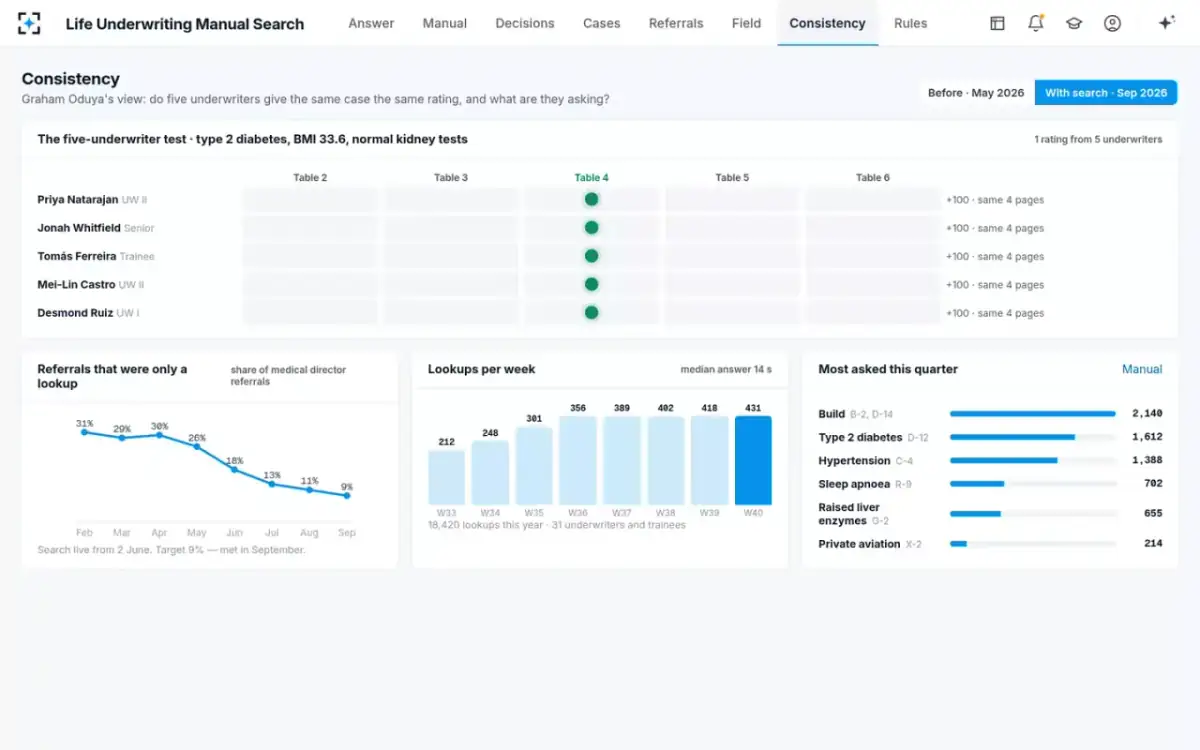
The manual decides the detail, and the detail is where flat extras go wrong. In the Society of Actuaries' simplified issue survey, products' aviation rules turned on the kind of flying and how much of it, so a question with the wrong facts gets the wrong charge. The same discipline applies as for a table: the facts, the section, the row, the rule, the page.
Reading a flat extra from the manual with Life Underwriting Manual Search
Life Underwriting Manual Search is built to answer a rating question from the insurer's own sources with the page behind every line: a question reader takes the facts and asks for the next one the manual needs, a manual searcher finds the governing section across the reinsurer's manual, the insurer's guidelines and the memos in force, and a calculator reads the printed value exactly, never between rows. Whether the manual prices a hazard as debits or as a charge per $1,000, the question is the same: which page, which row, and which rule of the insurer's own overrides it.
A rating built line by line, each with its page, landing on the class ladder

The underwriter decides; the agents never set a rating, order a requirement or contact the agent. To see the full sample case, start from Life Underwriting Manual Search.
Questions people ask
Is a flat extra worth it?
If the alternative is a table rating for the same hazard, a temporary flat extra can be the cheaper offer, because it stops. Compare the total over the years you expect to keep the policy: in Botminds' illustration, $10 per $1,000 for three years on $500,000 is $15,000 in all, while a table runs for the term and rises in dollars as you age.
Is a flat extra the same as a rated policy?
Both are substandard offers, and both are adverse underwriting decisions under the NAIC's privacy model because they are above standard rates. They differ in shape: a rated policy usually means a table rating, a percentage of standard mortality, while a flat extra is a fixed charge per $1,000.
What is the flat extra premium method?
It is the method of pricing a substandard risk by adding a fixed charge per $1,000 of cover to the class premium, instead of multiplying the mortality rate. The charge is set to cover the expected extra deaths per 1,000 lives, roughly $1 per $1,000 for each extra death per 1,000 a year.
Does a flat extra change the death benefit?
No. It changes the premium, not the cover. A graded death benefit, which reduces the benefit in the early years instead of raising the premium, is a different substandard method.
Can a flat extra and a table rating apply together?
Yes, where an applicant has both a medical impairment that the manual rates with a table and a hazard it prices with a flat extra, such as a diabetic private pilot. Each comes from its own section of the manual, and the insurer's combination rules say whether they interact.