A life insurance underwriting manual is the rulebook an underwriter rates impairments from: for each condition, a table of debits by severity, the credits allowed, the evidence to order and the combination rules that say how one impairment changes the rating of another. Most insurers license their core manual from a reinsurer and amend it with their own guidelines, the memos that change those guidelines and the medical director's decisions on hard cases, so the rule for any one case may sit in four documents at once. Combination rules are where that goes wrong most often, because two impairments are not rated as the sum of two separate lookups. Botminds' Life Underwriting Manual Search reads all four sources in the order the chief underwriter sets, applies the combination rules and shows the page behind every line, so each underwriter rates the same case to the same table.
This guide is written for chief underwriters, underwriting managers and medical directors. The worked case is a fictional sample with a fictional reinsurer manual and insurer: a 52-year-old non-tobacco applicant with type 2 diabetes diagnosed at 45, an HbA1c of 7.6% on metformin only, 6 feet and 248 pounds, applying for $1.5 million of 20-year term. Point values in real manuals are proprietary and differ by insurer. The medical evidence comes from the CDC, the NIH and two Swedish registry studies, linked where it appears.
How one sample manual rates type 2 diabetes with a heavy build
Agent
Diabetes tableOnset 40–49, current age 50–59, HbA1c 7.0–7.9%: +75 from table D-12b, page 418.
Agent
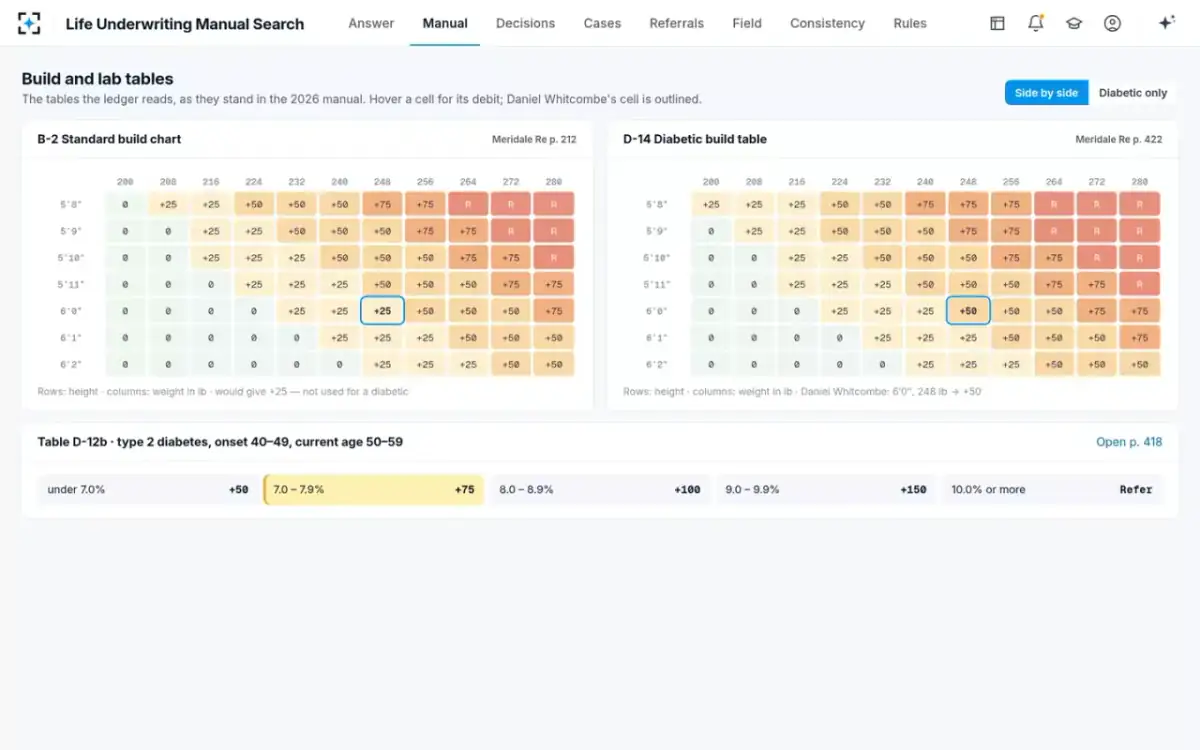
Combination rule§D-12.6: for an applicant with diabetes, read build from the diabetic build table D-14, not the standard chart.
Never: adding the standard chart’s +25 as well
Agent
Diabetic build tableBMI 33.6 falls in 33.0–35.9: +50, page 422.
Agent
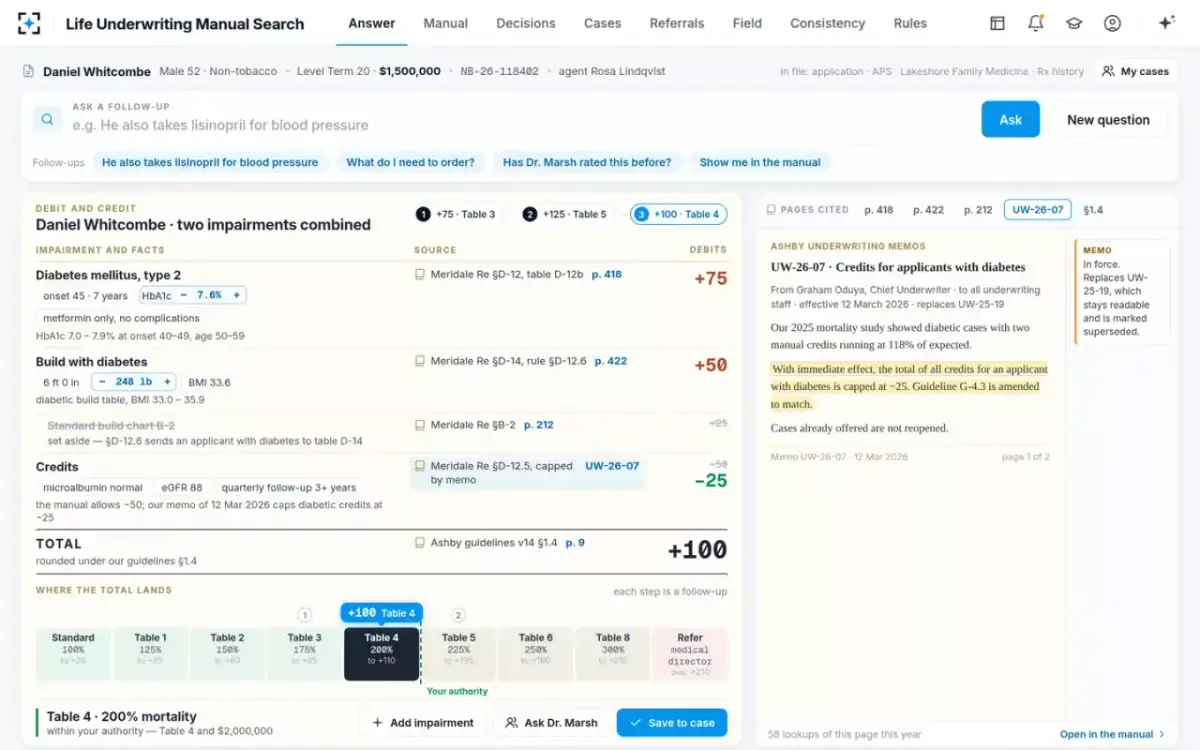
Credits and the capNormal microalbumin, eGFR 88, years of follow-up: the manual allows −50; the insurer’s memo caps diabetic credits at −25.
Agent
Total and class+75 +50 −25 = +100, Table 4 (200%) under the insurer’s rounding bands.
A person decides
UnderwriterDecides Table 4, within an authority of Table 4 and $2,000,000, and orders the requirements.
What is a life insurance underwriting manual?
A life insurance underwriting manual is the set of rules that turns medical and non-medical evidence into a rating. In practice it is a stack of sources, each with a different owner and authority, and the underwriter's first job on any case is to find which one governs. The table below sets out the four sources a typical company's underwriters work from, and what each one contributes.
The four sources behind one rating, and who owns each
| Source | What it holds | Who owns it | How often it changes |
|---|---|---|---|
| Reinsurer manual | Impairment sections, debit tables by severity, credits, combination rules, requirements by age and amount | The reinsurer, under the treaty | New editions and section updates |
| Company guidelines | Where the company departs from the manual: tighter or looser ratings, its own class rules and rounding bands | The chief underwriter | When experience or strategy moves |
| Underwriting memos | Changes to the guidelines between editions, often with immediate effect | The chief underwriter | Several a year, each superseding an earlier one |
| Medical director decisions | How hard cases were decided: facts, rating and reason | The medical director | Every referral adds one |
The stack explains the most common complaint about manual work: the same answers get looked up many times a day. In the fictional sample, the diabetes section of the primary manual has been asked for 212 times this year, the most read page in the book. A company that measures where its underwriters' minutes go usually finds most of them spent finding the page, not deciding the case.
Where a fully underwritten case's lookup minutes go
By hand · about 46 minutes (estimate)
- Finding the governing manual page · 33%
- Checking guidelines and memos in force · 17%
- Reading tables, adding debits · 17%
- Past medical director decisions · 13%
- Requirements to order · 9%
- Deciding · 11%
With the agents · about 8.5 minutes (estimate)
- Lookups and arithmetic, checked · 41%
- Deciding the rating · 59%
Which source wins when the manual and the guidelines disagree?
The company's own rule decides, and it must be written down, because underwriters otherwise resolve the conflict case by case. The common order is the company's guidelines first, then memos in force with the newest winning, then the primary reinsurer manual, then any secondary guide where the primary is silent. That is the order the chief underwriter has set in the fictional sample.
Two details matter as much as the order. A memo that supersedes an earlier memo must make the earlier one unusable without making it unreadable: an auditor reviewing a case signed last spring needs to see the rule in force that day. And where the company departs from the reinsurer's manual, the treaty may require the departure to be agreed or at least disclosed, so the guidelines should carry the reason with each departure. A manual stack in which nobody can say which page was in force on a given date cannot support a rating challenge or a mortality study.
Why underwriting manuals have combination rules
Manuals carry combination rules because impairments interact: the mortality of an applicant with two conditions is often not the sum of the mortality each would carry alone. The medical evidence on type 2 diabetes shows it clearly. In a study of 271,174 Swedish patients with type 2 diabetes matched against population controls, the excess risk of death and cardiovascular events "decreased stepwise for each risk-factor variable within the target range" across five factors: HbA1c, LDL cholesterol, albuminuria, smoking and blood pressure; with all five in range, the hazard ratio for death was 1.06 (Rawshani et al., NEJM 2018).
A second Swedish study, of 435,369 patients, found that excess mortality "increased with younger age, worse glycemic control, and greater severity of renal complications" (Tancredi et al., NEJM 2015). Those are the axes a diabetes section is built on: age at onset, current age, HbA1c band and kidney findings. They are also why a manual cannot rate diabetes in isolation and add build and blood pressure afterwards as if they were independent.
The excess risk of death with type 2 diabetes is largest in the young, even with good control
Rating type 2 diabetes with a heavy build: the combination rule at work
In the sample manual, the diabetes table gives +75 for onset at 40 to 49, current age 50 to 59 and an HbA1c of 7.0% to 7.9%. Build is where the combination rule takes over: for an applicant with diabetes, build is read from the diabetic build table, and the standard chart is not added. At 6 feet and 248 pounds the body mass index is 33.6, which the CDC classes as obesity, class 1 (30 to under 35) (CDC, adult BMI categories). The standard chart gives +25; the diabetic table gives +50.
The same facts, rated with and without the manual's combination rules
| Line | Read as separate lookups | Read with the rules in force |
|---|---|---|
| Diabetes, onset 40–49, age 50–59, HbA1c 7.6% | +75 | +75 |
| Build, BMI 33.6 | +25 from the standard chart | +50 from the diabetic build table (§D-12.6) |
| Credits: normal microalbumin, eGFR 88, regular follow-up | −50 as the manual allows | −25 under the insurer’s memo capping diabetic credits |
| Total | +50 | +100 |
| Class under the sample rounding bands | Table 2 (150%) | Table 4 (200%) |
The gap between the columns is two tables of mortality, 50 percentage points on the sample bands, and it comes entirely from where two numbers were read, not from any judgment. The arithmetic itself is worked line by line in the numerical rating system.
Both build tables, the applicant's cell outlined in each
Diabetes with treated hypertension works the same way in the sample manual: the pair adds +25 even where the hypertension alone would rate nothing. The Swedish evidence supports treating such pairs together. In the same study, smoking was the strongest predictor of death and an HbA1c outside the target range the strongest predictor of stroke and heart attack (Rawshani et al., NEJM 2018), so a diabetic smoker with high blood pressure carries interacting risks that independent debits would misprice in one direction or the other.
Credits, caps and the memo that changes a class
Credits reward the factors that reduce excess risk: normal kidney tests and regular follow-up for a diabetic applicant. The NIH's kidney guidance gives the thresholds an underwriter reads: an eGFR of 60 or more is in the normal range, and albumin in the urine is a sign of kidney damage (NIDDK, kidney disease tests). A company may still decide the manual's credits are too generous for its own business, and that is what memos are for.
With immediate effect, the total of all credits for an applicant with diabetes is capped at −25.
Fictional memo UW-26-07, sample insurer in Life Underwriting Manual Search
In the sample, the insurer's 2025 mortality study found diabetic cases with two manual credits running at 118% of expected, and the chief underwriter issued the memo on 12 March 2026, replacing an earlier one. The manual still allows −50; the worksheet carries −25 and shows the −50 struck through, with the memo beside it. That one memo moves the sample case from Table 3 to Table 4, and an underwriter who has not read it rates a table light.
Life Underwriting Manual Search shows the memo that caps the credit beside the worksheet
Where manual errors come from, and how to measure them
Most rating errors on manual cases are lookup errors: the wrong table, a missed memo, a credit applied that a newer rule caps. In the sample insurer's consistency test in May, five underwriters rated the same diabetic case with a heavy build, and two read build from the standard chart, landing a table lower. What an underwriting auditor tests takes that test apart underwriter by underwriter.
The second cost is referrals. When a junior underwriter cannot find the governing page, the case goes to the medical director, who finds the page and sends it back. In the sample insurer, 31% of referrals were only a lookup; the solution's design target is 9%, with each referral that does go up arriving with its worksheet and pages so the medical director's time goes on the cases that need medical judgment.
What the sample insurer measures about its manual work
212
times this year the diabetes section was asked for, the most read page in the sample manual
2 of 5
underwriters read the standard build chart for a diabetic case in the May consistency test
31%
of referrals to the medical director that were only a lookup, before the solution
9%
design target for lookup-only referrals with Life Underwriting Manual Search
What the law expects of a manual's ratings
A manual's ratings must rest on mortality evidence and be applied evenly. New York's Insurance Law bars a life insurer from charging a different rate solely because of an impairment or disease "except where the refusal, limitation or rate differential is permitted by law or regulation and is based on sound actuarial principles or is related to actual or reasonably anticipated experience," and from unfair discrimination "between individuals of the same class and of equal expectation of life" (NY Ins. Law § 4224).
Both halves bear on combination rules. A rule that rates diabetes with obesity more heavily than the sum of its parts needs the evidence behind it, and a company that departs from its reinsurer's rule needs its own. And two applicants with the same facts must land at the same table, which a stack read differently by different underwriters cannot promise. When the rating goes against the applicant, the NAIC's privacy model treats an offer above standard rates as an adverse underwriting decision and requires the specific reasons in writing, or notice that they can be requested (NAIC Model #670); a worksheet that names the rule behind each line is those reasons, already written.
Preferred classes have their own version of the problem. In the Society of Actuaries' 2002 survey, a personal history of diabetes, type 1 and type 2, was among the criteria used by at least 98% of insurers to define a preferred risk, and one respondent wrote that "any ratable impairment precludes preferred plus and preferred class" (SOA, report on 2002 preferred practices). How companies set those criteria is the subject of life insurance risk classification.
Governing the manual: versions, authority and the decision trail
A manual stack is governed by three controls: which version was in force for each case, who may sign at each rating and amount, and a trail from every rating back to its pages. In the sample insurer, an Underwriter II may sign up to Table 4 and $2,000,000; above that, or on any line marked refer, the medical director decides, and the medical director's queue shows seven open referrals, each with its worksheet and pages.
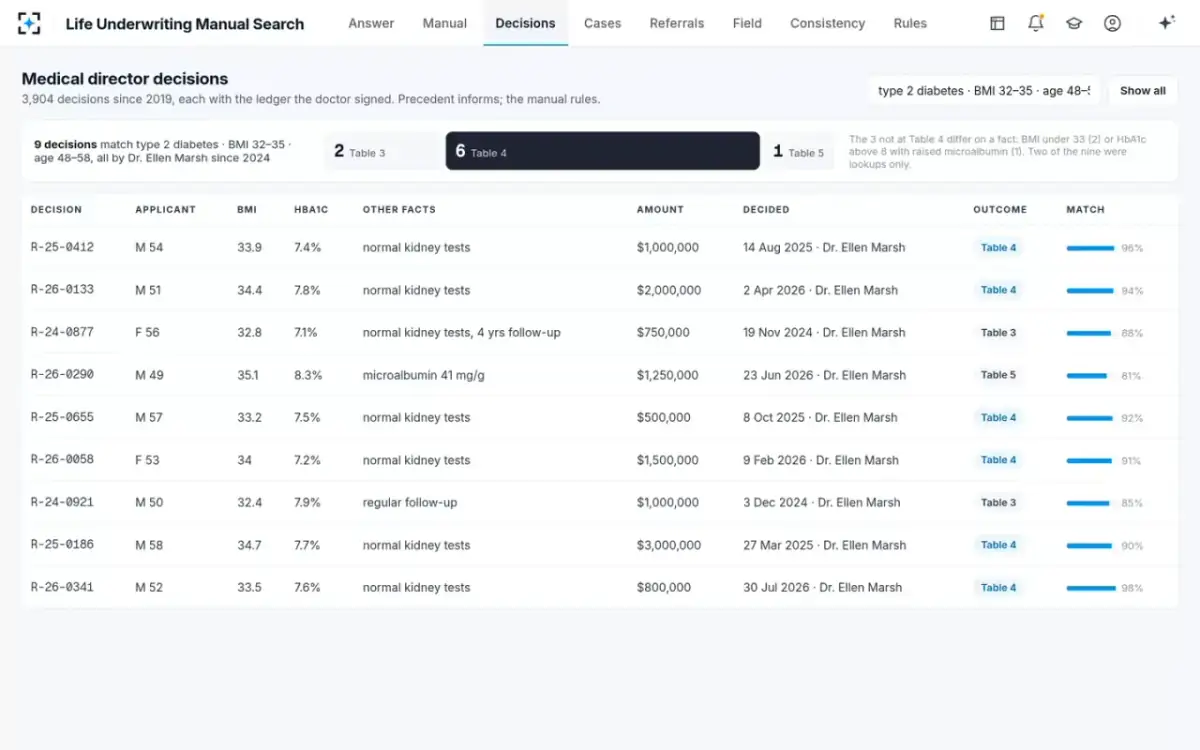
Precedent belongs in the trail, under the manual. In the sample, nine past medical director decisions match type 2 diabetes, a BMI of 32 to 35 and age 48 to 58: six at Table 4, two at Table 3 and one at Table 5, and the three that differ each turn on a fact, a BMI under 33 or an HbA1c above 8 with raised microalbumin. Precedent informs; the manual rules. Each question, the pages returned and the decision are logged with who asked and kept seven years.
Similar medical director decisions, filtered to the nine that match
Where Life Underwriting Manual Search fits in the underwriter's day
Life Underwriting Manual Search answers a rating question the way a careful underwriter would, with every step on the page. The underwriter types "52, type 2 diabetes, HbA1c 7.6, metformin only"; the question reader takes the facts and leaves build open until it is given; the manual searcher finds the diabetes section and the memo in force; the debit calculator reads the row exactly as printed; the combination checker applies the diabetic build rule and the credit cap and rounds the total; the precedent finder brings back similar decisions; the requirements writer drafts what to order from the age and amount grid. In the sample, the whole answer takes 14 seconds.
The agents never set a rating or order a requirement. The underwriter decides within their authority and orders the paramedical exam, the blood profile with HbA1c, the urinalysis with microalbumin, the resting ECG and NT-proBNP that the solution drafted. To see the full case, start from Life Underwriting Manual Search.
Questions people ask
Who writes life insurance underwriting manuals?
Most core manuals are written by reinsurers and licensed to the insurers they reinsure, who then add their own guidelines and memos. Some large insurers maintain their own manuals. Either way, the company's chief underwriter decides where the company departs from the manual and which source wins when they disagree.
Are life underwriting manuals public?
No. Debit tables and point values are proprietary and differ by insurer, which is why two companies can rate the same applicant differently. What regulators require is that the ratings rest on sound actuarial principles or experience and that applicants receive the reasons for an offer above standard rates.
What is a combination rule in underwriting?
A rule in the manual that changes how one impairment is rated when another is present, instead of adding separate ratings. In the sample manual, diabetes sends build to a diabetic build table (+50 instead of +25), and diabetes with treated hypertension adds +25 even where hypertension alone would rate nothing.
Can an insurer rate more strictly than its reinsurer's manual?
Yes: a company's guidelines and memos commonly tighten or loosen the manual where its own experience differs, subject to its reinsurance treaties. In the sample, a mortality study showing diabetic cases with two credits at 118% of expected led the chief underwriter to cap diabetic credits at −25.
How do underwriters keep ratings consistent across a team?
By testing it: give several underwriters the same case and compare the tables they reach, then trace each difference to its cause. In the sample insurer's test, two of five read the wrong build table. A worksheet that cites the page behind every line makes such errors visible to a reviewer in seconds.
How does the solution handle a superseded memo?
It keeps the superseded memo readable and marked, and never relies on it for a new answer. An auditor reviewing an older case can see which memo was in force on the day the case was signed.