AI in life insurance underwriting does two different jobs. The established one is triage: models that score an application from prescription histories, motor vehicle reports and the like, and decide who can skip the fluids and the exam. The newer one is reading: language models that answer an underwriter's question about how to rate an impairment. The second is where buyers get misled, because a general chat model writes a confident answer about debits and tables without ever having seen the insurer's reinsurer manual, guidelines or memos. A usable answer on a rated case has to cite the section, the page and the memo in force, apply the combination rules and stop where the printed table stops. This guide gives five test questions on one diabetic case that separate the two, and shows how Botminds' Life Underwriting Manual Search answers them.
The test case is a fictional sample run through the solution, with a fictional reinsurer manual and insurer: Daniel Whitcombe, 52, non-tobacco, $1.5 million of 20-year term, type 2 diabetes. The research comes from the NAIC, the Society of Actuaries, NIST and a peer-reviewed study in Nature Communications, linked where it appears.
Five test questions for any AI underwriting tool, on one rated case
1Which build table do I use for a 52-year-old type 2 diabetic, 6 ft, 248 lb?
What the answer needsThe manual's combination rule (§D-12.6) that sends a diabetic to the diabetic build table, and that table's row for BMI 33.6.
A passing answer+50 from the diabetic table, page 422, with the standard chart's +25 shown and set aside.
2He has normal kidney tests and years of follow-up. What credits apply?
What the answer needsThe manual's credit section and the insurer's memo in force, read in the insurer's order of precedence.
A passing answer−25, not the manual's −50, citing memo UW-26-07 and marking the old memo superseded.
3What if his HbA1c comes back at 8.2?
What the answer needsThe next row of the diabetes table, the rounding bands and the authority grid.
A passing answer+100 for diabetes, +125 in all, Table 5: above an Underwriter II's authority, so the medical director decides.
4And at 10.4?
What the answer needsThe edge of the printed table.
A passing answerDecline or refer to the medical director, as the table prints for 10.0% or more. No value is invented beyond the printed rows.
5Has the diabetic credit rule changed this year?
What the answer needsThe dated memo history: what replaced what, and when.
A passing answerYes: memo UW-26-07 of 12 March 2026 replaced UW-25-19, and guideline G-4.3 was amended to match.
How is AI used in life insurance underwriting today?
Mostly to speed up healthy applicants. The NAIC surveyed 161 life insurers on artificial intelligence and machine learning: 58% used, planned to use or were exploring it, against 88% of auto insurers and 70% of home insurers, and among the models in use, 36% were in marketing and 34% in underwriting (NAIC Big Data and AI Working Group, life insurer AI/ML survey). Among life insurers not using it, one of the reasons the survey lists is dependence on legacy systems. Software that orders and tracks the evidence before an underwriter rates is a different purchase, compared in life insurance underwriting software: four approaches.
Where life insurers' AI and machine learning models are in use
The accelerated programs those models feed run on third-party data. In the Society of Actuaries' 2022 survey of 24 direct companies, written by authors from Milliman, the most used tools were the electronic application (92% of respondents), prescription histories and MIB data (88%), motor vehicle records (79%) and the tele-underwriting interview (71%) (SOA Research Institute, 2022 AU survey). None of that answers how to rate a table-rated diabetic. That still takes the manual.
Can ChatGPT do life underwriting?
A general chat model can explain underwriting concepts, draft a letter or summarize a note; it cannot rate a life case to an insurer's standard, because the standard is the insurer's own and the model has never read it. The debits for diabetes, the build tables, the combination rules and the credit caps live in the reinsurer's proprietary manual and the insurer's guidelines and memos. A model trained on public text has none of them, so any table rating it gives is a guess that sounds like a rule.
The failure has a name. NIST's generative AI risk profile lists it among the risks specific to generative systems.
Confabulation: The production of confidently stated but erroneous or false content (known colloquially as "hallucinations" or "fabrications") by which users may be misled or deceived.
NIST AI 600-1, Generative Artificial Intelligence Profile (July 2024)
On a rating question confabulation looks exactly like a correct answer: a debit, a table and a sentence of reasoning. The only defence is a source the underwriter can open. That is why the first test of any tool is not whether its answer is right but whether every line of it cites the page that makes it right.
Is AI accurate for insurance underwriting? What the research shows on citations
No published study measures AI accuracy on life underwriting manuals, but the nearest evidence, on medical questions, shows how often cited answers are not supported by their citations. Researchers at Stanford built an automated check of whether the sources a model cites support what it says, and ran seven popular models on 800 medical questions.
When language models cite sources on medical questions, the sources often do not back them
50–90%
of responses not fully supported by the sources they cited, across seven models
~30%
of individual statements unsupported even for GPT-4o with web search
58,000
statement and source pairs checked, from 800 questions
In the authors' words, "between 50% and 90% of LLM responses are not fully supported, and sometimes contradicted, by the sources they cite" (Wu et al., Nature Communications, 2025). For an underwriter the lesson is specific: a citation is not proof. A tool must cite the page, and the page must say what the answer says. Testing that means opening the page, which is why the test questions above ask for the passing answer's page as well as its number.
Why a fluent answer is not a rating
A rating is the result of a procedure, not a judgment expressed in prose. The procedure has fixed steps: the facts, the governing section, the row for each fact, the combination rules, the order of precedence between sources, the rounding bands and the authority grid. A fluent answer can skip any of them and still read well.
A general chat answer and a cited answer to the same rating question
A general chat model: General training text; no access to the reinsurer manual or the insurer's memos.
A cited answer from the insurer's sources: The manual, the guidelines and the memos in force, each opened at the page.
A general chat model: Has no copy of the insurer's combination rules, so cannot know when one applies.
A cited answer from the insurer's sources: Applies the written rule and names it where it changes a number.
A general chat model: Cannot know that a memo capped a credit in March.
A cited answer from the insurer's sources: Ranks the memo above the manual and marks the old rule superseded.
A general chat model: Has no printed table to stop at, so nothing marks where an answer should end.
A cited answer from the insurer's sources: Writes Refer.
A general chat model: Does not know who may sign.
A cited answer from the insurer's sources: Says whether the total is within the reader's authority.
A general chat model: A paragraph that cannot be rebuilt.
A cited answer from the insurer's sources: A worksheet an auditor can rebuild line by line.
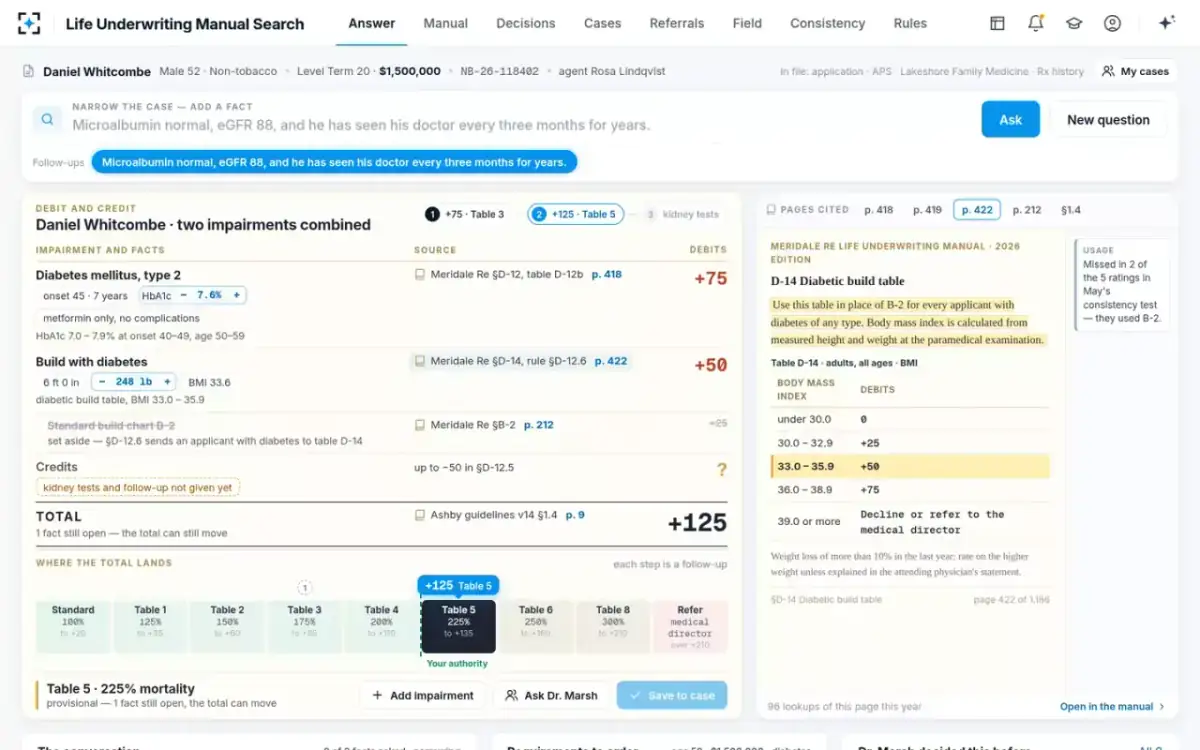
The sample case shows the stakes. Read with the standard build chart instead of the diabetic one, and with the manual's credits instead of the memo's cap, the same facts total +50, Table 2, instead of +100, Table 4. Every number in the wrong answer exists somewhere in the sources; two of them come from the wrong place. Why that distinction is the heart of the arithmetic is shown in the numerical rating system, debit by debit.
Two impairments combined: the struck-through line and the rule that set it aside
What regulators expect of AI in life underwriting
Regulators do not ban AI in underwriting; they hold the insurer responsible for it and expect it to be explained. New York's Insurance Circular Letter No. 7 of 2024 defines the systems it covers broadly.
AIS means any machine-based system designed to perform functions normally associated with human intelligence … that is used – in whole or in part – to supplement traditional health, life, property or casualty underwriting or pricing
NY DFS, Insurance Circular Letter No. 7 (2024)
On that wording a tool that helps an underwriter rate a life case supplements traditional life underwriting, so the letter's expectations of governance, documentation, testing and vendor oversight are the frame a buyer should assume. The NAIC's model bulletin on insurers' use of AI sets similar expectations for a written AI program; our compliance guides set out the NAIC AI bulletin requirements in full.
How to test AI life insurance underwriting software on your own manual
Buy for the answer you can defend, not the answer you can get fastest. Five tests on your own manual will tell you more than any demonstration on the vendor's.
Ask the five questions above on your own sources. Use a case your medical director has already decided, with at least one combination rule and one memo that changed a manual value. Open every cited page. The Stanford study's finding is that a citation can point to a page that does not say what the answer says. Ask a question past the edge of a table. The only acceptable answer is a referral. Change a memo and ask again. The new rule should win, and the old one should stay readable and marked. Ask who signs. A tool that sets the class itself is automation, and your authority grid, adverse decision notices and governance must be built around it.
What to refuse when buying AI for underwriting
Refuse a tool that answers rating questions without your manual loaded, that shows a total without its lines, or that will not say where it stops. Those are the features that make an answer impossible to audit.
Refuse, too, a contract that leaves you unable to examine the tool. New York's Circular Letter No. 7 holds the insurer responsible for vendor-built systems used in underwriting, and expects, where available, contract terms that give the insurer audit rights or audit reports and require the vendor's cooperation with regulatory inquiries. And refuse a design that shows manual text, debits or medical director notes to field agents: a likely range is the most an agent needs before quoting, and anything more puts the reinsurer's proprietary manual in the field.
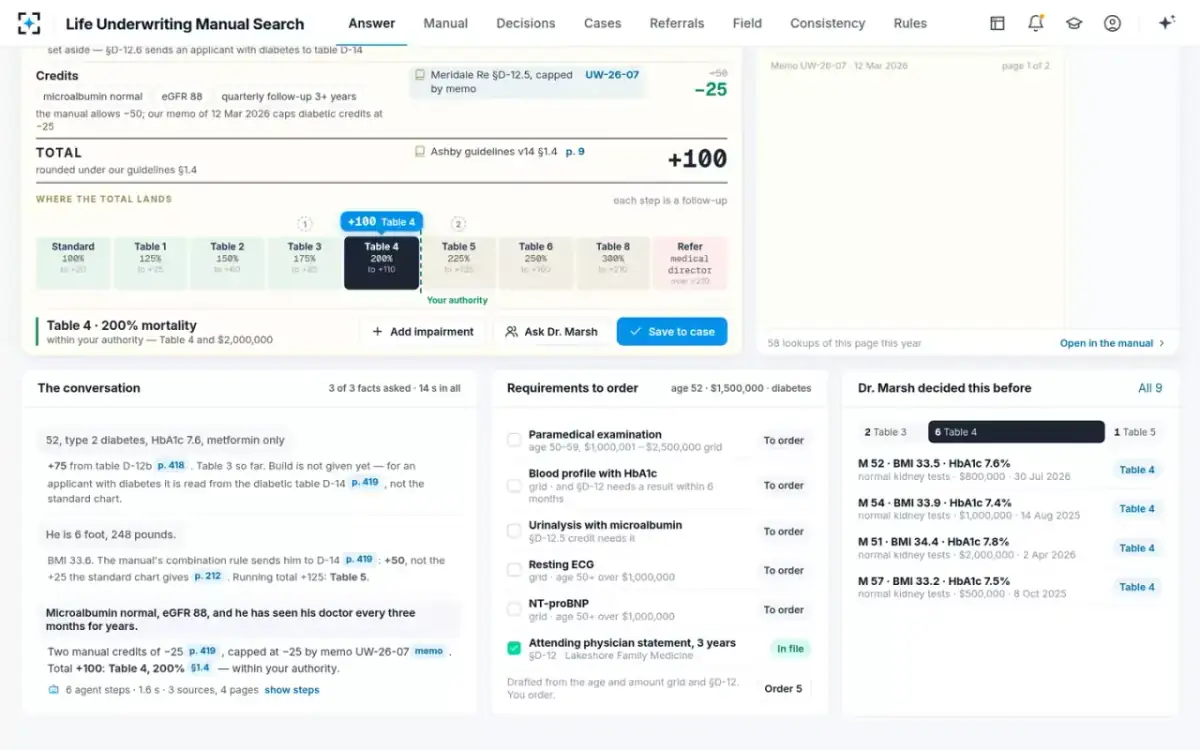
Three questions in plain words, the requirements drafted, and the precedents
Where Life Underwriting Manual Search passes the test, and what it leaves to others
Life Underwriting Manual Search is built for the reading job: an underwriter, a trainee or a medical director asks how to rate a case in plain words, and six agents return a worksheet in which every debit and credit carries its section and page, the order of precedence is the chief underwriter's, combination rules are named where they change a number, and the total lands on a class ladder that shows the reader's authority. It passes the five tests on the sample case because it reads only the insurer's sources and writes Refer where they stop.
It is not a triage model. It does not score applicants from prescription or motor vehicle data, and it does not decide who may skip the exam; insurers that run accelerated programs keep those models. It does not set the rating, order requirements or contact the agent. And it is only as current as the sources loaded into it, which is why getting a copilot live on your own manual starts with every memo and its date. See the five questions answered on the full sample case at Life Underwriting Manual Search.
Questions people ask
Does ChatGPT know reinsurer underwriting manuals?
Not in any form an insurer can rely on. Reinsurers' manuals are proprietary and licensed to their clients, and each insurer's guidelines and memos change the manual's values. A general model can describe how manuals work; it cannot cite the page that rates your applicant.
Can AI give a table rating?
AI can compute a proposed total from the insurer's own tables and say which class the insurer's rounding bands give it. Whether that becomes the rating is a decision for a person with the authority to sign, which is how the sample insurer's authority grid works.
What are the risks of AI in underwriting?
Confident errors that look like rules, citations that do not support the answer, stale rules after a memo, and inconsistent treatment of identical applicants, which can amount to unfair discrimination. New York says that failing to disclose the material elements of an AI system and its external data to a consumer may constitute an unfair trade practice.
Will AI replace the underwriter on rated cases?
Not on the evidence so far. The NAIC's life insurer survey found AI used mainly in marketing and underwriting, and accelerated programs mostly sort healthy applicants; table-rated cases still need the manual, the guidelines and a person with authority to sign.
Is AI in life insurance underwriting regulated?
Through the general insurance laws, and increasingly through specific guidance. New York's Circular Letter No. 7 of 2024 covers AI used in life underwriting and pricing, the NAIC's model bulletin sets expectations for an AI program in the states that adopt it, and Colorado regulates life insurers' use of external data and models.