An underwriting AI agent is software that carries out one step of an underwriter's work, such as reading the facts out of a question, finding the governing page in a manual, or reading a table row, and hands its result to the next step or to a person. In life insurance the useful question about an underwriting AI agent is not how clever it is but where it stops. A rating question on an impaired applicant splits naturally into six jobs, and each needs a written limit that keeps the agent out of the decision: never round a value, never net debits without a rule, never set the rating. Botminds' Life Underwriting Manual Search is built that way, with six agents that read the reinsurer's manual, the insurer's guidelines and memos and past medical director decisions, and an underwriter who decides.
The worked examples come from a fictional sample case as it runs through the solution, with a fictional reinsurer manual, insurer and medical director: Daniel Whitcombe, 52, applying for $1.5 million of 20-year term with type 2 diabetes and a heavy build. The rules quoted are New York's and the NAIC's, linked where they appear.
One rating question, six agents and two people: where each stops
Agent
Question readerTurns "52, type 2 diabetes, HbA1c 7.6, metformin only" into rating facts and asks for the fact the manual needs next.
Never: Estimates a reading that was not given
Agent
Manual searcherFinds §D-12 on page 418 of the reinsurer manual, checks the insurer's guidelines and finds the memo in force.
Never: Cites a superseded page without the mark
Agent
Debit calculatorReads table D-12b at onset 40–49, age 50–59, HbA1c 7.0–7.9%: +75, with the page.
Never: Rounds, interpolates or invents a value
Agent
Combination checkerApplies §D-12.6 (diabetic build table) and memo UW-26-07 (credit cap), sums +100 and rounds it to Table 4.
Never: Nets debits across impairments without a written rule
Agent
Precedent finderFinds nine medical director decisions on similar facts: six at Table 4, two at Table 3, one at Table 5.
Never: Sets the rating
Agent
Requirements writerDrafts the requirements from the age and amount grid and §D-12, and marks the doctor's statement already in file.
Never: Orders a requirement
A person decides
Underwriter IIDecides Table 4 within an authority of Table 4 and $2,000,000, and orders the requirements.
A person decides
Medical directorDecides anything above authority or any line marked Refer.
What is an underwriting AI agent?
An underwriting AI agent is a narrow worker inside a larger process: it takes an input, does one defined job, and produces a result that a person or another agent can check. That is different from a single model asked for an answer. A single model returns a conclusion; a set of agents returns a conclusion and the steps that produced it, each with its source.
The distinction matters in life underwriting because the work is already divided this way when people do it. An underwriter reads the application, looks up the impairment, reads a table, applies the combination rules, checks what the medical director decided last time, lists the requirements, and only then decides. Splitting the same work across agents makes each step visible, so a reviewer can see which one went wrong. When an answer is wrong because the build came from the standard chart instead of the diabetic one, the error sits on one line of one agent's output, not somewhere inside a paragraph.
Life insurers already put much of their AI into this work. In the NAIC's survey of life insurers' AI and machine learning, underwriting was the second most common use after marketing, and the data most commonly used for pricing and underwriting models was medical data (NAIC Big Data and AI Working Group). The agents on this page do something narrower than modelling risk: they read the insurer's own rules.
Can an AI agent rate a life insurance case?
An agent can compute a proposed total and say where it lands on the class ladder; it should not be the one that sets the rating on a fully underwritten case. Setting the rating is a decision made under an authority grid, by a named person who can be asked to explain it. In the sample insurer, an Underwriter II may decide up to Table 4 and $2,000,000; a senior underwriter up to Table 8 and $5,000,000; the medical director any case.
The sample case shows why the line belongs there. The agents' total of +100 is Table 4, within the underwriter's authority, and the screen says so. If the applicant's HbA1c came back at 8.2, the same agents would produce +125, Table 5, and say the case is now above authority. The arithmetic is the agents'; the consequence, who may sign, is the insurer's rule, and the signature is a person's.
The agents at work on one question, each step shown as it runs
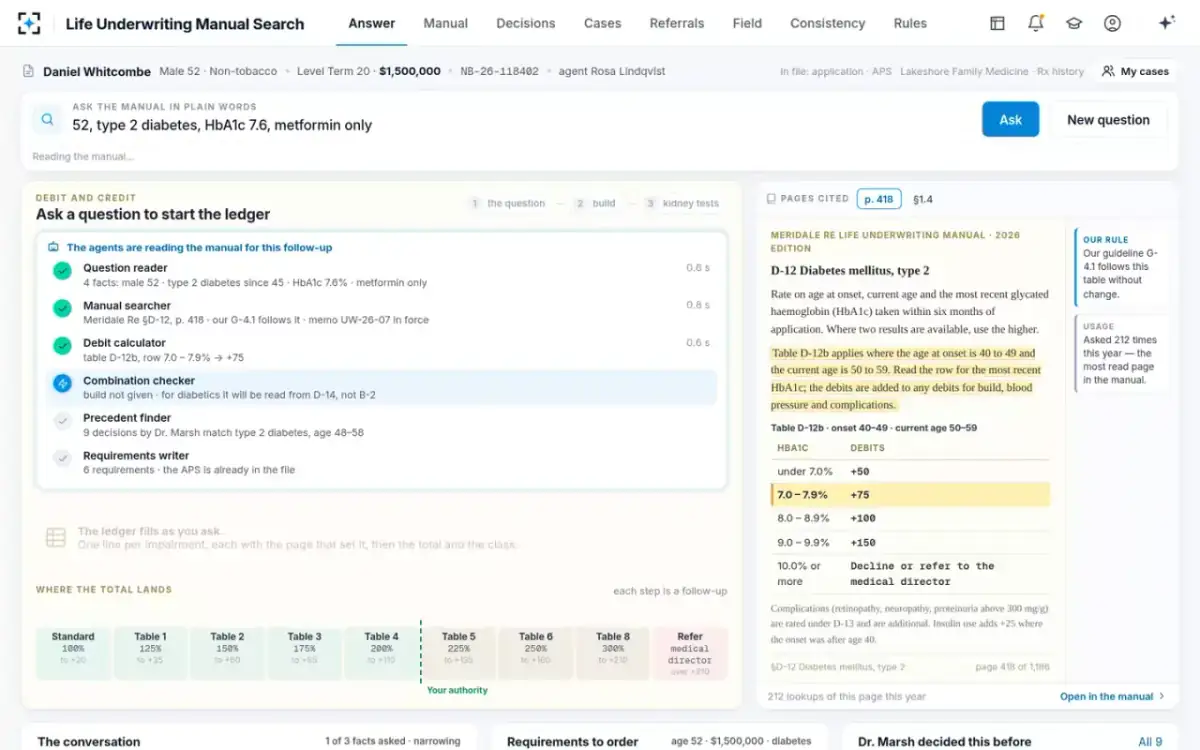
The six jobs in one rating question
Six jobs cover a rating question from plain words to a drafted order, and each maps to a step a careful underwriter already takes. Splitting them is what lets each have its own limit.
The question reader turns plain words into the facts the manual needs: age, age at onset, the most recent reading, medication, height and weight. Its job includes asking for the next fact, because a manual row needs all of its axes. The manual searcher finds the governing section across the reinsurer's manual, the insurer's guidelines and the memos in force, in the order of precedence the chief underwriter has set. The debit calculator reads the row that matches each fact and writes the value exactly as printed.
The combination checker tests every pair of impairments against the written combination rules, names the rule wherever it changes a number, sums the lines and rounds the total with the insurer's bands. The precedent finder brings back medical director decisions on similar facts, with the outcome and the doctor's note. The requirements writer lists what to order from the age and amount grid and the impairment section, and marks what is already in file.
Each agent's written limit, and the rule it protects
A limit is only useful if it is written down, testable and tied to a reason. The table below pairs each agent's limit with the risk it guards against; a buyer can ask any vendor for the same column.
Six underwriting AI agents: what each may not do, and why
| Agent | Written limit | What it protects against |
|---|---|---|
| Question reader | A fact not in the question or the file stays open; readings are quoted, never estimated. | A plausible guess, such as an assumed weight, turning into a debit no one can trace. |
| Manual searcher | No answer without a page; a superseded page is never cited without the mark. | An answer from last year's rule, after a memo replaced it. |
| Debit calculator | Never rounds, interpolates or invents a value; outside the table it writes Refer. | A value between two rows that the manual never printed. |
| Combination checker | Never nets debits across impairments without a written rule; says when the total is above authority. | Adding lines the manual says not to add, and a case decided above the reader's limit. |
| Precedent finder | Precedent informs, it never sets the rating; underwriting staff only, never shown in the field preview. | A past decision becoming a rule without anyone writing it, and medical director notes reaching agents. |
| Requirements writer | Drafts the list; the underwriter orders. Never orders a requirement. | An order going to the applicant that no underwriter approved. |
Two limits do most of the work. The debit calculator's refusal to interpolate keeps the arithmetic honest: if an applicant's reading falls outside the printed rows, the answer is Refer, not a number that looks reasonable. The combination checker's refusal to net debits without a written rule keeps the arithmetic lawful. Adding two impairments as if they were independent can understate or overstate a risk the manual has priced together, and the error lands on one applicant and not on another with the same facts.
Is an AI underwriting agent allowed? What New York and the NAIC say
Nothing in state insurance law prohibits AI agents in underwriting, but the insurer answers for what they do, including when a vendor built them. New York's Insurance Circular Letter No. 7 of 2024 is the most specific text. Its definition of an AI system covers systems that supplement traditional life underwriting, in whole or in part, and on vendors it is blunt.
Insurers retain responsibility for understanding any tools, EDCIS, or AIS used in underwriting and pricing for insurance that were developed or deployed by third-party vendors
NY DFS, Insurance Circular Letter No. 7 (2024)
The same letter expects written standards for buying and relying on vendor systems, procedures to report and correct wrong information, and, where available, contract terms giving the insurer audit rights and the vendor's cooperation in regulatory inquiries. Its inventory and documentation expectations are covered in our guide to New York's Circular Letter No. 7.
The older rule still applies too. The NAIC's model Unfair Trade Practices Act, which states adopt in their own versions, treats unfair discrimination between applicants of the same class and the same expectation of life as an unfair trade practice (NAIC Model #880). An agent that adds lines differently on two identical cases, or cites a superseded page on one of them, creates exactly that difference. The written limits are how a buyer shows the agents cannot; what unfair discrimination in insurance means is set out in full by our compliance guides.
Does AI replace the medical director?
No. In a well-built design the agents change what reaches the medical director, not who decides. A referral should arrive because it raises a medical question or exceeds the underwriter's authority, not because a junior could not find the page.
Similar medical director decisions, with the facts that set them apart
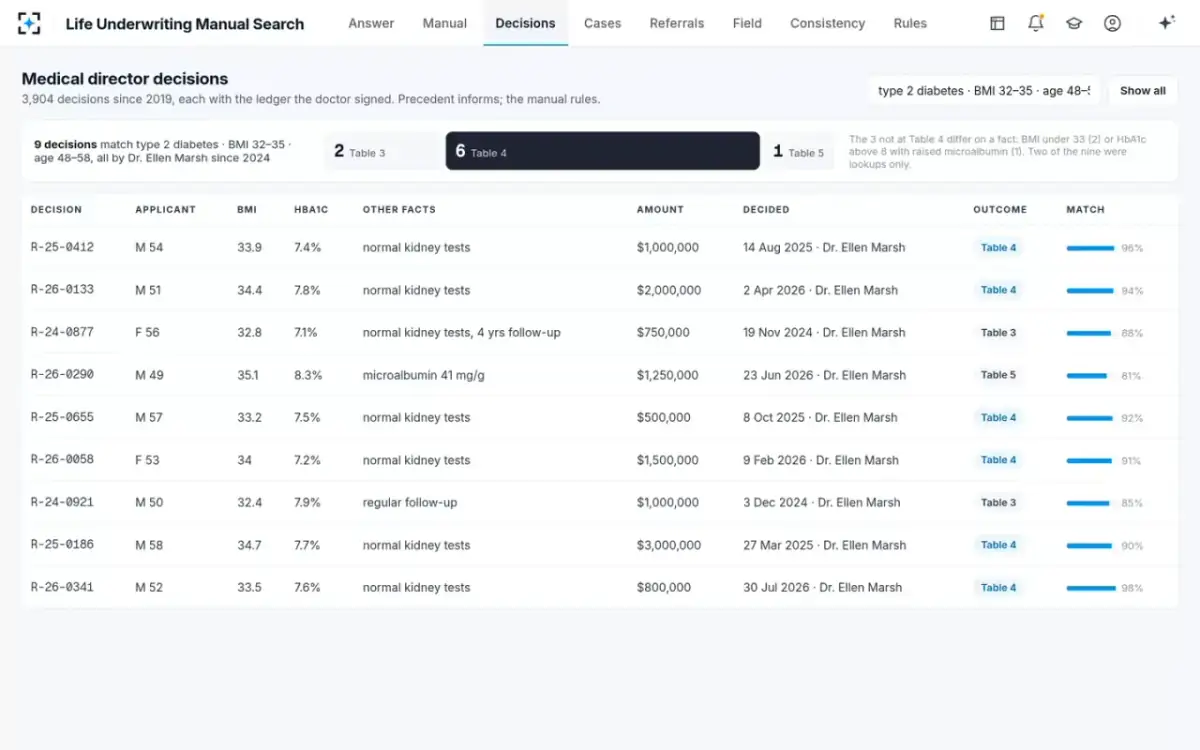
The precedent finder is the agent most likely to be misused, so its limit is the clearest: precedent informs, the manual rules. In the sample, nine decisions match the applicant's impairment, build and age. Six landed at Table 4, and the three that did not each differ on a fact, a BMI under 33 or an HbA1c above 8 with raised microalbumin. That is useful to the underwriter and to the medical director. It is not a rule; if the insurer wants it to be one, the chief underwriter writes it into the guidelines, where it gets a version and a date.
What the medical director gets back is time. Every referral in the sample queue arrives with its worksheet and pages attached, and the ones that were only a lookup are marked; in the sample data they were 31% of referrals before the search went live, and the design target is 9%.
How accurate are underwriting AI agents? Measure it on your own cases
No published study measures the accuracy of underwriting AI agents on life manuals, and a vendor's figure from someone else's manual says little about yours. Accuracy has to be measured on your own sources and your own decided cases, step by step, because an agent design can be right on the total and wrong on a line.
Two ways to test an underwriting AI agent before relying on it
Testing the answer: Whether the final class matches the class the case was issued at.
Testing each step: Whether each fact, page, row, combination rule and rounding step matches what the manual and guidelines require.
Testing the answer: Two errors that cancel: a build debit too low and a credit not capped.
Testing each step: Little, if the decided cases include combinations and memos.
Testing the answer: A random sample of issued policies.
Testing each step: Decided cases chosen to include each common combination, each memo in force and cases near band edges.
Testing the answer: A share of matching classes.
Testing each step: Every line cited; no superseded page without its mark; no value outside a printed row.
The step test also produces the evidence an auditor will ask for. A consistency test, in which several underwriters rate the same case, can then be rerun with the agents in the loop to see whether they converge on one rating from the same pages. What an underwriting auditor tests describes how to score one.
What to ask before buying underwriting AI agents
A short list of questions separates agents built for underwriting from a chat model wrapped in a workflow. Each one can be answered with a demonstration on your own manual.
Questions to put to any vendor of underwriting AI agents
- Does every line of the answer cite a section and page?
Ask to see an answer where the cited page is missing. The right behavior is no line, not a line without a source.
- How is the order of precedence set, and by whom?
Your guidelines, then memos in force, then the reinsurer manual is a common order; the chief underwriter should own it as a versioned setting.
- What happens when a reading falls outside a table?
The answer should be Refer. Any interpolated value is a value your manual never printed.
- Which combination rules are applied, and are they named on the answer?
Test a diabetic with a heavy build: the answer should name the rule that switches build tables.
- How are superseded pages handled?
Load a memo that replaces a rule and ask the old question. The old page should stay readable, marked, and unused.
- Can an agent set a rating, order a requirement or contact the field?
If yes, you are buying automation, and your authority grid and adverse-decision notices must cover it.
- What do field agents see?
A likely range, at most. Manual text, debits, guidelines and medical director notes should never reach them.
- What is logged, and for how long?
Each question, the pages returned and the decision, with who asked; long enough for your exam cycle.
Where Life Underwriting Manual Search fits, and where it does not
Life Underwriting Manual Search fits where a rating question needs the manual, the guidelines, the memos and past decisions read together, with a page behind every line: fully underwritten and impaired-risk cases, referrals, trainee questions and field previews. In the sample case three questions in plain words produced a cited worksheet in 14 seconds, from four pages in three sources.
It is not an accelerated underwriting engine: it does not score applicants from prescription, motor vehicle or credit data, and it does not decide who may skip the exam. It is not a case management system: it drafts requirements but does not order them or chase them. And it does not replace the reinsurer's manual: the answers are only as current as the manuals, guidelines and memos loaded into it, which is why superseded pages stay readable and marked, and why loading them in the right order is the first stage of an AI underwriting copilot's eight-week plan. To see the six agents on the full sample case, start from Life Underwriting Manual Search.
Questions people ask
What is an insurance underwriting AI agent?
It is a piece of software that performs one defined step of underwriting, such as reading facts, finding a manual page or reading a table, and passes a checkable result on. Several agents together can prepare a rating; in a supported design a person still decides. The value over a single model is that each step can be inspected.
What can't an underwriting AI agent do?
In a design built for regulated underwriting it cannot set the rating, order a requirement or contact the field, and it cannot invent a value the manual does not print. Those limits should be written down and tested. An agent that can do any of them is automation, and the insurer's authority rules and notices have to cover it.
Do underwriting AI agents need access to the reinsurer's manual?
Yes, under whatever terms the insurer's agreement with its reinsurer allows, because the debits are printed only there. The insurer's guidelines and memos are needed too: they record where the company departs from the manual. An agent working from public information alone cannot produce a rating.
Who is responsible if an AI agent gets a rating wrong?
The insurer. New York's Circular Letter No. 7 says insurers "retain responsibility" for vendor-built tools used in underwriting, and the unfair discrimination rules apply to the outcome whatever produced it. That is why the decision and the signature stay with a named underwriter.
How long does it take an AI agent to answer a rating question?
In the sample case, three questions in plain words took 14 seconds in all and cited four pages from three sources. Time on real cases depends on the number of impairments and how many facts the underwriter has to add.