An underwriting auditor checks two things in a life insurer's ratings: that each decision is supported by the company's underwriting guidelines, and that different underwriters reach the same decision on the same facts. The first is what state examiners test file by file; the second is what a consistency test measures, by putting one case in front of several underwriters and counting how many land on the same table. Both are hard to prove when a rating rests on a reinsurer's manual, the company's own departures from it and a stack of memos, because the auditor has to reconstruct which page each underwriter read. Botminds' Life Underwriting Manual Search answers rating questions with the section and page behind every debit and credit, so the audit question "where did this number come from?" is answered on the file.
The examples on this page use a fictional sample insurer and case as they run through the solution. The examination standards and findings come from the NAIC, the Massachusetts Division of Insurance and the Society of Actuaries, linked where they appear.
Most insurers audit their underwriting exceptions; far fewer track how often they make them
What does an underwriting auditor do?
An underwriting auditor re-reads a sample of decided cases against the rules in force on the decision date and reports where the decision departs from them. In life insurance that means checking the application facts, the evidence ordered, each debit and credit, the rounding to a class, the authority of the person who signed, and the notices sent when the offer was worse than standard.
The role sits between the chief underwriter, who writes the guidelines, and the people outside the company who test them. Reinsurers audit the business they accept. State examiners test files in market conduct examinations. The internal auditor's job is to find what both would find, first. The Massachusetts Division of Insurance described one insurer's version of this in a 2022-period examination: "Senior underwriters perform monthly quality assurance reviews covering each underwriter" (Massachusetts Division of Insurance, market conduct report on Massachusetts Mutual Life).
How do you audit underwriting decisions in life insurance?
Start where the examiners start. The NAIC's Market Regulation Handbook gives a general underwriting standard that applies to every line, and life-specific standards on top of it. The general one has two halves that an auditor can test separately.
The regulated entity's underwriting practices are not unfairly discriminatory. The regulated entity adheres to applicable statutes, rules and regulations and regulated entity guidelines in the selection of risks.
NAIC Market Regulation Handbook, 2024 edition, Chapter 20, underwriting and rating standard 4
The second sentence is the file test: did this decision follow the guidelines? The first is the pattern test: do the decisions, taken together, treat like applicants alike? The life chapter adds a check that the application answers which become part of the contract are complete and accurate (how those answers are gathered is the subject of reflexive questions in insurance), which is why an auditor reads the application against the facts the rating used.
The Massachusetts examination shows what the file test looks like in practice. The examiners tested 55 life applications, among others, to determine "whether the underwriting conclusions were supported in the Company's underwriting guidelines", whether adverse underwriting decision notices went out when required, whether premium rates were applied as filed, and whether applications were processed under the company's procedures. They found the life conclusions supported; their one underwriting finding was a missing adverse decision notice on a disability income application.
One state examination of a life insurer's underwriting, in numbers
230
underwriters on individual life and long-term care, in four regional teams
12
quality assurance reviews a year, monthly, by senior underwriters covering each underwriter
55
life applications tested by the examiners against the guidelines
1
underwriting finding: a declined disability application without the required notice
What is an underwriting consistency test?
A consistency test gives the same case file to several underwriters, independently, and compares their ratings. It measures something a file audit cannot: whether the team, not just one underwriter, applies the manual the same way. A file audit asks whether a decision was supportable; a consistency test asks whether the decision would have been the same with a different underwriter.
The test matters because inconsistency is not only a quality problem. The NAIC's model Unfair Trade Practices Act forbids unfair discrimination in life insurance rates between people of the same class and the same life expectancy (NAIC Model #880). New York's Insurance Law § 4224 uses almost the same words for life insurers doing business in the state (NY Ins. Law § 4224). Two applicants with identical facts rated a table apart are, on the face of it, two individuals of the same class charged different rates. What unfair discrimination in insurance means, and how it is tested, is covered by our compliance guides.
The Society of Actuaries' survey of business decisions, the main public study of exceptions in life underwriting, says plainly what it left out: it "did NOT address underwriting disagreement or underwriting/processing errors." No public study measures how often life underwriters disagree on the same case. Each insurer has to measure its own.
How to run a five-underwriter consistency test
Choose a case where the manual's rules interact, give it to five underwriters of different grades without discussion, and ask for the rating and the pages relied on. The pages are as important as the rating: two underwriters can reach the same table from different tables in the manual, and only one of them is right.
A consistency test on one life case, step by step
- Pick a case with an interaction
Two impairments that a combination rule governs, a memo that caps a credit, or a total near a band edge. A single clean impairment tests nothing.
- Freeze the sources
Record the manual edition, guideline version and memos in force on the test date, so every answer is judged against the same rules.
- Choose five underwriters across grades
Include a trainee and a senior. Disagreement concentrated in one grade points to training; disagreement across grades points to the guidelines.
- Ask for the rating and every page
Each line of the worksheet should name its section and page, and the total its rounding rule.
- Score agreement on class and on source
Same class, within one table, and same pages. Record the spread from best to worst.
- Trace each disagreement to a line
A different table read, a missed memo, a rule not applied, or a rounding error. Each cause has a different fix.
- Fix the cause, then rerun
Rewrite a guideline, issue a memo, or train on the rule. Run the same case again the next month.
How to score a consistency test, and what each score means
Score at several levels, because a team can agree on the class for the wrong reasons. Exact agreement on the class is the headline; agreement within one table and the spread show how far apart the outliers are; agreement on the pages shows whether the agreement is reproducible.
Five underwriters, one case: four scores and what they tell the chief underwriter
| Score | How to compute it | What a low score usually means |
|---|---|---|
| Exact class agreement | Share of underwriters who reached the most common class. | Some underwriters are reading different tables or different versions of the rules. |
| Within one table | Share within one table of the most common class. | Small spreads point to band edges and credits; large spreads point to a missed combination rule. |
| Spread | Best class to worst class, in tables. | A spread of three tables on one case is a guideline problem, not a training one. |
| Source agreement | Share who cited the same section and page for each line. | The same class reached by different routes; it will diverge on the next case. |
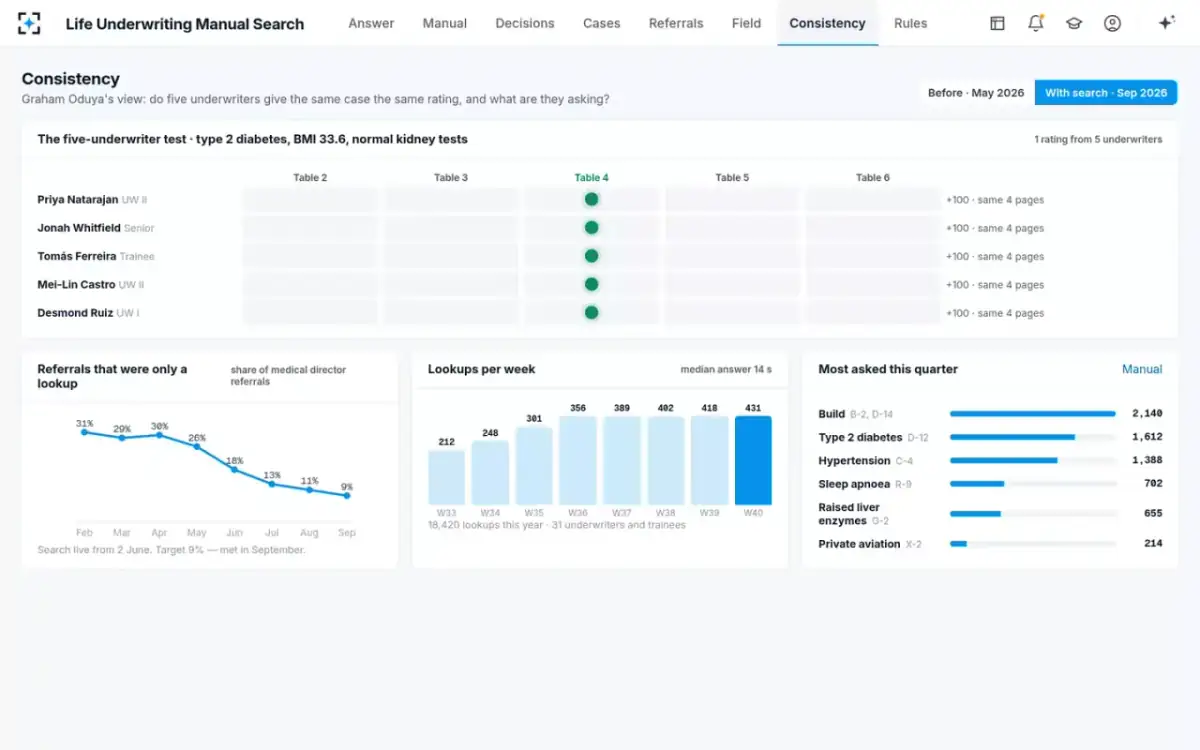
The sample insurer shows the before and after. Its chief underwriter ran the test in May 2026 on a type 2 diabetic with a body mass index of 33.6 and normal kidney tests; the ratings came back across three tables, and two of the five underwriters had read build from the standard chart instead of the diabetic build table. With the search in place, the September run had all five at +100, Table 4, citing the same four pages.
The five-underwriter test with search in place: one rating, the same four pages
How do auditors check table ratings?
An auditor checks a table rating by rebuilding it: each fact against the application and the evidence, each debit against the manual row for the applicant's age and readings, each departure against the guideline or memo that allows it, and the total against the rounding bands. A rating that cannot be rebuilt from the file fails the audit even if the class happens to be right.
Three errors account for most rebuild failures on combined impairments, and each is visible only if the worksheet names its source. The first is the wrong table: the standard build chart instead of a diabetic one, a +25 instead of a +50. The second is the stale rule: a credit the manual allows that a later memo capped. The third is the band edge: a total of +110 rounded up or a +86 rounded down. Each moves the class a full table, and what one table either way costs puts a price on that. The numerical rating system, worked line by line, shows all three on the sample case.
Accelerated programs add a second kind of check. In the Society of Actuaries' 2022 accelerated underwriting survey of 24 direct companies, written by authors from Milliman, insurers compared accelerated decisions with full underwriting on random holdouts; the share found as expected fell from 79% in 2019 to 71% in 2022, and the next largest group was worse by up to two classes or two tables (SOA Research Institute, 2022 AU survey). The same rebuild, on a sample, is how an auditor measures that drift.
How many files does an underwriting audit sample?
No regulation sets a sample size for an insurer's internal underwriting audit; it is set by the insurer's own audit plan and risk appetite. State examiners publish what they sample in each report, which gives a reference point: the Massachusetts examiners tested 55 life applications in a one-year period at a large insurer.
The useful question is what a sample can find. A random sample of 50 files from a book where 2% carry a given error will contain no such file a little over a third of the time, which is why a consistency test and targeted sampling of the most-asked impairments add more than a larger random draw. The arithmetic, and how to aim a second read, are set out in our guide to underwriting peer review.
Exceptions: the part of underwriting most audits miss
An exception, which the Society of Actuaries' survey calls a business decision, is an offer better than the guidelines support, usually to win or keep a case. The survey of 60 insurers found that the most common reason for one was to match or beat a competitor, for 58% of respondents on preferred classes, and that most respondents audited compliance with their exception rules but fewer than 40% had a formal process to track and monitor exceptions (SOA Business Decisions survey).
An exception is not wrong in itself; an untracked one is. Exceptions change the mortality of the classes they touch, which is why nearly two-thirds of the survey's respondents allowed for them in setting their preferred-class mortality assumption; and when reinsurers met exceptions they had not agreed, their most common response was a warning that a future claim may not be paid. The audit test is simple once each rating carries its pages: any line, or any class, that the cited pages do not support is an exception, and it should carry the name of whoever approved it.
How cited worksheets change the audit in Life Underwriting Manual Search
When every debit and credit carries its section and page, the auditor's rebuild becomes a check rather than a search. In Life Underwriting Manual Search each line names its source, a superseded page is shown with its mark, a line set aside by a combination rule stays on the worksheet struck through with the rule that removed it, and every question, the pages returned and the decision are logged with who asked. In the sample insurer's settings that log is kept for seven years.
The chief underwriter's controls are versioned settings too: which source wins when they disagree, the rounding bands, the combination rules and the authority grid, each saved as a new version of the guidelines. An auditor can therefore ask not only what a rating was, but which version of the rules produced it. To see the consistency test and the cited worksheet on the full sample case, start from Life Underwriting Manual Search.
Questions people ask
What is underwriting quality assurance?
It is the routine re-check of decided cases by senior underwriters, usually monthly or quarterly, to catch errors and coach underwriters. It differs from an audit in independence and scope: quality assurance sits inside the underwriting team, while an audit reports outside it and tests the controls as well as the cases.
What do market conduct examiners look for in life underwriting?
That conclusions follow the insurer's guidelines, that rates are applied as filed, that the application information is complete and accurate, and that notices go out when an applicant is declined or offered worse than standard. The Massachusetts examination cited above tested each of those in turn.
Is an inconsistent rating unfair discrimination?
It can be. The model law forbids unfair discrimination between individuals of the same class and equal expectation of life, and two identical applicants rated differently fit that description unless a documented reason separates them. Whether a regulator treats one inconsistent pair as a violation depends on the state and the pattern.
How often should an insurer run a consistency test?
No rule sets a frequency. A practical rhythm is monthly on the most-asked impairments and after every manual edition or memo that changes a common rule. The sample insurer runs one each month on a case chosen from its most-asked list.
What is an underwriting auditor's job description?
Typically: sample and rebuild decided cases against the guidelines in force, test authority and notices, run consistency tests, track exceptions, and report findings and fixes to the chief underwriter and internal audit. The BLS publishes no separate category for underwriting auditors, so pay data for the role is not available from official statistics.