Reflexive questions in insurance are follow-up questions that appear only when an earlier answer calls for them: answer "yes" to a diabetes question on a life application, and the reflexive questions ask for the type, the year of diagnosis, the treatment and the treating doctor. Their purpose is to collect enough detail to decide what evidence the underwriter needs, which means every reflexive answer ends in one of three ways: it orders a requirement, it adds to one already ordered, or it closes the question with nothing more to get. That makes the application the first point where a case's cycle time is set. Botminds' New Business Case Management reads each answer as it arrives and orders the requirement it calls for, with the answer recorded as the reason, instead of waiting a day or two for someone to read the file.
The worked application on this page belongs to a fictional applicant at a fictional sample carrier in the solution; the rules and research are linked where they appear.
One application read answer by answer: what each answer ordered
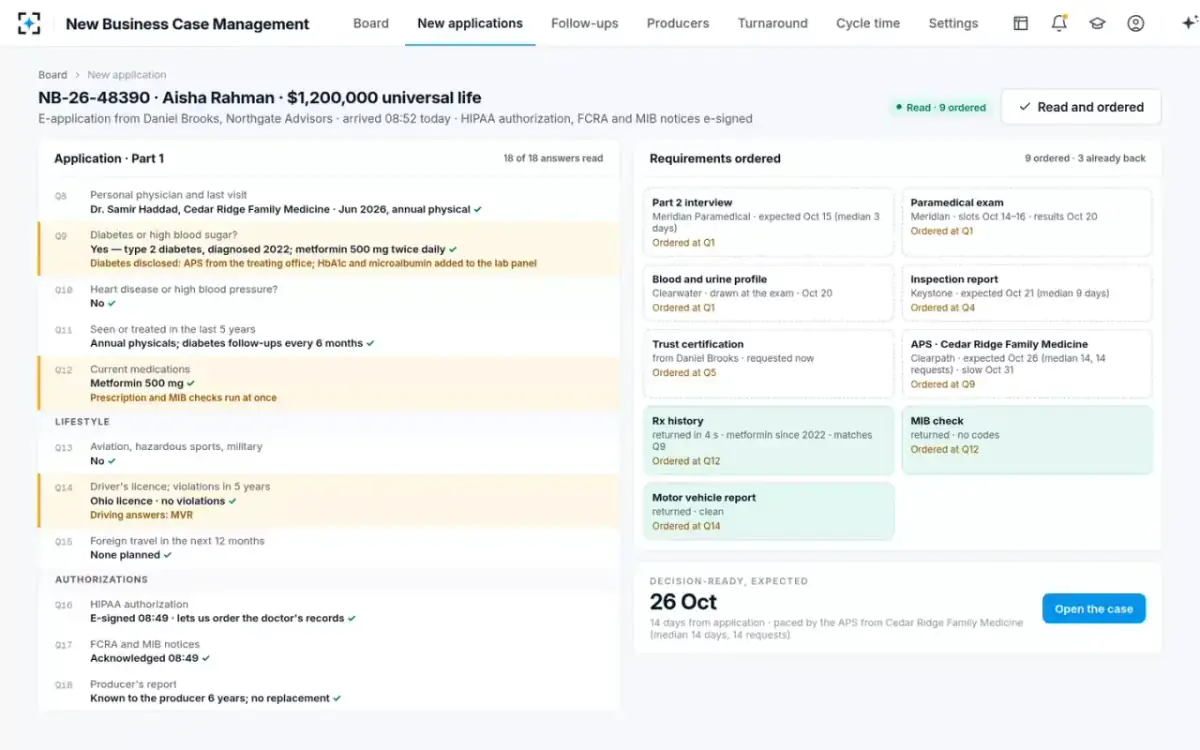
Q1 · Q4
What the applicant saidApplicant aged 52; $1,200,000 universal life
What it orderedPart 2 interview, paramedical exam, blood and urine; inspection report
WhyThe grid for ages 51–60 at $1M–$2M
Q5
What the applicant saidOwner: an irrevocable trust
What it orderedTrust certification, from the producer
WhyOwner is a trust or business
Q9
What the applicant saidYes: type 2 diabetes, diagnosed 2022, metformin
What it orderedAPS from the treating office; HbA1c and microalbumin added to the labs
WhyDiabetes disclosed
Q12
What the applicant saidMetformin 500 mg
What it orderedPrescription history and MIB check, run at once
WhyBoth back at once; the Rx history matches Q9
Q14
What the applicant saidOhio licence, no violations in 5 years
What it orderedMotor vehicle report
WhyBack at once: clean
Q18
What the applicant saidProducer: no replacement
What it orderedNo replacement notice
WhyA yes here would add the state notice
What are reflexive questions in insurance?
A reflexive question is a branch: it is asked only if the answer before it makes it relevant, so a healthy applicant sees a short application and an applicant with a disclosure sees the questions the underwriter would otherwise ask by phone. On a paper application the same effect came from "if yes, give details" boxes, which could be left half-filled. On an electronic application, or in the Part 2 interview a paramedical vendor conducts by phone, the branch is enforced: the next question does not appear until the last one is answered.
The value of the branch is in what it collects for ordering. "Seen a doctor in the last five years?" is not useful on its own; the reflexive follow-ups (which doctor, which office, when, for what) are what let an APS request be addressed to the right records desk on day zero. A reflexive set that asks for the condition but not the office forces a second contact later, and that contact can cost the first week of a case.
What questions are on a life insurance application?
A life application has two broad parts. Part 1 covers the applicant, owner, beneficiary, the coverage applied for, other insurance and replacement, and finances. Part 2 covers health and lifestyle: physicians and recent visits, conditions and treatment, medications, tobacco, driving, hazardous activities and travel. The authorizations and notices (HIPAA, the consumer-report notices) are signed with it.
The answers matter beyond ordering, because the application becomes part of the contract. The NAIC's 2024 Market Regulation Handbook lists, among the underwriting standards specific to life and annuity exams, that "Pertinent information on applications that form a part of the policy and contract is complete and accurate." A reflexive design that leaves gaps is not only slow; it produces applications an examiner will mark as incomplete.
What happens if you answer yes on a life insurance application?
A "yes" opens the follow-ups, and the completed answer usually orders evidence. The applicant does not see the order; what they see is a Part 2 call, an exam booking or a request for a doctor's name. The flow below is how one disclosure becomes one requirement in the solution.
From a yes to an ordered requirement, the same morning
A person decides
ApplicantAnswers yes to diabetes or high blood sugar, then the follow-ups: type 2, diagnosed 2022, metformin, and the treating office.
Agent
Application readerApplies the disclosure rule for diabetes: an APS from the treating office, with HbA1c and microalbumin added to the lab panel.
Never: Never contacts the applicant about health
Agent
Application readerChecks the authorization is on file, places the APS order through the retrieval vendor and records Q9 as the reason.
Agent
Requirement trackerDates the APS from that office's last 90 days: median 14 days on 14 requests, slow date 19 days.
A person decides
Case managerSees the order, its reason and its date; owns any exception, such as removing a requirement, which needs her and a reason.
Six answers that order work, and the rule behind each
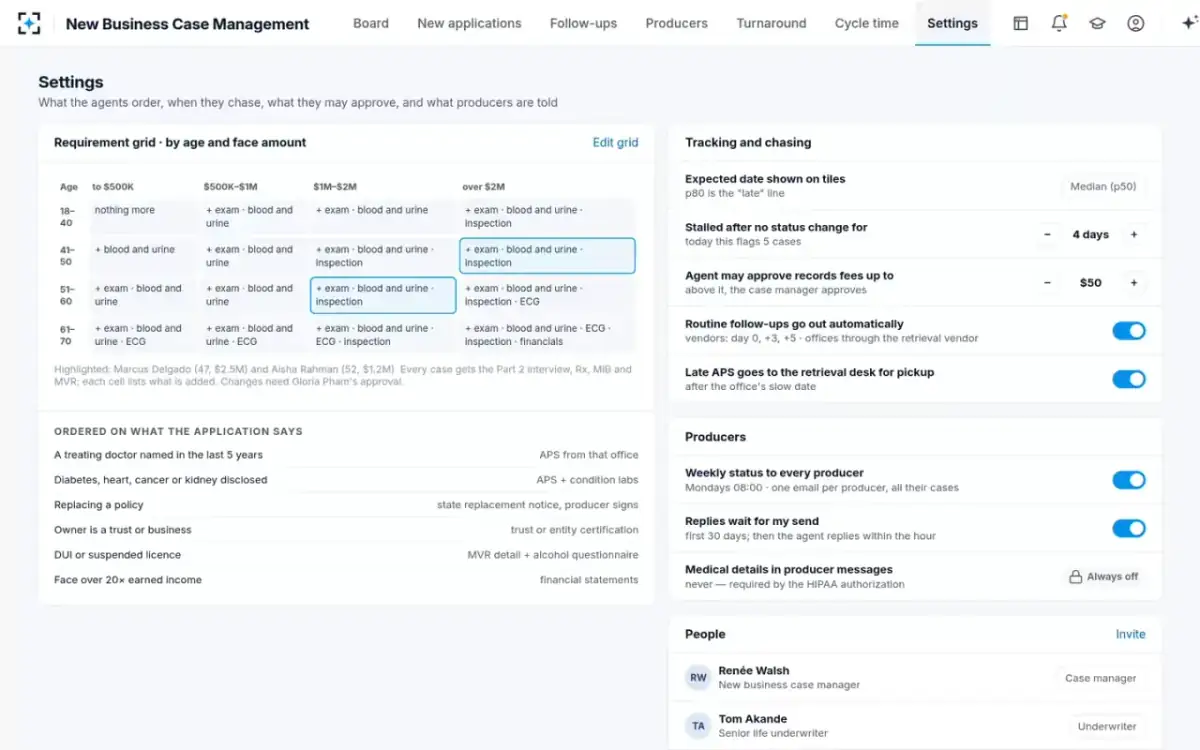
Most of a fully underwritten case's requirements come from the grid by age and amount; the rest come from a handful of answers. The sample carrier runs six disclosure rules, and each answers to a rule outside the carrier as well as its own manual.
The answers that add requirements, and the outside rule each one meets
| The answer | What it orders | The rule behind the order |
|---|---|---|
| A treating doctor named in the last 5 years | An APS from that office | A HIPAA authorization must be on file before the request goes |
| Diabetes, heart, cancer or kidney disease | An APS and condition labs | The same authorization; lab panels are the carrier's guidelines |
| Replacing an existing policy | The state replacement notice, signed by the producer | NAIC Model #613: the replacing insurer notifies the existing insurer within five business days |
| A trust or business as owner | A trust or entity certification | The carrier's own ownership and insurable-interest rules |
| A DUI or a suspended licence | Driving record detail and an alcohol questionnaire | The Driver's Privacy Protection Act permits insurers to use driving records for underwriting |
| Face amount over 20 times earned income | Financial statements | Financial underwriting; an inspection report brings consumer-report rules |
Two of the outside rules carry clocks that start at the application. The NAIC's replacement model requires the replacing insurer to "Notify any other existing insurer that may be affected by the proposed replacement within five (5) business days of receipt of a completed application indicating replacement". A replacement answer read two days late has used two of the five. And the federal driving-records law lets a state release records "For use by any insurer or insurance support organization, or by a self-insured entity, or its agents, employees, or contractors, in connection with claims investigation activities, antifraud activities, rating or underwriting", which is why a driving answer can be checked in seconds while a health answer waits on an office. The consumer-report rules behind inspection reports, prescription histories and MIB are in investigative consumer report for life insurance.
A new application, read and ordered as it arrives
Answers that close requirements, and the ones that never can
A reflexive answer can also end a branch: "no" to tobacco, "no violations" on driving, "no replacement" from the producer. Those answers close the question, but they do not cancel what the grid requires. In the solution the application reader never removes a requirement the grid calls for, however clean the answers; removing one needs a reason and the case manager.
Some answers are checked rather than trusted. The sample applicant's prescription history came back within seconds and matched her diabetes answer; her MIB check returned no codes. When an instant check contradicts an answer (a medication with no matching disclosure, an MIB code the application does not explain), the case gains a question for the underwriter, not a conclusion. The agents list the difference with its source; they do not decide what it means.
Accelerated underwriting vs simplified issue: which questions decide
Both skip the exam for some applicants, but they price differently. The NAIC describes the older route: "Some insurers also use simplified underwriting techniques which allow an applicant to forgo the medical exam and collection of fluids in exchange for generally higher premiums." The Society of Actuaries' 2019 practices survey, written by Milliman actuaries Al Klein and Karen Rudolph, adds the definitions: "Simplified issue underwriting generally involves less underwriting questions than fully underwritten but more than GI, less third-party evidence and limited amounts of coverage", while with accelerated underwriting companies "believe the algorithms can produce applicants with mortality expectations comparable to those who went through full/traditional underwriting, therefore allowing them to pay the same premium".
Four ways to underwrite a life application, by what the answers do
| Route | What the answers decide | Evidence | Price |
|---|---|---|---|
| Guaranteed issue | Eligibility only: age, actively at work, not terminally ill | None beyond eligibility | Higher than fully underwritten |
| Simplified issue | Accept or decline on a short question set | Little third-party evidence; limited amounts | Higher than fully underwritten |
| Accelerated underwriting | Whether data can stand in for the exam and fluids | Application plus data: Rx, MIB, driving records | The same as fully underwritten, for those accepted |
| Full underwriting | Which requirements to order, on top of the grid | Exam, fluids, APS, inspection as the answers and grid call for | Set by the evidence |
For the case manager the difference is where the reflexive answers send the work. On simplified issue they decide the case; on accelerated underwriting they decide whether the case stays fast; on full underwriting they decide which requirements to order. The Society of Actuaries' 2022 survey of 24 direct writers, also written by Milliman actuaries, shows how much business now starts on the accelerated route.
How much business accelerated programs now touch
59%
average share of applications eligible for the accelerated program in 2022, up from 51% in 2019
46%
average share of eligible policies expected to have fluids or the exam waived in 2022
13–100%
range of that waiver share across the responding companies
The rules that still apply when answers drive the order
Automating the order does not change what the order must respect. The NAIC working group that studied accelerated underwriting put it plainly in its 2024 referral to the market conduct examiners: "Existing laws and regulations apply to accelerated underwriting programs in the same way as traditional underwriting programs." The same holds for software that orders requirements from answers. Authorizations come before records requests, consumer-report notices come before consumer reports, replacement notices go out on the statutory clock, and the same answer produces the same order for every applicant.
That last point is the strongest argument for writing the rules down. A case manager reading by hand may order an APS for one applicant's "seen for blood pressure" and not another's. A written rule applied to every answer, with the answer recorded as the reason, is consistent by construction and can be shown to an examiner.
The disclosure rules, as settings the carrier owns
Designing a reflexive question set that orders cleanly
A reflexive set is well designed when every branch ends in an order or a close, with nothing left for a person to interpret. The tests below can be run on last quarter's applications.
Five tests for a reflexive question set
- Every branch ends in an order or a close
No branch ends in free text that someone must read before deciding what to order.
- Records requests can be addressed from the answers
Doctor, office, city and the date of the last visit, so the APS goes to the right desk on day zero.
- Replacement is asked of both applicant and producer
The replacement clock starts at a completed application that indicates replacement.
- Ownership and finances are asked before amounts are final
A trust owner or a large income multiple adds paper the producer must collect.
- Instant checks are run against the answers
Prescription history, MIB and driving records come back in seconds; differences go to the underwriter as questions.
A question set that passes these tests moves the first week of a case into the first hour. What that does to the case manager's day is in life insurance new business case manager, and how to measure the effect on the dates is in life insurance cycle times. To see an application read and ordered on sample cases, start from New Business Case Management.
Questions people ask
What is a Part 2 medical?
The health portion of a life application: physicians, conditions, medications, tobacco and lifestyle. It is often completed by phone with a paramedical vendor's interviewer; on the fictional sample carrier those interviews ran a median of 3 days from order.
What is an e-application?
An electronic life application that enforces its reflexive branches, so a disclosure cannot be left without its details. It is also the starting data for accelerated programs, which decide from the answers and instant checks whether the exam can be skipped.
How do application answers trigger an APS?
Through disclosure rules: a treating doctor named in the last five years, or a condition such as diabetes or heart disease, adds an attending physician statement from that office. The order can only go once a HIPAA authorization is on file.
Why did my insurer order more tests?
Because an answer or a check called for them: a disclosed condition adds condition labs, a large face amount adds an inspection or financial statements, and an instant check that disagrees with an answer adds a question. The grid by age and amount sets the rest.
Can a wrong answer be fixed after the application is signed?
Yes, usually by an amendment before the policy is issued or at delivery, and it is far better fixed early. The application becomes part of the contract, and examiners check that pertinent information on it is complete and accurate.
Are reflexive questions used in accelerated underwriting?
Yes. The answers decide whether data can stand in for the exam; applicants the accelerated program cannot assess go to full underwriting, where the same answers order the requirements.