An investigative consumer report in life insurance is a consumer report, usually an inspection report ordered for financial underwriting on a large policy, in which information about the applicant's character, general reputation, personal characteristics or mode of living comes from interviews with neighbors, friends, associates or others who know them. The Fair Credit Reporting Act lets an insurer order one only if it tells the applicant in writing within three days of requesting it and answers, within five days, a written request about the nature and scope of the investigation; state insurance privacy laws modelled on the NAIC's act add a right to be interviewed and to a copy. Most of a life case's other checks, MIB and prescription histories among them, are consumer reports too, with their own notices and rights. Botminds' New Business Case Management orders inspection reports from the carrier's grid and orders nothing that needs a notice until the notice is acknowledged.
The sample applications on this page belong to fictional applicants at a fictional carrier in the solution. The statutes, model law and exam report are linked where they appear.
Ordering an investigative consumer report lawfully, step by step
A person decides
ApplicantSigns the application with the FCRA and MIB notices and the authorization; the notices say an investigative report may be made and how to ask about it.
Agent
Application readerOrders the inspection report the grid calls for (on the sample carrier, from $1 million at ages 41 to 60), with the answer or band behind it.
Never: Orders nothing that needs a notice until it is acknowledged
Agent
Requirement trackerDates the report from the inspection company's last 90 days: a median of 9 days and a slow date of 12 on the sample carrier.
A person decides
Case managerAnswers any request from the applicant about the nature and scope of the report, inside the five-day limit, and arranges an interview if one is asked for.
Agent
Evidence readerReads the report against the application and the financial guidelines, citing each line; notes differences for the underwriter.
Never: Never assigns a class, approves or declines
A person decides
UnderwriterDecides, and if the decision is adverse, it goes out with its reasons and the applicant's rights.
What is an investigative consumer report?
The Fair Credit Reporting Act defines it by how the information is gathered. An investigative consumer report is "a consumer report or portion thereof in which information on a consumer’s character, general reputation, personal characteristics, or mode of living is obtained through personal interviews with neighbors, friends, or associates of the consumer reported on or with others with whom he is acquainted or who may have knowledge concerning any such items of information." A consumer report becomes investigative when people other than the applicant are interviewed about them.
That distinction does real work in life underwriting. A report built from public records and an interview with the applicant alone is a consumer report but not an investigative one, and the extra notice duties do not attach to it. A report that adds calls to a business partner, an accountant or a neighbour is investigative. Case managers should know which kind their inspection vendor delivers for each order type, because the notices differ.
When does a life insurer order an inspection report?
Usually when the amount applied for is large relative to income or net worth, or when the owner or purpose of the policy needs checking: a business-owned policy, a trust as owner, a key-person case. The report confirms earned income, net worth, the business and the reason for the insurance, so the underwriter can judge whether the amount makes financial sense.
On the fictional sample carrier, the grid adds an inspection report at $1 million and above for ages 41 to 60, at over $2 million for ages 18 to 40, and at $1 million and above for ages 61 to 70; a face amount over 20 times earned income adds financial statements. The sample inspection company returned reports in a median of 9 days over 96 requests in 90 days. On the sample case of a 47-year-old applying for $2.5 million, the report found earned income of $410,000 and net worth of $3.1 million, putting the face amount at 6.1 times income, inside the 20-times guideline.
Do I have to be told about an inspection report?
Yes, if it is investigative. The FCRA says a person "may not procure or cause to be prepared an investigative consumer report on any consumer unless" it is clearly disclosed that one may be made, in a writing delivered "not later than three days after the date on which the report was first requested", including a statement of the right to ask for more and the summary of FCRA rights. If the applicant then asks in writing, the insurer must disclose "the nature and scope of the investigation requested", in writing, "not later than five days after the date on which the request for such disclosure was received from the consumer or such report was first requested, whichever is the later."
In practice carriers put the disclosure in the notices signed with the application, so it is delivered before any report is ordered. The five-day answer is the case manager's to watch: a written question about an inspection report is a dated obligation, not a customer-service request.
What insurance law adds: the right to be interviewed, and to a copy
State insurance privacy laws based on the NAIC's Insurance Information and Privacy Protection Model Act go further than the FCRA. The model bars an insurer or agent from preparing or requesting an investigative consumer report on an application unless it informs the individual "That he or she may request to be interviewed in connection with the preparation of the investigative consumer report" and "That upon a request pursuant to Section 8, he or she is entitled to receive a copy of the investigative consumer report." Where the report is prepared by an inspection company, the insurer must tell the company whether an interview was requested.
Massachusetts, which enacted the model as chapter 175I, adds a limit on content: no investigative consumer report "shall contain any information designed to determine the sexual orientation of an applicant, proposed insured, policyholder, beneficiary or any other person", or information relating to counselling for AIDS. A case manager working across states needs the carrier's state-by-state notices, not one national form.
Two layers of rules on one inspection report
The Fair Credit Reporting Act (federal): Written disclosure that an investigative report may be made, within three days of requesting it
State insurance privacy acts (NAIC model): Tell the applicant they may ask to be interviewed and may receive a copy
The Fair Credit Reporting Act (federal): Nature and scope of the investigation, in writing, within five days
State insurance privacy acts (NAIC model): Access to recorded personal information within 30 business days, including a copy of the report
The Fair Credit Reporting Act (federal): Must have the insurer's certification that the disclosures were made
State insurance privacy acts (NAIC model): Must be told whether an interview was requested, and conduct it
The Fair Credit Reporting Act (federal): Notice naming the reporting company and the right to a free copy within 60 days
State insurance privacy acts (NAIC model): Specific reasons in writing, on request within 90 business days, answered within 21
Is a phone interview an investigative consumer report?
Not usually. The Part 2 health interview a paramedical vendor conducts by phone asks the applicant about themselves; it is part of the application, not a report from people who know them. An inspection company's call to the applicant alone, confirming income and the purpose of the insurance, is also not investigative under the FCRA definition, because the definition turns on interviews with others. The line is crossed when the inspector calls a business associate, an accountant or a neighbour.
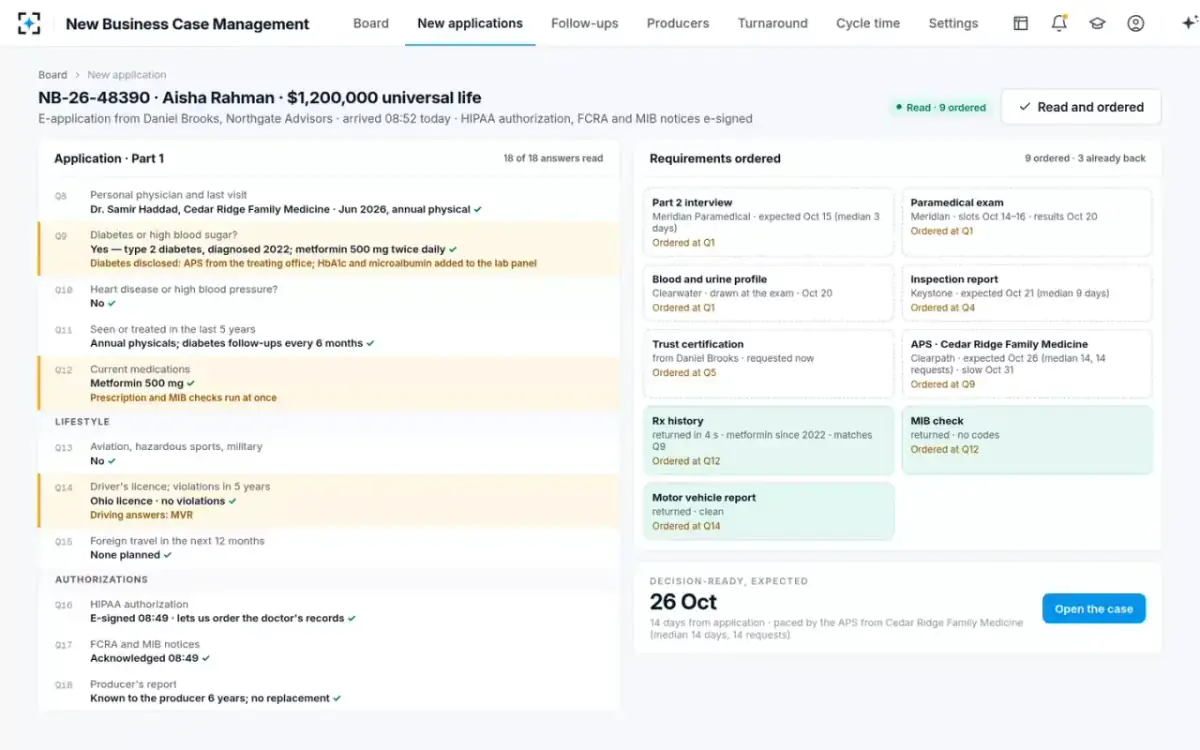
That is a question to settle with the inspection vendor, order type by order type, and to write into the carrier's notices. On the sample carrier the notices are signed with the application and the authorizations, three minutes before the application arrives, which covers either case.
The notices come before the orders
What is an MIB report, and the other consumer reports in a life case?
Several of a life case's instant checks are consumer reports, kept by specialty companies the CFPB lists. Its 2025 list describes MIB, Inc. as collecting "information about medical conditions and hazardous avocations" and reporting it to life and health insurers with the applicant's authorization, and lists a prescription-history company that "Collects prescription drug purchase history for quantifying the relative mortality risk of life insurance applicants and provides risk scores for underwriting decisions."
Three consumer reports in a life case, and the applicant's rights over each
| Report | What it holds | What the applicant can ask for |
|---|---|---|
| Inspection report | Income, net worth, business, purpose of the insurance; investigative if others are interviewed | Notice before; nature and scope within five days; under state law, an interview and a copy |
| MIB report | Codes for medical conditions and hazardous avocations reported by member insurers | One free report every 12 months on request, per the CFPB list; a free copy after an adverse decision |
| Prescription history | Prescription purchase history and a risk score for underwriting | A free copy if the company holds one, per the CFPB list; a dispute if it is wrong |
The federal law gives these specialty companies a duty the applicant can use. The FCRA requires the agencies it names, including nationwide specialty agencies, to make their disclosures "once during any 12-month period upon request of the consumer and without charge to the consumer", and to provide the report within 15 days of the request. The CFPB's own advice to applicants is to check these reports before or when applying.
What is an adverse underwriting decision notice?
It is the notice an applicant receives when the insurer declines or offers worse terms, and two laws shape it. Under the FCRA, an insurer that takes adverse action based on a consumer report must give notice, the name and contact details of the reporting company, "a statement that the consumer reporting agency did not make the decision to take the adverse action and is unable to provide the consumer the specific reasons why the adverse action was taken", and notice of the right to a free copy within 60 days and to dispute it.
The NAIC model defines the adverse decisions it covers for life insurance as a declination, a termination or "an offer to insure at higher than standard rates". The insurer must give the specific reasons in writing, or tell the applicant they may have them on written request; a request made within 90 business days must be answered within 21 business days, with the specific information behind the reasons and its sources. Medical details go to the applicant or a doctor they designate. The model lets the insurer choose which; Massachusetts gives that choice to the individual, "whichever such individual prefers".
Note what the definition leaves out. An applicant who applied for a preferred class and is offered standard has received a worse offer but not one "higher than standard"; under the model's wording that is not an adverse underwriting decision, while a table rating is. Each state's own act decides the edge cases.
What examiners find
Examiners test these notices in the underwriting files they sample. The Massachusetts Division of Insurance's market conduct examination of Massachusetts Mutual Life Insurance Company, covering 2022, made this finding:
"For one IDI application, there was no evidence that an Adverse Underwriting Decision Notice was provided to the applicant when coverage was declined in violation of M.G.L. c. 175I, § 10."
Massachusetts Division of Insurance, market conduct examination report, period January 1 to December 31, 2022
The finding concerned a disability income application, and the examiners otherwise observed that notices "were issued when life and LLTC premium rates offered were higher than standard, when IDI rates were different than the quoted rate, when any exclusions were offered, or when the applications were declined by the Company, except as noted above". The required action was to update procedures and train staff. One missing notice in a sample is enough for a finding, which is why the notice should be part of the decision step, not a task after it. How exam reports are structured is covered in market conduct examination report example.
The case manager's checklist for ordering consumer reports lawfully
Eight checks before and after an inspection report in New Business Case Management
- Notices signed before any report is ordered
The FCRA disclosure, the MIB notice and the state insurance privacy notice, in the version for the applicant's state.
- The order type is known: investigative or not
If the vendor will interview others, the investigative disclosures and state rights apply.
- Interview requests reach the vendor
State law requires the insurer to tell the inspection company whether the applicant asked to be interviewed.
- A written question starts a five-day clock
The nature and scope of the investigation, in writing, within five days of the request or of ordering the report, whichever is later.
- Access requests start a 30-business-day clock
Under the NAIC model, recorded personal information, including the report, on written request.
- Reports are read for what they are
Each statement cited to its line; differences from the application go to the underwriter as questions.
- Adverse decisions go out with their reasons and rights
FCRA adverse action content where a consumer report contributed; the state notice for declines and above-standard offers.
- Nothing medical reaches the producer
Status messages carry what is done and what is waiting, never findings.
Instant checks in the file, read but not decided
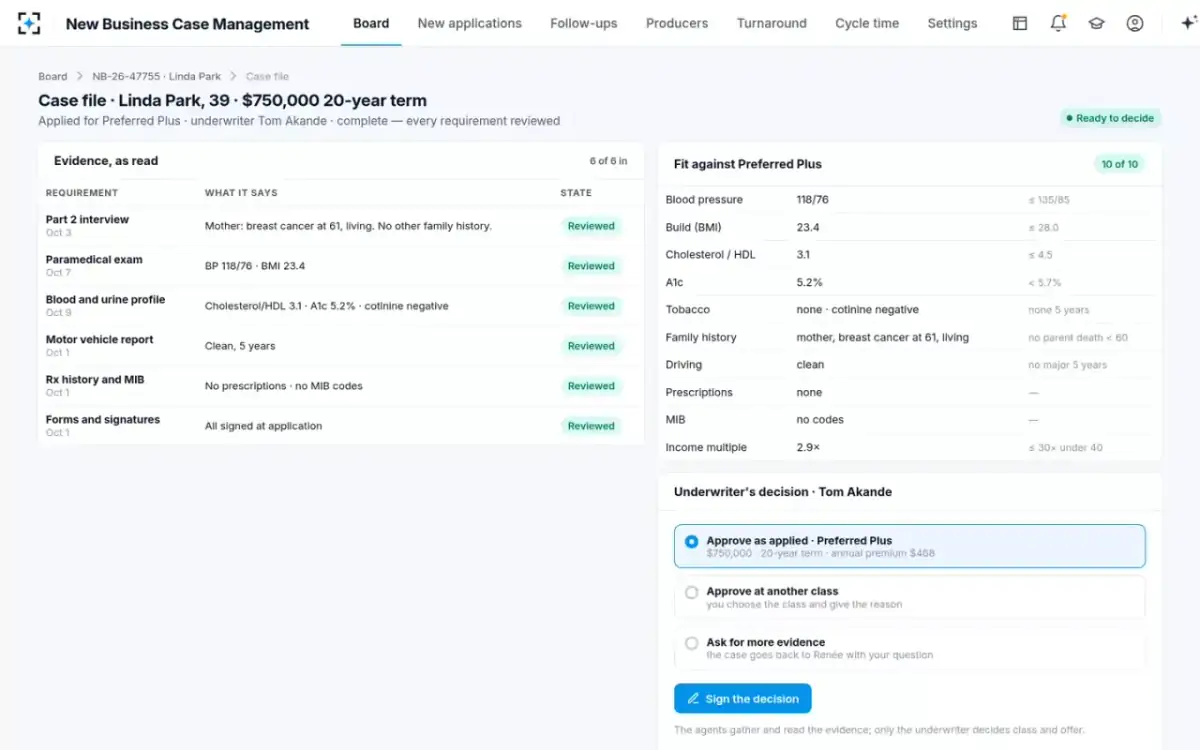
Where the solution fits is narrow and deliberate. It orders inspection reports and instant checks from the grid and the answers only after the notices are acknowledged, dates and chases them, and reads them with citations. Adverse decisions, and the notices that carry them, stay with the underwriter and the carrier's compliance process. How the answers that trigger these orders are mapped is in reflexive questions in insurance. To see the order sequence on sample cases, start from New Business Case Management.
Questions people ask
What does a life insurance inspection report include?
Typically earned income, net worth, occupation and business details and the purpose of the insurance, gathered from the applicant, records and sometimes others who know them. On the fictional sample case it confirmed $410,000 of earned income and a $3.1 million net worth.
What is the difference between a consumer report and an investigative consumer report?
Every investigative consumer report is a consumer report, but only one gathered through personal interviews with neighbours, friends, associates or others who know the applicant is investigative. That status triggers the FCRA's three-day disclosure and five-day answer duties.
Can I get a copy of my MIB report?
Yes. The CFPB's 2025 list says MIB will provide one free report every 12 months on request if it has a file on you, and the FCRA adds a free copy within 60 days of an adverse decision based on it. The same list gives MIB's phone number and address.
Is an inspection report required for life insurance?
Only where the carrier's rules call for one, usually at larger face amounts or when the owner or purpose needs checking. On the fictional sample carrier it starts at $1 million for applicants aged 41 to 60.
Can I dispute what an inspection report or MIB says?
Yes. The FCRA gives the right to dispute inaccurate information with the reporting company, and state insurance privacy acts based on the NAIC model give a right to ask the insurer to correct, amend or delete recorded personal information.
Is being offered standard instead of preferred an adverse decision?
Under the NAIC model's wording for life insurance, an adverse underwriting decision is a declination, a termination or an offer at higher than standard rates. A standard offer is not higher than standard, so it falls outside that definition, though carriers may still explain it.