A life insurance new business case manager takes an application from the moment it arrives to the point an underwriter can decide it: ordering the paramedical exam, the blood and urine profile, the attending physician statement (APS), the prescription, MIB and driving checks and the forms the case calls for, tracking each one, chasing whatever stalls and keeping the producer informed. The case manager owns the case but not the decision; the rating class and the offer belong to the underwriter. What makes the job hard is not any single requirement but the forty-odd cases open at once, each waiting on different outside parties. Botminds' New Business Case Management is built for that desk: agents order, date, read and chase every requirement, and the case manager spends her hours on the calls that need a person.
This guide follows a fictional case manager, Renée Walsh at the sample carrier Cedarbrook Life, through Monday 12 October 2026, with 46 open cases on her board. The people, carrier, agencies, vendors and doctors' offices are invented sample data; the labour statistics and rules are linked where they appear.
Where a case manager's hours go, by hand and with a requirement board
- Status checks2.3 h
- Chasing1.5 h
- Producers, new apps1.2 h
- Judgement0.5 h
- Review and send0.7 h
- Judgement0.5 h
What does a life insurance new business case manager do?
A new business case manager runs the requirements of a life application, from submission to a ready-to-decide file. The job has four verbs. The case manager orders what the case needs, from the carrier's requirement grid by age and face amount and from what the applicant disclosed. She tracks each order with its vendor or doctor's office. She chases what stalls, by phone, email and the retrieval vendor's desk. And she tells the producer where the case stands, without passing on anything medical.
What the job is not matters as much. The case manager does not rate the applicant, approve or decline the case, or decide what evidence the underwriter may waive. She owns the file and its dates; the underwriter owns the class and the offer. Carriers can also give the case manager small decisions with money attached, such as approving a doctor's office copy fee up to a limit, which is why a good case manager is part logistics lead and part account manager for the producers who bring the business.
The life application itself sets the workload. A fully underwritten case at a larger face amount can carry nine or ten requirements: a Part 2 health interview, the exam, labs, one or more APSs, driving, prescription and MIB checks, an inspection report or financial statements, and signed forms. Each comes from a different outside party with its own pace, and none of them works for the case manager.
Case manager vs underwriter: who orders and who decides
The underwriter decides; the case manager gets the underwriter what the decision needs. The Bureau of Labor Statistics lists among an insurance underwriter's duties to "Contact field representatives, medical personnel, and others to obtain additional information". In a life new business department that contacting is usually delegated: the underwriter names what is missing, and the case manager gets it.
The split shows up in pay. The BLS puts the median underwriter wage at $81,370 in May 2025, against $49,230 for the clerical occupation that includes policy processing, which is why a carrier that lets underwriters spend their day chasing doctors' offices is paying an underwriter's rate for a case manager's work. It also shows up in the file. In the solution, the underwriter's screen offers three choices when a case is whole: approve as applied, approve at another class with a reason, or ask for more evidence and send the case back. The case manager never sees those buttons, and the agents do not either.
The five people who move a life case, and what stays theirs
Today
Starts each morning in the requirements screen and a spreadsheet, finding out what is late, then spends the day on the phone.
With agents
Starts from a board where every requirement carries its expected date and every stall is flagged, with the follow-ups already drafted.
Still theirs: fee approvals above the agent's limit, removing a requirement, every non-routine message
Today
Gets files with pieces still missing and works out what changed since the last look.
With agents
Gets the case when it is whole, with every value read against the class guidelines and cited to its line.
Still theirs: the class, the offer and the signature
Today
Calls to find out what is holding a case up, and whether it is on them.
With agents
Gets a written status in plain words: done, waiting on, needs you, expected date.
Still theirs: the client conversation and their own forms
Today
Reports cycle time and placement to distribution each month from spreadsheets.
With agents
Sees days to decision and why requirements stalled, by source.
Still theirs: approval of every change to the requirement grid
Today
Works doctors' office fee requests and follow-ups, with stalls waiting on a fee nobody approved.
With agents
Gets the approved fee and one clear ask: pay, phone the office, or collect in person.
Still theirs: the relationship with each records desk
Life insurance case manager salary and job numbers, from the BLS
The BLS publishes no separate occupation called new business case manager. The nearest federal category is insurance claims and policy processing clerks, who, in the Bureau's words, "process applications for insurance policies" and whose "duties include interviewing clients and reviewing insurance applications to make sure that all questions have been answered." That category is broader than life new business and includes claims clerks, so read its figures as context for the role.
The federal numbers nearest the case manager's job
239,100
insurance claims and policy processing clerk jobs in 2025
$49,230
median annual wage, May 2025
−2%
projected change in jobs, 2025 to 2035
The category mixes claims clerks and policy processing clerks across every line of insurance, so the wage is a reference point, not a benchmark for a life case manager. The projection is the more useful number: a small decline in clerical processing jobs over ten years, while the underwriter occupation itself is projected to fall 4 percent. The work that remains is the work that needs judgement.
07:00: the first hours go on finding out what is late
A case manager's morning is a status hunt. By hand it means opening each vendor's portal, the APS retrieval vendor's queue and the requirements screen in the policy system, then reconciling all of it against a spreadsheet that holds the real notes. On the sample desk that is 138 open requirements from six vendor feeds. At one minute a check, that is more than two hours before the first phone call.
On Renée's board the hunt has already happened. At 07:00 the requirement tracker read every open requirement from the six feeds; at 07:02 it re-dated each one from its source's last 90 days of turnaround and moved three dates later; at 07:03 it flagged five stalled cases; at 07:05 the follow-up agent sent six routine vendor follow-ups and drafted nine more for her. Her first view is a filter: twelve cases need her or move today, five are stalled, and 31 requirements are expected this week.
The requirement board at 07:00: one row per case, one tile per requirement
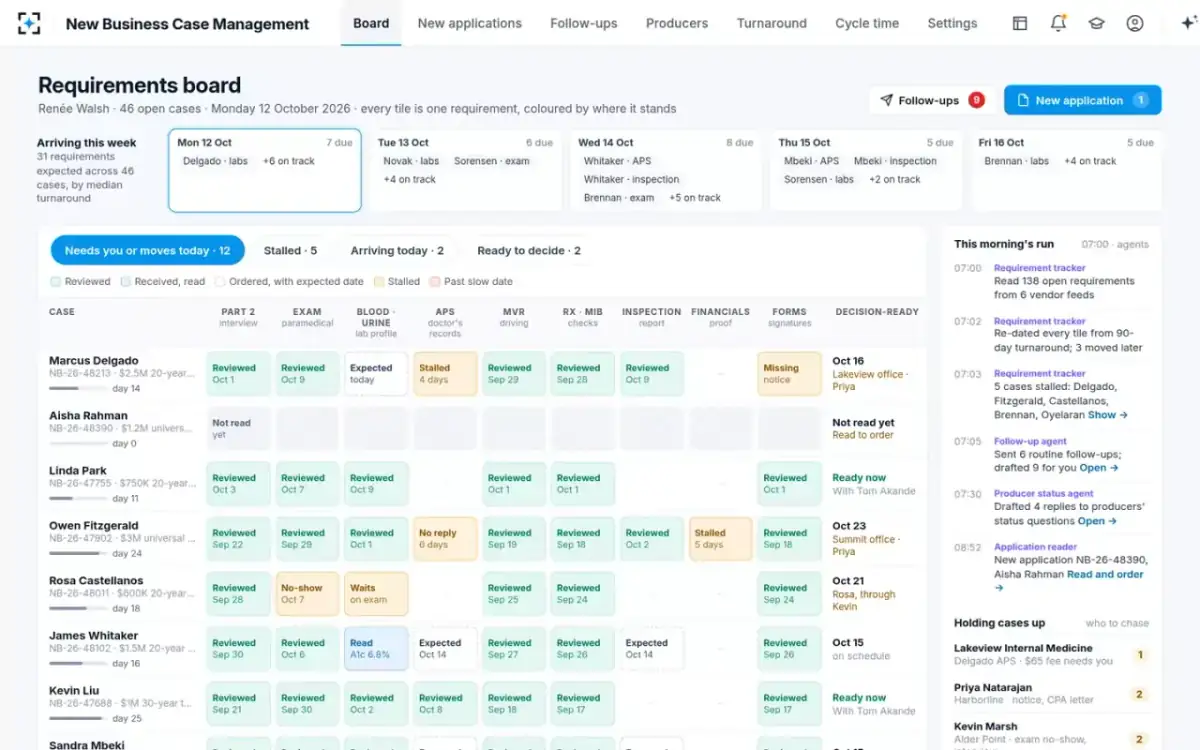
The board changes the question the case manager asks. A spreadsheet answers "what did I last write about this case?". A tile with a date answers "is this late, and who can move it?", which is the only question that leads to an action. How those dates are set, from each source's median and 80th-percentile turnaround, is worked through in underwriting requirements tracking software.
08:52: one application becomes nine orders
New applications are the second claim on the morning. At 08:52 Aisha Rahman's $1,200,000 universal life e-application arrives from her producer at Northgate Advisors. Read by hand, an application is a list of answers to scan for anything that adds work: a treating doctor, a condition, a replacement, an unusual owner. Each one becomes an order only after someone has read it, often a day or two after submission.
In the solution the application reader goes answer by answer against the requirement grid for ages 51 to 60 at $1 million to $2 million. Interview, exam and labs come from the grid at question 1, an inspection report at question 4, and a trust certification at question 5 because the owner is an irrevocable trust. Question 9 discloses type 2 diabetes, so an APS is ordered from the treating office and HbA1c and microalbumin are added to the lab panel. Nine requirements are ordered, three come back at once (the prescription history in four seconds, then MIB and the driving record), and the case is expected to be ready for the underwriter in 14 days.
One order waits on paper. An APS cannot go out until a HIPAA authorization is on file, and federal rules require that a valid one name, among other things, "A description of the information to be used or disclosed that identifies the information in a specific and meaningful fashion". Aisha e-signed hers at 08:49, three minutes before the application landed. Which answers trigger which requirement, and why each disclosure rule exists, is the subject of reflexive questions in insurance.
09:41: the stall that was a $65 records fee
The most expensive stall on a case manager's desk is often the cheapest item on it. Marcus Delgado, 47, applied for Preferred on a $2,500,000 20-year term on 28 September. His APS from Dr. Helen Ward at Lakeview Internal Medicine was ordered through the retrieval vendor on 29 September, received by the office and put in its copy queue on 2 October, and still being copied when the vendor called on 6 October. On 8 October the office sent an invoice: a $65 copy fee, payment before release. Then nothing moved for four days. The vendor's feed still said "pending".
Fees like this sit outside the federal access rule's caps. HHS guidance on the HIPAA right of access explains that when a third party such as an insurer requests records "with the individual's HIPAA authorization", "the access fee limitations do not apply". The caps that protect a patient asking for her own records do not reach the insurer's request. A case manager therefore needs a fee policy, and the agents need a limit.
A fee only the case manager can approve
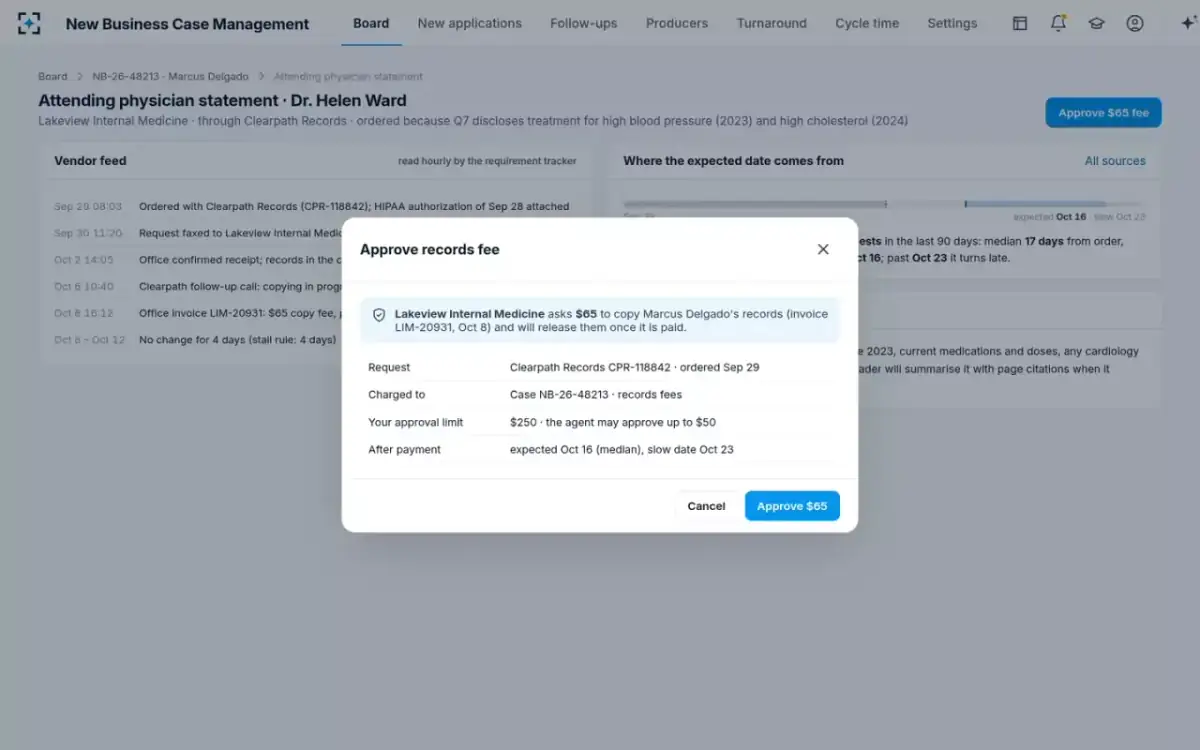
Renée approves the fee at 09:42, and two minutes later the follow-up agent tells the retrieval vendor, who pays the office and asks for release the same day. The four days the APS sat still were not the doctor's pace; they were an invoice nobody had seen. In the sample quarter's stall reasons, a records fee waiting for approval is the most common single cause, ahead of offices that simply do not answer.
Afternoon: producers, and the one thing never said to them
Producers call because they cannot see the case. Priya Natarajan wrote at 08:14: Marcus has an offer from another carrier at a similar premium, and she wants to know whether there will be a decision this month and what is still outstanding. By hand that message means opening the case, reading every requirement, and writing an answer carefully enough that nothing medical slips into it.
A producer's question, answered from the case's tiles
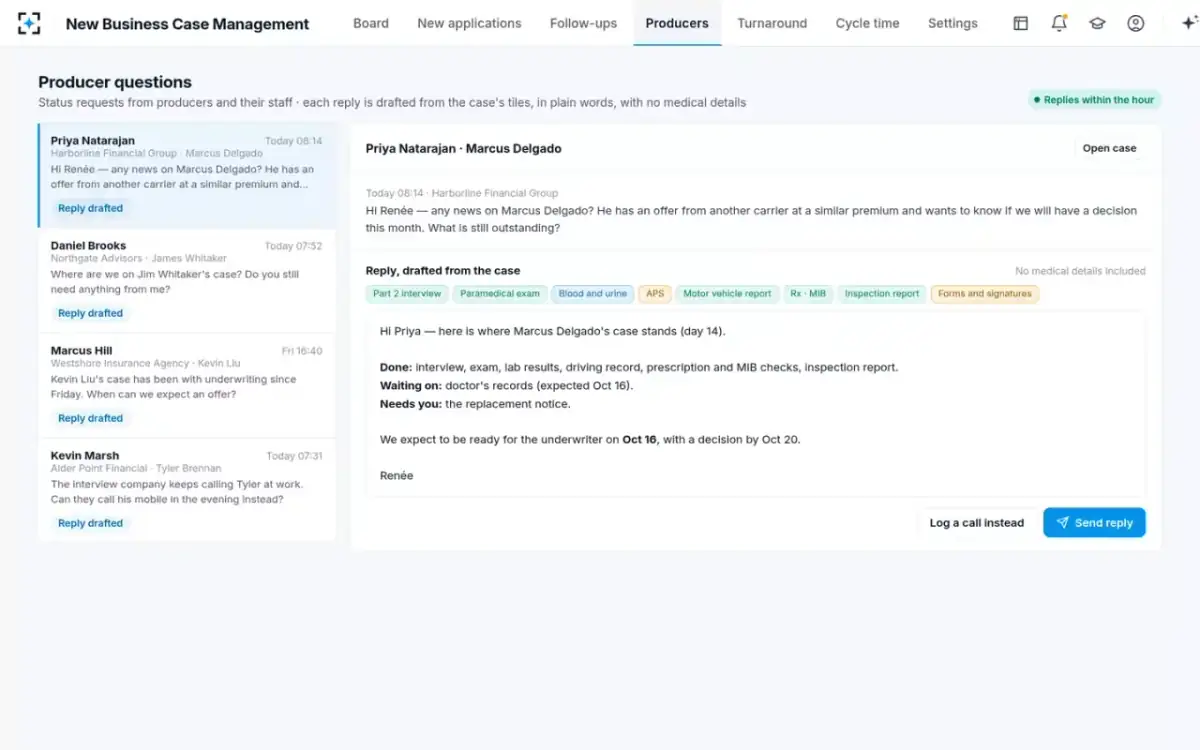
The reply is four lines: what is done, what is still coming and when, what needs Priya (the replacement notice, because question 14 says the policy replaces a $500,000 one), and the expected date for the underwriter. In the first 30 days every producer reply waits for the case manager to read and send it; after that, letting the agent answer within the hour is a setting. Medical details are never included, and that setting cannot be switched on.
The producer's message is also the commercial argument for the whole job. An applicant with another carrier's offer in hand is weighing two promises, and the one with a date attached is easier to keep. A case manager who can say "doctor's records expected 16 October, decision by 20 October" is selling the carrier's reliability as much as answering a status question.
How many cases does a new business case manager handle?
We found no public source that publishes a standard caseload, and counting cases is the wrong unit anyway. A desk of 46 fully underwritten cases at large face amounts can carry more open requirements than 80 small simplified-issue cases with none. The sample desk shows the better measure: 46 cases, 138 open requirements, 31 expected this week, twelve needing the case manager today.
A workable way to size a desk is to count open requirements and the share that need a person on a given day. Routine follow-ups can go out without anyone; fee approvals, missed exams, offices that refuse a request and producer forms cannot. If a desk has 140 open requirements and one in ten needs judgement each day, the case manager's real load is fourteen decisions plus the producer conversations around them, which is a day's work. If every one of the 140 needs a manual status check first, the same desk is overloaded before lunch.
What stays the case manager's judgement
Automation in case management moves the status hunt and the drafting, not the decisions with consequences. In the solution, five agents order, date, read and chase; the case manager owns the case and the underwriter decides. The list below is where the line sits in the sample configuration, and where a carrier would set it for its own desk.
Six calls that stay with the case manager in New Business Case Management
- Approving a records fee above the agent's limit
The agent may approve up to $50 in the sample setup; above that the case manager decides, within her own limit.
- Removing a requirement the grid calls for
The application reader never drops one; removing it needs a reason and the case manager.
- Every producer message in the first 30 days
Drafted from the tiles, read and sent by a person until the carrier chooses otherwise.
- A missed exam or an applicant who cannot be reached
The agent groups them and drafts the ask; the case manager decides whether to hold slots or call the producer.
- An office that will not release records
In-person collection or a re-sent authorization is her call, through the retrieval desk.
- Anything that touches the applicant's health
The agents never contact the applicant about medical findings.
The list also answers the career question. The status hunt, the drafting and the first reading of an application are the parts of the job most exposed to automation. The fee calls, the exceptions and the producer relationship are not. To see the board, the fee approval and the producer replies together on sample cases, start from New Business Case Management.
Questions people ask
What is new business in life insurance?
New business is the department and the process that take a life application from submission to an issued policy: intake, ordering and tracking underwriting requirements, the underwriting decision and policy issue. Case managers, underwriters and issue staff work in it. It ends when the policy is placed, meaning delivered, paid for and accepted by the owner.
How much does a life insurance case manager make?
The BLS does not publish a case manager occupation. Its nearest category, insurance claims and policy processing clerks, had a median annual wage of $49,230 in May 2025 and 239,100 jobs in 2025. The category also includes claims clerks across all lines, so treat it as a reference point rather than a benchmark.
What goes in a new business case manager job description?
Ordering and tracking underwriting requirements, following up with paramedical, lab, inspection and APS retrieval vendors, approving fees within a limit, keeping producers informed without disclosing medical information, and handing a complete file to the underwriter. A carrier may also set a caseload and turnaround goals of its own.
What skills does a new business case manager need?
Enough medical and financial vocabulary to know what an APS, a lipid panel or an inspection report is for; vendor management; and clear, careful writing for producers. The job also needs judgement about money and exceptions, such as when a $65 copy fee is worth approving to save a week.
Will AI replace new business case managers?
The BLS projects jobs in the clerical category nearest the role to fall 2 percent from 2025 to 2035, a slow decline rather than a disappearance. Software takes the status checks and the drafting; fee decisions, exceptions and the producer relationship remain with people in the solution described here.
Do new business case managers talk to applicants?
Sometimes, about scheduling, missing signatures or contact details, but not about medical findings. In the solution the agents never contact the applicant about health, and producer messages never include medical values; findings are the underwriter's to explain.