Life insurance policy delivery requirements are the items a carrier and its producer must complete before or when an issued policy reaches its owner: typically a signed delivery receipt, any amendment to the application, a revised illustration if the policy was issued other than as applied for, outstanding forms and the initial premium, together with the disclosures the state requires, such as the buyer's guide and a policy summary. They matter because a case is not placed at approval. The policy is placed only when the owner accepts it, and the delivery date starts the free-look period in which the owner can return it for a refund. Botminds' New Business Case Management runs a case from the application to the underwriter's signed decision; this guide covers the tail that follows, because the same discipline (every item dated, every stall seen) decides whether an approved case becomes a placed one.
Rules here are quoted from NAIC model regulations, which bind only where a state has adopted them, and from New York and California statutes as examples. The sample case is fictional.
The clocks that start when a life policy is delivered
- Free look10 d
- Free look10 d
- Right to return for a full refund30 d
- Cancellation period30 d
What are life insurance policy delivery requirements?
They are the conditions an issued policy must meet before coverage is accepted and in force on the carrier's terms. Some come from the carrier: a signed delivery receipt, the initial premium if it was not paid with the application, and an amendment if the policy differs from the application. Some come from state law: the buyer's guide and policy summary, a revised illustration signed at delivery, and replacement disclosures (the notice regarding replacement of life insurance). The underwriter's approval lists the carrier's items; the state's items depend on the product and the owner's state.
Life insurance policy delivery requirements and the rule behind each
| Item | When it is needed | The rule behind it |
|---|---|---|
| Delivery receipt, signed and dated | On every policy | Carrier practice: proves the date the free-look clock started |
| Amendment to the application | When the policy differs from what was applied for, or an answer is corrected | The application forms part of the contract; the change must be accepted in writing |
| Revised illustration, signed | When an illustrated policy is issued other than as applied for | NAIC Model #582: signed and dated no later than delivery |
| Buyer's guide and policy summary | If not given before the premium was accepted | NAIC Model #580; New York §3209 requires a policy summary on delivery |
| Replacement disclosures and printed sales material | When the policy replaces another | NAIC Model #613: printed sales material by delivery; a 30-day return right |
| Initial premium | If not paid with the application | Carrier practice, set out in the application and the policy |
| Outstanding forms | Anything the decision was conditional on | Carrier practice: trust papers, ownership changes, financial proof |
Why is the policy delivery date important?
Because the free-look period runs from it. The NAIC's disclosure model lets a carrier deliver the buyer's guide with the policy instead of before the first premium only "if the policy for which application is made contains an unconditional refund provision of at least ten (10) days". New York tells the applicant that "following the receipt of the policy and policy summary, there will be a period of not less than ten days within which the applicant may return the policy for an unconditional refund of the premiums paid". California requires a notice on the policy for buyers aged 60 or over that the policy may be returned "after receipt of the policy by the owner", within a period of "not less than 30 days".
Each of those clocks starts at the owner's receipt, so the carrier needs proof of the date. Without it, a policy returned on day 25 can be argued either way, and a placement report cannot say when the policy became safe to count. That is the job of the delivery receipt.
What is a policy delivery receipt?
It is the owner's signed acknowledgment that the policy was delivered on a stated date. We found no model or statute that prescribes one; it is a carrier form, and it earns its place because of the clocks above. A receipt dated by the owner fixes the start of the free-look period, the date a revised illustration was signed, and the day the case can be counted as placed once the period passes.
When delivery is by mail rather than in person, the carrier needs another way to fix the date. The illustration model shows one approach: an illustration sent by mail must carry instructions to sign a duplicate of its numeric summary page and return it, and the insurer's obligation is met if it shows a diligent effort to get the signed page back, which a prepaid return envelope with instructions satisfies. A carrier can do the same for its receipt, or use an electronic delivery that records the moment the owner opened the policy.
What is an amendment at delivery?
An amendment changes the application to match the policy as issued, and the owner must accept it. It arises when the underwriter approves at another class, adds a rating or an exclusion, changes the amount or plan, or when an answer on the application turns out to need correcting. Because the application becomes part of the contract, the owner's signature on the amendment is what makes the changed terms the agreed ones.
Issued as applied for, or issued other than applied for
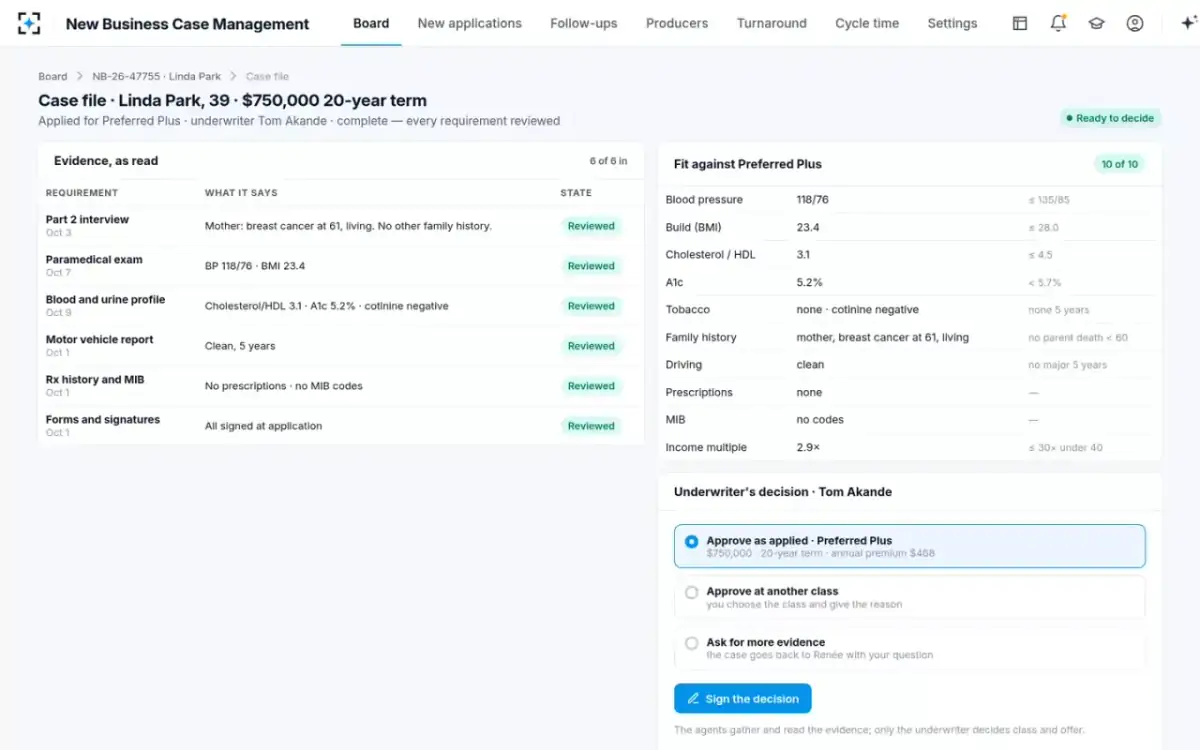
Issued as applied for: Approve as applied: the class and amount requested
Issued other than applied for: Approve at another class, with a rating or exclusion, or a different amount or plan
Issued as applied for: Usually none, unless an answer is corrected
Issued other than applied for: Needed: the owner signs to accept the changed terms
Issued as applied for: The illustration signed at application stands
Issued other than applied for: A revised illustration, signed and dated no later than delivery
Issued as applied for: None for the decision itself
Issued other than applied for: An adverse underwriting decision notice where the offer is above standard rates or declined
Issued as applied for: The offer is what the owner expected
Issued other than applied for: The owner meets a new price and decides again
The illustration rule is exact. If an illustrated policy "is issued other than as applied for, a revised basic illustration conforming to the policy as issued shall be sent with the policy", labelled "Revised Illustration", and it "shall be signed and dated by the applicant or policy owner and producer or other authorized representative of the insurer no later than the time the policy is delivered." A rated offer therefore travels with two documents to sign, and a producer who delivers without them has delivered an incomplete policy. Where a rated offer also triggers an adverse underwriting decision notice, the rules are set out in investigative consumer report for life insurance.
The decision that sets the tail: as applied, or not
The buyer's guide and policy summary: before the premium or with the policy
The NAIC's disclosure model sets the default: the insurer "shall provide a Buyer’s Guide to all prospective purchasers, prior to accepting the applicant’s initial premium or premium deposit", unless the policy carries the ten-day refund provision, in which case the guide may come with the policy. A policy summary, for products not marketed with an illustration, follows the same timing. New York requires the buyer's guide and preliminary information at or before application, and "a policy summary upon delivery of the policy".
For the case manager the practical question is whether the guide went out before the premium was taken. If it did not, the policy must carry the refund provision and the guide must travel with it, and the delivery checklist must show it.
Replacement cases: the extra paper at delivery
A policy that replaces another carries the most delivery paper. Under the NAIC's replacement model, the producer must leave the applicant all sales material used, and material presented electronically "shall be provided to the policy or contract owner in printed form no later than at the time of policy or contract delivery". The replacing insurer must also give the owner notice of the right to return the new policy within 30 days of delivery for an unconditional full refund of premiums paid.
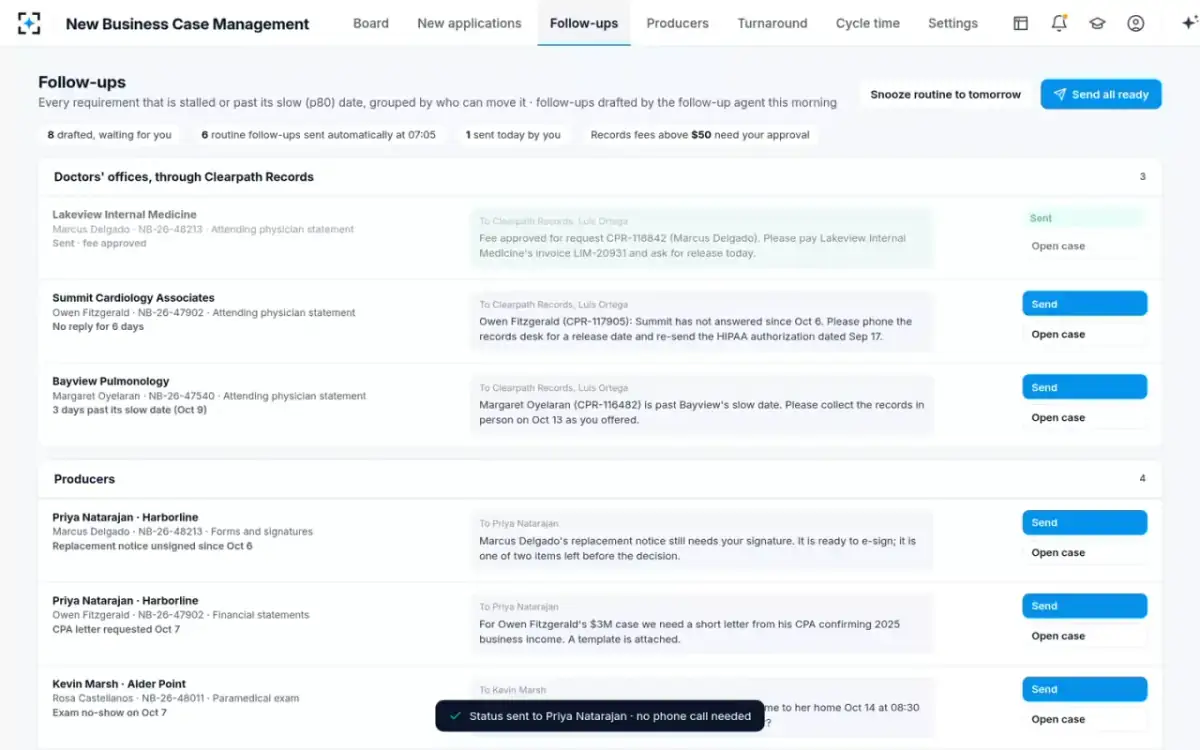
On the fictional sample carrier, a replacement answer on the application orders the state replacement notice at intake, and the follow-up list shows it waiting on the producer's signature: on the sample case it had been unsigned for six days on the Monday the case was reviewed. The same notice and the 30-day right are why replacement cases deserve their own row on any delivery checklist.
Forms waiting on the producer, before and after the decision
Can delivery requirements be done electronically?
Yes, where the owner consents. The federal E-SIGN Act says "It is the specific intent of the Congress that this subchapter and subchapter II apply to the business of insurance." Where a law requires information to be given in writing, an electronic record satisfies it only if "the consumer has affirmatively consented to such use and has not withdrawn such consent", after a clear statement of the right to paper, how to withdraw consent and the hardware and software needed, and with consent given electronically in a way that shows the owner can open the records.
Electronic delivery solves the date problem too: a system that records when the owner opened the policy and signed the receipt, amendment and revised illustration fixes every clock at once. It does not remove any requirement. A replacement still needs its printed sales material by delivery under the NAIC model, unless the state's version says otherwise, and the consent must be captured before the first required disclosure is sent electronically.
What happens if delivery requirements are not met?
The case stalls short of placement, and the carrier carries an examination risk. An owner who does not sign the amendment or receipt has not accepted the policy; the case becomes a not-taken, and the Society of Actuaries' 2022 survey of accelerated underwriting at 24 companies, written by Milliman actuaries, counts a policy returned in the free look the same way. How those losses are measured, and why free-look returns are often missed in new business data, is in life insurance placement rates.
Examiners look at the same tail. Among the NAIC's general underwriting and rating standards for market conduct examinations is this one:
"Policies, contracts, riders, amendments and endorsements are issued or renewed accurately, timely and completely."
NAIC, Market Regulation Handbook, 2024 edition, Chapter 20, underwriting and rating standard 6
An amendment that was never signed, a revised illustration missing from the file or a buyer's guide with no proof of delivery is the kind of gap that standard is written to find.
Who delivers a life insurance policy, and who owns the tail?
Usually the producer who sold it, in person or electronically, or the carrier by mail. Who may act for the insurer, and the difference between a producer's licence and an appointment, is covered in insurance license vs appointment. The new business case manager owns the tail on the carrier's side: what must go with the policy, what must come back signed, and by when.
A case manager's delivery checklist
- Was the policy issued as applied for?
If not, prepare the amendment and, for illustrated products, the revised illustration for signature at delivery.
- Did the buyer's guide go out before the premium?
If not, confirm the policy has the refund provision and the guide travels with it.
- Is this a replacement?
Printed sales material by delivery and notice of the 30-day return right, under the state's version of the model.
- Is the owner 60 or over in California, or in a state with its own period?
Set the free-look date from the state's rule, not the carrier default.
- Is the delivery date provable?
A signed and dated receipt, a returned summary page, or an electronic record of opening and signing.
- Has electronic consent been captured first?
Before any required disclosure is sent electronically.
- Is every item dated and chased?
Each outstanding signature with an expected date and a follow-up cadence, as before the decision.
Be clear about the solution's scope. New Business Case Management runs a case to the underwriter's signed decision, and producers hear about each case in plain words throughout; the delivery tail runs in the carrier's issue and policy systems. The habits the solution enforces before the decision (every item dated, every stall seen the day it happens, every message drafted for a person to send) are the ones that keep the tail short too. To see a case through to the decision on sample data, start from New Business Case Management.
Questions people ask
What is the free look period for life insurance?
A period after delivery in which the owner can return the policy for a refund. Under the NAIC's disclosure model it is at least ten days where the buyer's guide comes with the policy; New York sets at least ten days; replacements under the NAIC model get 30 days, and California gives owners aged 60 or over at least 30.
What is the difference between the issue date and the delivery date?
The issue date is when the carrier issues the policy, and contract clocks such as the contestable period usually run from it. The delivery date is when the owner receives it, and the free-look period runs from that.
What happens if the owner does not sign the amendment?
The policy as issued has not been accepted, so the case is usually closed as not taken. If the amendment reflects a different class or rating, the owner can ask why; the reasons for an above-standard offer are covered by the state's adverse underwriting decision rules.
Can a life insurance policy be delivered by email?
Yes, if the owner has consented under the E-SIGN Act's conditions: a clear statement of the right to paper and to withdraw consent, the technical requirements, and consent given in a way that shows the owner can open the records.
Why does the delivery receipt matter once the premium is paid?
Because it fixes the date the free-look clock started and the date the policy was accepted. Without a dated receipt, neither the owner nor the carrier can prove when the refund period ended.
Does every state use the NAIC models?
No. NAIC models bind only where a state adopts them, and states often change the periods and forms; New York and California, quoted here, have their own statutes. The owner's state decides the rule.