Life insurance case management software takes a new application to a file the underwriter can decide: it orders the requirements the case calls for, follows each with its vendor or doctor's office, reads what comes back, chases what stalls and keeps the producer informed. Which product a carrier buys matters less than what the carrier brings to it, because every order, date and message the software produces comes from the carrier's own requirement grid, disclosure rules, vendor feeds, authorizations and limits. A buyer who has those ready can test any product on its own closed cases in weeks; a buyer who has not will spend the project writing them. Botminds' New Business Case Management runs on exactly these inputs, and this guide lists each one with who owns it and how to test it before go-live.
Settings, screens and cases shown here are from a fictional sample carrier, Cedarbrook Life, in the solution. Rules are linked where they appear.
What a carrier brings to life insurance case management software, with the owner and the test
- The requirement grid by age and face amount
Owner: chief underwriter, approved by the head of new business. Test: run 50 closed cases through it and compare with what was actually ordered.
- Disclosure rules: the answers that add requirements
Owner: underwriting. Test: every rule names the answer that triggers it and the requirement it adds; replay finds no case where a person had to add one by hand.
- Vendor status feeds
Owner: vendor management. Test: every open order has a status event in the last 24 hours, with a timestamp and the vendor's note text.
- 90 days of turnaround history
Owner: new business operations. Test: order and receipt dates per vendor and per doctor's office, enough to date each source.
- Authorizations and notices, and when each is signed
Owner: compliance. Test: no APS order can leave before a HIPAA authorization is on file; FCRA and MIB notices are acknowledged with the application.
- Limits on what software may do
Owner: head of new business. Test: the fee limit, the message rules and who may remove a requirement are written down and enforced as settings.
- Producer message rules
Owner: distribution and compliance. Test: no medical detail can reach a producer; the first weeks' replies wait for a person.
- A sample of closed cases to replay
Owner: new business analytics. Test: a quarter of cases with their requirement dates, used to check the expected dates before any producer sees one.
What does life insurance case management software do?
It does five jobs between the application and the decision: order, date, read, chase and inform. Ordering turns the grid and the applicant's answers into requirements, each with the reason. Dating gives each requirement an expected and a slow date from its source's history. Reading takes each lab report, exam or statement as it arrives and lays its values against the class guidelines. Chasing sends the follow-ups, and informing gives producers a status in plain words. In the solution, five agents split those jobs; the case manager owns the case and the underwriter decides.
Buyers often confuse the category with its neighbours, so name them. A policy administration system issues and services the policy and usually has a requirements screen, but it records rather than predicts. An electronic application collects the answers. A rules engine or accelerated underwriting model decides whether a case can skip evidence. An underwriting workbench presents the evidence to the underwriter. Case management software sits across all of them and owns the weeks between application and a whole file. Searches for "insurance case management software" also return health and workers' compensation products that manage care, not applications; they are a different category with different rules.
The requirement grid by age and face amount
The grid is the carrier's standing order: for each age band and face amount band, the evidence every case gets regardless of what the applicant says. It may live in an underwriting manual and, in practice, also in the habits of the people who apply it, and the two can drift. Software forces the question of which is right.
A sample requirement grid: what each age and face band adds
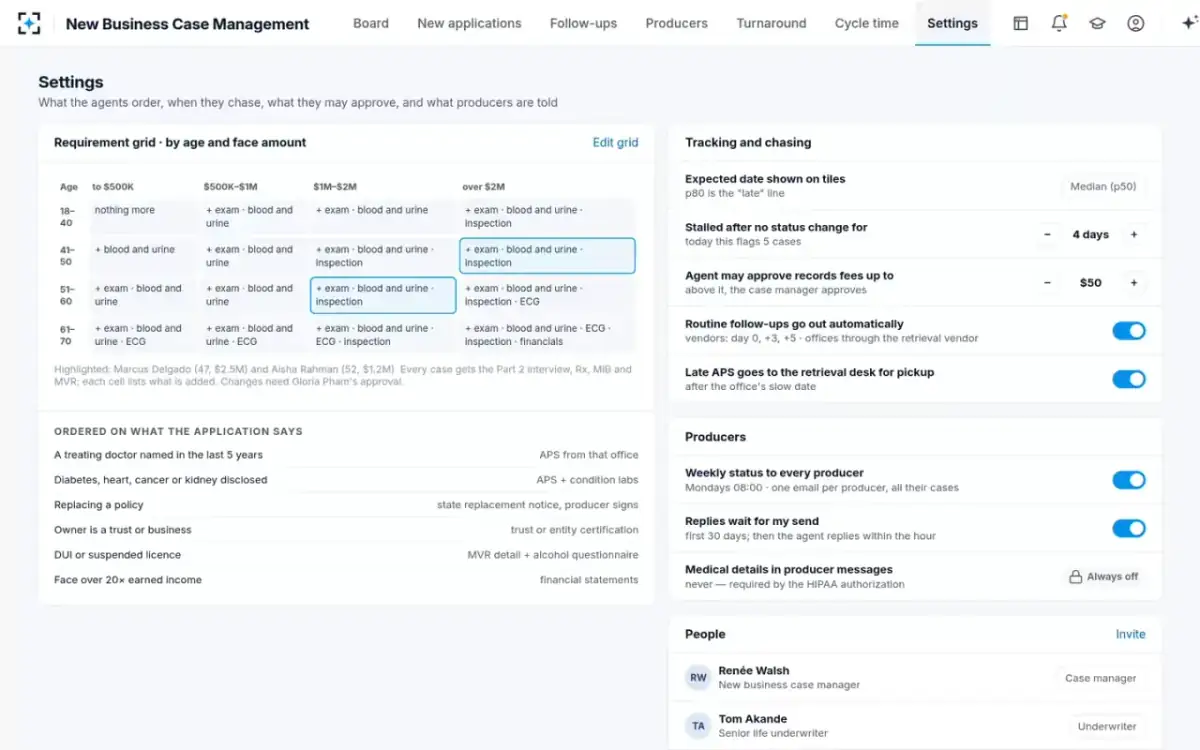
| Age | To $500,000 | $500,000 to $1M | $1M to $2M | Over $2M |
|---|---|---|---|---|
| 18–40 | Nothing more | Exam, blood and urine | Exam, blood and urine | Exam, blood and urine, inspection |
| 41–50 | Blood and urine | Exam, blood and urine | Exam, blood and urine, inspection | Exam, blood and urine, inspection |
| 51–60 | Exam, blood and urine | Exam, blood and urine | Exam, blood and urine, inspection | Exam, blood and urine, inspection, ECG |
| 61–70 | Exam, blood and urine, ECG | Exam, blood and urine, ECG | Exam, blood and urine, ECG, inspection | Exam, blood and urine, ECG, inspection, financials |
Test the grid before it runs. Take 50 closed cases from last quarter, apply the written grid to each applicant's age and amount, and compare the result with what was actually ordered. Every difference is either an error in the grid or an undocumented habit; both need a decision before go-live. A grid applied by software is applied the same way to every applicant, which is also the point of the examiners' standard that underwriting practices are not unfairly discriminatory.
Disclosure rules: the answers that add requirements
The second input is the set of rules that add evidence from what the applicant discloses. The sample carrier runs six: a treating doctor named in the last five years brings an APS from that office; diabetes, heart, cancer or kidney disease adds an APS and condition labs; replacing a policy brings the state replacement notice for the producer to sign; a trust or business as owner brings a trust or entity certification; a DUI or suspended licence adds the driving record detail and an alcohol questionnaire; and a face amount over 20 times earned income brings financial statements.
Each rule should name the question that triggers it, so every order carries its reason. In the solution the application reader goes answer by answer and records the answer behind every order, and it never removes a requirement the grid calls for. How the rules map onto the reflexive questions of an electronic application, and which answers close requirements rather than add them, is in reflexive questions in insurance.
Do vendors provide status feeds? What the feeds must carry
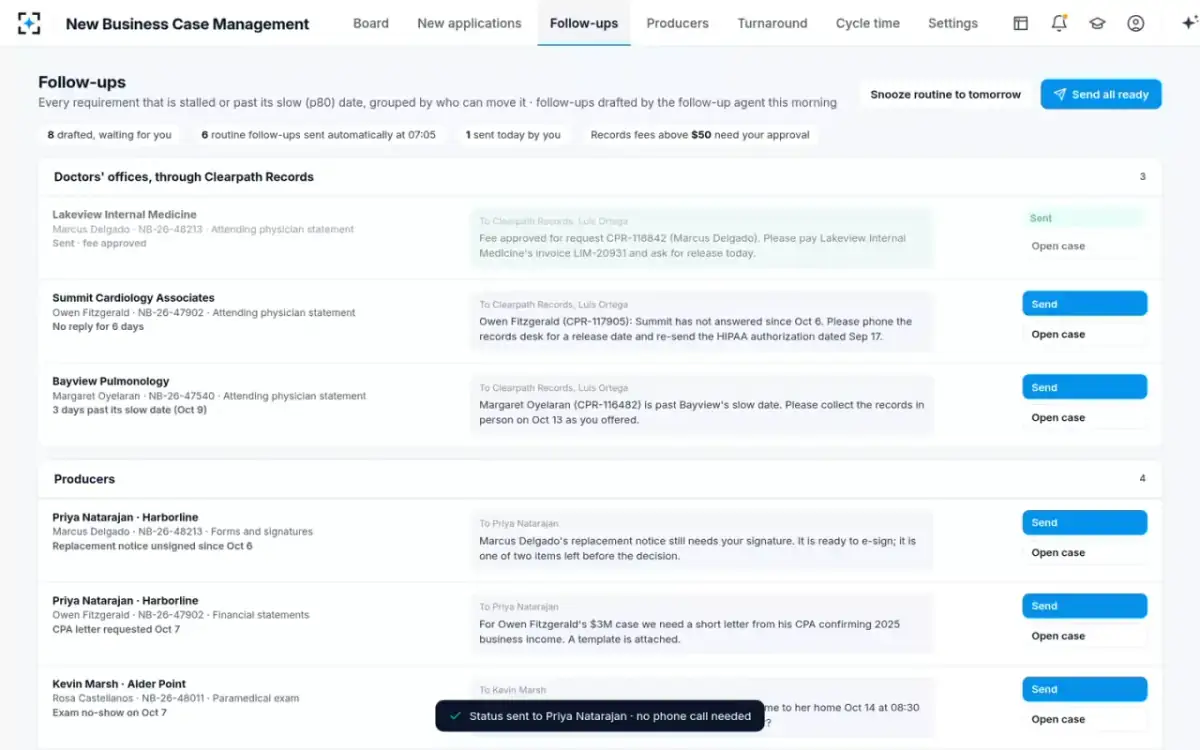
The solution reads the status feeds of the carrier's paramedical, laboratory and inspection vendors and its APS retrieval vendor; what matters is what is in them. A useful feed carries every status change with a timestamp and the vendor's free-text note, not just a current code. The note is where the reason for a stall lives: "Office invoice LIM-20931: $65 copy fee, payment before release" is in the text, while the code still says pending.
The feeds also seed the dates. The solution dates each requirement from its exact source's last 90 days, so the carrier brings order and receipt dates for each vendor and each doctor's office, typically from the vendors' own extracts. Sources with fewer than five requests in 90 days borrow the vendor's regional average until they have their own. How those dates are built and tested is in underwriting requirements tracking software.
Settings: the carrier's inputs, as the solution runs them
The authorizations and notices that must be on file first
Some requirements may not be ordered until paper is in place, and the software has to know which. An APS needs a HIPAA authorization. HHS describes what a valid one includes: "a description of who is authorized to make the disclosure and receive the PHI, a specific and meaningful description of the PHI, a description of the purpose of the disclosure, an expiration date or event", among other elements. A carrier should hand the software its current authorization form and the rule: no APS order leaves without one on file, attached to the request.
State insurance privacy law adds a notice. The NAIC's Insurance Information and Privacy Protection Model Act, a model Massachusetts, for one, enacted as chapter 175I of its General Laws, requires a notice of information practices on an application "At the time the collection of personal information is initiated when personal information is collected from a source other than the applicant or public records". Prescription histories, MIB checks and inspection reports are all such sources, which is why the sample application collects the FCRA and MIB notices with the authorizations before anything is ordered. The consumer-report rules behind those checks are in investigative consumer report for life insurance.
Limits: fees, messages and who may remove a requirement
Write down what the software may do on its own before it does anything. Three limits matter most. A records-fee ceiling: in the sample setup the agent may approve fees up to $50, and above that the case manager approves within her own limit. A message rule: routine vendor follow-ups go out on their own, while every producer reply waits for the case manager in the first 30 days. And a removal rule: no requirement the grid calls for is removed without a reason and a person.
Who owns each input in New Business Case Management
Today
The grid lives in a manual and in case managers' habits, and the two drift.
With agents
One grid, applied the same way to every case, with each order's reason shown.
Still theirs: the grid's content and the class guidelines
Today
Limits are informal: who may approve a fee, what producers may be told.
With agents
Limits are settings, each changed only with approval and visible on the audit trail.
Still theirs: approval of grid changes and every limit
Today
Each vendor reports in its own portal; status is checked by hand.
With agents
Feeds arrive hourly with notes; each source's turnaround is visible to the vendor conversation.
Still theirs: contracts and service levels
Today
Checks authorizations and notices after the fact, in samples.
With agents
Orders that need paper cannot leave without it; every message is retained.
Still theirs: the forms, the notices and the producer message rules
Today
Applies the grid and rules from memory.
With agents
Sees each order with its reason and handles the exceptions.
Still theirs: fees above the agent's limit and every non-routine message
How long does it take to implement case management software?
The honest answer depends on how ready the inputs are, and we know of no public source that measures implementation time for this category. What can be said is the order of work, because each step depends on the one before it. A carrier with a written grid, clean feeds and a quarter of closed cases moves through the sequence quickly; one that has to write its disclosure rules for the first time spends most of the project there.
The order of a go-live, and who does each step
A person decides
Carrier and BotmindsChoose a sample of the carrier's own fully underwritten cases and their requirement history.
A person decides
UnderwritingWrite down the grid and the disclosure rules, and settle every difference the sample shows.
Agent
Application readerReads the sample applications and orders against the written grid and rules; the differences come back for a decision.
Never: Never removes a requirement the grid calls for
Agent
Requirement trackerDates every sample requirement as of its order day from 90 days of history; the replay scores the dates.
A person decides
Head of new businessSets the fee limit, the stall threshold and the message rules, and approves the grid.
A person decides
Case managersRun live cases with every producer reply waiting for their send for the first 30 days.
What will an examiner check?
Market conduct examiners do not test the software; they test what it produced. The NAIC's 2024 Market Regulation Handbook lists, among its general underwriting and rating standards, that "All mandated disclosures are documented and in accordance with applicable statutes, rules and regulations." Case management software that keeps every order with its reason, every authorization attached to its request and every producer message as sent makes that standard an extract rather than a file hunt.
Ask any vendor to show, for one sample case, the trail an examiner would request: who ordered each requirement and why, when each authorization and notice was signed, what each message said and who sent it. In the solution every order, read, chase and message is on the audit trail with who (person or agent) and when. Preparing for the exam itself is a compliance job; the questions examiners ask are gathered in market conduct exam self-audit questions.
Build or buy, and where this software does not fit
Building case management on a policy system's requirements screen is possible. What is hard to build is the part this guide has listed: per-source dating that updates daily, reading vendor notes for reasons, reading evidence documents against class guidelines with citations, and drafting producer messages that can never carry medical detail. A buyer should price those, not the screens.
Be clear about where New Business Case Management does not fit. It does not replace the policy administration system, the electronic application, an accelerated underwriting model or the retrieval vendor's people. It does not decide anything an underwriter decides. And it adds little to simplified issue or guaranteed issue business, where there are few or no requirements to manage. It earns its place on fully underwritten business with several requirements per case and outside parties who set their own pace. To see it on a sample of your own cases, start from New Business Case Management.
What the inputs produce: every stall with its reason and a drafted message
Questions people ask
What is a requirement grid in life insurance?
A table of the evidence a carrier orders on every case by age band and face amount, such as blood and urine above a certain amount or an inspection report above $1 million. It is the starting order for every application, before any disclosure adds more.
Is insurance case management software the same as health case management?
No. Health and workers' compensation case management software coordinates care for a patient or injured worker. Life insurance new business case management manages the evidence for an application, from order to a decision-ready file, and must keep medical findings away from producers.
What data do you need to start?
The requirement grid, the disclosure rules, vendor status feeds with their notes, about 90 days of order and receipt dates per vendor and doctor's office, the current authorization and notice forms, and a quarter of closed cases to replay the dates on.
Do paramedical and APS vendors provide status feeds?
Check what each vendor sends today, by feed or portal extract, and that each update carries a timestamp and the vendor's note text, not only a code, because the reason for a stall is usually in the note.
Can case management software run alongside our policy administration system?
Yes, and it should. New Business Case Management reads applications and vendor feeds and hands the underwriter a whole file; issuing and servicing the policy stay in the policy administration system.
How long does implementation take?
It depends mainly on how ready the grid, rules and feeds are, so we do not quote a figure. The work runs in order: choose sample cases, write down the grid and rules, replay them, set the limits, then go live with every producer reply waiting for a person for the first 30 days.