Life insurance underwriting software is a family of tools, not one product: rules engines and accelerated underwriting models that decide whether a case can skip the exam, underwriting workbenches that present the evidence to the underwriter, outsourced retrieval and case management services that collect the evidence, and case management agents that run the weeks between the application and a whole file. They are often sold against each other, but on a fully underwritten case they do different jobs, and the one a carrier lacks is the one where its cycle time sits. Put one nine-requirement case through each and the difference is plain: most of a slow case's weeks are spent waiting for evidence, and only some of these tools look at the wait. Botminds' New Business Case Management is the fourth kind, and this guide is honest about what the other three do better.
The case below is a fictional sample case from the solution; the research and regulators' material is linked where it appears.
The case: nine requirements on day 14
Part 2 interview
Reviewed 1 Oct
Paramedical exam
Reviewed 9 Oct
Blood and urine
Due today
Attending physician statement
Stalled 4 days: $65 fee
Motor vehicle report
Reviewed 29 Sep
Prescription history
Reviewed 28 Sep
MIB check
Reviewed 28 Sep
Inspection report
Reviewed 9 Oct
Replacement notice
Unsigned since 6 Oct
What is life insurance underwriting software?
It is any software that helps a carrier decide whether to insure an applicant and on what terms, and the term covers four jobs. A rules engine or accelerated underwriting model applies rules and predictive models to the application and instant data, and either decides the case or sends it for full evidence. An underwriting workbench gathers the evidence on one screen for the underwriter and records the decision. A retrieval or case management service, usually a vendor's staff, orders and collects exams, labs and doctors' records. Case management software, increasingly built from agents, orders, dates, reads and chases the requirements and keeps producers informed.
The categories overlap at the edges; many products do some of two. But a buyer who asks "which underwriting software is best?" without saying which job is asking the wrong question. The useful question is which job, on the carrier's own fully underwritten cases, holds the most days.
Rules engines and accelerated models: fast on clean cases, silent on waits
A rules engine is excellent at the decision it is built for and has nothing to say about a case that must wait. The NAIC's description of accelerated underwriting is precise about the limit: "AU alone does not always lead to issuance of a policy. For some applicants, the available data will be insufficient to adequately evaluate their risk profile, so they will still need to complete the traditional underwriting process, including the physical exam."
The sample case is one of those. At $2.5 million, above the most common accelerated limits, it was always going to full evidence. A rules engine would have ordered the grid's requirements on day zero, which is valuable, and then waited with everyone else. The APS invoice on day 10, the producer's unsigned notice on day 8: neither is a rule the engine runs.
What accelerated programs run on: the tools direct writers use most
The bars explain why acceleration and case management meet. Every input on the list returns in seconds or minutes, except one: the hybrid programs bring the APS back into the fast path. A carrier running a hybrid program has an APS problem whatever its rules engine does, because the doctor's office sets the pace.
What is an underwriting workbench?
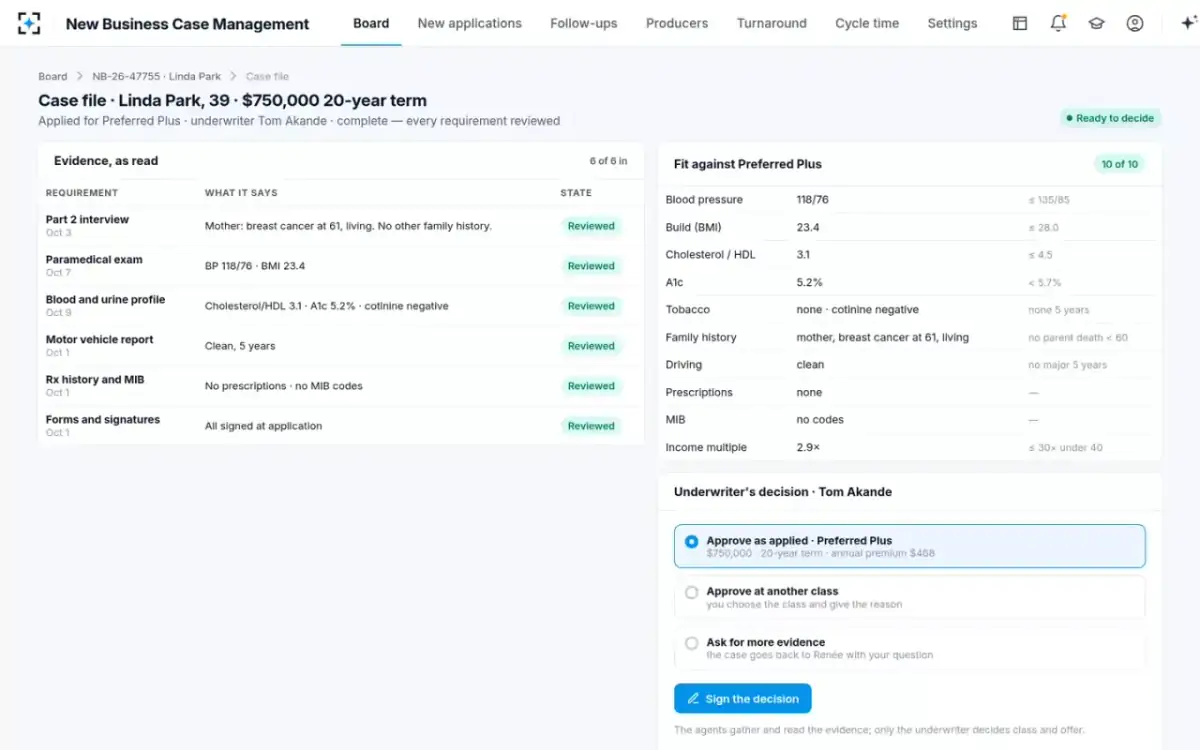
An underwriting workbench is the underwriter's desk in software: the evidence on one screen, the guidelines beside it, notes, referrals and the decision. Its job starts when the evidence is in. The Bureau of Labor Statistics already lists among underwriters' duties to "Review recommendations from underwriting software", and its outlook for the occupation reads: "Automated underwriting software allows workers to process applications quickly, reducing the need for underwriters."
On the sample case a workbench would have shown the underwriter eight of nine items on day 14 and the missing ninth. It would not have known that the ninth was waiting on a $65 invoice, or dated when it would arrive, or drafted the producer's status. Workbenches shorten the last stretch of a case, from a whole file to a signed decision; the weeks before that stretch belong to someone else.
Where a workbench begins: the whole file and the underwriter's decision
Outsourced retrieval and case management services
Outsourcing moves the chasing to people who do it all day, and it is the approach with the deepest relationships with doctors' offices. A good retrieval desk knows which offices answer faxes, which need a phone call and which will only release to a courier. On the sample case, it was the retrieval vendor's call on day 8 that heard the office was copying, and its feed that carried the invoice.
What outsourcing does not move is visibility. The vendor sees its own queue: the APS, not the producer's unsigned notice or the lab due today. The carrier's case manager still reconciles several vendors' portals to know where a case stands, and a fee above the vendor's authority still waits for someone at the carrier to approve it. The solution is built to work with a retrieval vendor, not instead of one: it reads the vendor's feed, dates each office from its history and sends the vendor one clear ask when a request stalls.
Case management agents: running the weeks in between
Agents take the job none of the other three owns: the whole case, every requirement, every day. In New Business Case Management five agents split it. An application reader orders from the grid and the answers, recording the answer behind each order. A requirement tracker dates each requirement from its source's last 90 days and flags stalls after four days without a status change. An evidence reader reads labs, exams and statements against the class guidelines, citing each value's line. A follow-up agent chases on a cadence and approves records fees up to a limit. A producer status agent tells producers where the case stands, never with medical detail.
Evidence read and cited, not decided
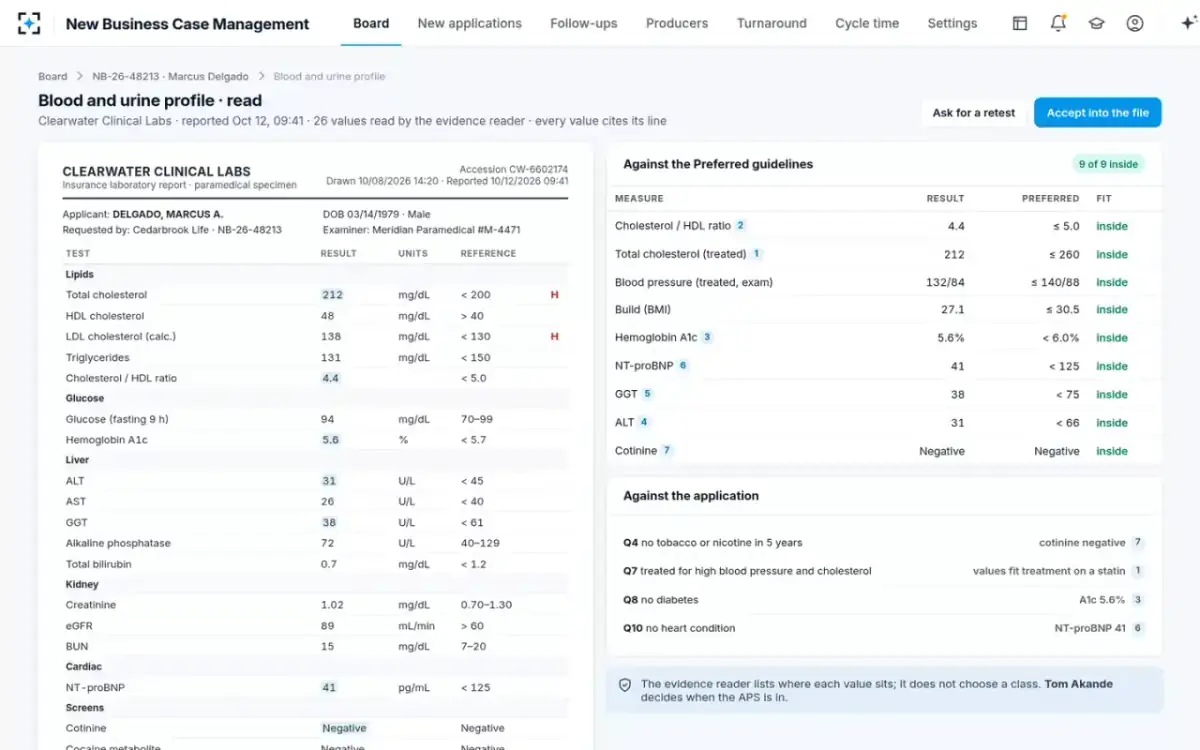
The limits are as important as the jobs. The agents never assign a class, approve or decline; never cancel or re-route an order; never contact the applicant about health; and never include medical detail in a producer message. Fees above the agent's limit and every non-routine message wait for the case manager. That is what lets a carrier put agents on the case without moving any decision away from the underwriter.
Four approaches scored on one case
Score each approach on the six things the sample case needed between day 0 and the decision. The table is our reading of what each approach typically covers on its own; real products vary, and a carrier should score its shortlist the same way on its own cases.
Life insurance underwriting software: who covers what on the sample case
| What the case needed | Rules engine or AU model | Underwriting workbench | Outsourced retrieval | Case management agents |
|---|---|---|---|---|
| Requirements ordered on day 0, with the reason | Yes, from rules | Usually not its job | Only what it is asked to order | Yes, answer by answer |
| A date for each requirement | No | No | For its own queue | Yes, from each source's last 90 days |
| The $65 stall seen, with its reason | No | No | In its feed, if read | Day 4 of the stall, with the reason |
| Arrivals read against the guidelines | For instant data | Shown to the underwriter | No | Yes, every value cited |
| The producer told, without medical detail | No | No | No | Drafted from the case; a person sends it |
| The class and the offer | Decides clean cases by rule | The underwriter decides here | No | Never: the underwriter decides |
The same case with a rules engine alone, and with case management agents added
Rules engine and portals: Grid requirements ordered; the case is not eligible to skip the exam
With case management agents: Grid and disclosure requirements ordered with reasons; each dated from its source
Rules engine and portals: The office invoices a $65 fee; the feed still says pending
With case management agents: The invoice is read as the reason; the stall clock starts
Rules engine and portals: No status change for four days; nobody has looked
With case management agents: Stalled on its fourth day; the fee goes to the case manager, who approves it
Rules engine and portals: A call, a portal hunt, an answer by phone
With case management agents: A drafted reply: records expected 16 October, decision by 20 October
Where AI sits in life underwriting today
Life insurers use AI less than other lines, and mostly at the front of the funnel. The NAIC's survey of life insurers, presented to its Big Data and Artificial Intelligence Working Group in December 2023, found 58% of 161 responding life insurers use, plan to use or explore AI or machine learning (with generalised linear models counted in, unlike the auto and home surveys), against 88% of auto and 70% of home insurers. Of the models in use, 36% were in marketing, 34% in underwriting and 18% in pricing (NAIC survey), and among the reasons for not adopting, respondents cited dependence on legacy systems. How to test an AI answer on your own manual before relying on it is the subject of AI in life insurance underwriting: a buyer's test.
The legacy point matters for the choice of approach. A rules engine or workbench usually has to be integrated into the policy and new business systems to do its job. Case management agents read what those systems and the vendors already produce (applications, feeds, documents) and hand back a file, which is a lighter dependency on the core system. That is an architectural argument, not a performance one, and a carrier should test it in its own environment.
What regulators will ask about any of them
Whatever the approach, regulators look at the data and the decisions, not the label on the software. The NAIC working group's regulatory guidance on accelerated underwriting (its June 2024 draft; the NAIC reports the Life Insurance and Annuities Committee adopted the guidance on 14 August 2024) lists questions for departments to put to insurers, starting with "What specific external data or information about life insurance applicants is being utilized by the Accelerated Underwriting program?" and including "What process or recourse does the company provide to an applicant for life insurance should they receive an Adverse Underwriting decision based on external data or information?"
New York went first for life insurers alone. Its 2019 circular letter set out "to advise insurers authorized to write life insurance in New York of their statutory obligations regarding the use of external consumer data and information sources in underwriting for life insurance." The governance rules that now apply across lines, the NAIC's AI model bulletin and state testing rules, are covered in NAIC AI bulletin requirements and Colorado life insurance quantitative testing. Software that orders and reads evidence without deciding the class keeps the decision, and the explanation, with the underwriter.
How to choose life insurance underwriting software
Choose by where your days are, then by what the software may decide. The checklist below is ordered that way.
Six questions that pick the right approach
- Where do your fully underwritten cases spend their days?
Measure application to last requirement, and last requirement to decision. The first is case management; the second is the workbench.
- How many cases can acceleration take?
Count cases outside your program's age and amount limits; those need full evidence whatever the rules engine does.
- Who sees a stall first today?
If the answer is the producer, visibility is the gap, not the decision.
- What may the software decide?
Class and offer, or only orders, dates and drafts. The answer sets the governance you need.
- Can every output be traced to a source?
Each order to an answer, each date to a source's history, each value to a line in a report.
- Does it work with what you have?
Your policy system, e-application, vendors and retrieval desk. Replacement is rarely the cheapest route to a shorter case.
A carrier whose days sit between application and a whole file needs case management first; one whose whole files queue for underwriters needs a workbench; one with many clean, small cases needs acceleration. What to bring to a case management product is in life insurance case management software, and how its dates are set is in underwriting requirements tracking software. To see the agents on sample cases, start from New Business Case Management.
Questions people ask
What is the difference between a rules engine and AI underwriting?
A rules engine applies written rules to the application and instant data; AI underwriting adds predictive models trained on past cases. Both decide whether a case can skip evidence. Neither runs the weeks a fully underwritten case spends waiting for exams, labs and doctors' records.
How do life insurers automate underwriting?
Mostly through accelerated programs that use the electronic application, prescription histories, MIB data and driving records to waive the exam for some applicants. The Society of Actuaries' 2022 survey of 24 direct writers found the average share of eligible policies expected to skip fluids or the exam was 46%.
Does AI decide the rating class?
In some accelerated programs a model decides clean cases within set classes. In New Business Case Management it never does: the evidence reader lists where each value sits against the guidelines, with citations, and the underwriter decides the class and the offer.
What are life insurance underwriting platforms?
Products that combine several of the four jobs, typically a rules engine with a workbench. Ask which of the six needs in the scoring table the platform covers on a fully underwritten case, and test it on your own closed cases.
Will underwriting software replace underwriters?
The BLS projects underwriter jobs to fall 4 percent from 2025 to 2035 and says automated software reduces the need for them. The decision on complex and impaired cases, and the signature, remain the underwriter's in every approach described here.
Can these tools work together?
Yes, and on most carriers they should: a rules engine for the fast path, a retrieval vendor for doctors' offices, case management for the weeks in between and a workbench for the decision.