Life insurance cycle times measure how long a case takes between two fixed events, most often from the day the application is received to the underwriting decision, and they are best reported as a distribution (median, 80th percentile and the tail) rather than an average. For a new business department the cycle time that matters is the one it promises: the date a producer is told the case will be decided. Before any date is shown to a producer it should be tested on cases that have already closed, by asking what the method would have predicted on each order day and comparing that with what happened. Botminds' New Business Case Management dates every requirement from its source's recent turnaround and dates each case from its slowest open requirement, so the replay test applies directly to it.
The worked figures on this page come from a fictional sample carrier, Cedarbrook Life, and its fictional vendors and doctors' offices in the solution. Published research is linked where it appears.
What an honest expected date looks like when you replay closed cases
Dates set at the median (p50)
- Arrive by the expected date · 50%
- Between expected and slow date · 30%
- After the slow date · 20%
Dates set at p70, a setting
- Arrive by the expected date · 70%
- Between expected and slow date · 10%
- After the slow date · 20%
What is cycle time in life insurance?
Cycle time is the elapsed time between a start event and a stop event on a case, and the definition of both decides what the number means. Application to decision measures new business and underwriting together. Decision to placed measures issue, delivery and the producer. Application to placed is what the applicant experiences. A department that reports one without saying which is reporting a number nobody can act on.
Five cycle times, and what each one tells you
| Measure | Starts | Stops | What it shows |
|---|---|---|---|
| Application to decision | Application received by the carrier | Underwriter signs the decision | New business and underwriting together; the number distribution asks about |
| Requirement turnaround | Requirement ordered | Result received | Each vendor's and doctor's office's pace; the input to every expected date |
| Last requirement to decision | Final requirement received | Decision signed | Underwriting queue time once the file is whole |
| Decision to placed | Decision signed | Policy delivered, paid and accepted | Issue, delivery and the producer; where approved cases are lost |
| Application to placed | Application received | Placed | What the applicant lives through; the sum of the above |
Two choices trip up most reports. The first is whether the clock pauses while the case waits on the applicant or the producer. Pausing flatters the department and hides the waits a producer feels; keeping the clock running and labelling the wait shows where the days went. The second is which cases count. Mixing accelerated decisions, which can come in hours, with fully underwritten cases produces an average that describes neither; report them separately.
How long does underwriting take? What regulators and actuaries have published
Public sources give ranges, not benchmarks. The NAIC, the state insurance regulators' standards body, describes accelerated underwriting as able to "reduce the length of the application process from several weeks to just a few hours". The Society of Actuaries' 2019 Accelerated Underwriting Practices Survey, written by Milliman actuaries Al Klein and Karen Rudolph, put it this way: "Traditional underwriting for many companies has historically taken four to six weeks to complete."
Neither is a benchmark a carrier can set targets against. The NAIC figure is a description of what acceleration changes; the SOA line is a survey report's background sentence, not a measured average. No regulator or independent study publishes a current industry distribution of fully underwritten cycle times. A carrier that wants a benchmark has one honest choice: its own last four quarters, measured the same way every time.
Mean or median: why one cycle-time number misleads
Report the median and the 80th percentile, and show the tail. Cycle times are skewed to the right, because a case cannot be decided in fewer than zero days but can wait months for a doctor's office. A handful of very long cases pulls the mean up, and a department that manages to the mean will chase the tail and ignore the middle.
One sample quarter of fully underwritten decisions in New Business Case Management, by days from application
The shape says more than either average. Three quarters of the sample quarter's cases were decided within four weeks; one in eight took longer than six. Those 159 cases are a different management problem from the rest, and each deserves a named reason. A target set on the mean ("bring it down by two days") invites shortcuts across the middle. A target set on the tail ("no case past six weeks without a named reason") points at the cases that need a person.
Replay before you promise: testing dates on closed cases
A replay asks one question: had this method been running last quarter, would its dates have come true? It is the accuracy test for case management, because the promise a new business department makes is a date, and a wrong date costs more trust than no date. The steps below can be run on any tracker, including a spreadsheet, as long as the order and receipt dates are kept.
How to replay a quarter of closed cases
- Take every requirement ordered in the quarter
Order date, source (the vendor or the exact doctor's office), status changes and receipt date. Include cancelled ones and say so.
- Date each one as of its order day only
Compute the source's median and 80th percentile from the 90 days before that order. Using later history leaks the answer into the test.
- Apply the thin-history rule
A source with fewer than five requests in its window borrows the vendor's regional average, exactly as it would have live.
- Score the arrivals
Share by the expected date, share by the slow date, and days past the slow date for the rest. Overall and by source.
- Score the cases, not only the requirements
A case's decision-ready date is its slowest open requirement; compare it with the day the file was actually complete.
- Count the stall days nobody saw
For each requirement, days between its last status change and the first follow-up. This is the part software can shorten.
- Read the misses by source
A few offices usually explain most of the late arrivals; they need a different route, not a different formula.
The second step is where replays go wrong. If the office's turnaround is computed from the whole quarter, including requests that had not yet come back on the order day, the replay looks better than the live system ever could. The test has to use only what was known at the time. The same discipline applies to the case's date: the decision-ready date shown on day 3 is the one to score, not the one shown on day 15 after the slow office finally answered.
A replay also tells you which setting to choose. A carrier that wants producers to hear dates that come true seven times in ten can show the 70th percentile instead of the median; the trade is a later date on every case. How the dates themselves are built is in underwriting requirements tracking software.
What slows life insurance cycle time? The stall days nobody saw
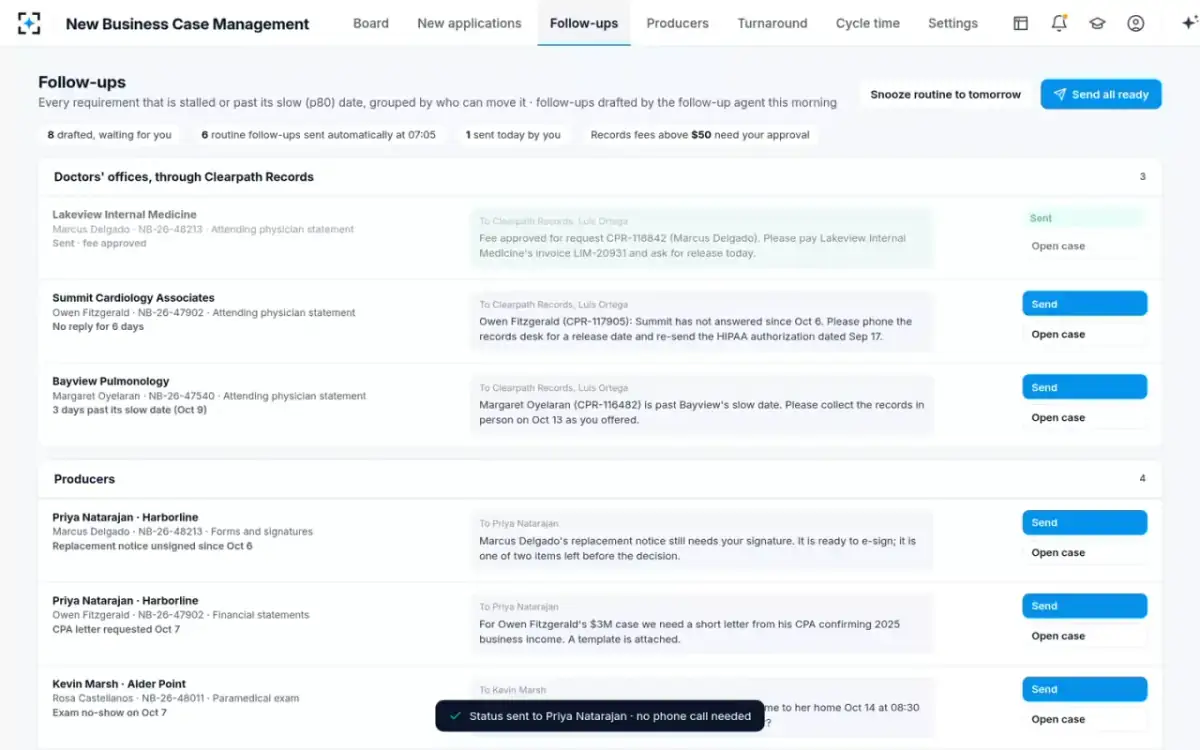
Waiting slows a case, and the part of waiting a carrier controls is the time between a requirement stopping and someone acting on it. A records office that needs a fee, an applicant who missed an exam, a producer form left unsigned: each is a stall that costs nothing to resolve once it is seen and a week when it is not.
Why requirements stalled in one sample quarter
Stalled requirements, July to September 2026
- Records fee waiting for approval · 31%
- Doctor's office not responding · 24%
- Exam no-show or reschedule · 17%
- Producer form unsigned · 15%
- Applicant unreachable · 13%
The largest slice in the sample is also the cheapest to fix: almost a third of stalls waited on a records fee nobody had approved. The second slice, offices that do not respond, is the one the carrier cannot fix directly; the retrieval vendor's desk can phone, re-send the authorization or collect in person, but the office sets its own pace. The other three slices all wait on a person outside underwriting and can be routed the morning they appear.
Every stall, grouped by who can move it
The doctor's-office queue: why dates must be set per office
The attending physician statement sets the pace of most fully underwritten cases, and its turnaround varies more between offices than between any other sources. In the sample carrier's last 90 days, the median from order to records ranged from 12 days at one family practice to 26 at a cardiology group, whose 80th percentile was 38 days. A department that dates every APS with one allowance is right on average and wrong on almost every case.
Per-office dating needs volume, which is why the thin-history rule matters: a practice that has sent four sets of records in 90 days has no reliable median of its own, and borrows the retrieval vendor's average for its region until it does. The same office data also tells the retrieval vendor where to spend its phone calls. An office that is late against its own history is news; an office that is always slow is a standing route problem, and may be worth collecting in person from the start.
How to reduce new business cycle time without cutting evidence
Cut the days between events, not the evidence. Three changes do most of the work, and none of them asks an underwriter to decide with less. Order every requirement on day zero, from the answers as they are read, rather than a day or two later when someone gets to the application. Act on every stall the day it is detected, with the reason in hand. And tell the producer the date, so the applicant's own steps (the exam appointment, the signature, the accountant's letter) happen sooner.
Be honest about what does not change. The doctor's office still works at its own pace; in the sample case that took 17 days at the median. Accelerated programs cut cycle time by removing requirements altogether, which is a product and underwriting decision, not a case management one. A department that shortens its waits will find its remaining cycle time is mostly the slowest office on each case, which is the right thing for its dates to show.
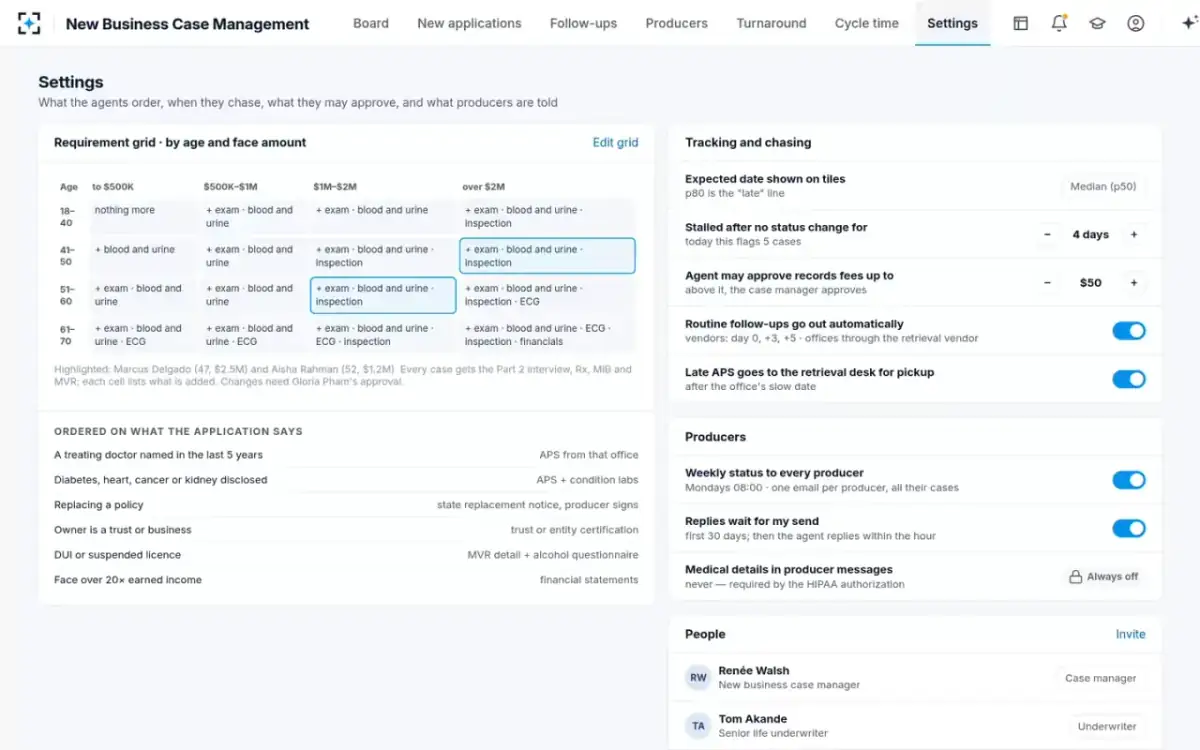
The settings behind every promised date
Cycle time vs placement rate: report both, by days
Cycle time measures how long cases take; placement rate measures how many approved cases become paid policies. They belong in one report because the second depends on the first: an applicant who waits has more time to accept another offer, lose interest or have a circumstance change. The useful view is placement by days to decision, read with care, because slow cases also differ in age, amount and health. How to build that curve without fooling yourself, and how to price a waiting day from it, is in life insurance placement rates. To replay the solution's dates on a sample of your own closed cases, start from New Business Case Management.
Questions people ask
How is life insurance cycle time measured?
As the days between two fixed events, usually from the date the carrier receives the application to the underwriter's signed decision. Report the median and 80th percentile, separately for fully underwritten and accelerated cases, and keep the clock running while the case waits on the applicant or producer.
What is application to issue time?
The days from receipt of the application to the policy being issued, which adds issue processing after the decision. It is shorter than application to placed, which also includes delivery, the initial premium and the owner's acceptance, the stage where approved cases are lost to not-takens.
How do carriers benchmark life insurance cycle times?
Mostly against themselves. No regulator or independent study publishes a current industry distribution; the Society of Actuaries' 2019 survey report describes traditional underwriting as historically four to six weeks. A carrier's own last four quarters, measured the same way, is the benchmark it can act on.
Does accelerated underwriting reduce cycle time?
For the cases it accepts, sharply: the NAIC describes it as cutting the process from several weeks to a few hours by replacing the exam and fluids with data. Applicants the accelerated path cannot assess return to full underwriting, so the fully underwritten queue holds the cases acceleration could not take.
What is a good cycle time for fully underwritten life insurance?
There is no public standard. A useful internal goal is a median the department can keep and a tail with a reason for every case in it: in the fictional sample quarter, the median was 20 days and 12% of cases ran past six weeks.
Should the clock stop while waiting on the applicant?
Not in the main measure. Stopping it hides the waits a producer and applicant actually feel. Keep the clock running and label each wait by reason, such as an exam no-show or an unsigned form, so the report shows which waits sit outside underwriting.