A notice regarding replacement of life insurance is the form a producer must read to, and sign with, any applicant who is dropping, surrendering or borrowing against an existing life policy or annuity to buy a new one. Under the NAIC's Life Insurance and Annuities Replacement Model Regulation (#613) it is titled "Important Notice: Replacement of Life Insurance or Annuities", it lists every contract being replaced, and once it reaches the replacing insurer it starts a chain of short deadlines: five business days to tell the existing insurer, five more for that insurer to offer the owner the old contract's values, and a 30-day right to return the new contract. The hard part of replacement processing is not the form; it is keeping four parties moving on one file. Botminds' Annuity & Life Replacement Analysis reads the replacement packet the moment it is complete, checks the notice is signed, starts every clock and drafts the notice to the existing insurer, so the person who sends it can do so on day one.
The examples below come from a fictional sample carrier, Larkspur Life & Annuity, as its files run through the solution. The rules are quoted from the NAIC model and the regulators who enforce it, and linked where they appear.
One replacement, six hand-offs: who acts, and who waits
A person decides
Producer and applicantAnswer in writing whether the applicant has existing policies or contracts. If yes, the producer reads the notice aloud (unless the applicant declines), both sign, and the applicant keeps a copy.
Never: The producer may not advise the applicant to answer “no” to avoid notice to the existing insurer.
Agent
Packet readerSorts the application, the signed notice, the transfer request and the sales material; checks every replaced contract is listed with its insurer, insured and number; starts the clocks.
Never: Never fills in a missing signature or form.
A person decides
Replacement processing specialistSends the notice to each existing insurer within five business days of a completed application, and answers that insurer’s request for an illustration or disclosure document within five more.
A person decides
Existing insurerWrites to the owner about the right to receive the old contract’s values, including an in force illustration or policy summary, and sends them within five business days of the owner’s request.
Agent
Letter writerDrafts the notice to the existing insurer, the owner’s right-to-return notice and any return letter to the producer.
Never: Sends nothing without a person’s signature.
A person decides
OwnerCompares old and new with both insurers’ information in hand, and keeps 30 days from delivery to return the new contract for a full refund.
What is a notice regarding replacement of life insurance?
It is a disclosure the applicant signs before the sale closes, and a trigger for the insurers. The model defines a replacement broadly: a new policy or contract is bought and, as the producer knows or should know, an existing one "has been or is to be" lapsed, forfeited, surrendered or partially surrendered, assigned to the replacing insurer, converted to reduced paid-up or extended term insurance, amended to cut benefits, reissued with less cash value, or "Used in a financed purchase". A financed purchase is a new policy paid for with withdrawals, surrenders or loans from an old one.
The notice itself does three jobs. It tells the applicant, in plain words, that "You will pay acquisition costs and there may be surrender costs deducted from your policy or contract." It forces a written answer to two questions, whether the applicant is considering ending an existing contract and whether existing values will pay the new premiums. And it lists each contract affected, "properly identified by name of insurer, the insured or annuitant, and policy or contract number if available", with a mark for whether it will be replaced or used as financing. That list is what the replacing insurer needs to find and notify the existing insurer.
The reverse side is a checklist for the buyer: premiums, policy values, insurability and tax. Two lines matter most on a life replacement: claims on a new policy can be denied for inaccurate statements during its first two years, and the suicide limitation may start again. Those restarts are why the solution flags every life replacement for a fresh contestable and suicide period, and why the 30-day return window after a replacement deserves its own reading.
Who signs the replacement notice, and when?
Both the applicant and the producer sign it, no later than when the application is taken. The model requires the producer to "present and read to the applicant, not later than at the time of taking the application, a notice regarding replacements", and both signatures attest "that the notice has been read aloud by the producer or that the applicant did not wish the notice to be read aloud". An applicant who declines initials a line saying so. A copy stays with the applicant.
Before the notice, there is a simpler signature that every application carries, replacement or not: "a statement signed by both the applicant and the producer as to whether the applicant has existing policies or contracts." If the answer is no, the producer's replacement duties end there. If it is yes, the notice follows, the producer leaves the applicant the original or a copy of all sales material, and sends the insurer copies of every required document and of any individualized sales material, including illustrations.
What the replacing insurer should find in a complete replacement packet
| Document | Who signs or supplies it | Model #613 provision | Why the file stalls without it |
|---|---|---|---|
| Existing-coverage statement | Applicant and producer | §3A, §4C | Without it the insurer cannot show it asked; a missing “yes” is the most common way a replacement goes unreported. |
| Important Notice: Replacement of Life Insurance or Annuities | Applicant and producer, read aloud unless declined | §3B, §4D, Appendix A | The replacing insurer must verify it before the five-day clock to the existing insurer means anything. |
| List of contracts replaced or financing | Producer, on the notice | §3C | No insurer name or contract number, no notice to the existing insurer. |
| Sales material and illustrations used | Producer | §3D, §3E, §4E | The insurer must be able to produce them for five years after the new contract ends. |
| Right-to-return notice | Replacing insurer | §5A(4) | The owner’s 30 days run from delivery whether or not the notice was sent. |
When must the existing insurer be notified? Five clocks, four parties
Within five business days. The replacing insurer must "Notify any other existing insurer that may be affected by the proposed replacement within five (5) business days of receipt of a completed application indicating replacement or when the replacement is identified if not indicated on the application". The second half of that sentence matters: a replacement the applicant did not disclose, but that the insurer later spots, starts the same clock from the day it is spotted.
That first clock sets off four more. The replacing insurer must mail its illustration, policy summary or disclosure document within five business days of a request from the existing insurer. The existing insurer must write to the owner about the right to receive the old contract's values. The owner, having asked, must get them within five business days. And once the new contract is delivered, the owner has 30 days to return it for a full refund of premiums and fees, or, for a variable or market value adjusted contract, the cash surrender value plus the fees and charges deducted.
Five clocks, run end to end: about seven weeks if each takes its full time
- Notify5 bus. days
- Owner letter5 bus. days
- Values sent5 bus. days
- Right to return after delivery30 days
- Review4 days
- Right to return, had it been issued30 days
Who waits on whom is the point of the chart. The owner cannot compare until the existing insurer writes, the existing insurer cannot write until it hears from the replacing insurer, and the replacing insurer cannot notify until the packet is complete and the notice is verified. Every day lost at the front of the chain is a day the owner spends deciding with only the new insurer's numbers.
What does the existing insurer have to send?
A letter to the owner, and then the information the owner asks for. The model's wording is precise: the existing insurer must "Send a letter to the policy or contract owner of the right to receive information regarding the existing policy or contract values including, if available, an in force illustration or policy summary if an in force illustration cannot be produced within five (5) business days of receipt of a notice that an existing policy or contract is being replaced." Then: "The information shall be provided within five (5) business days of receipt of the request from the policy or contract owner."
A policy summary is defined in the model. For most policies it shows the current death benefit, annual premium, cash surrender value, current dividend and how it is applied, and any loan. For universal life it shows the report period, the policy value at the start and end, every credit and charge by type, the death benefit, the net cash surrender value and loans. Those are the numbers an owner needs to compare, and the replacing insurer rarely sees them unless the producer asks.
The existing insurer has two more duties. It must keep every replacement notification it receives, indexed by replacing insurer, for at least five years or until its next regular examination, whichever is later. And when an owner asks to borrow, surrender or withdraw values, it must warn that releasing them "may affect the guaranteed elements, non-guaranteed elements, face amount or surrender value of the policy".
Is a conservation letter the same as the existing insurer's letter?
No: the letter the model requires is a right-to-information notice, not a sales pitch. Carriers often call their reply to a replacement notice a conservation letter, and many use it to ask the owner to stay. Model #613 does not use the word and does not require persuasion. What it requires is that the owner learn of the right to the old contract's values and receive them on request within five business days. A carrier can do both in one letter, but an examiner will look for the required part.
The buyer's side of the notice says the same thing in the applicant's words: "Make sure you know the facts. Contact your existing company or its agent for information about the old policy or contract. If you request one, an in force illustration, policy summary or available disclosure documents must be sent to you by the existing insurer." For a carrier on the receiving end, that sentence is the reason to answer fast. For a carrier on the replacing end, it is the reason its own comparison should already show what the old contract guarantees.
Four seats on one replacement file, and what each waits for
Today
Waits on the applicant’s answers and signatures before the application can go in.
With agents
Gets back any missing form within hours, with the exact item named, instead of a rejected packet days later.
Still theirs: Reading the notice aloud and the recommendation itself.
Today
Waits on a complete packet; then chases statements and contract numbers to address the notice.
With agents
Receives a sorted packet with the notice checked and the existing insurer identified, and sends the notice on day 1.
Still theirs: Sending notices and answering the existing insurer.
Today
Waits on the replacing insurer’s notice before it can offer the owner the old contract’s values.
With agents
Hears within the five business days, often the next morning.
Still theirs: Its letter to the owner and the in force illustration.
Today
Waits on all of it, then compares from the producer’s own summary.
With agents
Opens the file with both contracts read, cited and priced, and the clocks on screen.
Still theirs: Approving, returning or declining, and the signature.
Is a replacement notice required for an internal exchange?
Usually yes, with narrow exceptions. Model #613 does not apply to "An application to the existing insurer that issued the existing policy or contract when a contractual change or a conversion privilege is being exercised; or, when the existing policy or contract is being replaced by the same insurer pursuant to a program filed with and approved by the commissioner; or, when a term conversion privilege is exercised among corporate affiliates". An internal exchange outside those cases is a replacement like any other, and the insurer must have "Procedures to detect transactions that are replacements of existing policies or contracts by the existing insurer, but that have not been reported as such by the applicant or producer."
When the replacing and existing insurer are the same or affiliated, the model adds a benefit for the owner: the insurer must "allow credit for the period of time that has elapsed under the replaced policy's or contract's incontestability and suicide period up to the face amount of the existing policy or contract." New York writes its own internal-replacement exemptions, limited to conversion privileges and approved plans and to policy changes that add no surrender or expense charge and no new suicide or contestable period (11 NYCRR 51.3); how New York's Regulation 60 differs is set out in its own guide.
Two other exemptions surprise processing teams. Existing life insurance that is "a non-convertible term life insurance policy that will expire in five (5) years or less and cannot be renewed" is outside the model. So are "Immediate annuities that are purchased with proceeds from an existing contract", although immediate annuities bought with proceeds of an existing policy are not exempt. New York takes the opposite view on annuity-to-immediate replacements and has fined insurers over them.
What happens if the replacement form is missing or the notice never goes out?
The model treats it as twisting, and examiners find it. Any failure to comply "shall be considered a violation of" the state's twisting provision, and where the requirements were not met "the replacing insurer shall provide to the policy owner an in force illustration if available or policy summary for the replacement policy or available disclosure document for the replacement contract and the appropriate notice regarding replacements". Penalties can include license suspension or revocation, fines, forfeiture of the producer's commission and, where the violations were material to the sale, restitution with interest.
The Massachusetts Division of Insurance's comprehensive examination of a large Massachusetts life insurer, issued in July 2025 for the 2022 exam period, shows how the failure looks in practice. Examiners tested 40 annuity applications, 20 of them replacements, and 45 life applications, 21 of them replacements. The finding: "The Company did not send notice to the replaced carriers for six annuity replacement sales and one life replacement sale, in violation of 211 CMR 34.06." Six of the 20 annuity replacements in the sample is 30% (our arithmetic). The life case involved an old group policy, which "created confusion about the replacement notice to the existing carrier", though the company acknowledged the notice should have been sent (Massachusetts DOI examination report).
The required actions are what any compliance team would draft after such a finding: update the procedures, retrain the people who send notices, and "conduct an audit by corporate audit or compliance by June 30, 2026, and provide the report to the Division." The insurer also told examiners it was "considering a possible system enhancement to provide clearer reminders to staff on the replacement notice requirement." A missed notice is rarely a policy failure. It is a hand-off that nobody saw was open, which is why a self-audit should sample sent notices against completed applications, as market conduct self-audit questions tested on closed files describes.
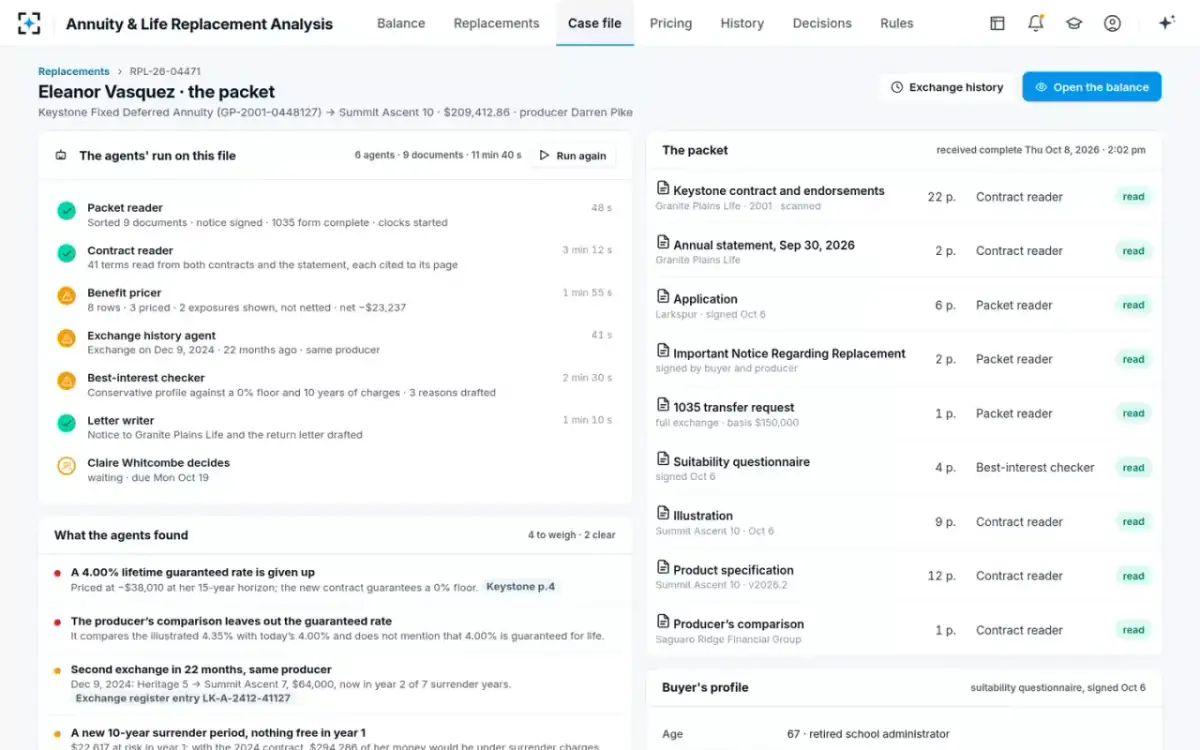
The replacement packet, sorted, with the clocks already running
Where agents shorten the waiting, and where people still sign
The clocks in Model #613 are short for a reason: the owner should see both insurers' numbers before the money moves. Agents shorten the front of the chain, where most of the waiting is clerical. In Annuity & Life Replacement Analysis the packet reader sorts the documents, confirms the existence statement and the notice are signed, checks that every listed contract has an insurer and a number, and starts the five-business-day clock from the moment the packet is complete. The letter writer drafts the notice to each existing insurer. A replacement processing specialist sends it.
The same file then serves the people further down the chain. The contract reader extracts each guarantee and charge from the old contract, cited to its page, so the comparison the principal sees is not built from the producer's summary alone. The exchange history agent checks the buyer's earlier exchanges and the producer's replacement pattern, the monitoring the model expects in Section 4B: each producer's life replacements and annuity replacements "as a percentage of the producer's total annual" sales, and "Replacements, indexed by replacing producer and existing insurer". What stays with people is everything with legal weight: reading the notice to the applicant, sending notices, and approving or returning the sale.
Each state's replacement rule set, its clocks and its owner
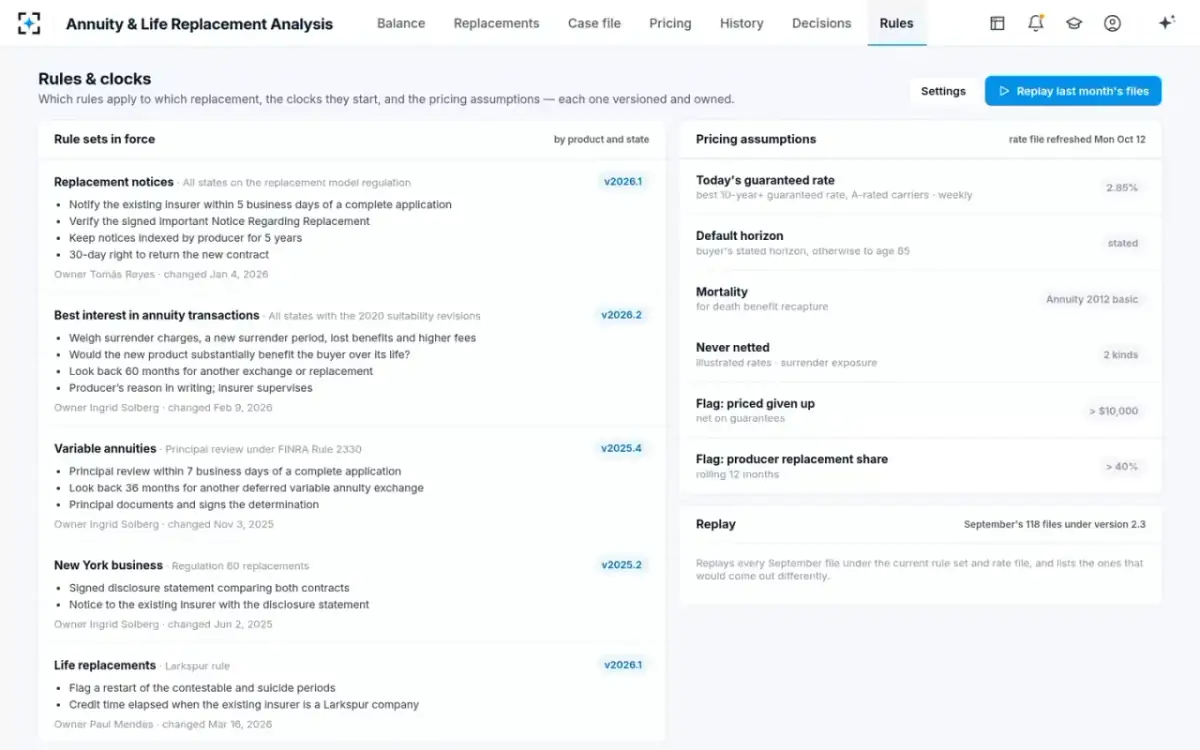
Most states follow some version of the model, but the NAIC's own state page warns that its chart "does not constitute a formal legal opinion" and lists states on older versions or their own rules (NAIC state page for Model #613). Before setting a clock, read your state's text. New York, for instance, gives the existing insurer 20 days to answer and the owner 60 days to return the new contract (11 NYCRR 51.6). The transfer form that usually travels with the notice carries its own tax rules. To see the notice, the clocks and the priced comparison on one file, start from Annuity & Life Replacement Analysis.
Questions people ask
Is the replacement notice the same as the 1035 exchange form?
No. The notice is a state insurance-law disclosure that the applicant and producer sign; the 1035 form is the carriers' request to move the old contract's value directly to the new insurer so the exchange stays tax-free. Most annuity replacements need both, and a missing one stops the file for a different reason.
Does the existing insurer have to be told if the applicant says it is not a replacement?
Yes, once the replacing insurer identifies it. The five-business-day clock runs from a completed application "indicating replacement or when the replacement is identified if not indicated on the application". Model #613 also says a pattern of owners replacing after denying it, with the same producer, is prima facie evidence that the producer knew.
How long must replacement notices be kept?
The replacing insurer must be able to produce the notices, indexed by producer, for at least five years or until the next regular examination by its domiciliary state, whichever is later. The existing insurer keeps the notifications it receives, indexed by replacing insurer, on the same terms. Sales material and signed statements must be kept for at least five years after the new contract ends.
Does a replacement notice apply to group life insurance?
Generally not, unless there is direct solicitation of individuals by a producer. Model #613 excludes "Group life insurance or group annuities where there is no direct solicitation of individuals by an insurance producer", along with credit life, structured settlements and certain employer-funded plans. Replacing an individual policy with group coverage, or the reverse, can still raise state-specific questions, as the Massachusetts examination's group-policy case shows.
What if the existing insurer never sends the in force illustration?
The model obliges it to provide the information within five business days of the owner's request, and failure is a violation the regulator can pursue. In New York, if the existing insurer misses its 20-day deadline, the replacing producer may use "good faith approximations" and the replacing insurer reports non-responding insurers to the superintendent each year by 1 February.
Can the replacement notice be signed electronically?
Model #613 allows records in "paper, photograph, microprocess, magnetic, mechanical or electronic media", and electronically presented sales material must reach the owner in printed form no later than delivery. Whether an electronic signature on the notice itself is valid depends on your state's electronic-transactions law and any approved form, so check the state rule before switching.