An annuity comparison tool, for a carrier or broker-dealer that reviews replacements, is software that sets the contract a buyer is leaving beside the one they are buying and shows, row by row, what changes: guaranteed rates, surrender charges and a new surrender period, death and living benefits, fees and tax. Consumer calculators compare quotes for a new purchase; a reviewer's tool has to read an old contract, often decades old and scanned, and say what the buyer gives up. The best test of any such tool is not a demonstration on its own sample data. It is a trial run on replacements your principals have already signed, set beside the producer's comparison and the decision you made. Botminds' Annuity & Life Replacement Analysis is built for that test: it reads both contracts, cites every term to its page and prices each benefit given up in dollars, so the trial measures something your examiners would recognise.
Screens and figures from the solution come from a fictional sample carrier, Larkspur Life & Annuity, and its sample month of files. Industry figures are the NAIC's and the US Treasury's, linked where they appear.
A four-week trial on files you have already decided
- Pick 40–60 signed files and the rulesWeek 1
- Answer questions on edge casesWeek 2
- Principals score findings blindWeek 3
- Decide, with complianceWeek 4
- Load rule sets, rate file, templatesSet-up
- Run every file; cite and priceRun
- Replay with a changed thresholdReplay
- Report by file and producerReport
Why test an annuity comparison tool on replacements already signed?
Because a decided file has an answer key. You know what the producer showed, what the principal decided and, for files returned or declined, why. A tool run on the same packet either finds the same issues, finds more, or misses some, and each of those is countable. A demonstration on a vendor's sample file proves only that the tool works on files built to work.
Signed files also carry the risk that matters. The NAIC model asks each insurer to be able to produce every replacement, indexed by producer, and the sales material behind it, for years after the sale (NAIC Model #613). A trial that reads last quarter's approvals is a preview of what an examiner could read. If the tool finds a guarantee your comparison did not price, that is a finding you would rather make yourself.
The money leaving life and annuity contracts each year
$487.6B
surrender benefits paid by US life insurers in 2025, up 0.7%
61.1%
surrenders as a share of premiums in 2025, up from 58.4%
$484.2B
surrenders reported for 2024 by the Federal Insurance Office
16.3%
growth in surrenders in 2024, after 17.9% in 2023
What should an annuity comparison include?
Everything the buyer gives up and everything the buyer gains, each on a stated basis. The regulators' own forms are a good specification. The NAIC replacement notice asks the buyer to consider whether surrender charges apply on the old contract, "What are the interest rate guarantees for the new contract?", "Have you compared the contract charges or other policy expenses?" and "What are the tax consequences of buying the new policy?" New York's annuity-to-annuity disclosure statement goes further, with account value, surrender charge, market value adjustment and surrender value for each contract, and surrender values and death benefits at 5 and 10 years at both guaranteed and current rates (NY DFS Regulation 60, Appendix 10B).
What a reviewer's annuity comparison should show, row by row
- Guaranteed rates and floors, old and new
The old contract’s minimum rate and its duration, from the contract page, against the new contract’s guaranteed elements only.
- The charge to leave, and the new schedule
Surrender charge and any market value adjustment on the old contract today; the new surrender period year by year, with the free withdrawal amount.
- Death and living benefits given up
Including a living-benefit base above the contract value, which FINRA expects exchange disclosures to show.
- Fees and rider charges, both sides
Mortality and expense, administration, rider and advisory fees, as a rate and in dollars.
- Bonus and its conditions
Amount, vesting and recapture. NAIC Model #245 requires that conditions on bonuses be explained.
- Tax and the transfer method
Whether the exchange qualifies under section 1035, the cost basis carried over, and any loan cancelled.
- The buyer’s exchange history
Other exchanges in 60 months under the NAIC best-interest model, 36 for deferred variable annuities under FINRA Rule 2330.
- A net on guarantees, with illustrations shown apart
Projections are context. A comparison that nets them with guarantees is how a loss reads as a gain.
Can you compare an old annuity to a new one?
Yes, but only from the old contract itself and the existing insurer's figures, not from the new product's materials. The owner is entitled to them: under the NAIC model, the existing insurer must tell the owner of the right to the old contract's values, with an in force illustration or policy summary where one is available, and send them within five business days of the owner's request. The SEC's investor guidance gives the owner the same instruction in plain words: "Be sure to compare the old and new annuities to determine which one better suits your needs. Consider the features, fees, surrender period, investment restrictions, benefits and risks." (SEC, Investor.gov: Variable Annuities).
The difficulty is practical. The old contract may be a 2001 fixed annuity whose guaranteed rate sits on page 4 and whose death benefit is in an endorsement scanned at an angle. The new product has a clean specification and an illustration. A tool that cannot read the old document compares a full picture with half of one. How a guaranteed rate is priced shows what that half usually leaves out.
How to run the trial: files, measures and a fair comparison
Choose 40 to 60 replacement files decided in the last two quarters, weighted toward the hard ones: old fixed annuities with lifetime guarantees, variable annuities with living-benefit riders, life replacements, New York business, and files from the producers with the highest replacement shares. Include some you approved, some you returned and some you declined. Give the tool the same packet your principal saw, your rule sets, your rate file for current guaranteed rates and your letter templates, and nothing else.
What to count in the trial, and how
| Measure | How to count it | What it tells you |
|---|---|---|
| Given-up value found | Benefits priced as given up that the producer’s comparison did not mention, in dollars per file | Whether the tool finds what the producer left out |
| Citation accuracy | A principal checks every cited value on a random 10 files against the page cited | Whether reviewers can trust the numbers without retyping them |
| Decisions that would differ | Files where the priced comparison would have changed approve, return or decline, scored by a principal who did not decide the file | The real value of the comparison, and the risk in last quarter’s approvals |
| Referrals | Producers the look-back and replacement-share flags would have referred, and when | How much earlier a pattern surfaces than at year end |
| Minutes per file | Time from complete packet to a priced comparison, and the principal’s own time | Whether the review window is spent on judgment or on reading |
| Replay | Re-run all files after changing one threshold or method | Whether a rule change can be tested before it goes live |
Two cautions keep the trial honest. Do not count speed alone; a fast comparison that nets an illustration against a guarantee is worse than a slow manual one. And do not let the tool decide anything in the trial either: the measure of "decisions that would differ" is a principal's judgment on the tool's comparison, which is the only way it will be used in production.
A month of files in one register: decided, priced, and indexed by producer
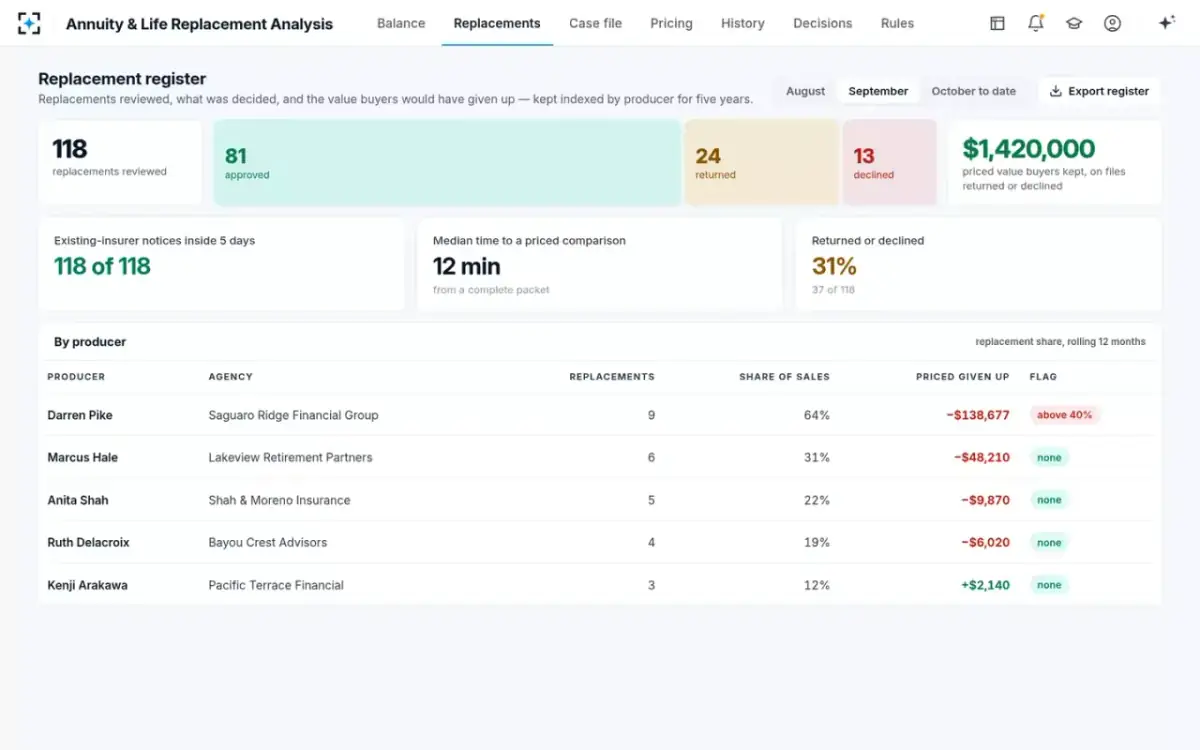
On the sample carrier's September, the register shows what a trial report looks like: 118 replacements reviewed, 81 approved, 24 returned and 13 declined, and $1,420,000 of priced value that buyers kept on the 37 files returned or declined. Those are figures from fictional sample data, not a customer's results. Your trial's version of that last number is the one to take to the chief compliance officer.
How long does an annuity replacement review take, with and without a tool?
The rules set the outer limits; the work sets the rest. A deferred variable annuity must be approved or rejected by a registered principal within seven business days of a complete package under FINRA Rule 2330, and the existing insurer must be notified within five business days under the NAIC model. Inside those windows, Botminds estimates one annuity replacement file at two to three hours by hand, most of it reading both contracts and pricing what is given up. The solution's design target is 12 minutes from a complete packet to a priced, cited comparison; on the sample file the agents' run took 11 minutes 40 seconds. A trial measures your number, which is the one that matters.
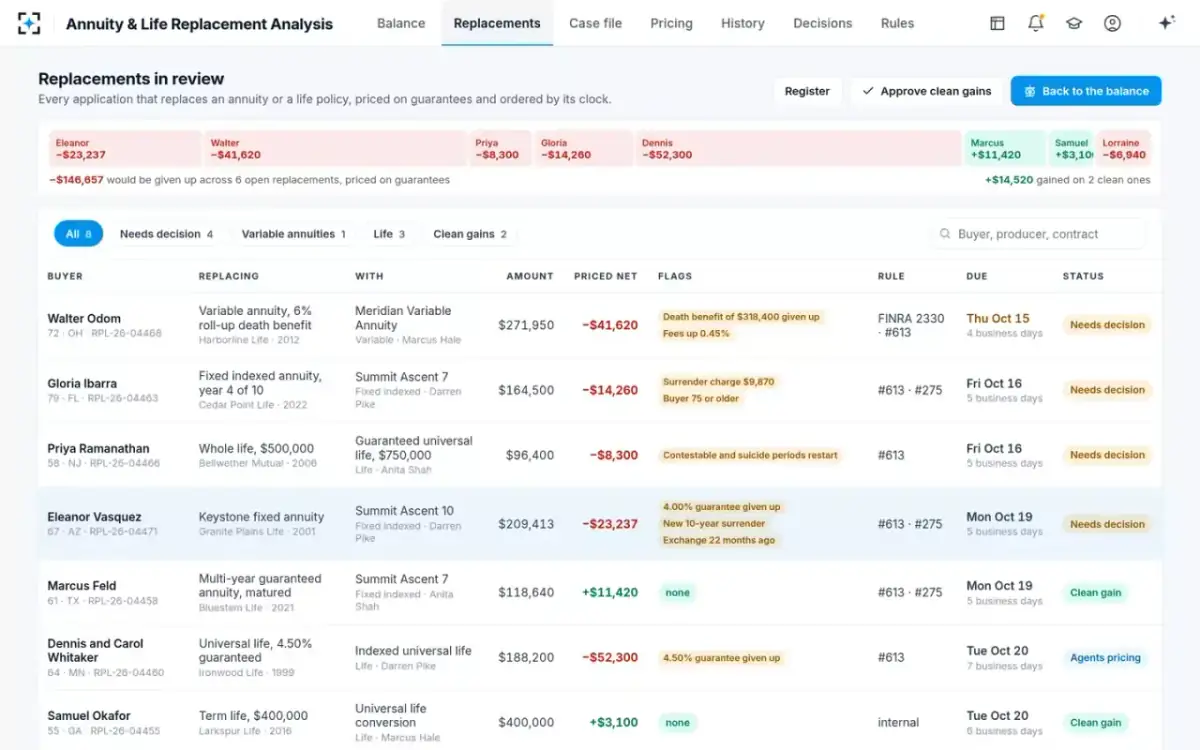
Every open replacement, priced on guarantees and ordered by its clock
Is there a free annuity comparison tool?
For owners, the most useful free comparison is the one the law already provides: the existing insurer's in force illustration or policy summary on request, set beside the new insurer's disclosure and, in New York, the signed disclosure statement with guaranteed and current columns for both contracts. Many consumer calculators compare new-purchase quotes; few can read an existing contract, which is what a replacement turns on. For reviewers, a spreadsheet built on the New York form's rows is a fair free baseline, and a trial should beat it on the files where it struggles: scanned contracts, riders and guarantees that need pricing.
What to look for in the best annuity comparison tool for reviewers, and where this one fits
Look for four things a demonstration rarely shows. It reads the old contract and its endorsements, not only a product database. It cites every value to a page a principal can open. It nets only guaranteed values and shows illustrations and surrender exposure separately. And it leaves the decision, the signature and every outgoing letter with a named person. Which review tasks agents take and which stay with the principal sets those lines out rule by rule.
Annuity & Life Replacement Analysis does those four things with six agents: a packet reader, a contract reader, a benefit pricer, an exchange history agent, a best-interest checker and a letter writer. It is not a consumer quote engine, a product shelf or a rate survey; the current guaranteed rate it prices against comes from a rate file the carrier owns. Its headline numbers, 12 minutes to a priced comparison and every given-up benefit priced before the decision, are design targets, and a trial on your files is how to test them. What unsuitable replacements have cost carriers is the case for running it. To start a trial, begin from Annuity & Life Replacement Analysis.
Questions people ask
How do principals compare annuities on a replacement?
They weigh the whole transaction: surrender charges and a new surrender period, benefits lost, fee changes, whether the new contract would substantially benefit the buyer, and earlier exchanges. FINRA expects principals to verify the representative's figures for fees, rider benefits and existing values, not just read the rationale.
What is an annuity exchange comparison form?
It is a side-by-side disclosure of the existing and proposed contracts given to the buyer before an exchange. FINRA lists using one as an effective practice, showing fees, surrender periods and any benefits lost, and New York prescribes its own disclosure statement for annuity-to-annuity replacements in Regulation 60, Appendix 10B.
Can an annuity comparison tool replace the principal's review?
No. FINRA Rule 2330 requires a registered principal to determine and sign the approval of a deferred variable annuity exchange, and state best-interest rules keep the insurer responsible for its review even when it uses a screening system. A tool can prepare the comparison; a person decides.
How many files does a fair trial need?
Enough to include the hard cases at least a few times each. Forty to sixty files, weighted toward old guaranteed contracts, living-benefit riders, life replacements and high-replacement producers, usually covers them; a random sample of clean files mostly tests the easy path.
Does a comparison need the buyer's suitability information?
To decide, yes. A priced comparison shows what changes; whether the change suits the buyer depends on age, liquidity needs, horizon and objectives, which the NAIC best-interest model and FINRA Rule 2330 require the seller to gather. The solution's best-interest checker sets the priced switch against that profile and drafts reasons, without deciding.