Twisting and churning penalties are the sanctions for inducing a policyholder to replace a life policy or annuity through misrepresentation or for the producer's gain rather than the buyer's: fines, forfeiture of commissions, suspension or revocation of the producer's or insurer's license, and restitution that restores the buyer's values with interest. Twisting is the misleading comparison that moves a policy to another insurer; churning, in states that define it, is the same abuse inside one insurer, using a policy's own values to buy a new one. The costs are not theoretical. New York's industry-wide inquiry into annuity replacements had reached 13 life insurers and about $29 million in restitution and penalties by 2022, and FINRA ordered nearly $1 million in restitution in a single 2026 exchange case. Botminds' Annuity & Life Replacement Analysis prices what each buyer gives up and tracks each producer's replacement pattern, so a reviewer sees an unsuitable switch before it is signed, not at the next examination.
The sample figures come from a fictional carrier, Larkspur Life & Annuity, and its fictional producers. Every case and sanction below is quoted from the regulator's own release or rule and linked where it appears; the firms in them neither admitted nor denied the findings unless stated.
What regulators have ordered over annuity replacements, 2018–2026
| Year and regulator | Who | What was found | Restitution and penalties |
|---|---|---|---|
| 2018 · NY DFS | One insurer | Replaced deferred with immediate annuities without obtaining the guaranteed income the old contract would pay or disclosing a payout comparison | $240,000 penalty, plus restitution with interest |
| 2019 · NY DFS | One insurer (broader exam) | Failed to give accurate comparisons of fees and expenses when moving customers to a new variable annuity | $1.5 million of restitution for that finding |
| 2019 · NY DFS | Six insurers | Deferred-to-immediate replacements without proper income comparisons and suitability information | $1,152,154 restitution, $673,000 penalties |
| 2020 · NY DFS | One insurer | The same | $5.4 million restitution, $5,529,000 penalties |
| 2020 · NY DFS | Three insurers | The same | $1,084,407 restitution, $934,000 penalties |
| 2020 · NY DFS | One insurer | The same, affecting hundreds of consumers | More than $6 million in restitution and penalties |
| 2022 · NY DFS | One insurer | The same; consumers “primarily elderly individuals” | About $3.4 million restitution, $2.24 million penalties |
| 2026 · FINRA | One broker-dealer | No surveillance of exchange rates; 22 inappropriate exchanges undetected | $150,000 fine, $129,938.79 restitution |
| 2026 · FINRA | One broker-dealer | Weak supervision of exchanges into living-benefit riders for 114 customers | $450,000 fine, $993,950.47 restitution |
What is twisting in insurance?
Twisting is inducing someone to drop, surrender, borrow on or replace a policy by misrepresentation or an incomplete comparison. Florida's statute is one of the clearest definitions: "Knowingly making any misleading representations or incomplete or fraudulent comparisons or fraudulent material omissions of or with respect to any insurance policies or insurers for the purpose of inducing, or tending to induce, any person to lapse, forfeit, surrender, terminate, retain, pledge, assign, borrow on, or convert any insurance policy or to take out a policy of insurance in another insurer" (Fla. Stat. § 626.9541(1)(l)).
The NAIC's Unfair Trade Practices Act reaches the same conduct through its misrepresentation clause: any estimate, illustration, sales presentation, omission or comparison that "Is a misrepresentation, including any intentional misquote of premium rate, for the purpose of inducing or tending to induce the purchase, lapse, forfeiture, exchange, conversion or surrender of any policy" (NAIC Model #880). The NAIC replacement model then links the two: "Any failure to comply with this regulation shall be considered a violation of" the state's twisting section (NAIC Model #613, Section 8). In model states, a replacement without the required notice is twisting by definition, whatever the producer intended.
What is churning in insurance, and how does it differ from twisting?
Churning uses a policy's own values to buy another policy from the same insurer, for the seller's benefit. Florida again: churning "is the practice whereby policy values in an existing life insurance policy or annuity contract, including, but not limited to, cash, loan values, or dividend values, and in any riders to that policy or contract, are directly or indirectly used to purchase another insurance policy or annuity contract with that same insurer for the purpose of earning additional premiums, fees, commissions, or other compensation", done without an objectively reasonable basis for an "actual and demonstrable benefit to the policyholder", deceptively, or without telling the buyer the old values will be reduced or that new premiums will fall due.
Twisting and churning: the same harm, two directions
Twisting: From one insurer to another.
Churning: Within the same insurer, using the old policy’s values.
Twisting: Misleading representations, incomplete comparisons or material omissions to induce the switch.
Churning: A switch for the seller’s compensation without a reasonable basis for real benefit, or without disclosing what the old values will lose.
Twisting: A comparison that omits guarantees, surrender charges or lost benefits; a notice never sent.
Churning: Repeated internal replacements by one producer; financed purchases with no disclosure of when old values run out.
Twisting: Replacement procedures and producer monitoring under Model #613.
Churning: In Florida, written procedures “to reasonably avoid churning”, whose absence is itself a violation.
Florida makes the insurer answerable too: "Each insurer shall adopt written procedures to reasonably avoid churning of policies or contracts that it has issued, and failure to adopt written procedures sufficient to reasonably avoid churning shall be an unfair method of competition and an unfair or deceptive act or practice." That is the most direct statement in any statute that detection is the carrier's job, not only the regulator's.
What are the penalties for twisting? The menu regulators can use
Under the NAIC replacement model, violations "shall subject the violators to penalties that may include the revocation or suspension of a producer's or company's license, monetary fines and the forfeiture of any commissions or compensation paid to a producer as a result of the transaction". Where the violations were material to the sale, the insurer "may be required to make restitution, restore policy or contract values and pay interest" on any cash refunded. The model's own drafting note asks each state to check it has the authority, so the menu varies.
The NAIC's Unfair Trade Practices Act model sets fine ceilings of its own: "a monetary penalty of not more than $1,000 for each violation, but not to exceed an aggregate penalty of $100,000, unless the violation was committed flagrantly in a conscious disregard of this Act, in which case the penalty shall not be more than $25,000 for each violation not to exceed an aggregate penalty of $250,000". Breaking a cease-and-desist order adds up to $25,000 per violation. New York's Regulation 60 lists its own: penalties "which may include monetary restitution, restoration of policies or contracts, removal of directors or officers, suspension or revocation of agent's, broker's or company's licenses, and monetary fines" (11 NYCRR 51.7).
Read the table above against that menu and a pattern shows. Fines on a single case are rarely the largest cost. Restitution is, together with the work of finding every affected buyer and, in New York's settlements, paying "higher monthly payout amounts for the remainder of their contract terms" for years after the order (NY DFS, September 2019).
New York's deferred-to-immediate replacement cases: restitution plus penalties per action
What is an unsuitable replacement? The New York cases, read closely
An unsuitable replacement is one the buyer would not have made with the comparison the rules require. New York's cases show it precisely. Replacing a deferred annuity with an immediate one can be sensible, but the buyer needs to know what the old contract would pay if annuitized. In the first case, DFS found the insurer "did not obtain information to determine the suitability of replacing deferred with immediate annuities, including information about the amount of guaranteed income that would be available if a contract holder's existing deferred annuity was annuitized" (NY DFS, December 2018). Later releases describe consumers who received "less income for identical or substantially similar payout options" (NY DFS, April 2020).
The corrective actions are a checklist any carrier can use: revise disclosure statements "to include side-by-side monthly income comparison information", and revise disclosure, suitability and training procedures. The NAIC model, by contrast, exempts immediate annuities bought with proceeds of an existing annuity from its notice rules, which is one reason New York reached cases other states did not. New York's Regulation 60 covers the rule those cases enforced.
The same failure appears in variable annuity exchanges. In January 2019 a broad DFS examination of one insurer included $1.5 million in restitution "to consumers whom the insurer failed to provide with accurate comparisons of fees and expenses when transferring from an existing to a new variable annuity contract" (NY DFS, January 2019). The FINRA cases of 2026 found principals left without guidance on whether a new rider's growth credit justified its higher fees for customers about to start withdrawals, and one representative who did not reasonably compare six senior customers' existing and proposed living benefit riders (FINRA, April 2026).
Why replacement abuse persists, in four numbers
13
life insurers settled New York’s replacement inquiry by May 2022, ≈ $29M in total
4×
how much more variable annuity sales responded to brokers’ financial interests than to investors’
52%
fall in sales of high-expense variable annuities after the 2016 proposed fiduciary rule
$8,719
average extra cost per customer of exchanges in one 2026 FINRA case
How do regulators detect churning and twisting?
Mostly by counting, and by expecting carriers to count first. The NAIC model requires each insurer to be able to produce, for each producer, life replacements "as a percentage of the producer's total annual sales for life insurance", lapses as a percentage of sales, annuity replacements as a percentage of annuity sales, the unreported replacements its own monitoring detected, and "Replacements, indexed by replacing producer and existing insurer". Those are the ratios an examiner asks for, and the ones a carrier should watch monthly.
The model also turns a pattern into evidence. Owners may replace after saying they would not, "however, patterns of such action by policy or contract owners of the same producer shall be deemed prima facie evidence of the producer's knowledge that replacement was intended". New York's Regulation 60 says the same in nearly the same words. On the securities side, Rule 2330(d) requires "surveillance procedures to determine if any of the member's associated persons have rates of effecting deferred variable annuity exchanges that raise for review" whether they are inappropriate, and corrective measures when they are (FINRA Rule 2330). One of the 2026 firms had no report or review doing that at all.
The producer's pattern, found while his files are still open
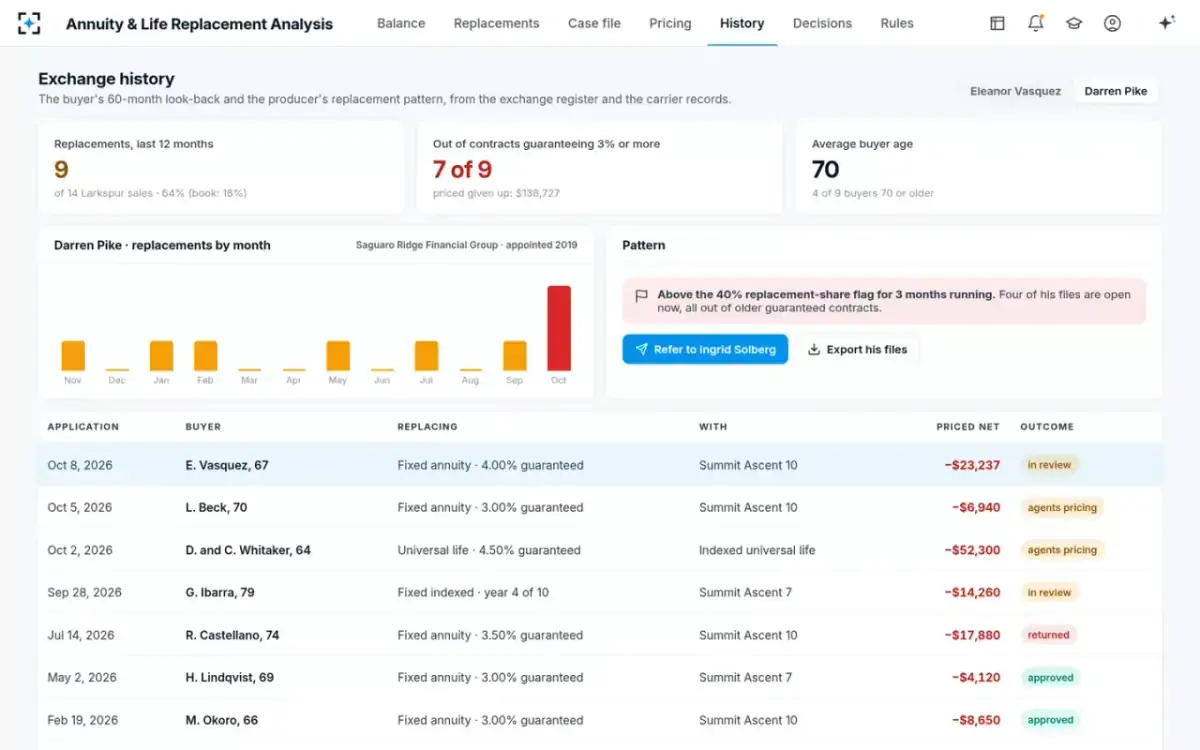
The sample carrier's producer screen is that ratio made visible. One fictional producer wrote 9 replacements in 12 months, 64% of his sales with the carrier against a book average of 18%, and 7 of the 9 came out of contracts guaranteeing 3% or more. The solution flags him above the carrier's 40% replacement-share threshold for three months running, while four of his files are still open, with a referral to sales-practice compliance one click away. Under the model's prima facie rule, that is the pattern an examiner would ask the carrier to explain. Which parts of exchange review agents can take on shows where the referral sits in the workflow.
Is churning illegal?
Where a state defines it, yes. Florida calls churning by an insurer or an agent "an unfair method of competition and an unfair or deceptive act or practice", which brings the unfair trade practices penalties with it. Where a state has no churning clause, the same conduct is usually reached through the twisting, misrepresentation and replacement rules, because an internal replacement that is not exempt still needs the notice and the comparison. Not every internal exchange is churning: a conversion privilege or a program the regulator approved is expressly outside the NAIC replacement model.
Can a consumer get restitution for a bad annuity replacement?
Often, through the regulator rather than a lawsuit. Restitution, restored values and interest are in the NAIC model's penalty menu, New York's settlements paid both lump sums and higher payouts for life, and FINRA routinely orders restitution in exchange cases, such as the $129,938.79 in "unnecessary surrender fees" refunded to 14 customers in one 2026 case. In New York a buyer also has 60 days after delivery of a replacement to return it and have the old contract reinstated without new underwriting; elsewhere the model's return period is 30 days. What happens to the old contract after a return covers the limits of that right.
The cheaper path for everyone is the one regulators keep pointing to: a comparison made on the right basis before the money moves. That is where Annuity & Life Replacement Analysis works. It prices every benefit the buyer gives up on guaranteed values, flags a second exchange inside the look-back, drafts the reasons, and refers a producer above the carrier's threshold while files are open. The principal decides; a switch priced as a loss needs a written reason and a second approver. To see the producer view and the priced balance on your own files, start from Annuity & Life Replacement Analysis.
Questions people ask
What is the difference between twisting and churning?
Twisting moves a policy to another insurer through misrepresentation or an incomplete comparison. Churning, as Florida defines it, uses a policy's values to buy another policy from the same insurer for the seller's compensation, without a reasonable basis for real benefit or without disclosure. Both are unfair trade practices where the state defines them.
Can a producer lose a license for twisting?
Yes. The NAIC replacement model lists revocation or suspension of a producer's or company's license among the penalties, alongside fines and forfeiture of commissions. New York's Regulation 60 lists suspension or revocation of an agent's or broker's license, and FINRA can suspend or bar registered representatives.
Is an internal replacement ever churning?
It can be, if it uses the old policy's values for the seller's gain without a real benefit or without disclosure. Exempt internal changes, such as exercising a contractual conversion privilege or a program approved by the commissioner, are outside the NAIC replacement model, and Florida requires each insurer to have written procedures to avoid churning its own policies.
What is a replacement ratio, and is there a legal limit?
It is a producer's replacements as a share of sales. The NAIC model requires insurers to be able to produce it for each producer, separately for life and annuities, but sets no legal maximum. Thresholds are a carrier's own setting; the sample carrier flags producers above 40% over a rolling 12 months.
Do twisting rules apply to variable annuities?
Yes, on both sides. Variable annuities are insurance contracts covered by state replacement and unfair trade practices rules, and securities covered by FINRA Rule 2330 and the SEC's Regulation Best Interest. A single exchange can draw both a state insurance penalty and a FINRA sanction. Which state rule governs a fixed or indexed exchange is set out in NAIC best interest states, and what the commission research means now that the federal rule is gone in the DOL fiduciary rule in 2026.