A guaranteed minimum interest rate on a fixed annuity is the lowest rate the insurer promises to credit for as long as the guarantee lasts, often the life of the contract; the declared or current rate can move, but never below it. In the NAIC's own model disclosure for a fixed annuity, the wording is: "After the Initial Interest Guarantee Period, a new interest rate will be declared annually. This rate cannot be lower than the Minimum Guaranteed Interest Rate." In a replacement that guarantee is what the buyer gives up, and it is easy to lose sight of: the old contract's 4.00% shows on the statement as a declared rate, the new contract's illustrated 4.35% looks higher, and a file can be complete, signed and still compare the wrong numbers. Botminds' Annuity & Life Replacement Analysis reads the guarantee from the old contract, cites its page, and prices it in dollars at the buyer's horizon, so the principal sees what the switch costs on guarantees before deciding.
The worked figures come from one fictional sample file at Larkspur Life & Annuity: Eleanor Vasquez, 67, moving $209,412.86 from a 2001 fixed annuity guaranteeing 4.00% for life into a fixed indexed annuity with an 8% bonus. Rules and rates are quoted from the NAIC, the SEC, FINRA and the US Treasury.
One file, two comparisons: complete is not the same as correct
The comparison the buyer was shown: Current 4.00% against illustrated 4.35%: the new contract looks ahead.
The same file priced on guarantees: Old: 4.00% guaranteed for life (contract p.4). New: 0% index floor. Given up: −$38,010 at her 15-year horizon.
The comparison the buyer was shown: 8% bonus, $16,753, shown as a gain.
The same file priced on guarantees: +$16,753, vesting 10% a year, fully vested after year 10.
The comparison the buyer was shown: New 10-year schedule listed in the specification.
The same file priced on guarantees: $22,617 at risk in year 1; shown year by year, never netted.
The comparison the buyer was shown: Not mentioned.
The same file priced on guarantees: Old: greater of value or premiums paid. Given up: −$1,980.
The comparison the buyer was shown: $51,224 ahead at 82, as illustrated.
The same file priced on guarantees: −$23,237 on guarantees. To match the old guarantee the new contract must credit 3.47% a year for 15 years.
What is a guaranteed minimum interest rate on a fixed annuity?
It is a guaranteed element of the contract: a crediting rate the insurer cannot go below. The NAIC's Annuity Disclosure Model Regulation (#245) draws the line every reviewer needs. "Guaranteed elements" are the premiums, "credited interest rates (including any bonus)", benefits, values and charges "that are guaranteed or have determinable elements at issue". Non-guaranteed elements are the same items "that are subject to company discretion and are not guaranteed at issue" (NAIC Model #245).
A fixed deferred annuity usually carries two guaranteed rates and one that is not. The initial guaranteed rate holds for a stated period, such as five years. The minimum guaranteed rate applies after it, for the rest of the contract. The declared rate, set by the insurer each year after the initial period, is the non-guaranteed element: it can be higher than the minimum, and when rates fall it drifts down to it. In the sample file, the 2001 contract's statement shows a 4.00% declared rate sitting at its guaranteed floor. The rate on the statement and the guarantee in the contract are the same number, but only one of them is a promise.
The model requires the disclosure to say so: "Minimum guarantees shall be clearly explained", and illustrations must use non-guaranteed elements "no more favorable than current" ones, with any planned change after an initial guaranteed or bonus period shown.
What is the difference between the guaranteed rate and the current rate?
The guaranteed rate is fixed in the contract; the current rate is what the insurer chooses to credit now. The current rate can rise above the guarantee when new money earns more, and can be cut back to it at the next declaration. On an indexed annuity, the equivalent levers are the cap, participation rate and spread. The SEC's investor bulletin warns: "Indexed annuity contracts commonly allow the insurance company to change some of these features periodically, such as the rate cap. Changes can affect your return." (SEC Office of Investor Education and Advocacy, Updated Investor Bulletin: Indexed Annuities, 2020).
That asymmetry is the whole replacement problem. The old contract's guarantee is a floor the buyer already owns. The new contract's illustrated rate is a current-rate assumption. A comparison that sets one against the other is comparing a promise with a projection, and the arithmetic will usually favour the projection.
"Illustrations should not, however, be used as a sole basis to compare policies or contracts."
NAIC Model #613, Appendix A, the replacement notice the buyer signs
Can an insurer lower my annuity rate?
It can lower the current rate, but not below the guaranteed minimum. After an initial guarantee period ends, the insurer declares a new rate, and the contract's minimum is the floor. Nothing in that process is unusual; it is how fixed annuities are priced. What the owner cannot lose, unless the contract ends, is the minimum itself. That is why surrendering an old contract to buy a new one is different from riding out a rate cut: the cut is temporary and bounded, while the surrender gives up the floor for good.
Two contract features can blunt that floor and belong in any comparison. A market value adjustment, as Model #245 defines it, can raise or lower the account or cash value when money is withdrawn or the contract surrendered outside a guaranteed date, depending on an external index or the insurer's current rates. And a surrender charge applies to early withdrawals above any free amount. On an old contract past its surrender schedule, neither usually bites; on the new one, both start again.
Are old annuity guaranteed rates higher? The legal floor, then and now
Often, but not always, and the reason is a formula. The NAIC's Standard Nonforfeiture Law for Individual Deferred Annuities (#805), amended in 2003 and again in 2020, sets the minimum values a deferred annuity must provide. Its interest rate is "the lesser of three percent (3%) per annum" and the five-year Constant Maturity Treasury rate "Reduced by 125 basis points", provided "the resulting interest rate is not less than 15 basis points (0.15%)" (NAIC Model #805, Section 4B). Minimum values build at that rate on 87.5% of the premiums paid, less a $50 annual charge and any premium tax actually paid.
The legal floor on deferred annuity values moved from 0.15% to 3% in three years
Three points follow for a replacement reviewer. First, the nonforfeiture rate is a floor on surrender values, not the crediting guarantee itself; a contract may promise a higher minimum, as the sample's 2001 contract does at 4.00%. Second, a contract issued at the end of 2020 or 2021 could meet the law with a floor as low as 0.15%, so a newer replacement contract can genuinely carry better guarantees than an older one. Third, at today's yields the formula's 3% cap binds: a contract issued in October 2026 has to support minimum values at 3% on 87.5% of premium, less for an indexed design. The age of a contract tells you to look; only the contract page tells you what the floor is.
How do you value an annuity guarantee? Price what it would cost to buy again
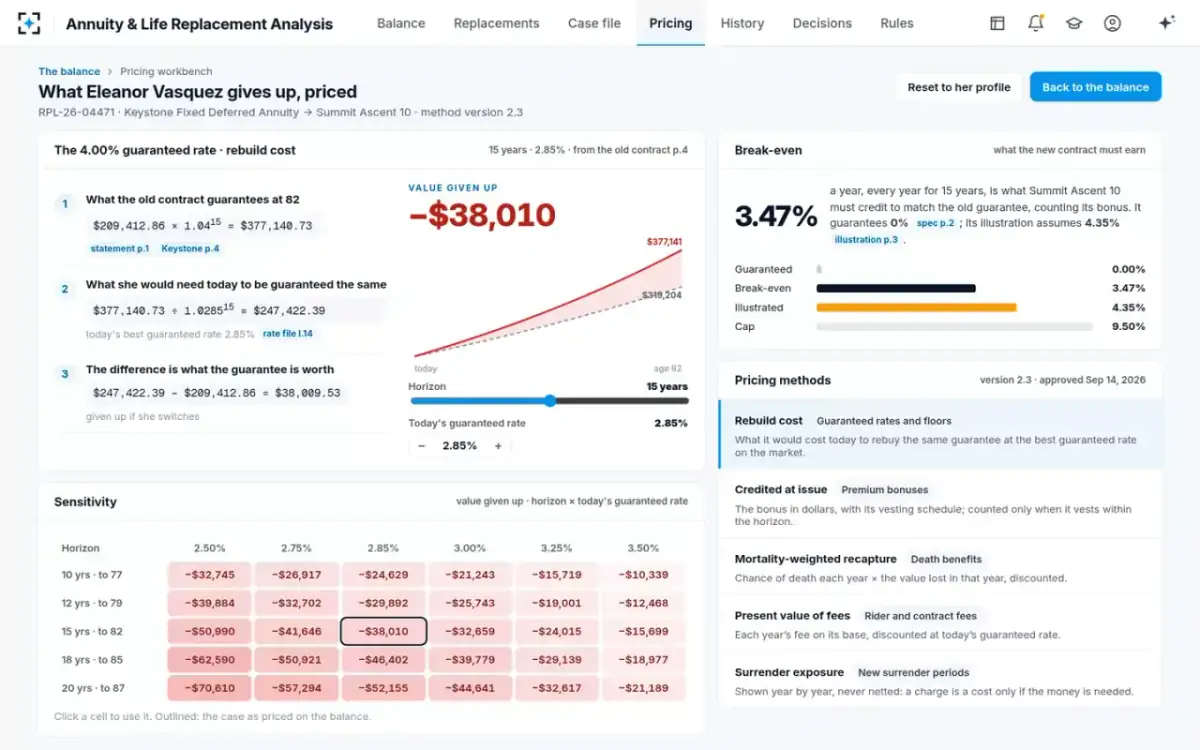
The most direct method is rebuild cost: what the buyer would have to deposit today, at the best guaranteed rate now available, to be promised the same amount the old contract already promises at her horizon. The difference between that deposit and her current value is what the guarantee is worth to her. It uses only guaranteed numbers and a horizon the buyer has stated, so it can be checked line by line.
Rebuild cost: the 4.00% guarantee, priced at a 15-year horizon
What the old contract guarantees at 82
$209,412.86 × 1.04¹⁵ = $377,140.73
Current value from the 30 September statement; 4.00% for life from the contract, page 4.
Contract reader
What she would need today for the same guarantee
$377,140.73 ÷ 1.0285¹⁵ = $247,422.39
2.85% is the sample rate file’s best 10-year-plus guaranteed rate from A-rated carriers.
Benefit pricer
Value given up by switching
$247,422.39 − $209,412.86 = $38,009.53
Shown as −$38,010. Netted against the bonus and death benefit only on guaranteed values.
Benefit pricer
Every input is a choice, and the method shows it. At a 10-year horizon and a 3.50% market rate the same guarantee is worth $10,339 on the sample's sensitivity grid; at 20 years and 2.50% it is worth $70,610. The point is not one number but a range a principal can read: in no cell of the grid is the guarantee worth nothing. Against it, the solution sets the gains in the same currency. The 8% bonus is $16,753, credited at issue. The old contract's death benefit, the greater of value or premiums paid, is priced at −$1,980 by mortality-weighted recapture. The net, on guarantees, is −$23,237.
The pricing workbench: the method in three steps, and the break-even
Why a complete replacement file can still compare the wrong numbers
Because the forms ask whether a comparison was made, not whether it was made on the right basis. Regulators keep finding the gap. FINRA's 2026 oversight report lists paperwork that misstated the economics of an exchange, including "understating surrender charges", and recommends exchange disclosures that spell out every benefit lost with the old contract, including a benefit base above the account value (FINRA 2026 oversight report: Annuities; the full list is in annuity exchange technology). New York's industry-wide cases on deferred-to-immediate replacements turned on the same failure: insurers "failed to properly disclose to consumers income comparisons and suitability information", so consumers swapped "more financially favorable deferred annuities" for immediate ones (NY DFS, September 2019).
New York's own disclosure statement for annuity replacements shows what a correct comparison looks like on paper. Its summary table has, for both the proposed and the existing contract, a column "At Guaranteed Rate" beside one "At Current Rate", with surrender values and death benefits at 5 and 10 years (NY DFS Regulation 60, Appendix 10B). Put the guaranteed columns side by side and the sample file's answer is visible before any pricing. How New York's replacement rules differ from the NAIC model covers the rest of that form.
Where a guaranteed rate hides in a replacement packet
| Document | What it usually says | What the reviewer needs from it |
|---|---|---|
| Old contract, rate page | The minimum guaranteed rate and how long it lasts, sometimes by endorsement | The rate, its duration, and any later endorsement that changed it |
| Annual statement | The declared rate, often equal to the guarantee | The current value, and whether the declared rate is at the floor |
| Producer’s comparison | Old current rate against new illustrated rate | Whether the word “guaranteed” appears beside the old rate |
| New product specification | Index floor, caps, bonus vesting, surrender schedule | The new contract’s guaranteed elements only |
| Illustration | Values at an assumed crediting rate | Context for the buyer’s expectations, never a netted gain |
Should I keep an annuity with a 4% guarantee? The break-even test
The question a reviewer can answer is narrower than the one a buyer asks: what would the new contract have to earn to be worth the switch on guarantees? On the sample file it is 3.47% a year, every year for 15 years, counting the bonus. The new contract guarantees 0%; its illustration assumes 4.35%. The illustration may be met. It is not promised, and the old 4.00% is. Whether a buyer should take that bet depends on things a rate cannot show: her liquidity needs, her horizon, her other contracts under surrender charges, and why she is being offered the switch.
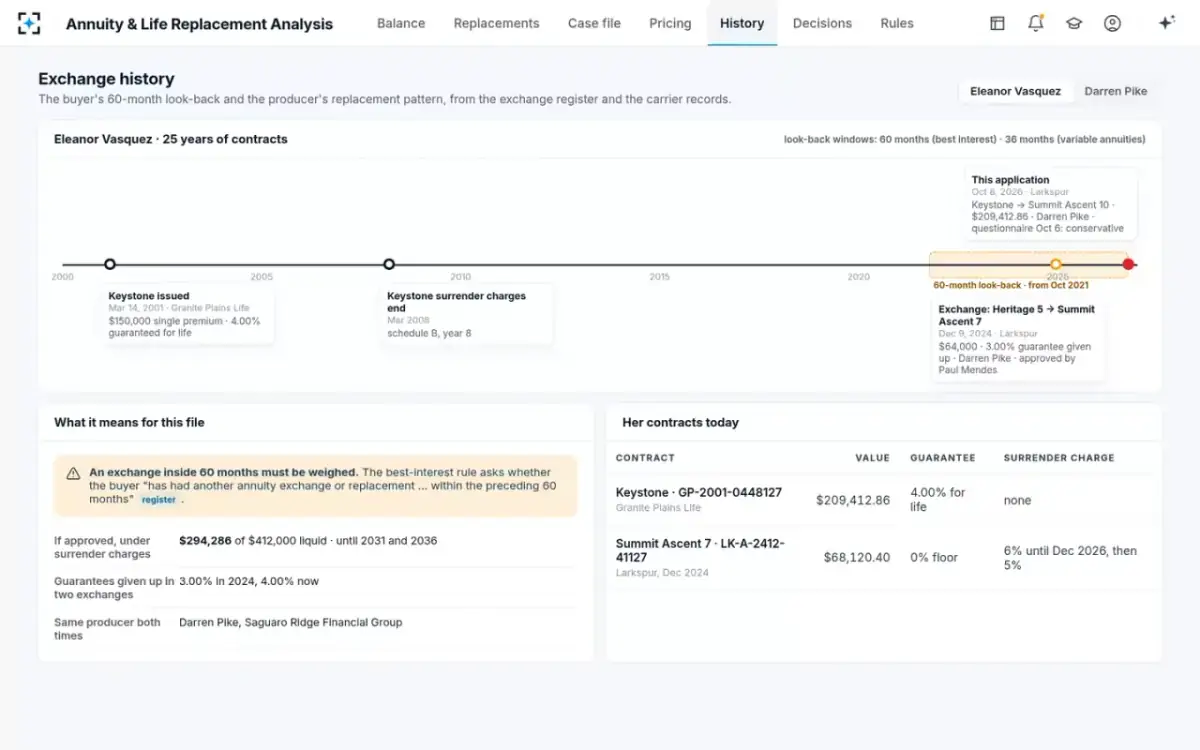
The sample file shows how those facts stack up. The buyer had already exchanged one contract 22 months earlier through the same producer, and approving this one would have put $294,286 of her $412,000 of liquid money under surrender charges until 2031 and 2036. The principal returned the file with the priced comparison attached. Annuity bonus recapture works through the bonus side of the same trade: how the bonus vests and what it nets against.
The buyer's look-back: what the 4.00% guarantee has outlived
Where Annuity & Life Replacement Analysis prices the guarantee, and where people decide
The contract reader reads the old contract, its endorsements and the latest statement, and extracts the guaranteed minimum rate with the page it came from; it never infers a guarantee it cannot cite, and low-confidence values go to a person. The benefit pricer applies the named method, rebuild cost for guaranteed rates and floors, and nets only guaranteed values; illustrated rates and surrender exposure are shown but never netted, a setting the carrier can see and change. The principal moves the horizon or the market rate, reads the break-even, and decides.
The method is only as good as its rate file, and the sample carrier refreshes its best guaranteed rate weekly. A carrier adopting the method should own that input, review it like any pricing assumption, and replay last month's files when it changes. A trial run on replacements already signed is the way to see how many past files the method would have read differently. To price a guarantee on one of your own files, start from Annuity & Life Replacement Analysis.
Questions people ask
Is the guaranteed minimum interest rate the same as the minimum nonforfeiture rate?
No. The nonforfeiture rate in NAIC Model #805 sets the minimum surrender and paid-up values the law requires, built on 87.5% of premiums. The guaranteed minimum interest rate is a contract promise on the account value, and it is often higher. A replacement review should compare the contract guarantees, with the nonforfeiture floor as the lower bound.
What is a bailout rate on an annuity?
Some contracts include a provision that waives the surrender charge if the declared rate falls below a stated level, so the owner can leave without penalty. Whether a contract has one, and at what level, is in its rate and surrender provisions; it is worth checking on the new contract before a buyer accepts a long surrender schedule.
Does a fixed indexed annuity have a guaranteed minimum interest rate?
It has guarantees, but they usually work differently: an index floor, often 0%, limits losses in a crediting period, and minimum surrender values follow the nonforfeiture law. The SEC notes that indexed annuities it does not regulate "include minimum guarantees that limit and in many cases eliminate the potential for investment losses". A 0% floor is not the same promise as a 4% minimum rate.
Can I keep my old guarantee and still buy a new annuity?
Yes, by funding the new contract with other money, or by a partial exchange that leaves the old contract in force with a smaller value. A partial exchange keeps the guarantee on what remains, and Rev. Proc. 2011-38 sets a 180-day test for withdrawals from either contract afterward. The 1035 exchange form explains the partial-exchange fields.
Why do illustrations show higher values than guarantees?
Because they include non-guaranteed elements at current levels. NAIC Model #245 lets an illustration use non-guaranteed elements "no more favorable than current" ones, and requires the guaranteed values to be shown and labelled. The replacement notice warns that illustrations should not be the sole basis for comparing contracts.