The free look period on an annuity is the window after delivery in which the owner can return the contract and get the money back without a surrender charge. Its length depends on the rule that applies: the SEC tells investors it is "usually 10 to 30 days"; NAIC rules require at least 15 days when the annuity buyer's guide and disclosure came late, and 30 days when the annuity replaces an existing life policy or annuity; New York gives 60 days on a replacement. For a replacement, the free look is the last check on the whole transaction, and it has a gap the rules mostly leave open: returning the new contract does not, outside New York, bring back the old one. Botminds' Annuity & Life Replacement Analysis tracks the right-to-return clock on every replacement file, alongside the notices, and flags the parts of a switch that do not reverse, such as a fresh contestable and suicide period on a life replacement.
Examples from the solution use a fictional sample carrier, Larkspur Life & Annuity. The rules are quoted from the NAIC models, New York's Regulation 60 and the SEC, and linked where they appear.
How long a buyer has to return a new contract, by the rule that applies
How long is the free look period on an annuity?
There is no single number; there are several floors, and the longest that applies wins. The SEC's investor guidance describes the general practice: "You may cancel your contract within a short period (usually 10 to 30 days) of receiving it without a penalty fee called a surrender charge. This is called the free look period." It adds that "Your contract should prominently state how long your free look period is and how to return your contract." (SEC, Investor.gov: Variable Annuities).
The NAIC's annuity disclosure model sets one floor tied to paperwork: if the buyer's guide and disclosure document were not given at or before the application, the buyer gets at least 15 days to return the annuity without penalty, running at the same time as any other free look under state law, so it never adds to a longer one (NAIC Model #245). For life insurance, the disclosure model lets the buyer's guide arrive with the policy only if the policy "contains an unconditional refund provision of at least ten (10) days" (NAIC Model #580).
Is the free look 30 days for a replacement?
Under the NAIC replacement model, yes. The replacing insurer must give the owner "notice of the right to return the policy or contract within thirty (30) days of the delivery of the contract and receive an unconditional full refund of all premiums or considerations paid on it, including any policy fees or charges". The notice can sit in the replacement notice itself. New York doubles it: "Any insurer that issues a replacement life insurance policy or annuity contract shall provide to the policy or contract owner the right to return the policy or contract within 60 days from the date of delivery" (11 NYCRR 51.6(d)).
Two practical points follow for a processing team. The longer replacement period applies even when the buyer's guide arrived on time, because it attaches to the replacement, not the paperwork. And the state that governs is the one where the contract is delivered; the NAIC's state page shows most states on some version of the model, a few on older text and New York on its own (NAIC state page for Model #613). The other clocks a replacement starts run before delivery; this one runs after.
Free look rules side by side: who owes it, from when, and what comes back
| Rule | Applies to | Clock starts | What the owner gets back |
|---|---|---|---|
| NAIC #580 | Life policies whose buyer’s guide comes with the policy | Delivery | Unconditional refund, at least 10 days |
| NAIC #245 | Annuities when the guide or disclosure came after the application | Delivery | Return without penalty, at least 15 days, concurrent with other free looks |
| NAIC #613 | Replacements of life insurance or annuities | Delivery of the new contract | Full refund of premiums and fees; for variable or MVA contracts, cash surrender value plus fees and charges deducted |
| NY Regulation 60 | Replacements delivered in New York | Date of delivery | The same refund, paid within ten days, and reinstatement of the old contract on conditions |
When does the free look start?
On delivery of the new contract, not on the application or the issue date. Both the NAIC model and New York count from delivery, which is why a carrier needs a delivery date it can prove: a mailed contract, an electronic delivery confirmation or a producer's signed delivery receipt. A file that records only the issue date cannot show when the owner's right expires. In practice the clock on a replacement can therefore run well after the existing insurer has paid out, which is the root of the problem below.
Do you get your money back in the free look period?
On a fixed annuity, all of it. The NAIC model requires "an unconditional full refund of all premiums or considerations paid on it, including any policy fees or charges". On a variable or market value adjusted contract the refund is different: "a payment of the cash surrender value provided under the policy or contract plus the fees and other charges deducted from the gross premiums or considerations or imposed under such policy or contract". The owner gets the fees back but bears the market movement during the free look. The SEC says the same in plain words: the refund "may be adjusted up or down to reflect the performance of your investment options".
New York adds a deadline on the insurer: "Payment of such refund shall be made within ten days following receipt of the policy or contract for cancellation". Its notice to buyers warns that on a variable or market value adjusted contract "THE VALUE OF THE POLICY OR CONTRACT MAY INCREASE OR DECREASE DURING THE 60 DAY PERIOD" (NY DFS Regulation 60, Appendix 10C).
What happens to my old annuity if I cancel the new one?
Under the NAIC model, nothing restores it. The model's free look refunds the new contract; it places no duty on the existing insurer to take the old one back. If the old contract was surrendered to fund a 1035 exchange, the surrender charges paid, the guarantee given up and any rider ended stay ended unless the old insurer agrees otherwise. That is the gap a buyer should know about before signing, and the reason the comparison has to be right the first time.
New York closes it. During the 60 days, the existing insurer "shall reinstate or restore, without underwriting or a new contestable or suicide period, such policy or contract as of the date of replacement", once it receives written proof the new contract was cancelled, any funds it released, and any premium due from the paid-to-date (11 NYCRR 51.6(d)). It reinstates "to the extent possible and in accordance with its published reinstatement rules".
Returning a replacement: what reverses, and what may not
A person decides
Owner returns the new contractWithin 30 days of delivery under the NAIC model, 60 in New York, as the contract states.
A person decides
Replacing insurer refundsPremiums and fees on a fixed contract; cash surrender value plus fees on a variable or MVA contract. Within ten days in New York.
A person decides
Existing insurer, in New YorkReinstates the old contract as of the replacement date, without underwriting or a new contestable or suicide period, on proof of cancellation and return of funds released.
Never: Outside New York the NAIC model imposes no such duty.
A person decides
Owner, everywhereChecks what did not come back: interest or investment performance while replaced, any tax effect, and riders or guarantees the old insurer will not restore.
Even in New York the restoration is not perfect, and the state's own notice says so. The right "SHOULD NOT BE VIEWED AS REINSTATING OR RESTORING YOUR LIFE INSURANCE POLICY OR ANNUITY CONTRACT TO THE SAME CONDITION AS IF IT HAD NEVER BEEN REPLACED." It applies "ONLY TO COMPANIES SUBJECT TO NEW YORK INSURANCE LAWS"; the owner "MAY NOT RECEIVE THE INTEREST OR INVESTMENT PERFORMANCE DURING THE PERIOD" the contract was replaced; and "THERE MAY BE UNFAVORABLE FEDERAL INCOME TAX CONSEQUENCES" from reinstatement. New York's Regulation 60 covers the rest of its replacement rules.
Does the free look apply to 1035 exchanges?
Yes: the new contract issued in a 1035 exchange is a replacement contract, and the right to return it applies like any other. The harder question is where the refund goes and how it is taxed once the old contract no longer exists. The model rules say what the replacing insurer must refund, not to whom or on what tax footing for an exchange, and New York's notice warns that reinstatement itself can carry tax consequences. An owner who is thinking about returning an exchanged contract should ask both insurers, before returning it, how the refund will be paid and reported, and take tax advice. The 1035 transfer request shows why the payment route matters to the tax.
A life replacement restarts the contestable and suicide periods
On life insurance, the free look is not the only thing that starts again. The NAIC replacement notice tells the buyer: "Claims on most new policies for up to the first two years can be denied based on inaccurate statements" and "Suicide limitations may begin anew on the new coverage." New York's notice is blunter: "The incontestable and suicide clauses begin anew in a new life insurance policy. This could result in a claim being denied under the new life insurance policy that would have been paid under the life insurance policy that was replaced."
The NAIC model softens this only for replacements within one group: where the replacing and existing insurers are the same or affiliated, the insurer must credit the time already elapsed under the old contract's incontestability and suicide periods, up to the old face amount. A free look gives the owner time to reconsider; it does not shorten a contestable period that has already restarted. That is why the solution flags every life replacement for the restart, separately from the price of the switch.
The buyer's free look sits beside the other clocks on the file
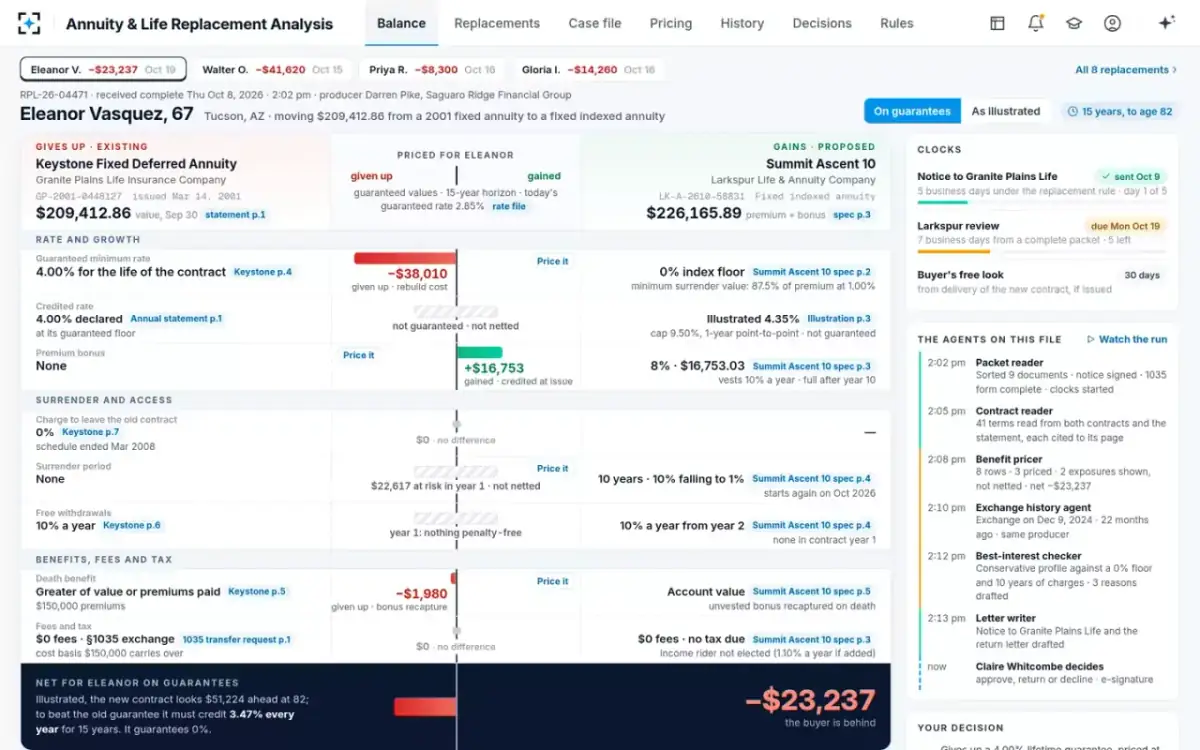
What a replacement team should track after the new contract is delivered
The free look is the end of the file for the buyer and the start of the tail for the carrier. The replacing insurer has duties after delivery: in New York it must send the completed disclosure statement and a list of the sales material to the existing insurer "within ten days of the delivery", and where an insurer uses the NAIC model's alternative for company-approved sales material it must contact the applicant within ten days of issue through someone outside its marketing area. Each of those depends on a known delivery date.
After delivery: the replacement tail, item by item
- Record the delivery date the free look runs from
Not the issue date. The owner’s right and the carrier’s refund deadline both count from delivery.
- Set the expiry by state
30 days on the NAIC model; 60 days in New York; longer if the contract says so.
- Hold the refund method ready
Full premiums and fees for fixed contracts; cash surrender value plus fees for variable and MVA contracts; ten days to pay in New York.
- In New York, send the disclosure statement to the existing insurer
Within ten days of delivery, with a list of the sales material and an offer to provide copies.
- Flag a restarted contestable and suicide period
On every life replacement, and give credit for elapsed time where the old insurer is an affiliate.
- Keep the file indexed by producer
Notices, sales material and signed statements for at least five years under the NAIC model.
In Annuity & Life Replacement Analysis those clocks sit on the file from the moment the packet is complete, and the rule set for each state, including New York's, is versioned with a named owner. The letter writer drafts the notices; people send them. The best use of a free look, though, is not needing it: a buyer who saw the priced comparison before signing has less reason to return the contract after. To see the clocks and the comparison on one file, start from Annuity & Life Replacement Analysis.
Questions people ask
Is the free look period the same in every state?
No. The NAIC models set floors that states adopt with their own variations, and some states set longer periods. On a replacement the model gives 30 days from delivery and New York gives 60. The contract itself must state the period, and a longer contractual period applies over a shorter legal one.
Can an insurer charge a surrender charge during the free look?
No; that is the point of the free look. The SEC describes it as cancelling "without a penalty fee called a surrender charge", and the NAIC replacement model requires an unconditional full refund on fixed contracts. Variable and market value adjusted contracts refund the cash surrender value plus fees, so market movement can change the amount.
What is the free look period for a variable annuity?
The same rules apply, with a different refund. Under the NAIC replacement model the owner of a variable or market value adjusted contract gets "the cash surrender value provided under the policy or contract plus the fees and other charges deducted", so the refund rises or falls with the investments during the period.
Does returning a replacement undo the surrender of the old annuity?
Only where a rule requires it. New York's Regulation 60 makes the existing insurer reinstate the old contract during the 60 days, without new underwriting, once it receives proof of cancellation and any funds it released. The NAIC model has no equivalent duty, so elsewhere the old insurer's own rules decide.
Does the free look apply to life insurance replacements too?
Yes. NAIC Model #613 covers life insurance and annuities alike, with the same 30 days from delivery, and New York's 60 days apply to both. On a life replacement the contestable and suicide periods also restart, which a return within the free look does not cure if the owner keeps the new policy.