A 1035 exchange form is the carriers' request, signed by the owner, to transfer all or part of an existing life insurance, endowment or annuity contract directly to another insurer in exchange for a new contract, so that the exchange qualifies under section 1035 of the Internal Revenue Code and no gain is taxed. There is no IRS form to file to make an exchange; the paperwork is the insurers', and the IRS sees the exchange through the Form 1099-R the old insurer files with code 6. What the form must capture is set by the statute and by IRS rulings: the same owner and insured on both contracts, a permitted direction (life into annuity, never annuity into life), a direct transfer rather than a check, and, for part of a contract, the 180-day rule. In most annuity replacements it travels with the state replacement notice. Botminds' Annuity & Life Replacement Analysis reads both in the same packet, checks the transfer request is complete and consistent with the contracts, and carries the cost basis into the comparison.
The packet used as an example is from a fictional sample carrier, Larkspur Life & Annuity; the rules are quoted from the Internal Revenue Code, IRS rulings and instructions, and the NAIC model, linked where they appear. Nothing here is tax advice for a particular exchange.
The 1035 transfer request, field by field: what each answers
| Field | What it asks | The rule behind it | What goes wrong |
|---|---|---|---|
| Owner and taxpayer ID | Who owns the old contract, and will own the new one | Same person or persons must be the obligee on both (Treas. Reg. 1.1035-1) | A different owner on the new contract can take the exchange outside section 1035 |
| Insured or annuitant | Whose life the contracts are on | The contracts exchanged must relate to the same insured (Treas. Reg. 1.1035-1, as Rev. Rul. 2007-24 restates it) | Adding or changing the insured breaks the like-for-like test |
| Existing contract type and number | Life, endowment, annuity or qualified long-term care | IRC §1035(a) lists the permitted directions | Annuity into life insurance is not on the list |
| New contract type | What the value buys | Same list | A life policy funded from an annuity is a taxable surrender first |
| Full or partial, and the amount | All the value, or a stated sum or percentage | Rev. Rul. 2003-76; Rev. Proc. 2011-38 (180 days) | Withdrawals from either contract within 180 days can be recharacterised |
| Payment instruction | Who receives the money | Direct transfer or assignment between insurers (Rev. Rul. 2007-24) | A check to the owner, endorsed over, is a taxable distribution |
| Outstanding loan | Whether a loan is carried over, repaid or cancelled | 1099-R instructions: a cancelled loan may be taxable | A life policy with a loan exchanged for an annuity can create income |
| Cost basis | Premiums paid, less amounts already recovered | IRC §1035(d) and §1031(d): basis carries over | A blank basis reaches the new insurer as zero, overstating future tax |
| Owner’s signature, assignment and acceptance | Authority to assign; the new insurer’s acceptance | Carrier and state requirements; the replacement notice travels with it | A form that moves money without the replacement notice is a replacement violation |
What is a 1035 exchange form, and what does section 1035 allow?
It is the instruction that makes a replacement tax-free under section 1035. The statute says "No gain or loss shall be recognized on the exchange of" four kinds of contract: "a contract of life insurance for another contract of life insurance or for an endowment or annuity contract or for a qualified long-term care insurance contract"; an endowment contract for certain endowments, an annuity or long-term care contract; "an annuity contract for an annuity contract or for a qualified long-term care insurance contract"; and long-term care for long-term care (26 U.S.C. §1035). The long-term care directions were added in 2006 (Pub. L. 109-280) and apply to exchanges after 31 December 2009. A life policy received in exchange for a modified endowment contract is itself one, a point worked through in the modified endowment contract 7 pay test.
The reason for the rule is in its legislative history, which the IRS quotes in its rulings on exchanges:
Exchange treatment is appropriate for "individuals who have merely exchanged one insurance policy for another better suited to their needs and who have not actually realized gain."
H.R. Rep. No. 1337 (1954), as quoted by the IRS in Rev. Rul. 2003-76
That purpose explains every field on the form. The exchange is tax-free because nothing changes hands except one contract for another, for the same person, on the same life. Any field that lets the owner touch the money, change the owner or change the insured is a field where the exchange can fail.
Can you 1035 an annuity into life insurance?
No. Section 1035 lets life insurance move into an annuity, but an annuity may only be exchanged for another annuity or a qualified long-term care contract. An owner who wants life coverage funded from an annuity has to surrender the annuity, which is taxed under section 72 to the extent of the gain, and then buy the policy with what is left. The SEC's investor glossary describes the common case, an annuity for an annuity: section 1035 "allows you to exchange an existing variable annuity contract for a new annuity contract without paying tax on the income and investment gains in your current account. But you may have to pay surrender charges on your old annuity if you are still within the surrender period." (Investor.gov, Section 1035).
Is a 1035 exchange taxable? Direct transfer or check
Not if it is done by direct transfer and nothing else is received. Rev. Rul. 2007-24 decided the classic mistake. An owner asked the first insurer to send a check straight to the second; the first insurer refused and paid the owner, who endorsed the check to the new insurer without depositing it. The IRS held that "the endorsement of the check to a second company as consideration for a second annuity contract does not qualify as a tax-free exchange", because "there was no actual exchange of annuity contracts; nor did A assign the IC1 contract to IC2; nor was there a direct transfer from IC1 to IC2 of the cash value of the old contract" (Rev. Rul. 2007-24).
How the money moves decides the tax
Tax-free under section 1035: The old insurer pays the new insurer directly, or the contract is assigned to it.
Taxable distribution: The old insurer pays the owner, who endorses or deposits the check and pays the new insurer.
Tax-free under section 1035: Same obligee and same insured on both contracts.
Taxable distribution: A change of owner or insured in the same transaction.
Tax-free under section 1035: Nothing but the new contract.
Taxable distribution: Cash or other property alongside the new contract is taxed to the extent of gain, as boot.
Tax-free under section 1035: Carried into the new contract where the carriers allow it.
Taxable distribution: A loan cancelled at the exchange may be taxable and reported on a separate Form 1099-R.
Tax-free under section 1035: Rev. Rul. 2002-75 (assignment into an existing annuity); Rev. Rul. 2003-76 (part of a contract, transferred directly).
Taxable distribution: Rev. Rul. 2007-24 (check endorsed to the second insurer).
Rev. Proc. 2011-38 adds the boot rule: if, besides the new contract, the owner "receives other property or money in exchange for a second annuity contract, then gain (if any) is recognized to the extent of the sum of money and the fair market value of other property received, but loss (if any) is not recognized to any extent" (Rev. Proc. 2011-38). The cost basis of the old contract carries into the new one under section 1035(d), which points to the basis rule of section 1031(d).
What is the 180-day rule for partial 1035 exchanges?
A partial exchange moves part of one annuity's value directly into a new annuity and keeps the rest in the old contract. Rev. Rul. 2003-76 approved one where the owner assigned "60 percent of the cash surrender value" to a second insurer and never had access to the money. Rev. Proc. 2011-38 then set the test: the transfer "will be treated as a tax-free exchange under § 1035 if no amount, other than an amount received as an annuity for a period of 10 years or more or during one or more lives, is received under either the original contract or the new contract during the 180 days beginning on the date of the transfer". For the new contract, the 180 days start when it is placed in force.
The revenue procedure took effect for transfers completed on or after 24 October 2011 and cut the old 12-month waiting period to 180 days. A withdrawal inside the window is not automatically taxable; the IRS "will apply general tax principles to determine the substance" of the transaction. Annuitizing either contract for ten years or more, or for life, does not count. A later 1035 exchange of either contract does not break the test either.
A partial exchange splits the basis in proportion to the cash value moved
| Step | Arithmetic | Rule |
|---|---|---|
| Old contract before the exchange | Cash value $200,000 · basis $120,000 | An illustrative contract, not a sample file |
| Share moved to the new insurer | 60% × $200,000 = $120,000 | Transferred directly; the owner never has access to it |
| Basis carried to the new contract | 60% × $120,000 = $72,000 | Rev. Rul. 2003-76: basis and investment in the contract allocated ratably by cash value |
| Basis left in the old contract | 40% × $120,000 = $48,000 | No withdrawal from either contract for 180 days keeps the exchange inside Rev. Proc. 2011-38 |
Is a 1035 exchange reported on a 1099-R?
Usually yes, with code 6. The IRS instructions say: "For section 1035 exchanges that are reportable on Form 1099-R, enter the total value of the contract in box 1, -0- (zero) in box 2a, the total premiums paid in box 5, and code 6 in box 7a." Code 6 is used "to indicate the tax-free exchange of life insurance, annuity, long-term care insurance, or endowment contracts under section 1035." (IRS Instructions for Forms 1099-R and 5498).
There is one exception processing teams should know. Reporting "is not required if (a) the exchange occurs within the same company; (b) the exchange is solely a contract for contract exchange ... that does not result in a designated distribution; and (c) the company maintains adequate records of the policyholder's basis in the contracts." And where part of an exchange is taxable, such as a cancelled loan, the insurer files a separate Form 1099-R for the taxable amount. That is why the basis and loan fields on the request are not clerical: they decide what the old insurer reports.
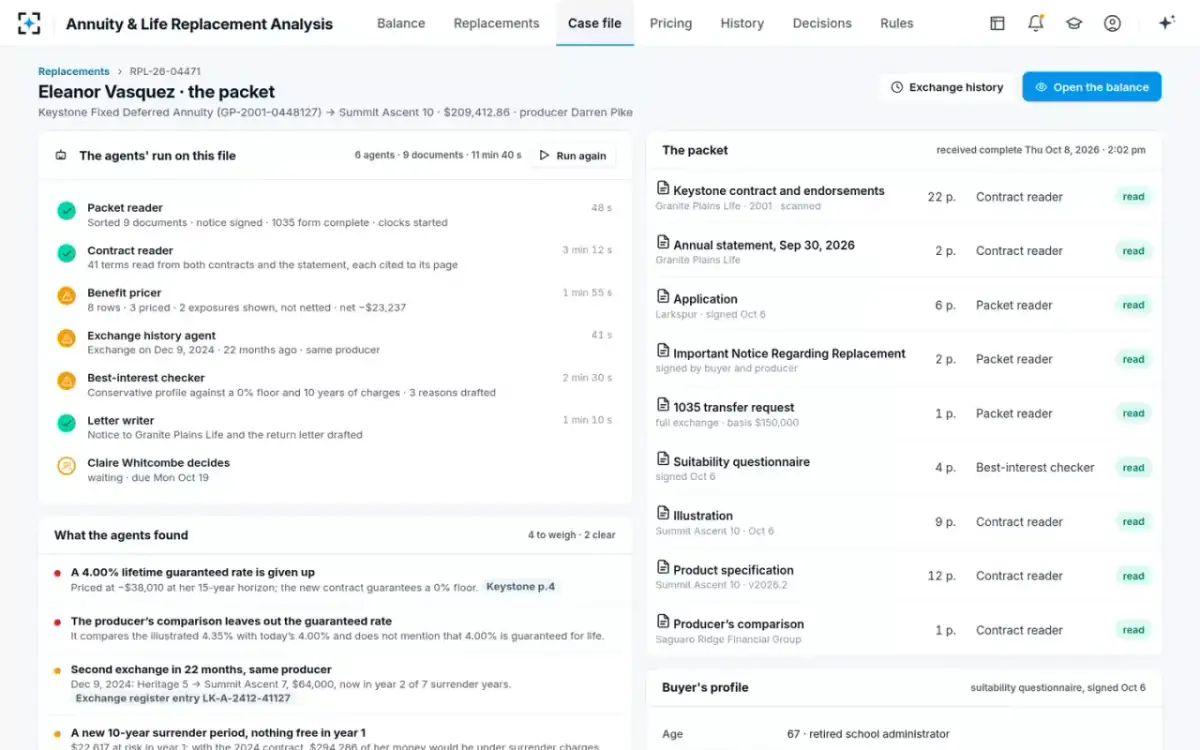
The transfer request and the notice, read together in one packet
Is a 1035 exchange a replacement?
For insurance-law purposes, almost always. The NAIC replacement model (Model #613) counts any new purchase where an existing contract is surrendered, in whole or in part, assigned to the replacing insurer or otherwise ended, and a 1035 exchange does exactly that; the model's full definition is walked through in the notice regarding replacement of life insurance. So the transfer request triggers the replacement notice, the five-business-day notice to the existing insurer and the buyer's right to return the new contract. Tax-free is not the same as suitable; the tax rule says nothing about surrender charges, a new surrender period or guarantees given up. The replacement notice that travels with the form sets out those clocks.
The NAIC notice even asks the buyer the tax questions: "Is this a tax free exchange? (See your tax advisor.)" and "Is there a benefit from favorable “grandfathered” treatment of the old policy under the federal tax code?" An old contract may carry tax features a new one cannot, and a reviewer should look for them before the transfer request moves the money.
How do I fill out a 1035 exchange form without the common errors?
Fill it from the contracts, not from memory. Take the owner, insured and contract number from the old contract's latest statement; make the new application match them exactly; state full or partial, and for partial the amount or percentage; direct payment to the new insurer; disclose any loan and how it will be treated; and attach the replacement notice and any form the old insurer requires. Ask the old insurer for the cost basis in writing if the statement does not show it. Each of those steps is a field on a typical transfer request, and each one, missed, sends the packet back.
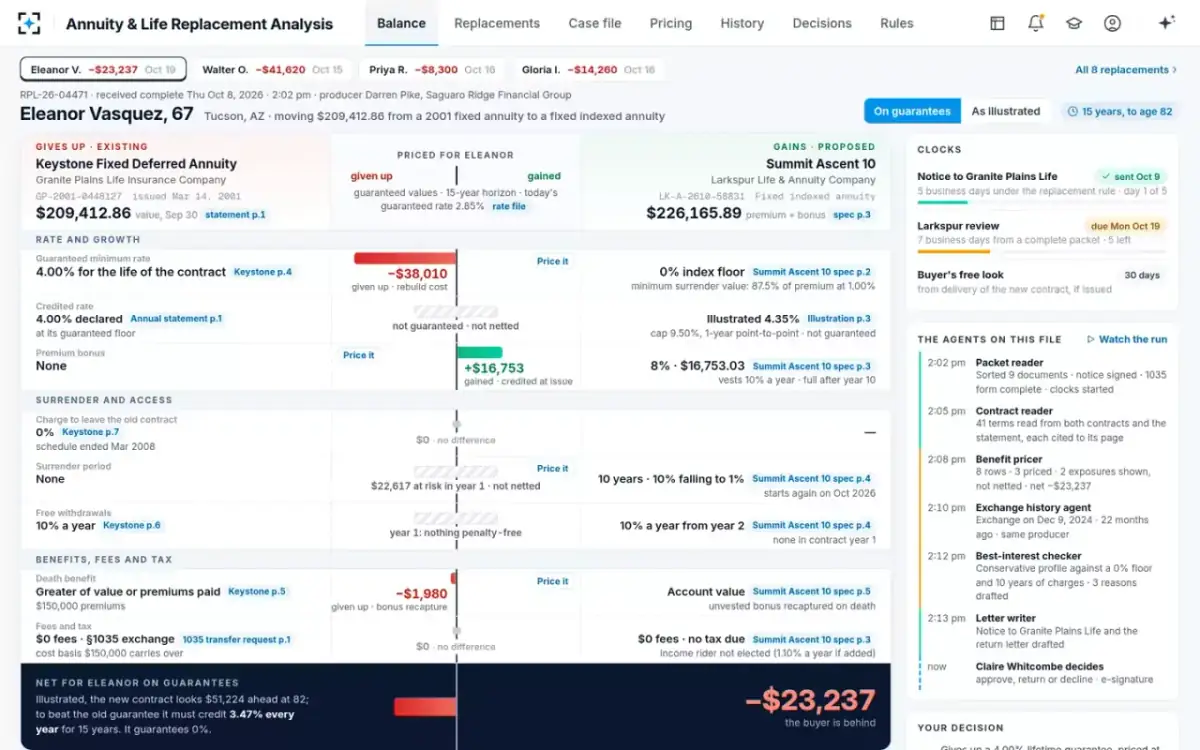
Fees and tax, priced on the same balance as the guarantees
How long does a 1035 exchange take?
No federal or NAIC rule sets a deadline for the transfer itself, so the time depends on the two insurers. The rules around it are timed: the replacing insurer has five business days to notify the existing insurer under the NAIC model, a deferred variable annuity sold through a broker-dealer needs a principal's approval within seven business days of a complete package under FINRA Rule 2330, and in New York the existing insurer has 20 days to answer a request for disclosure information. The fastest exchanges are the ones whose packet is complete the first time, which is where checking the form against the contracts pays off. How exchange review divides between agents and the principal covers the approval clock.
Where Annuity & Life Replacement Analysis checks the form
The packet reader sorts the transfer request with the rest of the packet and checks that it is signed and complete; it never fills in a missing field or signature. The contract reader compares its owner, insured and contract number with the old contract and the new application, and carries the cost basis into the fees and tax row of the comparison, so a principal sees on one screen that the exchange is tax-free and what it costs on guarantees. A partial exchange shows the share moved and flags the 180-day window for both contracts. The carrier's own people send the transfer and answer the old insurer. To see the transfer request read alongside the notice and the contracts, start from Annuity & Life Replacement Analysis.
Questions people ask
Is there an IRS form for a 1035 exchange?
No form is filed with the IRS to make the exchange. The owner signs the insurers' transfer or assignment request; the old insurer then reports the exchange on Form 1099-R with code 6, unless the same-company exception applies. The owner's own return reports no taxable amount for a fully tax-free exchange.
Can you 1035 exchange a life insurance policy with a loan into an annuity?
Yes, but the loan needs attention. The IRS instructions warn that "the cancellation of a contract loan at the time of the exchange may be taxable and reportable on a separate Form 1099-R." If the new contract cannot carry the loan, repaying it before the exchange or accepting the taxable portion are the usual choices, and a tax adviser should look at it first.
Can two annuities be combined in a 1035 exchange?
The IRS has approved moving an annuity into an existing annuity owned by the same person: Rev. Rul. 2002-75 treats an assignment of one contract to a second insurer, deposited into a pre-existing contract of the same owner, as a tax-free exchange. The owners and annuitants must match.
Does a 1035 exchange restart the surrender charge?
The tax rule does not, but the new contract usually does. The SEC's glossary notes surrender charges may apply on the old annuity, and new contracts typically start their own surrender period, a cost the replacement review must weigh. Model #613's notice asks the buyer directly: "Will you pay surrender charges on your old contract?"
Do 1035 exchange rules apply to IRAs?
This guide covers non-qualified contracts. For annuities held in IRAs or employer plans, ask the custodian and a tax adviser which transfer rules apply: Rev. Rul. 2007-24 turned partly on its contract being non-qualified, so that "no rollover provision, such as § 403(a)(4), applied" to the check the owner received.